Chapter 1: The Joy of the First Light
Dr. Emily Green woke up with a smile, even before the sun had fully risen. The sky outside her window was painted with soft orange and pink colors. She stretched her arms and whispered, “Today is a brand new day for discoveries.” There was a gentle excitement in her heart, the kind she always felt at the start of a new digging season.
Emily was an archaeologist. That meant she looked for traces left by people who lived long ago. She loved her job, not because she hoped to find treasure, but because each little piece she found was like a puzzle piece that helped tell the story of the past. She felt grateful every time she slipped on her sturdy boots and zipped up her jacket, ready to protect history.
Her backpack was already packed from the night before. Inside were her favorite tools: a brush, a trowel, a notebook, and her GPS device. Emily always checked the GPS to make sure she was at the right place to dig. She also packed a snack and a big bottle of water. The dig site was a little far from the village, and she would spend most of her day there.
As she stepped outside, the grass was still cool and soft beneath her feet. Birds chirped, and the air was fresh. Emily waved at her friend and teammate, Leo, who was waiting by the car. “Ready for another adventure, Emily?” called Leo, his voice cheerful.
“Always!” Emily replied, grinning. She climbed into the car, and together they drove toward the old hill where the ruins of a Byzantine monastery waited. All around them, fields sparkled with dew, and the world seemed full of promise.
When they arrived, Emily took out her GPS and checked their location. The numbers on the screen told her that they were exactly where they needed to be. The site was quiet, peaceful, and full of secrets waiting to be uncovered.
“Hooray! The GPS says we're right on top of the main hall,” Emily announced. Leo gave her a thumbs-up. Emily felt so grateful—her work let her be a detective for the past, and every day was a chance to learn something new.
Chapter 2: The Gentle Dig
Before any digging began, Emily and Leo put on their hats and gloves. The sun was climbing higher, warming the stones and earth. “Remember,” Emily reminded Leo, “archaeology is about patience. We must be gentle, like brushing the dust off an old book.”
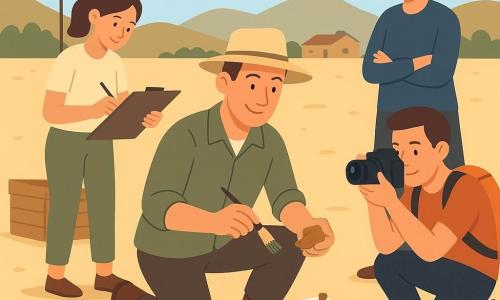
First, they walked slowly around the area, looking for clues. Sometimes, finding the right place to dig was just as important as the digging itself. Emily knelt and picked up a small piece of pottery, turning it over in her hand.
“This could be from a cup someone used a thousand years ago,” she said softly. She placed it gently in a small tray. “Every fragment matters.”
They marked the ground with string, making neat squares. “We call these ‘grids,'” Emily explained. “It helps us remember exactly where we found each thing, so we can tell the story correctly.”
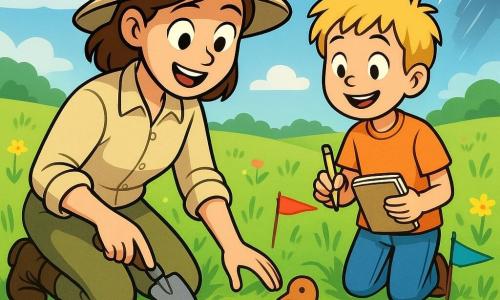
With her trowel, Emily began to scrape away a thin layer of soil. She worked slowly, brushing dirt aside bit by bit. Sometimes, she would stop just to listen to the wind or the distant sound of sheep.
Leo worked nearby. “Emily, look!” he called. Emily came over. Leo had uncovered something shiny. It was a tiny piece of gold mosaic, glittering in the sunlight.
“Wow!” Emily said, her eyes wide. “This is from the floor of the monastery! Imagine all the feet that walked on this, long ago.”
Leo grinned. “I'm glad we're careful. It would be sad to miss something so small.”
Emily nodded. “That's why we never hurry. Archaeology is not a race—it's a way to say thank you to the people of the past by caring for what they left behind.”
They carefully placed the mosaic piece in a padded box. Emily felt a warm sense of gratitude. She whispered, “Thank you, old monastery, for trusting us with your secrets.”
Chapter 3: A Golden Discovery
After lunch, Emily and Leo explored the inside of the ruined monastery. Sunlight streamed through broken windows, lighting up the ancient walls. The air smelled of wildflowers and old stone.
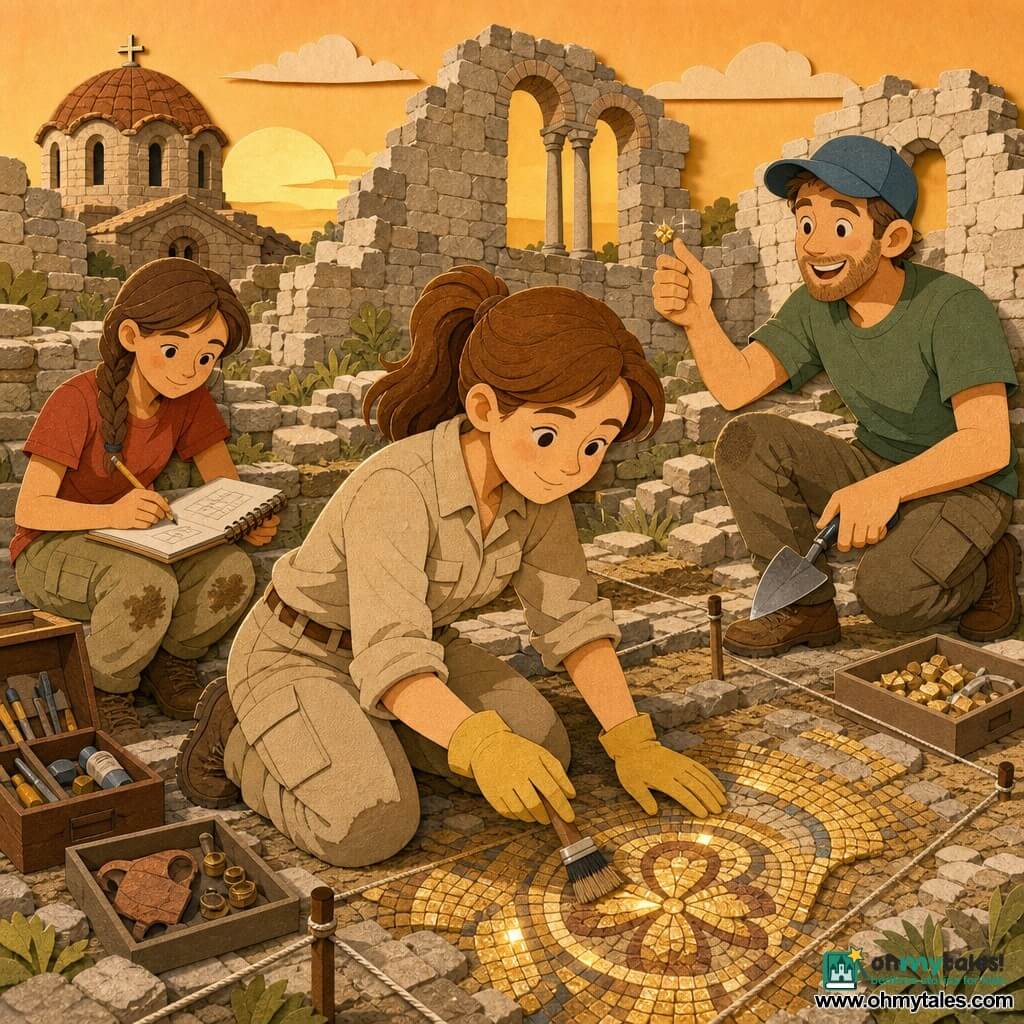
Inside, the floor was covered with dirt and grass, but Emily could see the edges of beautiful mosaics peeking through. She knelt down and brushed away the soil, revealing tiny golden tiles that shone like stars.
Leo's eyes sparkled. “It's like a hidden painting!” he said. “How did they make these?”
Emily smiled. “Long ago, artists used small pieces of colored glass and gold to make pictures on the floor. That's called a mosaic. Each piece was placed by hand, one by one. It took a lot of care and teamwork.”
As they worked, Emily showed Leo how to draw a map of the mosaic in her notebook. “We must record everything we see,” she explained. “That way, when we share our discoveries, people can imagine how it looked long ago.”
Suddenly, Emily noticed a pattern in the tiles—a circle surrounded by flowers. She pointed. “This was made to bring joy. Maybe people gathered here to sing or to hope for good things.”
Leo nodded. “It's nice to think they were happy here.”
Emily gently ran her fingers over the golden tiles. She felt connected to the people who had made them, so many years before. “We can learn so much from the past. Their art, their stories, even their dreams.”
As the sun moved across the sky, the golden mosaics glowed. Emily and Leo took pictures and notes, making sure to treat everything with respect.
Chapter 4: Sharing the Story
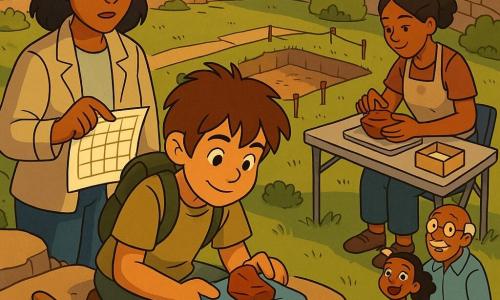
The next day, Emily gathered her team around the big table in their small field tent. The table was covered with trays of pottery, drawings, and photographs. Everyone was excited to see what had been found.
Emily began, “Archaeology is not about keeping things for ourselves. It's about sharing what we learn so everyone can understand the past.”
She showed the team the gold mosaic piece. “This tiny tile tells us how beautiful the monastery once was. Imagine the work it took to make the floor sparkle! And look at this pottery fragment, or this old iron key. Each piece has a story.”
Leo added, “We followed the GPS to the right spot. Then, by working together and being careful, we found things that were hidden for centuries.”
Emily nodded. “We can write about our discoveries and make drawings to help others see what we see. Museums can show these pieces, and schools can teach about them.”
One of the youngest team members, Sara, asked, “Why do we have to be so careful with everything?”
Emily smiled warmly. “Because every fragment, even the smallest, is important. If we rush or forget where we found something, we lose part of the story. We must be grateful for every discovery, big or small.”
The team spent the afternoon cleaning finds, labeling them, and talking about what life might have been like in the monastery. Emily felt proud—not just of what they had found, but of how they worked together, with kindness and respect.
Chapter 5: Every Piece Matters
As the digging season came to an end, Emily stood at the edge of the site, looking out over the green hills and golden mosaics. The monastery was quiet again, but it felt alive with memories.
Leo joined her, holding a notebook full of maps and drawings. “We found so much,” he said. “But there's still more to learn.”
Emily nodded. “That's the wonder of archaeology. The past is like a big puzzle, and we find the pieces one by one. Some are shiny and bright, like the gold mosaics. Others are simple, like a broken cup. But each one helps us understand the people who were here before us.”
She thought about all the days spent brushing dirt, recording notes, and laughing with her team. She felt grateful for every moment. “I'm happy we can help protect these stories,” she said.
Leo grinned. “And we can share them with everyone!”
Emily took a deep breath, feeling the warm sun on her face. She knew that being an archaeologist wasn't about finding treasure. It was about being patient, respectful, and thankful. It was about working together to uncover the past and sharing it with the world.
As she packed up her tools, Emily whispered, “Thank you, monastery, for letting us learn from you. We promise to take care of every piece.”
The wind rustled through the grass, as if the old walls were saying thank you, too. Emily smiled, ready for the next season, and the next adventure—because she knew that in archaeology, every fragment counts, and every day brings new gratitude.