Chapter One: The Meeting Beneath the Clock
There was a small town that kept its clocks outside, because time liked to be looked at. On the square, under the slow face of the town clock, four girls met every afternoon. Mira, a girl who carried her questions like bright pebbles; Sora, who laughed like a bell; Ana, who sketched clouds on the backs of envelopes; and June, who moved in a gentle wheelchair that rolled like a ship's cradle. They were almost ten, and they had the habit of turning ordinary afternoons into little expeditions.
“One day,” said Mira, tapping a pebble in her pocket, “I want to know what it means to do my part. When grown-ups say, ‘Do your part,' are we supposed to carry the moon or sweep the stars?”
“That sounds like a lot of sweeping,” Sora said, and her laugh made the pigeons lift themselves into a pattern of commas across the sky.
“You don't have to sweep the stars,” Ana said, drawing a tiny moon on her knee with a fingertip. “Maybe it's like planting a seed.”
June turned her head slowly and smiled. “Let's ask the world,” she said. “It might have a quiet answer.”
They set off, the clock on their backs like a patient friend, down a lane where the houses leaned together like gossiping neighbors. The town was full of analogies: lamp-posts that behaved like lighthouses, doors that pleaded politely to be opened, gardens that hummed soft tunes when watered. Everything seemed to mean more than it looked.
Chapter Two: The Bridge of Small Hands
Their first stop was the river where a new footbridge had been made by many small hands. The boards smelled of pine and stories. On one side, a boy sat with a broken kite; on the other side, an old woman rocked on her porch, knitting a scarf that looked like sunrise.
Mira watched a nail shine in the bright wood. “Is this bridge someone's big part?” she wondered aloud.
A man with paint on his trousers wiped his hands and said, “No one here painted a whole bridge alone. Someone held the plank, someone passed the nails, someone hummed to keep courage steady. Each small thing made the bridge steady.”
Sora tried to help by handing a hammer, but she was nervous and dropped it into the river like a silver fish. June laughed softly and fished it out with a long stick. Ana tied the kite again with a careful knot. The old woman offered them slices of bread, and everyone ate in a way that made their shoulders relax.
“That's doing your part,” said Mira at last, tasting the bread. “It isn't one big hero. It's—” she searched for the right shape of words, “—a pattern of small stitches.”
The bridge learned their footsteps and creaked a friendly hello.
Chapter Three: The Garden That Couldn't Remember
Beyond the bridge was a garden that had forgotten how to be green. Its vegetables sat small and unsure, and the flowers looked like trousers turned inside out. The garden's soil was tired; it had once been praised for abundance but now needed a memory.
“We'll help it remember,” said June, as if remembering were a thing one could teach.
They began with simple acts. Ana hummed a tune that sounded like rain and pressed seeds into the earth as if tucking them into bed. Sora watered the rows by walking slowly so no plant would be shocked. Mira cleared stones, whispering, “You can grow,” to each uncovered root. June drew gentle patterns in the dirt with the rim of her wheel so the soil would feel someone gentle had passed.
Day by day, the plants lifted like shy faces toward the sun. The carrots came up as fingers, nodding. The beans braided themselves into stories. A small sprig of tomato stretched like a needle pointing to the sky.
One evening, the garden gave them a single tomato, red and perfect. They passed it around without cutting it at once. Each girl kissed the skin with a promise: to come back, to keep the soil listening, to sing sometimes when the rain was late.
“It remembered because we remembered it with small things,” said Mira. “Is that doing your part?”
“Perhaps,” June murmured. “Part of a thing is the attention you lend it. It's like gathering light in your palms.”
Chapter Four: The Library of Whispered Things
Next they found a tiny library where books slept with bookmarks like bookmarks in the ribs of birds. The librarian was a boy who measured silence and wore spectacles that made him look like a thinking owl. The library welcomed a lost idea: the town's story of how to be together. But the book of small kindnesses had pages missing; snippets of generosity were scattered like leaves.
“Can we mend it?” Sora asked, eyes wide.
“Yes,” the librarian replied. “But a book mended with glue is different. This book needs new pieces: new kindnesses to be written inside.”
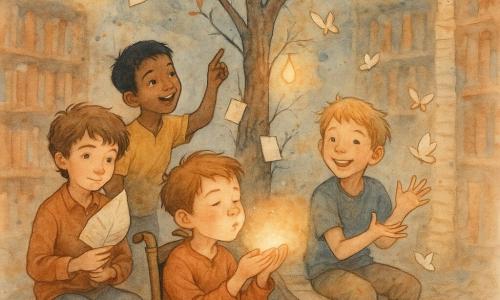
They began collecting stories: Ana wrote one about sharing an umbrella until two people fit under the curve; June wrote about pushing a swing until it learned to fly on its own; Sora told a story about laughing when someone makes a mistake; Mira wrote down a question that had been answered by listening instead of speaking.
When the pages were filled, the librarian stitched them with thread and applause. The book hummed like a saved tune. People who read it remembered to hold doors, to say thank you like tiny lanterns, and to apologize like soft apologies that stop a bruise from needing time to heal.
Mira's pebble felt warm in her pocket, as if some answer was being added to it.
Chapter Five: The Night of Loose Stars
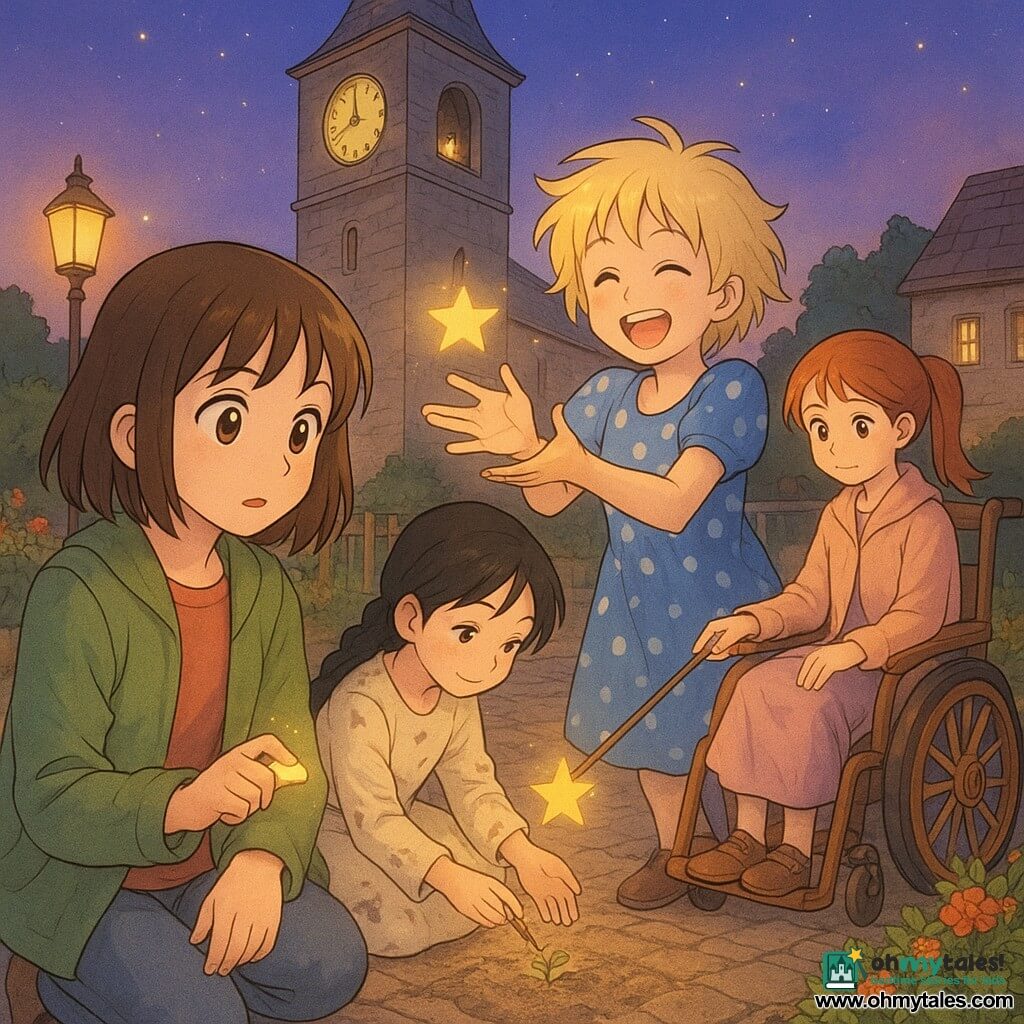
One night, the sky shed a few stars that came down like confetti. They landed in the square and rolled like curious animals. The town's people worried because the sky seemed lighter for missing them. The girls sat in a circle and watched the stars blink with small, shy eyes.
“What if the sky expects one person to put them back?” asked Sora, pulling her knees to her chin.
Mira thought of the bridge and the garden and the book. “Maybe each of us puts back one star with a thing we do,” she said. “Maybe doing your part is choosing to be that small hand for something.”
They began to gather stars. Not in the way you gather a toy to keep, but like returning a borrowed thing to its owner. Ana placed a star on a window so an old woman could have a light; June rolled another gently to a child who had lost his way, and the star became a compass; Sora let a star rest on the town bakery so the bread would taste of starlight; Mira tucked the last star into the pocket of the town clock, where time could keep it company.
The stars went back up at dawn, as if someone had given them permission to fly again. The clock ticked a new tick, softer and proud.
Chapter Six: The Notebook of Tenderness
As the sun folded itself into a nap, the four girls sat beneath the clock and made a small book from leftover pages, a ribbon, and the quiet glue of promises. They called it the Notebook of Tenderness. Inside they wrote things that were easy to forget: how to tie a knot when another person is trembling, how to send a note to someone who needs a smile, how to keep asking even when an answer is patient.
Mira placed her pebble on the first page and wrote, “Doing my part is a compass made of tiny acts.” June wrote, “Doing my part is rolling my chair so others can see farther.” Ana drew a page full of small seeds. Sora stuck a thread of laughter to the spine.
They agreed to carry the notebook from house to house, leaving it where someone might need a little courage. Each of them promised to add one page when they learned something new about being together. The notebook smelled faintly of bread and rain, and when people read it, their hands softened.
“Is that all?” Sora asked, eyes sleepy.
“No,” Mira replied, folding the ribbon around her fingers like a map. “It's a beginning, and beginnings ask for patience.”
June closed her eyes and said in a voice like a hush, “Resilience is not a single roar. It is a chorus of small notes that keeps singing even when the wind is rough.”
They understood then that ‘doing your part' was not a heavy stone to lift but a pebble placed in the river that made a ripple reach far shores. It was the steady kindness that stitches the torn places. It was the courage to try again.
They put the notebook in a small hollow of the clock for safekeeping, where time would read it and remember how gently people can hold each other. The town tucked itself into bed, and the girls walked home, their steps soft like pages turning.
That night, Mira's pebble felt lighter, as if an answer had turned into a question that could be asked and shared. The world outside their window breathed, patient and wide, and the girls slept with the notebook's promise folded beneath their dreams.