Chapter One: The Corner of the Table
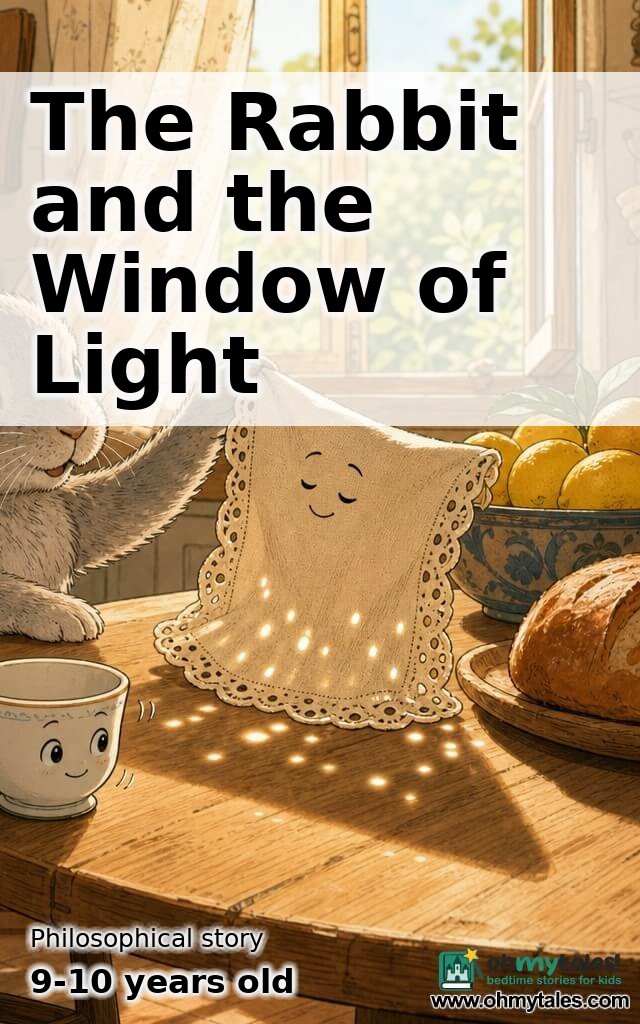
At the corner of a round wooden table, where sunlight always made a small golden island, lived a rabbit named Tillo. He was a rabbit with soft grey ears and a habit of listening. The table sat in a little kitchen that smelled of lemon and warm bread, and every afternoon it became a meeting place for tiny debates: the teacup would argue with the spoon, the napkin would whisper to the butter dish, and Tillo would sit very still on his stool, watching the words bounce like pebbles on a pond.
"Why do you tremble?" the teacup would ask the spoon, clinking politely. "Because I'm thin," the spoon replied, "and thin things bend."
Tillo liked these debates because they were small and honest. They were not noisy fights but gentle questions, as if the objects were discovering themselves for the first time. Tillo's favorite question, which he asked in his soft voice, was: "Can something that seems fragile also be strong?"
People in the house thought of Tillo as a quiet rabbit. They saw his thin whiskers and the places where his fur had gone a little pale, and they believed fragility meant being weak. But Tillo had an idea that kept nibbling at his heart like a carrot: what if fragility was a kind of truth? What if it was a light that could be held carefully, with both hands?
Chapter Two: The Little Debate
One rainy afternoon, when the table's island of sun had shrunk to a coin of light, the napkin sighed. "I'm full of holes," it said, folding itself into tiny creases. "I soak tears and tea and sometimes I tear. I am useless."
"They are not holes," said the butter dish, cool as a pond. "They are places where stories can seep. You carry the memory of our messy meals."
"That's not the same," the napkin insisted. "I am fragile."
Tillo hopped closer, his nose twitching. "Tell me," he said, "what does fragile mean to you?"
The napkin fluffed. "It means I can be ruined by a thorn, by a tug, by being forgotten. It means I disappear."
Tillo thought of the time his own ear had been nipped by a thorn while chasing a sunbeam in the garden. It had bled, and he had limped home. He remembered how the house had hummed around him—gentle hands, warm cloths, stories lowered like blankets. "Perhaps," he said slowly, "fragile means you remember being touched."
The table fell quiet. The teacup stopped its clinking. "Remembering being touched," murmured the spoon like a thought finding its place. Tillo smiled with the softness of a bell. "And remembering makes you honest," he added. "You cannot pretend you are whole. You show how you were loved."
"That's a strange kind of strength," said the napkin, and for the first time it did not fold into itself.
Chapter Three: The Rabbit's Question
A week later, a visitor came: a small boy with knees that always had scrapes and a laugh like rain. He sat at the corner of the table and pulled Tillo onto his lap. His hands were gentle and his voice smelled of apples. As he stroked Tillo, he asked aloud, as children do, questions that are both blunt and bright: "Are you brave, Tillo?"
Tillo blinked. He had never thought of himself as brave. He thought of bravery like the old clock on the wall—steady and loud. But his life was quieter, a steady attention to small things. "I am honest," he said into the boy's shirt, because that is how Tillo thought of himself. "I tell the truth about what I feel."
The boy frowned in a thoughtful way and then laughed. "Honest is a kind of brave," he said. "My teacher says truth is like a light in a dark room."
Tillo liked that. Truth as a light. He imagined his thin ear as a candle, making a soft glow that did not pretend to be a sun. He remembered the napkin's holes like windows. Each hole was a light. He began to see fragility not as a crack but as a window that let truth come through.
That night, as the boy left and the kitchen settled into its hush, Tillo whispered to the spoon, "If truth is a light, we must not hide our holes."
The spoon clinked, small and brave. "Then we will show them," it said.
Chapter Four: The Garden of Small Things
On a clear morning, the house opened its door and a breeze wandered in carrying seeds and questions. Tillo went out into the garden, where the grass told stories in green whispers. He met a dandelion whose stem had been bent by a passing child. "I am broken," it sighed, drooping like a flag after a parade. "I will never stand tall."
Tillo tilted his head. "You are a map of journeys," he said. "Your seeds fly more easily now. The world can hold you like a map that wants to be shared."
The dandelion brightened a little. Nearby, a bluebird watched from a fence and chirped, "Why do you speak like a poet, rabbit?"
"Because life is a gentle poem," Tillo answered. "And poems keep the truth."
A snail, slow as a thought, slid by. On its shell there were tiny ridges like rings in a tree. "People think I am fragile," it said, moving the way time moves. "But I carry my home on my back."
"That is both truth and strength," Tillo said. "You carry what you need. You don't pretend to be anything else."
The garden agreed in small sounds: a rustle, a buzz, the hush of soil. Tillo felt his ears warm with a quiet confidence. He realized that everything small and nicked and softened by life had its own honesty. Fragility was not the opposite of strength but one of its faces—like the moon and its pale, courageous light.
Chapter Five: A Little Speech
Back at the table, the objects gathered. The teacup trembled but held its place; the napkin smoothed its folds; even the old clock listened without ticking too loudly. Tillo cleared his throat, which sounded like a bell wrapped in wool, and he spoke in the kind voice he always used for important small things.
"My friends," he said, "we have been thinking about being whole and being broken. I think we are made of stories. A broken place is a story that tells us where we have been touched. It tells us what cares for us. When we show our cracks, we give others a path to understand us. We make room for truth."
The butter dish sighed, as if letting steam out of a kettle. "So showing a crack does not make us lesser?"
"No," Tillo said. "It lets light in. It asks for a hand."
The napkin lifted one corner like a flag. "If truth is a light," it said, "then to show my holes is to say: I was here, and someone loved me enough to use me."
Everyone murmured, and the boy returned, peering at the gathering as if he had returned to a secret club. He asked, "Will you tell my mom about the napkin? She thinks it is only used."
Tillo hopped onto the napkin and looked up. "Tell her the truth," he said. "Tell her the holes are proof of feasts and small kindnesses. Truth is a gentle gift."
The boy grinned and promised.
Chapter Six: The Quiet Curtain
Seasons moved like pages turned by a slow and careful hand. Leaves fell and rose, the boy grew a little taller, and the kitchen learned new smells. The table kept its island of sun, sometimes a coin, sometimes a lantern, sometimes just a soft whisper of warmth. The objects remembered their talks and practiced being honest. The napkin hung a little straighter; the teacup stopped apologizing for its thin handle.
One evening, as stars blinked awake beyond the curtains, the house grew still. Tillo sat in his usual place, ears folded in a comfortable listening, and the family finished their small debates with gentle chuckles. The boy kissed his mother's cheek and carried a story about the napkin like a treasure.
Tillo felt the truth settle in him like a warm blanket. Fragility had become a window; to show what is thin or torn was to invite a hand to mend, or at least to notice. He thought of the snail, the dandelion, the boy's scraped knees. He thought of the simple power of saying, "This is how I am."
Outside, a breeze teased the curtains. The curtain moved and then, as if having said all it needed to, stopped. It hung there, soft and sure, neither fluttering nor falling. It was not a flag of triumph, not a fanfare of strength, but an answer, calm and still.
Tillo watched that immobile curtain and felt the room hold its breath in a kind, even way. The curtain kept its place, neither hiding nor preaching, and in that quiet he understood the last, gentle lesson: truth needs no applause. It only needs to be seen.
He closed his eyes. The room hummed softly—like a lullaby that knows how to be honest—and the curtain stayed, steady as a promise.