Chapter One: The River of Questions
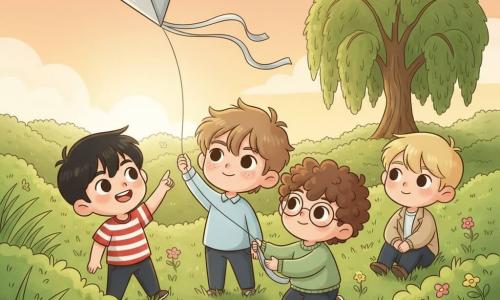
On the edge of a town that smelled of bread and rain, three boys met at a crooked bench. Their names were Jonah, Milo, and Tess—Tess called herself a boy because she liked the way it sounded when they planned mischief. They were about nine. They had the same habit of rolling a pebble in their pockets when they thought too hard.
Beyond the bench, the river ran like a ribbon of thought. It gleamed with small doubts and carried leaves that asked questions as they floated. Jonah was the most intuitive. He listened before he spoke, as if he could hear the world whisper its reasons. Milo liked clever maps and tidy answers. Tess folded questions into paper boats and launched them to see which ones sailed.
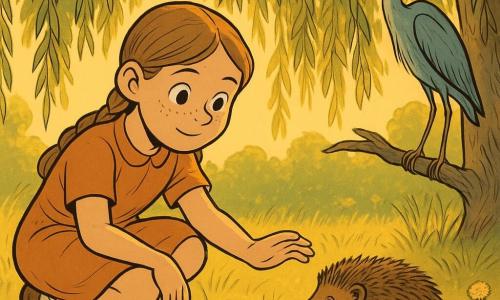
One bright afternoon, the boys found a sign stuck in the mud: “The Pond of Choices — Step Lightly.” A small heron watched from a willow, very grave for a bird. Jonah touched the words with his finger. The letters felt warm and strangely honest.
“Let's see what choices do,” Milo declared. He drew a little map in the dirt. Tess laughed and launched a paper boat shaped like a crown. Jonah folded his hands and listened to the river. “Every step can ripple,” he said. “Even a footfall can make a song.”
They crossed the meadow. Shadows followed like quiet questions. The pond lay like a dark mirror. It did not tell you what to do. It showed what happened afterwards.
Chapter Two: The Pebble and the Plea
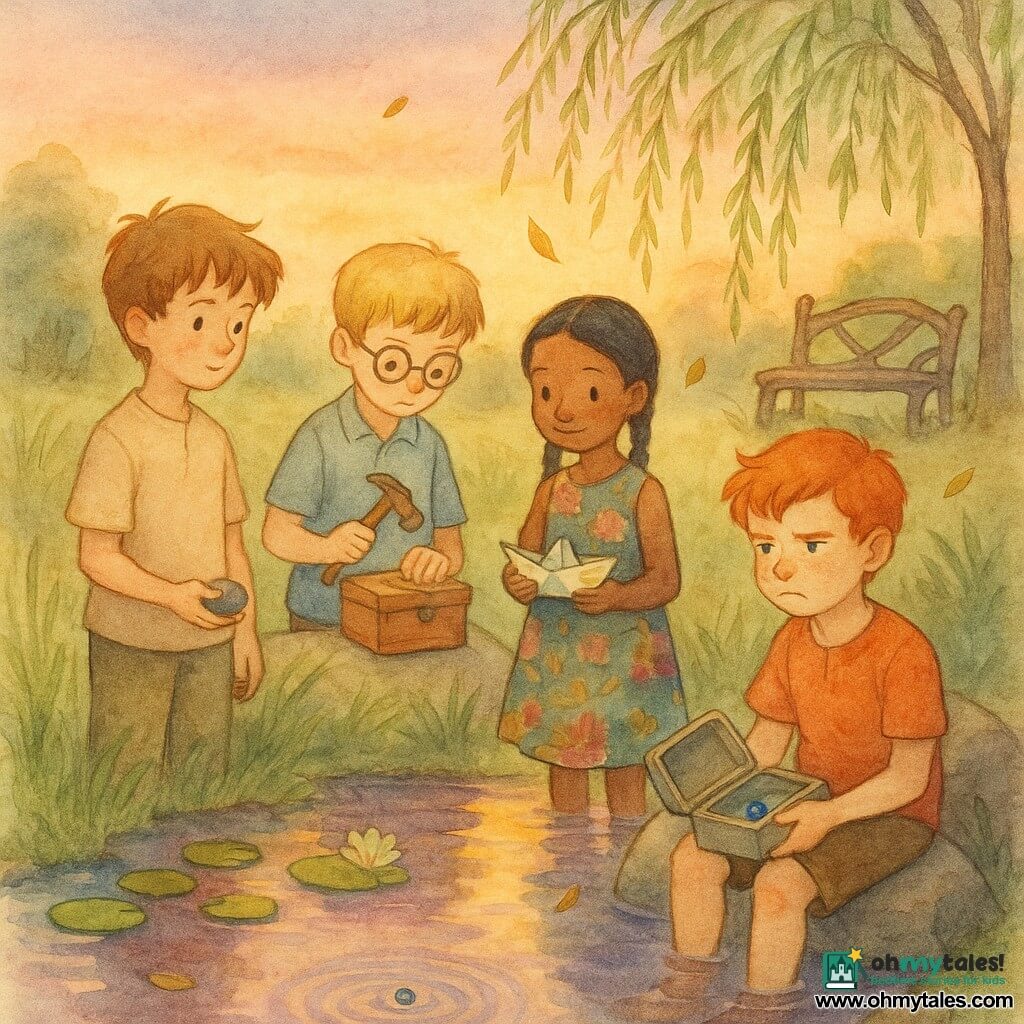
By the pond, a boy named Rowan sat with his knees glued to his chest. He had a box of marbles and a frown. Rowan guarded the marbles as if they were tiny suns. A cat had lost one that morning; it rolled away, and the cat had been puzzled all day.
Tess, who always fancied herself a helper, plucked a marble from Rowan's box without asking. It was so blue it hummed. She said it would be a joke, a small return for the cat's missing marble. Milo giggled. Jonah paused. His pebble made a tiny heartbeat in his pocket.
“Don't take it,” Jonah said softly. He looked at Rowan's hands, crooked around the box like a nest.
“No harm,” Tess whispered. “We'll put it back before he knows.” She tossed the marble across the path. It flew like a comet and dropped near the cat, which swallowed it and then yawned as if nothing had happened.
At first, the boys laughed. The pond rippled with little circles. Rowan's eyes were small and startled. He did not know the marble had been taken. The boys left with a secret that tasted like sugar and regret. Jonah's pebble in his pocket had stopped beating.
That night, Jonah could not sleep. He pictured Rowan's face. Doubt settled like a gentle moth on his chest. He wondered whether a joke could be fair. He began to feel each action as a pebble thrown into water.
Chapter Three: The Ripple Grows
The next day the town learned that a marble was missing. Rowan cried. His mother made a list of what mattered to him. The cat prowled, tail low. Tess's laugh turned small. Milo felt sticky with shame. The boys met again at the crooked bench. The river looked different, more like a mirror with cracks.
“We should tell him,” Milo said. He loved maps, and this was an unmapped apology. Tess chewed her lip. “But what if he's angry?” she asked. Jonah touched the pebble in his pocket. It was warm again.
They went to Rowan's house. The marbles lay scattered like planets across his rug. Rowan's jaw was a small fist. When Jonah opened his mouth, words came like clear water. He told Rowan what had happened. He told him how a marble had been taken and returned as a trick.
Rowan's first face was surprise. Then it became a slow, careful thing. “Why would you do that?” he asked. His voice was a bell. Jonah told him about the box, about the cat, about the laugh that turned sour. He said, “I thought it wouldn't matter. I was wrong.”
Rowan's anger was honest but not cruel. He spoke of trust as if it were a thin bridge. “I keep some things,” he said. “Not to be mean, but to remember.” The boys listened. The room hummed with a lesson that was not loud.
They agreed to make amends. They could not un-take what had been taken, but they could build something new.
Chapter Four: The Quiet Agreement
The boys spent the afternoon doing small, steady things. Milo fixed the latch on Rowan's box so nothing could slip out unseen. Tess painted a tiny star on the back of each marble she returned, so Rowan would know where they had been. Jonah planted a small willow by the pond, a tree to watch choices like a kind sentinel.
Together, they gave Rowan a jar filled with little apologies: folded notes, painted pebbles, the story of their mistake written like a map of confession. Rowan accepted it slowly. He pressed a marble into his palm. “Not all choices are loud,” he said. “Some are soft and take time to listen.”
By the pond that evening, the three boys stood with Rowan. The river had quieted. The willow's leaves made moth-shadows on the water. They did not speak much. Words had been spent and stretched into new shapes.
Jonah looked at the boys—their faces lit by the last light like paper lanterns. “We can doubt,” he said, “and still find our way. Doubt is a compass if we listen.” Milo grinned. Tess tossed a paper boat that sailed true. Rowan tucked a marble into Jonah's hand, a small thanks without a trumpet.
They left the pond with pockets lighter and heavier at once. Lighter because a secret had been lifted; heavier because they had learned how much weight a small action can carry. Justice, they discovered, was not a hammer but a steady hand that puts things right when they have been unbalanced.
That night, under a quiet sky, the boys met again at the crooked bench. They did not make loud promises. Instead, they sat shoulder to shoulder and listened to the river. It hummed like a clock. Each of them understood that actions are seeds and that seeds grow into something that asks for attention.
They closed their eyes. No one spoke. Their silence was not empty. It was an agreement—soft as a folded paper boat, sure as the pebble in Jonah's pocket. They had learned to doubt without losing themselves. They had learned that every small choice blooms into consequence. The night wrapped them in a calm they had earned, and the river of questions flowed on, patient and bright.