Chapter 1: The New Badge
Ethan clipped his hospital badge to his pocket for the third time, as if it might run away. It read: Dr. Ethan Brooks — Intern. The word intern made his stomach flutter like a small bird.
The hospital at night didn't feel spooky. It felt busy in a quieter way—like a kitchen after dinner, when people are still washing dishes and wrapping leftovers. Lights hummed. Wheels squeaked. Somewhere, a monitor beeped in a steady, patient rhythm.
“First night?” a nurse asked as she rolled past with a cart.
Ethan nodded. “Is it that obvious?”
She smiled. “Only because you're standing like a question mark.”
Ethan laughed, softer than he meant to. He wanted to be helpful, not in the way superheroes are helpful, but in the real way: the way you bring a glass of water without being asked.
At the nurses' station, his supervising resident, Dr. Lila Chen, waved him over. She had quick eyes and calm hands.
“Ethan,” she said, “welcome to the night shift. We'll see a little of everything. Your job is to listen, learn, and ask. Medicine isn't a guessing game.”
Ethan straightened. “Yes, Dr. Chen.”
She leaned closer. “Also—don't call me Dr. Chen all night. Lila is fine. We're a team.”
A page crackled over the speaker: “Emergency Department, triage room two.”
Lila's expression turned focused but friendly. “Let's go meet our first patient.”
Ethan followed, shoes whispering on the shiny floor. He tried to remember what his professors had said: check airway, breathing, circulation. Be kind. Explain what you're doing. A hospital could feel like a maze, but words could be a lantern.
In triage, a boy about Ethan's nephew's age sat on the bed with his mom. The boy's cheeks were pink, and he was hugging his stomach like it had offended him.
“Hi,” Ethan said gently. “I'm Dr. Brooks. I'm an intern—so I'm still learning—but I'm here with Lila, and we're going to help.”
The boy frowned. “Do you have to use needles?”
“Not if we can avoid it,” Lila said, stepping in. “First we talk. Then we check. Then we decide.”
Ethan felt his shoulders loosen. Talk. Check. Decide. Like steps on a staircase.
He pulled up a stool so he wasn't towering over anyone. “Can you tell me your name?”
“Rafi,” the boy mumbled.
“And what's bothering you tonight, Rafi?”
“My belly,” Rafi said. “It feels like… like a knot.”
Ethan nodded as if belly knots were normal, because sometimes they were. “When did it start?”
As Rafi explained, Ethan listened closely—not just to the words, but to the pauses and the way Rafi's mom kept rubbing her son's shoulder. Ethan learned something simple and huge: in medicine, feelings were clues too.
Lila guided him through a careful exam. “We press gently,” she told Rafi, “like checking if bread dough is rising. You tell us if it hurts.”
“Bread?” Rafi said, surprised.
“Exactly,” Lila replied. “No surprise punches. Just gentle science.”
Ethan watched. He learned where to listen for bowel sounds, how to notice dehydration by checking the mouth and skin, and how to ask questions that didn't sound like an interrogation.
When they left the room, Lila spoke softly. “Good. You explained things. That calms people. Calmer bodies give clearer information.”
Ethan felt a tiny spark of pride—not loud pride, not trumpet pride. More like a candle that didn't need anyone to clap to keep burning.
They returned to the hallway, where the hospital breathed on, steady and bright.
Chapter 2: The Stethoscope Story
Later, the Emergency Department slowed. The waiting room still had people, but the rushing energy softened into a watchful hush. Ethan and Lila stood by a window that looked out on the parking lot, where rain made the streetlights blur into golden puddles.
A colleague approached—Dr. Mateo Alvarez, another resident. He carried two cups of tea like they were precious lab samples.
“Night fuel,” Mateo said, handing one to Ethan. “Chamomile. It tastes like a warm blanket.”
Ethan took it carefully. “Thanks.”
Mateo looked at Ethan's badge. “Intern. First month?”
“First week,” Ethan admitted.
Mateo whistled softly. “Ah. Your brain is probably trying to read three textbooks at once.”
Ethan smiled. “It feels like that.”
They sat at a small table near the staff room, where a sleepy vending machine blinked like a tired robot. Mateo tapped his own stethoscope—dark tubing, silver chest piece—with a fondness that made Ethan curious.
“You know,” Mateo said, “people think doctors spend all day doing dramatic stuff. Like shouting, ‘Clear!' and saving lives in slow motion.”
Ethan raised an eyebrow. “Don't you?”
Mateo grinned. “Sometimes. But mostly? We listen. We look. We ask. And we prevent problems before they become disasters.”
Lila sipped her coffee. “Mateo has a story for everything.”
“It's how I remember,” Mateo said. He turned to Ethan. “Want one that explains why prevention matters?”
Ethan leaned in. “Yes.”
Mateo's voice softened, the way it does when someone opens a drawer full of memories.
“Last winter,” he began, “we had a man named Mr. O'Hara. Tough as a boot. He came in with chest pain but kept saying, ‘It's nothing, it's nothing.' He didn't want to bother anyone. He'd been ignoring shortness of breath for weeks.”
Ethan frowned. “Weeks?”
Mateo nodded. “He thought rest would fix it. But his heart was struggling. See, your heart is a muscle pump. If it doesn't get enough oxygen, it complains. Sometimes it whispers first—tiredness, breathlessness. Then it shouts—pain.”
Lila added, “People often wait for the shout.”
Mateo continued. “We did an EKG—those sticky pads and wires that read the heart's electrical signals. It's like watching a tiny lightning storm on paper. His showed trouble.”
Ethan pictured it: jagged lines telling a secret.
“We gave him medicine right away,” Mateo said. “Nitroglycerin to help blood vessels relax, aspirin to stop clots from growing, oxygen because his body needed it. We moved fast, but we also explained each step. His wife was terrified. He was pretending he wasn't.”
Ethan asked, “Did he end up okay?”
Mateo smiled gently. “He did. He got a stent—like a little metal scaffold—to keep a heart artery open. But the part I remember most wasn't the stent. It was what he told me afterward.”
Mateo stared into his tea as if the steam showed pictures.
“He said, ‘Doc, I'm proud I didn't make a fuss.' And I said, ‘Mr. O'Hara, being proud is fine. But being proud doesn't mean being silent. Real pride is taking care of your body so you can keep showing up for the people you love.'”
Ethan swallowed. The words landed softly but firmly, like a blanket tucked in at the corners.
Mateo looked at him. “So if you learn one thing this week: teach people not to wait. Prevention isn't boring. It's brave.”
Ethan nodded slowly. “Brave. I like that.”
Lila stood. “All right, story time's over. We've got patients.”
Mateo winked at Ethan. “Welcome to medicine: half science, half human.”
Ethan watched them walk away and felt, again, that small candle pride. He wasn't here to be a hero. He was here to be useful—steadily, kindly, and on purpose.
Chapter 3: The Asthma Cloud
Not long after, the overhead speaker called, “Pediatrics, room five.”
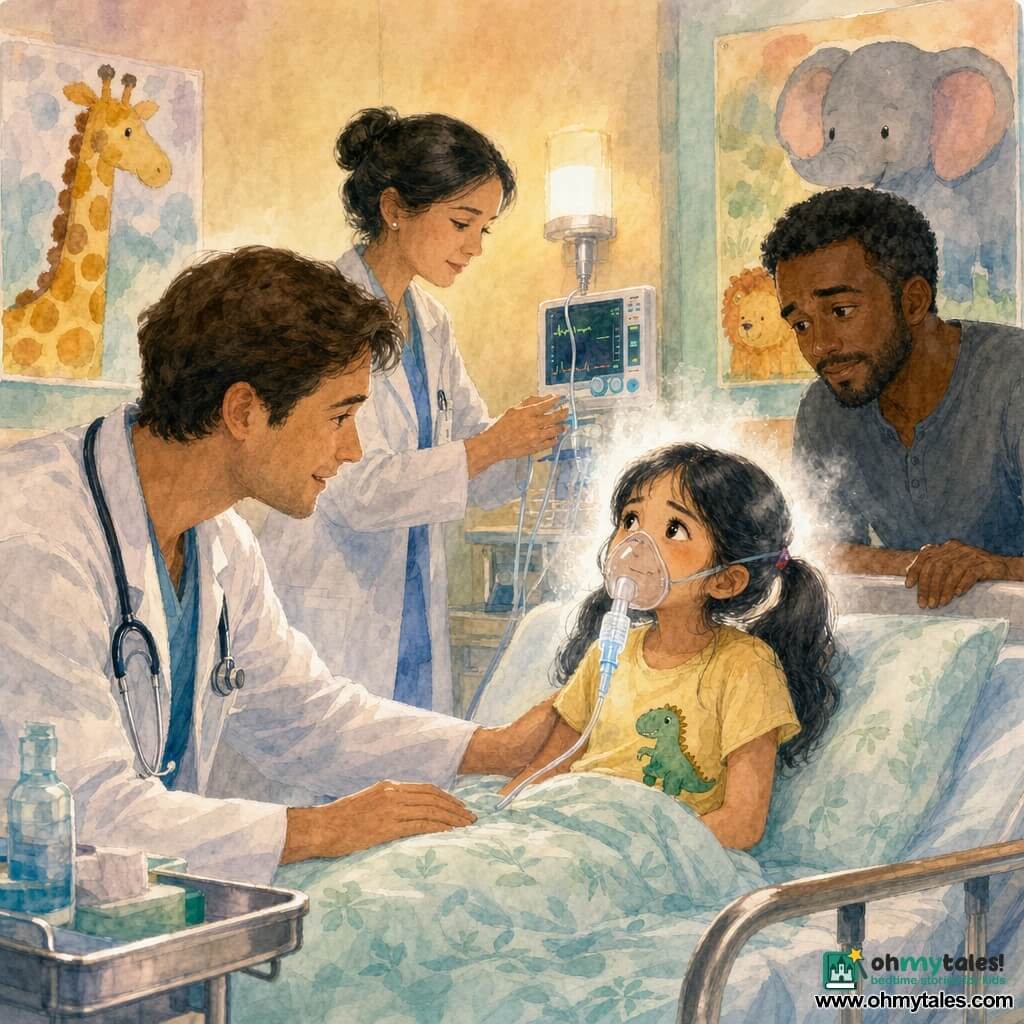
Ethan's feet moved before his nerves could argue. In room five, a girl sat upright, shoulders lifting with each breath like she was hauling invisible backpacks. Her dad stood close, trying to look calm and failing a little.
Lila spoke first. “Hi there. I'm Lila. This is Ethan.”
The girl's eyes were wide. “I can't—” She stopped to breathe.
Ethan remembered: air first. Calm first. He kept his voice low. “What's your name?”
“Maya,” she whispered.
Ethan nodded. “Maya, you're doing a good job. We're going to help your lungs relax.”
Her dad blurted, “She has asthma. We used her inhaler but it didn't work like it usually does.”
Lila checked Maya's oxygen level with the clip on her finger. Ethan listened with his stethoscope, hearing a faint, tight whistle—like wind trying to squeeze through a narrow crack.
Lila spoke in a clear, reassuring way. “Asthma is when the breathing tubes in the lungs get irritated and squeeze smaller. That makes it harder for air to move. The medicine in the inhaler tells those tubes to open.”
Ethan added, “Like opening a pinched straw.”
Maya's eyebrows lifted slightly, as if that image made sense.
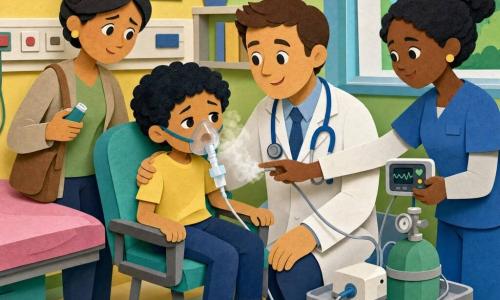
A respiratory therapist arrived with a nebulizer mask. The machine began to hum, turning medicine into a mist. Maya held the mask to her face, and the mist curled around her cheeks like a tiny cloud.
Ethan stayed beside her. “It might feel strange,” he said, “like breathing in warm fog. But it's helping.”
Maya's dad asked, “Did we do something wrong?”
Lila shook her head. “No. Asthma can flare up with colds, dust, exercise, even strong smells. You did the right thing by coming in.”
Ethan watched the team work together: the nurse checking vitals, the therapist adjusting the mask, Lila reviewing Maya's history. It was like a well-practiced orchestra. No single instrument made the whole song.
After a few minutes, Maya's shoulders lowered. Her breathing became less frantic. Her eyes blinked slower, like they could finally rest.
Ethan felt relief spread through him, warm and quiet.
Lila turned to the dad. “When you go home, make sure Maya uses her controller medicine if she has one. That helps prevent swelling in the airways. Rescue inhalers are for sudden tightness. Controller medicine is like keeping the path clear in the first place.”
Ethan added, “And if you notice signs early—coughing at night, using the rescue inhaler more than usual—that's a good time to call your doctor. Don't wait for the big struggle.”
The dad nodded hard, as if he wanted to memorize every word.
Maya, now calmer, whispered, “Do I get a sticker?”
Ethan looked at Lila, surprised.
Lila's face turned serious for one second. Then she said, “Absolutely.” She opened a drawer and handed Maya a sticker shaped like a bright green dinosaur.
Maya stuck it to her shirt. “He's guarding my lungs,” she said solemnly.
Ethan grinned. “Excellent choice. Dinosaurs are very protective.”
When they left the room, Ethan let out a breath he didn't realize he'd been holding. Lila glanced at him.
“Good job staying steady,” she said.
Ethan rubbed the back of his neck. “I was scared.”
“Being scared means you understand it matters,” Lila replied. “You did the important part: you stayed kind.”
They walked back into the hallway, where the hospital continued its nighttime work—quiet, constant, like a lighthouse that never slept.
Chapter 4: The Mystery of the Missing Water
Near midnight, Ethan finally sat down to type notes. His fingers hovered over the keyboard, trying to translate real life into tidy sentences. Sometimes medicine felt like writing a story where every detail could change the ending.
A nurse named Amina approached, her braid swinging as she walked. “Ethan, can you come to room twelve? We've got an older patient feeling dizzy.”
Ethan followed, heart thumping. In room twelve, an elderly woman lay back with her eyes closed. A half-finished crossword sat on her blanket. Her granddaughter hovered nearby, twisting a bracelet around her wrist.
“I'm Mrs. Patel,” the woman said, opening her eyes. “I stood up and the room did a little dance.”
Ethan smiled gently. “A dizzy dance?”
“The tango,” she said, very serious.
The granddaughter tried to laugh but looked worried. “She hasn't been eating much. She says water tastes ‘boring.'”
Ethan took Mrs. Patel's pulse, checked her blood pressure lying down and then sitting up. He remembered a lesson: standing can make blood pressure drop if you're dehydrated.
He asked, “Have you had vomiting or diarrhea?”
Mrs. Patel shook her head. “No. Just… not thirsty.”
Lila joined them, listening. “Sometimes people don't feel thirst as strongly as they get older,” she explained. “But the body still needs water to keep blood flowing smoothly.”
Ethan looked at the granddaughter. “Dehydration is like running a fountain without enough water. The pump struggles.”
Mrs. Patel sighed. “I didn't want to bother anyone. I can take care of myself.”
Ethan leaned forward. “That's a strong feeling. But asking for help is also strength. It's teamwork.”
Lila nodded. “We can give you fluids and check your electrolytes—salts like sodium and potassium that help nerves and muscles work. When those get out of balance, people can feel weak or dizzy.”
Mrs. Patel made a face. “Salts. Like chips?”
Ethan chuckled. “Sort of, but your body uses them for important messages. Like tiny text messages between cells.”
The granddaughter looked relieved just hearing a plan. “Will she need a big needle?”
Amina, the nurse, lifted an IV kit like a magician showing a wand. “Just a small one, and we'll be gentle.”
Ethan watched Amina place the IV with smooth skill. He admired how she spoke to Mrs. Patel the whole time, warning her before each step.
“Little pinch,” Amina said. “Breathe out.”
Mrs. Patel winced, then relaxed. “You're good,” she muttered.
Amina winked. “I practice on invisible dragons.”
As the clear fluid dripped into the IV line, Mrs. Patel's face softened. The room felt calmer, like a plant finally getting watered.
Lila spoke to Ethan in the hallway afterward. “Notice how we solved it? Not with a dramatic machine, but with listening, measuring, and a simple fix.”
Ethan nodded. “And explaining.”
“Always,” Lila said. “People deserve to understand their own bodies.”
Ethan returned to the nurses' station and typed his notes. He wrote not only the numbers, but the story: dizziness after standing, poor intake, improved after fluids. He realized medicine was full of small mysteries, and most could be solved with patience.
Outside, rain tapped the windows like gentle fingers.
Chapter 5: A Lesson from the Quiet Room
Around 2 a.m., the hospital seemed to inhale. The loudest sounds were softer now: distant footsteps, an elevator ding, a baby's brief cry that quickly settled.
Ethan found Mateo in the staff room, staring at a bulletin board covered in hand-drawn thank-you cards. One showed a stick figure doctor with a giant smile and a caption: THANK YOU FOR NOT BEING SCARY.
Mateo pointed at it. “Best review I've ever gotten.”
Ethan laughed. “That should be on your resume.”
Mateo leaned back. “How are you holding up?”
“Tired,” Ethan admitted. “But… good tired. Like after you help someone move furniture.”
Mateo nodded. “That's the shift. You carry things, but not just boxes.”
Ethan hesitated, then asked, “How do you stay calm? Even when things are serious?”
Mateo's eyes flicked to the cards again. “I learned something from a colleague when I was an intern,” he said. “A senior doctor named Priya. She used to take me to the ‘quiet room' after hard cases.”
Ethan blinked. “There's a quiet room?”
Mateo smiled. “Not an official one. Just a small unused office with one lamp and an old plant that refuses to die. She'd say, ‘We don't pretend we're made of stone. We pause. Then we go back.'”
Ethan listened closely. This was the colleague experience he needed, like another tool added to his belt.
Mateo continued, “One night, we lost a patient. Nothing we did was enough. I felt like I'd failed at being a doctor and at being a human.”
Ethan's throat tightened.
“Priya didn't give a big speech,” Mateo said. “She handed me a cup of water and said, ‘We measure what we can. We do what we can. We care either way. Caring is never wasted.' Then she made me eat half a banana because she said low blood sugar makes sad thoughts louder.”
Ethan let out a surprised laugh. “A banana prescription.”
“Exactly,” Mateo said. “She taught me that pride in medicine isn't about being perfect. It's about showing up again, still gentle.”
Ethan looked down at his tea cup. The hospital asked a lot of its people. But it also gave them something: a reason to cooperate, to be brave in small ways, and to take simple pride in doing the next right thing.
Lila appeared in the doorway. “You two hiding in here?”
Mateo raised his hands. “Educational meeting.”
Lila rolled her eyes, but her smile was kind. “We've got a new admission coming up. Ethan, you're with me.”
Ethan stood. His legs felt heavy, but his mind felt steadier.
As he walked out, he thought about the thank-you card: not being scary. He could do that. He could be the kind of doctor who explained, who listened, who offered banana-level wisdom when needed.
He followed Lila down the hallway, ready for whatever came next.
Chapter 6: The Hospital Settles
By early morning, the sky outside the windows turned from black to a deep, sleepy blue. The rain had stopped. The parking lot glistened as if someone had polished it overnight.
In the last hours of the shift, there were still patients, still questions, still medications and paperwork. But the sharp edges of the night had softened. Maya was breathing comfortably and watching cartoons with her dinosaur sticker guarding her chest. Mrs. Patel sat up and asked for “less boring water,” so Amina brought her a cup with a lemon slice like a tiny sun.
Ethan checked on Rafi, the boy with the belly knot. Tests suggested it was a stomach virus, not something needing surgery. Lila explained how to keep him hydrated and what warning signs would mean coming back.
Rafi asked, “So my belly just… needs a break?”
Ethan nodded. “A break and some gentle care. Small sips, rest, and time.”
Rafi's mom exhaled like she'd been holding a balloon in her lungs all night. “Thank you for explaining it.”
Ethan felt that candle pride again. It didn't shout. It didn't sparkle. It simply warmed him from the inside.
At the end of the shift, Ethan stood at the nurses' station while day staff arrived, looking fresh and bright-eyed. The night team gave reports—clear, careful handoffs so nothing important would be dropped. Ethan realized prevention wasn't just about vaccines and healthy habits. It was also about communication, about passing the baton smoothly so patients stayed safe.
Lila finished her last note and stretched her arms. “You made it,” she told Ethan.
“I did,” Ethan said, surprised by how much that meant.
Mateo walked by with his empty tea cup. “First night badge survived,” he said. “That's a victory.”
Ethan smiled. “Barely.”
The hospital around them seemed to settle, like a house after guests have gone home. Monitors still beeped, but not urgently. Hallway conversations softened to murmurs. Doors closed gently. Even the fluorescent lights felt less harsh in the morning.
Ethan stepped toward a window. The sunrise painted a pale stripe across the floor, turning it briefly into a path of light.
He thought about all the small things he'd learned: how lungs can tighten and loosen, how water can solve a dizzy tango, how hearts whisper before they shout, how teamwork holds everything together. And he thought about the kind of pride he wanted to carry—simple pride. The pride of doing careful work, of being kind, of asking for help, of helping others ask for help too.
Lila came to stand beside him. “Go home,” she said. “Sleep. Eat something that isn't from a vending machine.”
Ethan nodded. “Yes. And… thanks for letting me learn.”
Lila's voice was quiet and sure. “That's what we do here.”
Ethan walked toward the exit, his steps slower now, not from fear but from fatigue earned honestly. Behind him, the hospital continued—steady, cooperative, and calm—like a great ship that had sailed through the night and found smoother water by morning.