Chapter 1: The Quiet Waiting Room
Dr. Milo Hart liked mornings when the hospital sounded like a sea shell—soft echoes, distant footsteps, and a steady hush that made you breathe slower without even trying.
Today, though, he wasn't walking into his clinic as the doctor.
He was walking in as a patient.
His chest felt tight, like someone had tied a careful knot under his ribs. Not painful—just annoying, like a tiny drum tapping, tapping, tapping whenever he climbed stairs. He had waited a week, because doctors are famously stubborn about their own bodies, but his sister had raised one eyebrow and said, “Milo. Please. Be a good example.”
So he had promised.
Now he sat in the pulmonology waiting room—his own specialty—under a poster of cartoon lungs wearing tiny boxing gloves. The poster read: “Protect Your Breathing Power!”
A boy across from him was twisting the straps of his backpack. The boy's sneaker squeaked every time he bounced his knee.
Milo smiled. “Your shoe is practicing for a concert.”
The boy stopped bouncing. “Sorry.”
“No need to be sorry,” Milo said gently. “Your body is just saying, ‘I have extra energy.' Mine is saying, ‘Hello, I'd like a little attention.'”
The boy leaned forward, curious. “Are you a doctor?”
“I am,” Milo said. “A lung doctor, actually. A pulmonologist.”
The boy's eyes widened. “So you fix lungs?”
“Sometimes. More often, I help people understand them,” Milo replied. “Like being a detective for breathing.”
A nurse stepped out and called, “Dr. Hart?”
Milo stood. His name sounded different when it wasn't followed by “in Room 3.”
He gave the boy a small wave. “Wish me luck.”
The boy whispered, “Good luck, Lung Detective.”
Milo chuckled and followed the nurse down the hallway that smelled faintly of soap and warm plastic—clean, not scary. Just… hospital.
In the exam room, the nurse checked his oxygen level with a clip on his finger. It glowed red like a tiny robot eye.
“Good oxygen,” she said. “Any fever?”
“No,” Milo answered. “Just tightness and a bit of cough at night.”
She nodded. “Dr. Sato will be in soon.”
Milo sat on the paper-covered exam table. The paper crinkled like a secret note. He stared at the ceiling tiles—little squares like a giant chessboard—and took a slow breath in.
In… and out.
Breathing was strange, he thought. It happened without asking. It was the one job your body did all day and all night, even while you dreamed. And yet you could still learn new things about it every single day.
Curiosity, Milo reminded himself, was like oxygen for the mind.
When Dr. Sato entered, she greeted him with a calm smile. “Milo. I hear you've been ignoring your own advice.”
“Maybe a little,” Milo admitted.
She listened to his lungs with her stethoscope, moving it like a careful painter choosing spots for color. “Deep breath in… and out… again…”
The stethoscope was cold at first, then warmed quickly.
“Good airflow,” she said. “A tiny wheeze on the right when you breathe out hard. Any allergies acting up?”
“Dust,” Milo said. “And I've been updating review articles late at night. Too much coffee, not enough sleep.”
Dr. Sato raised an eyebrow. “Updating reviews, huh? The famous ‘I'll do one more paragraph' trap.”
Milo sighed. “I fell in.”
She nodded thoughtfully. “I don't hear anything urgent, which is good. But I'd like you to do spirometry today—breathing tests. Also, you need rest, and a plan.”
“A plan,” Milo repeated, as if it were a medicine.
“It is,” Dr. Sato said. “Prevention is often a quiet kind of medicine.”
Milo slid off the exam table. “All right. I'll cooperate.”
Dr. Sato smiled. “Excellent. Patients who cooperate are my favorite.”
Milo grinned. “I'll try to be one.”
Chapter 2: The Machine That Measures Breath
The pulmonary function lab felt a little like a science club room—computers, tubes, charts, and a technician named Rina who wore bright socks with tiny planets on them.
“Dr. Hart,” she said warmly, “welcome to the other side.”
Milo pointed at her socks. “Nice solar system.”
“Thanks,” Rina said. “Today you get to be Jupiter. Big breaths.”
She guided him to a chair and showed him the spirometer, a device with a mouthpiece and a screen. “This measures how much air you can blow out and how fast,” she explained. “It helps us see if your airways are narrow, inflamed, or just tired.”
Milo nodded, but he listened like a student, not like a colleague. That was the funny part: even when you already knew something, it sounded different when it was about you.
Rina handed him a nose clip. “Glamorous, I know.”
Milo put it on. His voice sounded nasal. “Do I look like a fancy sea creature?”
“Like a very responsible one,” Rina said. “Okay. Seal your lips around the mouthpiece. Breathe in as deep as you can. Then blast the air out hard and fast until you're empty. Like blowing out candles on a huge birthday cake.”
Milo inhaled. His chest expanded; his ribs made space like opening window shutters.
Then he exhaled with a strong, steady push. The machine beeped and drew a line on the screen.
“Great effort,” Rina said. “Again. We need a few tries to make sure the results are reliable. Medicine is like detective work, remember? We look for patterns.”
Milo did it again. The third time, his throat tickled and he coughed.
Rina paused. “That's okay. Coughs happen. We'll let you rest a moment.”
Milo took slow breaths in and out without the mouthpiece. “When kids ask if tests hurt,” he said, “I tell them they're usually more weird than painful.”
“Exactly,” Rina said. “Weird is manageable.”
She offered him water. “Also, you'd be surprised how much a little dehydration can irritate your airways. The lungs like moist air. Dryness makes them grumpy.”
Milo drank. “Grumpy lungs. I'll remember that.”
When they finished, Rina printed the results. Milo watched the paper slide out with numbers and curves like a small, serious piece of music.
Rina studied it. “Looks like mild airway narrowing. Nothing dramatic.”
Milo felt his shoulders loosen. Relief arrived like a warm scarf. “So… a little wheeze, a little inflammation.”
“Could be,” Rina said. “Dr. Sato will interpret it with your symptoms. But it fits with asthma-like irritation or allergies.”
Milo nodded. He thought of the dusty stack of journal articles on his desk at home, and how he had kept sneezing while pretending it was “just the season.”
Rina took off his nose clip and tossed it into a bin. “The good news is: you caught it early.”
Milo smiled. “Curiosity for the win.”
“Curiosity and cooperation,” Rina corrected. “Plus a willingness to look silly with a nose clip.”
Milo laughed. “I'll add that to my medical advice.”
As he walked back to the waiting area, he noticed the boy from earlier still there, now holding a comic book upside down.
Milo sat near him. “How's the concert shoe?”
The boy flipped the comic right-side up, embarrassed. “Um. Better.”
Milo leaned closer. “Want to know what I just did?”
The boy's eyes lit up. “The breathing machine?”
“Yep,” Milo said. “It's like a video game, but the controller is your lungs.”
The boy grinned. “Did you win?”
“I got a respectable score,” Milo said. “And I learned I should treat my own lungs as kindly as I tell everyone else to.”
The boy nodded slowly, as if storing that sentence in a pocket.
Chapter 3: The Clinic of Little Explanations
Back in Dr. Sato's office, Milo sat in a chair instead of standing by the door. It felt strangely polite, like he was visiting someone's living room.
Dr. Sato clicked through the spirometry report. “Mild obstruction,” she said. “Likely airway irritation—possibly allergies plus lack of sleep. Any new pets? New detergent? Construction dust?”
Milo pictured his apartment. The open window. The spring wind. The stack of papers. “No new pets. But I've been cleaning old boxes. And I've been working too late. Updating medical reviews.”
Dr. Sato gave him a look that was both kind and firm. “Your lungs do not care about deadlines.”
Milo tried to defend himself. “The reviews help other doctors. They summarize new research so people get better care.”
“I know,” Dr. Sato said. “It's important work. But you're not a machine. You're… a mammal.”
Milo laughed. “That's a very scientific insult.”
“It's not an insult,” she said. “It's a reminder. Mammals need sleep. Water. Fresh air. Breaks.”
She turned her screen toward him. “See this curve? When you blow out, the line dips a bit. That suggests your small airways are slightly narrowed. Often we treat this with an inhaler that relaxes the airway muscles, and sometimes another that reduces inflammation.”
Milo nodded. The explanation was clear, like someone drawing a simple map. “So my airways are like narrow hallways. The air can still get through, but it bumps the walls.”
“Exactly,” Dr. Sato said. “And when the hallway walls are irritated, they can swell. That makes it harder to move air quickly.”
Milo remembered how he explained it to kids: “Imagine breathing through a straw versus a big paper towel tube.” But today, he was the one imagining straws.
Dr. Sato continued, “We'll start with a rescue inhaler for when you feel tight. And because you're coughing at night, I want you to use a preventive inhaler for a few weeks.”
“Preventive,” Milo repeated.
“Prevention is a team sport,” Dr. Sato said. “You, your environment, your habits. Medicine isn't only about fixing; it's about keeping things from breaking.”
Milo's phone buzzed in his pocket. He ignored it.
Dr. Sato noticed. “Is that your review article calling?”
Milo sighed. “Yes.”
“Let it go to voicemail,” she said. “Here's your homework: no dusty boxes without a mask, air out your apartment, drink water, and set a bedtime. Also, follow up in a month.”
Milo raised an eyebrow. “A bedtime? For an adult?”
“For a mammal,” Dr. Sato corrected, smiling.
Milo took the prescriptions. The paper felt light, but the responsibility felt heavier—in a good way. “Thank you,” he said. “For treating me like a person and not a colleague.”
Dr. Sato nodded. “Doctors need doctors too.”
As Milo stood to leave, Dr. Sato added, “And Milo? Keep updating those reviews. Just don't update yourself into a wheeze.”
Milo laughed. “I'll try to stay readable.”
In the hallway, he passed the boy again—now with his mom, who looked worried in the special way adults get when they're trying to hide it.
The boy pointed at Milo. “Mom, that's the Lung Detective.”
Milo crouched to their level. “Hi. I'm Milo.”
The mom smiled politely. “He's nervous about his test.”
Milo nodded. “That makes sense. Nervousness is your brain's way of saying, ‘This matters.' But the test is safe. It just measures breathing. No needles.”
The boy's shoulders loosened a little. “No needles?”
“Nope,” Milo said. “Just big breaths. Like you're blowing out candles.”
The boy looked almost disappointed. “I'm kind of good at blowing out candles.”
“Then you'll do great,” Milo said. “And the more we understand your breathing, the better we can help you protect it. Curiosity helps the body, too.”
The boy stared at him as if that was a magic trick. Then he nodded, serious. “Okay. I'll be curious.”
Milo stood. “That's the spirit.”
Chapter 4: The Reviews That Needed Updating
That evening, Milo's apartment was quiet except for the gentle hum of the refrigerator. He opened the window a crack and let in air that smelled like rain on sidewalks.
On his desk sat his laptop, his notes, and a tall stack of medical journals. The stack leaned slightly, like it was tired of standing.
Milo set a glass of water beside the keyboard—an obvious reminder—and placed the new inhalers next to it. He read the labels, even though he could have recited them from memory. Being a patient made him want to be extra careful, like double-knotting shoelaces before a long walk.
He clicked open his draft: “Update: Chronic Cough in Adolescents—A Practical Review.”
He smiled. The title sounded serious, but Milo knew what it could become: a clear path for worried families, a calmer conversation for scared kids, a checklist for doctors who wanted to do better.
He started revising.
He wrote about how cough can come from many places: irritated airways, allergies, asthma, infections, even acid reflux. He wrote that the best doctors ask questions like curious reporters:
“When does it happen?”
“What makes it worse?”
“Does exercise trigger it?”
“Is there wheezing?”
“Any pets, dust, smoke, or strong perfumes?”
He added a section about prevention, because prevention was the gentle hero that didn't wear a cape. It wore boring shoes and showed up early.
“Reduce smoke exposure,” he typed. “Ventilate indoor spaces. Use protective masks in dusty environments. Encourage regular handwashing. Keep vaccines up to date.”
He paused and laughed softly. “Look at me,” he told the empty room. “Writing my own prescription into a paragraph.”
His phone buzzed again. This time it was a message from his sister: Did you go?
He typed back: Yes. Mild irritation. Got inhalers. Also got scolded for being a mammal.
A moment later: Good. Mammals need sleep. Don't fight science.
Milo snorted. “She's insufferable,” he said affectionately.
He continued updating the review, but he changed his rhythm. Every half hour, he stood up and stretched. He filled his water again. He stepped to the window and took three slow breaths, as if tasting the air.
In…and out.
He imagined his lungs like two soft trees inside his chest, branching into tiny twigs. Air flowed along those branches, bringing invisible gifts. When the branches were irritated, the airflow whistled like wind through a narrow fence. When the branches were calm, everything moved quietly.
He checked the clock. It was earlier than usual when he saved his work and shut the laptop. The stack of journals looked surprised.
“Not tonight,” Milo told them. “You can wait.”
He brushed his teeth and prepared for bed. But before turning off the light, he practiced using the inhaler, following the instructions like a student:
—Shake.
—Breathe out.
—Press and breathe in slowly.
—Hold.
—Breathe out.
It felt almost too simple, which made it powerful. Tiny actions, repeated, could change a whole day.
Milo lay down. His chest still felt a little tight, but his thoughts felt lighter. He listened to the night sounds: a car passing, a faraway dog, the soft hiss of the radiator.
He thought about the boy in the waiting room. About the mom's worried eyes. About how often fear grew in the spaces where nobody explained things.
Milo decided that tomorrow, in his clinic, he would explain more. Draw little maps. Use metaphors. Give kids permission to ask weird questions.
Curiosity, he thought as he drifted, is a flashlight. It doesn't erase the dark, but it shows you where to step.
Chapter 5: A Day of Breathing Lessons
The next afternoon, Milo was back where he belonged: in his clinic, wearing his badge and carrying a pen like a tiny wand.
His first patient was a girl named Inez who played soccer. She sat on the exam table swinging her legs, looking annoyed at her own lungs.
“They're being dramatic,” she said.
Milo sat on a stool, eye level with her. “Lungs are like that sometimes. Tell me what's happening.”
“During practice, I get tight,” Inez said. “I sound like a squeaky toy.”
Milo smiled. “Squeaky toys deserve answers.”
He asked questions—when, how often, what triggers—and listened, really listened, not only to her words but to the way she held her shoulders, the way she took cautious breaths.
Then he explained. “Inside your lungs, you have airways like branching roads. When they get irritated, they narrow. Air moving through narrow spaces can sound squeaky or wheezy.”
Inez frowned. “So my lungs are… traffic?”
“Exactly,” Milo said. “And we can help the traffic flow. We use inhalers to open the roads. We also look at prevention: warm-up exercises, managing allergies, and avoiding triggers like smoke.”
Her dad raised a hand. “Is it dangerous?”
Milo shook his head. “It can feel scary, but we have good tools. The important part is to recognize symptoms early and use medicine correctly. And to keep moving safely.”
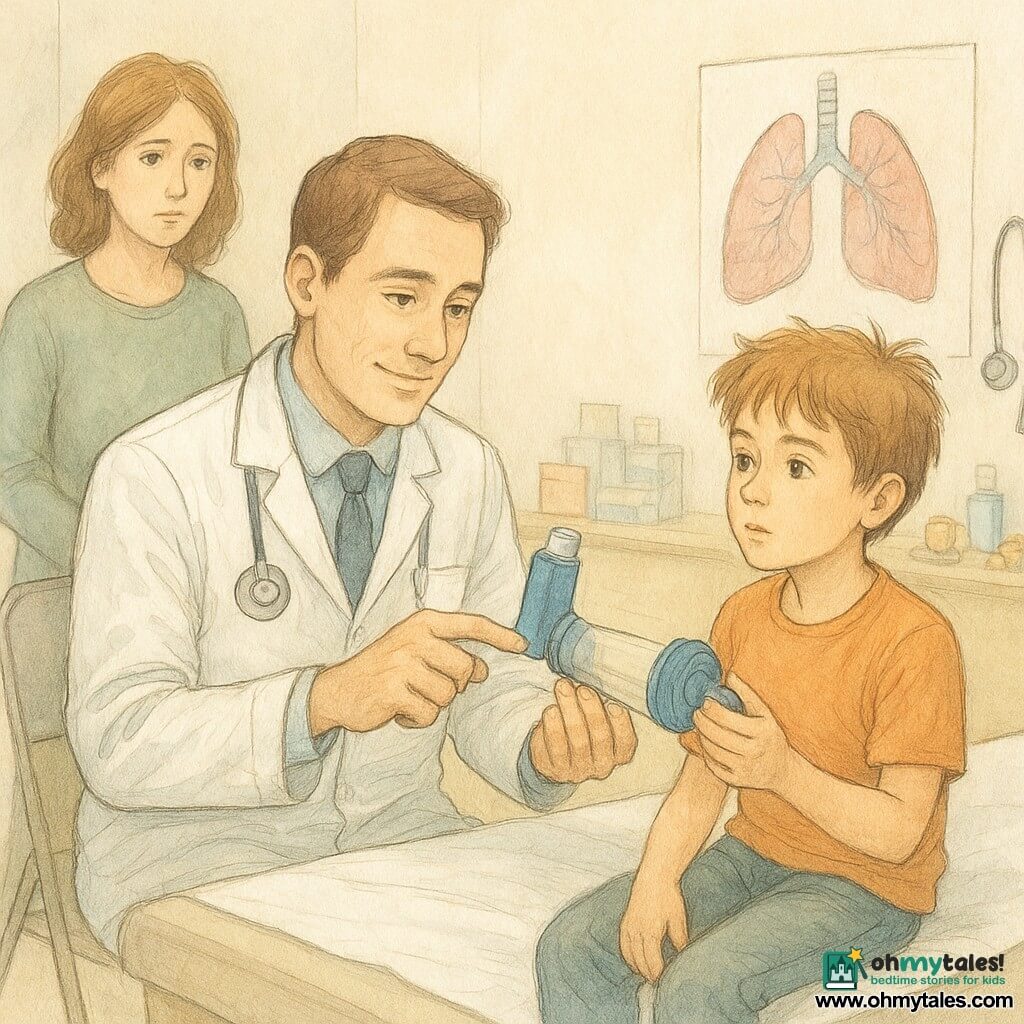
He demonstrated with a sample inhaler and spacer. The spacer looked like a clear plastic tunnel.
“This helps medicine reach the lungs,” Milo said. “If you puff straight into your mouth, some of it hits the back of your throat. The spacer gives the medicine time to float, so you can breathe it in calmly.”
Inez peered into it. “It's like a tiny space station.”
“Your lungs will receive supplies,” Milo said, keeping his voice playful.
Inez smirked. “I'm the astronaut.”
“You are,” Milo said. “A very brave one.”
Between appointments, Milo checked his own breathing. It felt steadier today. Not perfect, but improved—like a song tuning itself.
During lunch, he drank water and stepped outside for five minutes of fresh air. The sky was pale blue, and a breeze carried the smell of nearby trees. He noticed how the air felt cooler in his nose and warmer in his chest. Tiny details, easy to ignore when you were rushing.
Back inside, his nurse, Talia, leaned over his desk. “You're actually taking breaks,” she said, suspicious.
Milo raised his water bottle. “Dr. Sato's orders.”
Talia laughed. “Good. If you faint dramatically, I'm not catching you.”
“Fair,” Milo said. “I'm a tall mammal.”
Later, Milo saw the boy from the waiting room again—Leo, his chart said—now in Milo's own clinic, sitting with his mom. Leo recognized Milo immediately.
“Lung Detective!” Leo said, grinning.
Milo pretended to look around. “Where? I only see a very brave kid.”
Leo sat up straighter.
Milo examined him, listened to his lungs, and reviewed the test results. Mild asthma, likely triggered by exercise and seasonal allergies.
Leo's mom looked worried again. “Will he have to stop running?”
“Not necessarily,” Milo said. “Many people with asthma run, play sports, even become champions. The goal is control, not limitation.”
Leo blinked. “Champions?”
Milo nodded. “Your lungs aren't broken. They're sensitive. We can teach them to behave.”
He showed Leo an inhaler and spacer, explaining each step. Leo practiced, serious as a pilot.
“Why does it happen?” Leo asked.
Milo loved that question. Curiosity had arrived right on time.
“It's like your airways have a guard dog,” Milo explained. “Sometimes it barks too loudly at things that aren't truly dangerous—cold air, pollen, exercise. The barking is the narrowing. Medicine helps calm the guard dog.”
Leo giggled. “My lungs have a dog?”
“A very protective one,” Milo said. “We just need to train it.”
He added, “Also, prevention helps: taking your preventive medicine if prescribed, warming up before sports, noticing early signs, and avoiding smoke. Smoke is like throwing pepper in your airways.”
Leo made a face. “Gross.”
“Exactly,” Milo said. “And remember—ask questions. Tell adults how you feel. We're a team.”
Leo nodded solemnly. “Team Lungs.”
Milo held out his hand. Leo shook it like it was a real contract.
When they left, Leo turned back and called, “Good luck with your breathing, too!”
Milo felt something warm in his chest, and this time it wasn't tightness.
Chapter 6: A Blue-Night Sky
That evening, Milo updated one more section of his review before bed. He added a paragraph about listening—how the stethoscope was important, yes, but so was listening to the patient's story.
He wrote: “Symptoms are messages. Our job is to translate them with care.”
He saved the document and leaned back. The room was dim, and the window showed the city settling down, lights blinking on like sleepy fireflies.
Milo took his preventive inhaler, slow and steady, then rinsed his mouth as instructed. He liked the routine now. It was comforting, like putting books back on a shelf.
He stepped onto his small balcony with a blanket around his shoulders. The air was cool but gentle, and he breathed it in without thinking too hard about it.
Above him, the sky had turned a deep, clear blue—night-blue, like velvet washed clean. A few stars were visible, sharp as pins.
Milo rested his elbows on the railing and watched a plane glide across the sky, blinking calmly as it went.
He thought about the day: Inez the astronaut, Leo and his guard-dog lungs, Dr. Sato's steady voice, Rina's planet socks. He thought about how medicine wasn't just lab results and prescriptions. It was people learning their own bodies, one question at a time.
He spoke softly to the sky, as if it might answer. “All right,” he said. “I'm curious. I'm cooperative. I'm a mammal.”
A laugh slipped out of him, quiet and warm.
Inside, his phone buzzed once more. A message from his sister: Sleep. No negotiating.
Milo typed back: Yes, coach.
He stayed a moment longer, letting the night-blue sky fill his eyes. It felt like a calm ocean above the rooftops, vast and steady, promising that tomorrow would arrive with fresh air and another chance to learn.
Then Milo went inside, turned off the light, and went to bed—breathing in, breathing out—under a blue-night sky that looked like it was watching over everyone, kindly and quietly, the way a good doctor does.