Chapter 1: The Morning of Soft Footsteps
Dr. Amir Hale woke before his alarm, the way he always did on clinic days. Dawn pressed a pale gold thumb against the curtains. The city outside was still yawning.
He tied his shoelaces in a neat double knot and checked his pockets: penlight, stethoscope, tiny notebook with corners bent like dog ears. He didn't carry superhero gear, but in his own quiet way, he was one.
Geriatrics was his specialty—medical care for older adults. Some people thought that meant only “aches and pills.” Dr. Amir thought it meant stories, patience, and listening hard enough to hear what wasn't said.
On his way out, his neighbor Mrs. Nia was wrestling with a stubborn grocery bag that looked like it had eaten too many apples.
“Need a hand?” Dr. Amir asked.
Mrs. Nia huffed. “This bag is trying to retire early.”
He lifted it easily. “Then we'll give it a gentle encouragement.”
She smiled. “You always talk like a doctor, Amir. Gentle encouragement.”
“Works on bags and people,” he said, and she laughed, the sound bright as coins.
At the hospital entrance, the automatic doors whooshed open. The smell of clean soap and warm tea met him. A volunteer waved. A nurse called, “Morning, Dr. Hale!”
“Morning,” he answered, and his voice was calm the way a blanket is calm.
In the geriatrics ward, he paused at the whiteboard. Names, room numbers, small notes: “likes jazz,” “needs glasses,” “daughter visiting at noon.” It looked less like a list and more like a map of many small worlds.
He took a breath. “Alright,” he murmured. “Let's do good work.”
Chapter 2: The Ward of Stories
His first stop was Room 12, where Mrs. Ochoa sat upright like a captain on a ship, her silver hair pinned back with a purple clip.
“Doctor!” she announced as he entered. “Tell your stethoscope to behave. Last time it was cold as a fish.”
Dr. Amir tapped the metal against his palm. “I warmed it up. I had a serious talk with it.”
Mrs. Ochoa squinted. “Did it listen?”
“It promised to try.”
He checked her blood pressure, listening to the soft thump-thump that made a human being a human being. “How's your breathing today?”
“Better,” she said. “But my grandson keeps making me laugh, and that should be illegal.”
“Laughter is excellent medicine,” Dr. Amir said. “In correct doses.”
Mrs. Ochoa leaned in. “What's the dose?”
“About three good laughs a day,” he said, pretending to write a prescription in the air. “With a glass of water. And no doom-scrolling.”
She blinked. “What's doom-scrolling?”
“Never mind,” he said quickly. “Something we will not do.”
Next was Mr. Takeda, who always wore mismatched socks on purpose.
“Doctor,” Mr. Takeda said, lifting one foot. “Today's socks are a protest.”
“A protest against what?” Dr. Amir asked, checking his pulse.
“Against boring,” Mr. Takeda replied. “Also against the idea that old people should only wear beige.”
Dr. Amir smiled. “I support this protest. Strongly.”
As he moved from room to room, he did the same careful dance: ask, listen, examine, explain. He checked joints that creaked like old doors, lungs that wheezed like tiny accordions, and skin that bruised easily like ripe peaches.
Geriatrics, he often explained, was not just about treating diseases. It was about the whole person: how they slept, what they ate, whether they felt lonely, whether their home was safe. He asked about rugs people tripped on, about dizziness, about forgetting pills, about fear of falling.
And always, he used simple words.
“This medicine helps your heart pump smoothly,” he told Mr. Alvarez. “But we'll take it slow, because bodies are like old radios. You don't turn the volume up all at once.”
Mr. Alvarez nodded, relieved. “Good. Because I don't like surprises.”
Nobody did, really—especially when the surprise was inside your own body.
Near midday, Nurse Lina caught up with him in the hallway. She balanced a tray and a folder like a magician.
“Dr. Hale,” she said, “we've got an unusual visitor.”
“Unusual like… a parrot?” he asked.
“Unusual like… an eleven-year-old with a science project and a very serious face.”
Dr. Amir raised an eyebrow. “That does sound serious.”
“And,” Lina added, “his class is visiting the geriatric clinic today. Short tour. Just a small group.”
Dr. Amir glanced at his schedule. “Then we'll make it a good one. A gentle one.”
“Also,” Lina said, lowering her voice, “Mrs. Ochoa wants you to tell the children that laughter is illegal.”
Dr. Amir sighed dramatically. “My hands are tied.”
Chapter 3: The Tape Measure Mission
The school group arrived like a gust of wind in sneakers. Their teacher, Ms. Patel, herded them into a tidy line as if she were guiding ducklings across a very important road.
“Remember,” Ms. Patel said, “hospital voices.”
The ducklings tried. It came out as excited whispering.
One boy stood slightly apart. He had a backpack that looked heavy enough to contain at least one bowling ball. His hair stuck up in a way that suggested he had argued with a comb and won.
Dr. Amir stepped forward. “Hello. I'm Dr. Amir Hale. Welcome to geriatrics—care for older adults.”
A girl raised her hand immediately. “Is it scary?”
“Good question,” Dr. Amir said. “Sometimes hospitals feel scary because people don't know what's going to happen. But most of what we do is careful checking, listening, and helping people feel better—or stay as healthy as possible.”
The boy with the serious face raised his hand halfway, like he wasn't sure he trusted hands.
“Yes?” Dr. Amir asked.
“I'm Leo,” the boy said. “I'm doing a project about growth and bones and—uh—life.”
“Life is a big topic,” Dr. Amir said. “I respect your ambition.”
Leo nodded gravely, as if he'd been training for this moment.
They walked through the corridor. Dr. Amir pointed out hand sanitizer stations.
“First lesson,” he said. “Clean hands. Germs are tiny hitchhikers. We don't let them ride for free.”
A boy in the back whispered, “I wash my hands so much my thumbs are tired.”
“Your thumbs will recover,” Dr. Amir assured him.
At the nurses' station, Dr. Amir showed them a blood pressure cuff.
“This squeezes your arm gently,” he explained. “It tells us how strongly your blood pushes against your blood vessels. Like water pressure in a hose.”
A student asked, “Do you use it on old people only?”
“We use it on anyone,” Dr. Amir said. “Health doesn't care about your age. It visits everyone.”
Leo stepped forward. “Can you measure me?” he blurted. Then, quieter: “For the project.”
Ms. Patel looked surprised. “Leo, we can do that at school.”
Leo's ears turned red. “But… here it's… official.”
Dr. Amir chuckled. “We can do it. Measuring is part of medicine. We measure height, weight, temperature—because numbers can give us clues.”
He led Leo to a small examination room. The other students clustered at the door, peeking like curious cats.
“Okay,” Dr. Amir said, “this is a height chart. Shoes off, please.”
Leo tugged off his sneakers with the speed of someone who had been waiting his whole life to remove them dramatically.
Dr. Amir positioned him carefully. “Back against the wall. Heels together. Look straight ahead.”
Leo straightened so much he looked like he'd swallowed a ruler.
“Relax,” Dr. Amir said softly. “Bodies don't grow better when they're scared.”
Leo let out a breath. His shoulders dropped.
Dr. Amir slid the measuring bar down until it touched the top of Leo's head. “All set. You are… one hundred and fifty-one centimeters.”
Leo's eyes widened. “Is that good?”
“It's you,” Dr. Amir said. “And that's perfect. People grow at different speeds. Some shoot up like bamboo. Some grow like slow, steady trees. Both are normal.”
A girl asked from the doorway, “Do you measure old people too?”
“Sometimes,” Dr. Amir said. “People can get a little shorter as they age, because bones and posture change. That's why we also help older adults stay strong—good food, safe movement, and exercises that fit their bodies.”
Leo scribbled furiously in a notebook. “So—bones… can change?”
“Yes,” Dr. Amir said. “Bones are living tissue. They rebuild themselves. When people get older, bones can become more fragile, like chalk instead of stone. That's called osteoporosis. We prevent it with calcium, vitamin D, movement, and sometimes medicine.”
Leo's pen paused. “My grandma says she's afraid of falling.”
“That's very common,” Dr. Amir said. “In geriatrics, preventing falls is a big part of the job. We check balance, vision, medications—because some pills can make you dizzy—and we make sure homes are safer. No slippery rugs. Good lighting. Grab bars in the bathroom.”
A student frowned. “So being a doctor is… telling people to move rugs?”
“Sometimes,” Dr. Amir said, smiling. “A moved rug can be as powerful as a pill.”
The kids laughed, and the room felt lighter, as if someone had opened a window.
Chapter 4: The Puzzle of Mrs. Kwon
After the tour, most of the students returned to the waiting area for a short talk. But Dr. Amir noticed Leo lingering, still holding his notebook like a shield.
“Want to see how we listen to a heart?” Dr. Amir asked.
Leo nodded, then hesitated. “Is it… loud?”
“Not loud,” Dr. Amir said. “More like a secret drum.”
He guided Leo and two other students—just a few, to keep things calm—toward Room 7. “We'll visit Mrs. Kwon. We'll ask permission first.”
He knocked gently. “Mrs. Kwon? It's Dr. Hale.”
A voice, thin but firm: “Enter, but bring good news.”
Dr. Amir stepped in. Mrs. Kwon sat in a chair by the window, hands folded, eyes sharp as pins. Her hair was snowy and neat. On the table beside her sat a cup of tea and a book with a bookmark sticking out like a tongue.
“Good news,” Dr. Amir said, “I brought young visitors who are learning about health. Would you like to say hello?”
Mrs. Kwon looked at the kids. “If they don't stare like I'm a museum statue.”
Leo swallowed. “Hello, Mrs. Kwon.”
Mrs. Kwon examined him. “You look nervous.”
Leo blurted, “I'm not scared of you. I'm just… scared of messing up.”
Mrs. Kwon's mouth twitched. “That is an acceptable fear.”
Dr. Amir pulled up a stool. “Mrs. Kwon, how is your knee today?”
“It complains,” she said. “Like an old man who wants attention.”
Dr. Amir nodded. “Let's listen to the complaint.”
He asked her about pain—when it started, what made it worse, what made it better. He watched how she moved. He checked the joint carefully.
To the kids, he explained, “A lot of older adults have arthritis. That means the cushions in the joint can wear down, and the joint can get stiff and sore. We help with gentle exercise, physical therapy, heat, sometimes medicine. The goal is comfort and function.”
Mrs. Kwon sniffed. “Function. I want to function enough to beat my sister at mahjong.”
“A very important medical goal,” Dr. Amir said solemnly.
The kids giggled.
Leo raised his hand, then remembered he wasn't in class and lowered it again. “Do you… just give pills?”
Dr. Amir shook his head. “Pills can help. But geriatric medicine is also about teamwork. Doctors, nurses, physiotherapists, pharmacists, dietitians, social workers, families—and the patient. Especially the patient.”
Mrs. Kwon leaned forward. “Especially me.”
“Especially you,” Dr. Amir agreed.
A boy asked, “What if someone doesn't speak English well?”
Dr. Amir's eyes softened. “Then we find a way. We use interpreters. We use pictures. We slow down. Everyone deserves to be understood. Good care has no favorite language.”
Mrs. Kwon nodded once, approving.
Leo's shoulders loosened, as if the room had given him permission to breathe.
Dr. Amir asked Mrs. Kwon, “Can I show them how I check your pulse?”
Mrs. Kwon extended her wrist. “If it behaves.”
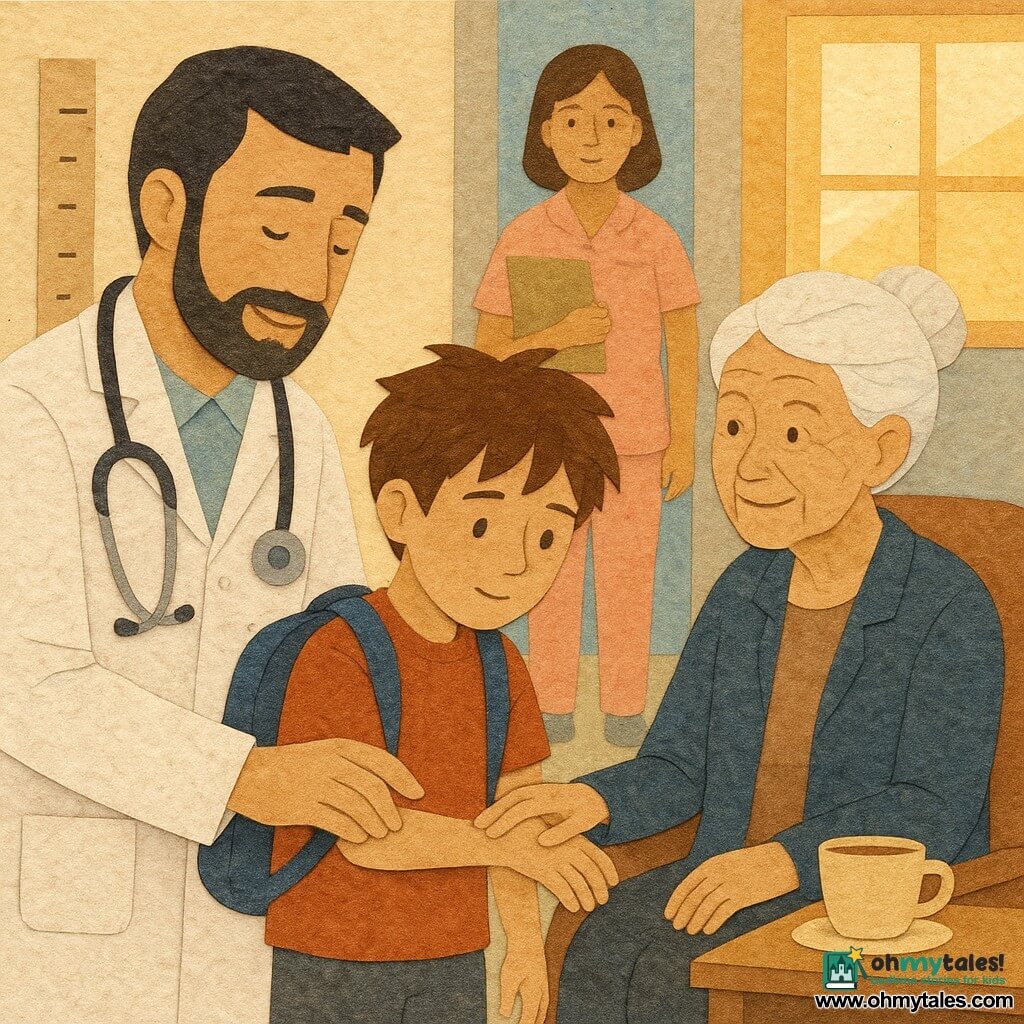
“It usually does,” Dr. Amir said, placing two fingers gently on her skin. “Pulse is the rhythm of blood moving because the heart is pumping. Like footsteps in a hallway.”
Leo watched closely.
“Want to feel it?” Dr. Amir asked.
Leo hesitated, then stepped forward. Dr. Amir guided Leo's fingers to the right spot.
Leo's eyes widened. “It's… there. Like a tiny tap.”
Mrs. Kwon looked pleased. “Congratulations. You have discovered I am alive.”
Leo smiled, a real one this time.
Chapter 5: The Great Cough Mystery
Back in the hallway, Nurse Lina approached with a look that meant, Something is up.
“Dr. Hale,” she said quietly, “Mr. Benton in Room 15 has a cough that's worse today. He's anxious. Keeps asking if it's something terrible.”
Dr. Amir nodded. “Let's go.”
Leo, still nearby, shifted his backpack. “Can I… watch? For the project?”
Dr. Amir considered. “Only if Mr. Benton agrees. And only if you stay calm and respectful.”
Leo nodded so hard his hair bounced.
In Room 15, Mr. Benton sat propped up with pillows, his thin hands fidgeting with the blanket. He looked like someone who had been worried for so long that worry had become a habit.
Dr. Amir greeted him warmly. “Mr. Benton, I heard your cough is bothering you.”
Mr. Benton cleared his throat, then coughed—short, scratchy. “It's a bad sign, isn't it? Every cough is a bad sign at my age.”
Dr. Amir pulled his chair close. “A cough is a sign, yes—but signs can mean many things. Like a ringing phone. It could be your friend, or it could be a wrong number. We need to check.”
Mr. Benton stared at him. “So… not automatically doom?”
“Not automatically doom,” Dr. Amir promised.
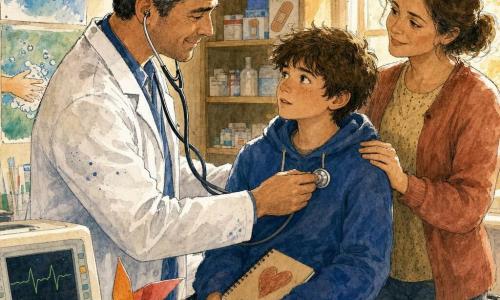
He explained each step before he did it. “I'm going to listen to your lungs with my stethoscope. It may feel cool.”
“I'd prefer warm,” Mr. Benton muttered.
Dr. Amir warmed it in his hand. “My stethoscope has been through sensitivity training.”
Mr. Benton snorted, half a laugh.
Dr. Amir listened—front and back—asking Mr. Benton to take slow breaths. “In through your nose… out through your mouth.”
To Leo and the others, Dr. Amir said, “When we listen, we're checking if air moves smoothly. Crackles can mean fluid. Wheezes can mean narrowed airways.”
He checked Mr. Benton's temperature and oxygen level with a small clip on his finger.
Mr. Benton eyed it suspiciously. “That thing looks like it bites.”
“It's a polite clip,” Dr. Amir said. “No teeth.”
The oxygen number was okay. The temperature was slightly up.
Dr. Amir asked about symptoms: sore throat, chest pain, shortness of breath, appetite, sleep. He asked about what Mr. Benton had eaten, whether he had been drinking enough water, whether he had been around anyone sick.
He looked at the medication list. “Sometimes,” he explained to the students, “medicine that helps one problem can cause another—like dizziness, dry mouth, or cough. That's why we review medicines carefully in older adults. It's called medication reconciliation. Fancy phrase, simple idea: make sure all the pills make sense together.”
Leo scribbled again, eyes focused.
Dr. Amir turned back to Mr. Benton. “Your lungs sound mostly clear. That's good news. Your oxygen is good. You have a mild fever and an irritated throat. It may be a virus, or it might be irritation from dry air. We'll do a simple test, and we'll watch you closely.”
Mr. Benton's shoulders sagged with relief. “So I'm not… you know… finished?”
Dr. Amir's voice was steady. “You're not finished. You're here. You're breathing. And we're taking care of you.”
Mr. Benton blinked, and his fidgeting slowed. “Thank you.”
Dr. Amir added, “Also, prevention matters. Hand washing. Vaccines. Drinking water. Rest. And telling us early when something changes. You did the right thing.”
Mr. Benton looked almost proud. “I did?”
“You did,” Dr. Amir said.
In the hallway, Leo whispered, “You didn't panic.”
Dr. Amir tilted his head. “Panic is loud. Medicine works better when we're quiet enough to think.”
Leo nodded slowly, as if storing that sentence in a special pocket.
Chapter 6: The Listening Lesson
Later, in a small meeting room, Dr. Amir spoke to the class. On the table, he placed objects like props: a stethoscope, a blood pressure cuff, a model of a knee joint, a small bottle of hand sanitizer.
“This is not a magic show,” he said. “But it can feel like one, because bodies are amazing.”
A student asked, “What's the hardest part of your job?”
Dr. Amir didn't answer right away. He looked out the window, where the sky was turning the color of watered-down blueberry.
“The hardest part,” he said, “is when someone feels invisible. Older adults can be treated like they're ‘just old,' like their opinions don't count. But they are full people—with choices, fears, jokes, and histories. My job is to listen and to respect them.”
Ms. Patel nodded. “That's an important lesson.”
Leo raised his hand again, more confident now. “Do you ever get annoyed?”
Dr. Amir smiled. “Yes. I'm human. But I try to notice the feeling and not let it drive. When someone is cranky, it's often because they're uncomfortable, scared, or tired of being poked and prodded.”
From the back, a girl asked, “What if someone is different from you? Like… their culture or religion?”
Dr. Amir's answer was gentle but clear. “Then I learn. I ask respectful questions. I don't assume. Tolerance means you don't treat differences like problems to fix. You treat them like parts of a person to understand.”
He picked up the hand sanitizer. “And we all agree germs are the enemy,” he added.
The class laughed.
Before they left, Dr. Amir invited them to practice a simple “doctor skill” that didn't involve needles or scary machines: introducing themselves kindly.
He demonstrated with Leo.
Dr. Amir offered his hand. “Hello, I'm Dr. Hale. What name do you like to be called?”
Leo shook his hand. “Leo. Just Leo.”
“And how can I help you today, Leo?”
Leo hesitated, then said honestly, “I want to understand things without being scared.”
Dr. Amir nodded. “That's a good request.”
The room went quiet for a moment, in a comfortable way, like a library.
Chapter 7: A Hand on the Heart
The students left with Ms. Patel, their sneakers squeaking down the hall like a flock of curious mice. Leo lingered at the door.
“Dr. Hale?” he said.
“Yes?”
Leo held up his notebook. It was full of messy handwriting and arrows and tiny drawings of bones. “Thanks for measuring me. And for… not making it weird.”
Dr. Amir chuckled. “Bodies aren't weird. They're just… complicated pets we live inside.”
Leo laughed, surprised by it, as if the sound had popped out before he could stop it.
Dr. Amir walked him toward the lobby. On the way, they passed Mrs. Ochoa, who was arguing with her grandson about whether her purple hair clip made her look like a movie star.
“It does,” Dr. Amir told her.
“I knew it!” Mrs. Ochoa crowed.
In the lobby, Leo's parent waited, waving. Leo started toward them, then turned back.
“Dr. Hale,” Leo said, “I thought doctors were mostly… rushing. But you're like… slow, in a good way.”
Dr. Amir placed his palm lightly over his own chest, right above his heartbeat. “This job is about speed when there's danger,” he said, “but it's also about patience. People heal better when they feel safe.”
He kept his hand there for one quiet moment, feeling the steady thump that had guided him all day—through jokes, worries, and careful listening.
Leo copied him without thinking, placing his own hand on his heart. His eyes softened.
For an instant, the busy lobby felt hushed, as if everyone's footsteps had learned to tiptoe.
Then Leo lowered his hand, waved, and ran to his parent—lighter than when he'd arrived.
Dr. Amir watched him go, then turned back toward the ward, ready for the next story, the next small act of care, the next gentle encouragement.