Chapter 1: The Slow Hands of Dr. Mira
The town clinic woke up the way a cat wakes up—stretching, blinking, and pretending it wasn't in a hurry at all.
Dr. Mira Lane hung her coat on the last hook, the one that squeaked like a tiny mouse. She rolled up her sleeves with careful folds and tied her hair back so neatly it looked like it had agreed to behave.
“Morning, Dr. Lane!” called Jae, the receptionist, from behind a tower of appointment cards.
“Good morning,” Dr. Mira said, smiling like warm tea. She didn't rush. She never did. Her movements were slow and precise, as if she was measuring kindness with every step.
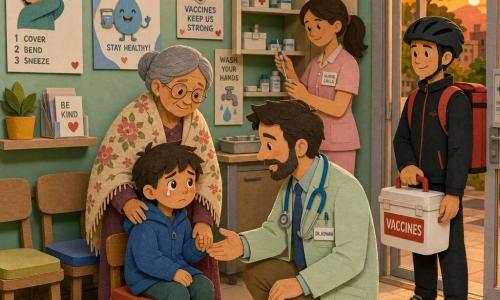
On the wall, a poster showed a cartoon heart lifting a dumbbell. Another one said: WASH HANDS LIKE YOU'RE WASHING OFF GLITTER.
Dr. Mira read them every day anyway. Not because she forgot, but because she liked reminders that big problems could be fought with small habits.
A soft knock came from the waiting room door.
“Come in,” Dr. Mira said.
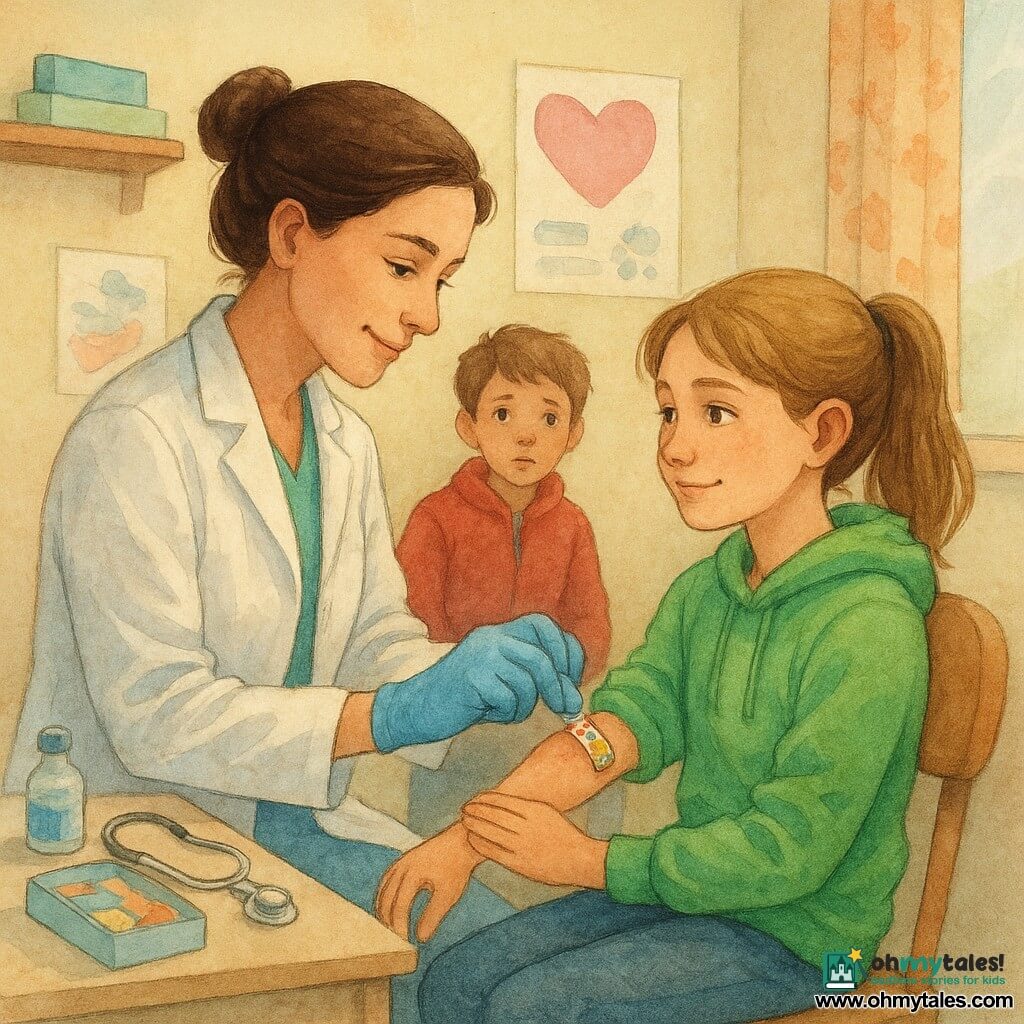
A girl about twelve slipped inside, holding her elbow like it might float away. Her hoodie was bright green, but her face was pale.
“I'm Saffy,” she mumbled.
Dr. Mira pulled up a stool so they were the same height. “Hi, Saffy. I'm Dr. Mira. Tell me what happened.”
Saffy glanced at her elbow. “I fell off my skateboard. My grandma says I need a shot. Like… immediately. Or my arm will… I don't know… explode?”
Dr. Mira's eyebrows lifted gently. “Explode is a dramatic word for an elbow.”
Saffy gave a shaky laugh that sounded like it had tripped over itself.
Dr. Mira washed her hands—slow, thorough, bubbles everywhere—and put on gloves with a quiet snap. Then she leaned in, looking carefully at the scrape.
“It looks angry,” Saffy said.
“It looks like your skin is doing its job,” Dr. Mira replied. “Your skin is a brave little wall. When it gets a scratch, it calls for help.”
“Like… tiny soldiers?”
“More like tiny helpers,” Dr. Mira said. “They're not looking for a fight. They're looking to clean up and rebuild.”
Saffy blinked. “So I don't need a shot?”
“Let's talk about that,” Dr. Mira said softly. “There's a common idea that every cut means you need a shot right away. But medicine is more like a map than a magic wand.”
Saffy stared. “A map?”
“A map tells you where you are and where you're going,” Dr. Mira explained. “We decide what you need based on the wound, your vaccine history, and how clean it is. Shots are important, but we don't give them just to chase fear away.”
Saffy's shoulders dropped a little, like they'd been carrying a backpack of worries.
Dr. Mira cleaned the scrape with cool saline, dabbing instead of scrubbing. “This might sting,” she warned.
Saffy squeezed her eyes shut. “I'm ready.”
The sting came, small and sharp, like a tiny pinch from a crab. Saffy hissed.
“That was—” she began.
“Not fun,” Dr. Mira finished.
“Exactly.”
Dr. Mira smiled. “Not fun, but useful. Like homework.”
Saffy snorted. “My elbow just got assigned math.”
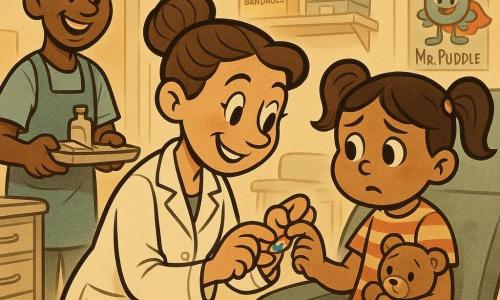
“Luckily, this homework is short,” Dr. Mira said, placing a neat bandage over the scrape. “Now: when was your last tetanus shot?”
Saffy frowned. “I… don't know.”
“That's okay,” Dr. Mira said. “We can check your records. Doctors do a lot of looking things up, not just knowing things.”
She tapped a few keys with patient fingers, as if each click mattered.
“Good news,” Dr. Mira said. “You're up to date.”
Saffy exhaled like she'd been holding her breath since the skateboard incident. “So my arm won't explode.”
“It will not explode,” Dr. Mira promised. “But it might itch while it heals. That's normal.”
Saffy stared at the bandage. “So… what do doctors really do all day? Just… bandages and shots?”
Dr. Mira's eyes twinkled. “Would you like to find out?”
Saffy hesitated. “Like… today?”
“Today,” Dr. Mira said. “We have a special afternoon. The clinic is visiting Maple Street School to teach about health. You could come as my helper, if your grandma agrees.”
Saffy's mouth opened. “Me? In a clinic?”
“In a clinic,” Dr. Mira said. “You'll see how medicine is often about listening, preventing problems, and working together.”
Saffy stood a bit taller. “Okay. But… do I have to touch anything gross?”
Dr. Mira's voice stayed gentle. “Only information. And maybe a stethoscope. Those are not gross.”
Saffy nodded slowly. “I can handle information.”
Chapter 2: The Mystery of the Noisy Lungs
By lunchtime, Saffy sat in the corner of Dr. Mira's office with a paper cup of water and a look that said she was trying to be brave in eight different ways.
Dr. Mira wheeled in a small cart. On it were a stethoscope, a blood pressure cuff, a thermometer, a little flashlight, and a box of colorful ear tips.
Saffy pointed. “That's… it?”
Dr. Mira chuckled. “People think doctors always need huge machines and bright lights. Sometimes we do. But most days, our best tools are our eyes, ears, hands, and time.”
There was another knock.
A boy walked in with his dad. The boy's cheeks were pink, and his breathing sounded like a whistle that had swallowed a pebble.
“I'm Eli,” he said between breaths.
“I'm Dr. Mira,” she replied, as if meeting him was the most important thing on her schedule—because it was. “This is Saffy. She's learning how the clinic works.”
Eli's eyes widened. “Cool.”
His dad rubbed his neck. “He's been coughing all night. I think it's pneumonia. Or… something serious.”
Eli coughed, then tried to laugh and failed halfway. “Dad watched a scary video.”
Dr. Mira sat down, shoulders relaxed. “Let's slow down,” she said. “First, Eli, I'm going to ask questions. Then I'll listen to your lungs. Then we'll decide together what's going on.”
Saffy whispered, “Decide together?”
Dr. Mira nodded. “Patients aren't puzzles we solve without them. They're people. We work with them.”
Dr. Mira asked Eli about his cough—when it started, if he had a fever, if his chest hurt, if he could still taste food. Eli answered in short bursts, pausing to catch his breath.
Then Dr. Mira warmed her stethoscope between her palms. Her hands moved like slow birds settling on a branch.
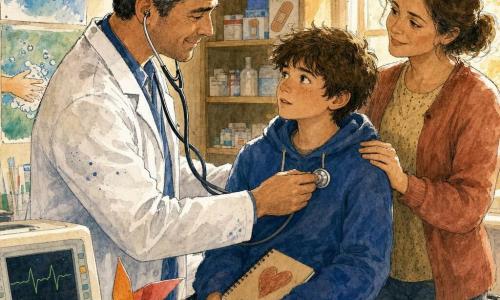
“This will be cold for a second,” she warned, placing the stethoscope on Eli's back.
Eli shivered. “It's like an ice coin!”
Dr. Mira listened carefully, shifting the stethoscope in small steps. “Breathe in… and out. Good. Again.”
Saffy watched Dr. Mira's face. It didn't look worried, but it didn't look careless either. It looked focused—like someone listening for a secret.
Dr. Mira then used the flashlight to check Eli's throat and ears. She measured his temperature and clipped a small device on his finger.
“What's that?” Saffy asked.
“A pulse oximeter,” Dr. Mira said. “It tells us how much oxygen is in the blood. It's a quick way to make sure breathing is doing its job.”
Eli wiggled his finger. “I'm a robot.”
“A very human robot,” Dr. Mira said.
After a moment, she turned to Eli and his dad. “Good news,” she said. “This sounds like asthma symptoms acting up, likely triggered by a cold. I don't hear signs of pneumonia today. Your oxygen level looks good.”
Eli's dad blinked. “So… he's not in danger?”
“Right now, he's okay,” Dr. Mira said. “But we need a plan. Asthma can make airways narrow and sensitive. The goal is to keep them calm.”
Eli's dad frowned. “We don't have to do an X-ray?”
“Not today,” Dr. Mira said. “We only use tests when they help us make a decision. Too many tests can be stressful, expensive, and sometimes confusing.”
Saffy leaned closer, whispering, “So doctors don't just… test everything?”
Dr. Mira shook her head. “That's another idea people have. But good medicine is choosing the right step, not every step.”
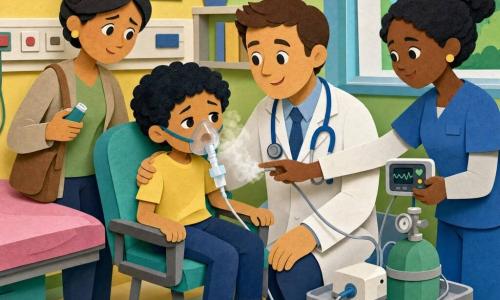
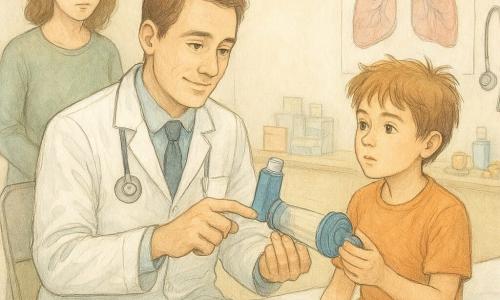
Dr. Mira demonstrated an inhaler spacer with a plastic tube that looked like a small science gadget.
“This helps the medicine reach the lungs,” she explained. “Eli, you'll breathe in slowly. Like you're smelling hot cocoa.”
Eli tried it. “Mmm… cocoa.”
His dad finally smiled, the tightness leaving his face. “Thank you. I was imagining the worst.”
“That happens,” Dr. Mira said. “Worry is loud. Facts are quieter. We listen for them.”
When they left, Saffy stayed still for a second.
“That was… calm,” she said.
Dr. Mira washed her hands again. “Calm helps people think. And thinking helps people heal.”
Saffy looked down at her bandaged elbow. “My grandma says doctors have to be fast.”
Dr. Mira dried her hands. “Sometimes emergencies require speed. But even then, precision matters. Fast doesn't mean frantic.”
Saffy nodded slowly, like she was tucking that idea into her pocket.
Chapter 3: The School Visit and the Gum Myth
In the afternoon, Dr. Mira and Saffy walked to Maple Street School carrying a tote bag that clinked softly—props for a health lesson.
The hallway smelled like pencil shavings and floor polish. Kids' artwork covered the walls: galaxies made of glitter, dragons with googly eyes, and one suspicious-looking banana wearing sunglasses.
In the classroom, a group of sixth graders stared at Dr. Mira like she might pull a rabbit out of a stethoscope.
Their teacher, Mr. Calder, clapped his hands. “Class, this is Dr. Lane. She's here to talk about what doctors do—and how to stay healthy.”
Dr. Mira set her tote on a desk. “Hello,” she said. “I brought some tools and some stories. Because medicine is made of both.”
Saffy stood beside her, trying not to look like she was bursting with curiosity.
A kid in the front row raised his hand so fast it nearly whistled. “Do you have to stitch people every day?”
Another hand shot up. “Do you see blood all the time?”
A third voice called, “Do doctors get grossed out?”
Dr. Mira smiled. “You're asking the honest questions. Let me answer with honesty too. Sometimes there's blood. Sometimes there are stitches. And yes—doctors are human. We can feel squeamish. But we learn how to handle it safely, because our job is to help.”
Saffy added, “She's really calm.”
Dr. Mira glanced at her with a grateful look.
Dr. Mira held up a model of a set of lungs, pink and spongey. “This is why we talk about prevention,” she said. “So we can keep these working well.”
“Like… not smoking?” someone said.
“Yes,” Dr. Mira said. “And also: washing hands, getting vaccines, eating a mix of foods, sleeping, managing stress, moving your body, and speaking up when something feels wrong.”
A girl in the back raised her hand. “My brother says if you swallow gum, it stays in your stomach for seven years.”
The room erupted in giggles and dramatic groans.
Saffy whispered, “Is that true?”
Dr. Mira's eyes sparkled. “Here's today's myth,” she said, loud enough for the room. “Swallowed gum does not stay in your stomach for seven years.”
A chorus of “Aww!” filled the room, half disappointed, half relieved.
Dr. Mira continued, “Gum isn't easy to digest, but your digestive system is like a moving walkway. Most gum will pass through in a day or two, like other things your body can't break down.”
A boy grinned. “So it's… like a tiny traveler.”
“Exactly,” Dr. Mira said. “But,” she added, raising one finger, “swallowing gum on purpose is still a bad idea. It can be a choking risk, and if someone swallowed lots of it, it could cause a blockage. So the best plan is still: spit it out.”
Saffy leaned closer. “Doctors correct myths a lot, don't they?”
Dr. Mira nodded. “All the time. Myths spread faster than colds. But truth can spread too—especially when people share it kindly.”
Mr. Calder asked, “Can you show them how to take a pulse?”
Dr. Mira held out her wrist. “Two fingers,” she instructed, placing them gently. “Not your thumb—your thumb has its own pulse and it can confuse you. Press lightly. You're listening for a tiny drumbeat.”
Saffy tried on her own wrist. “Oh! I found it.”
“That's you,” Dr. Mira said. “Your heart doing its steady work without asking for applause.”
The class practiced. Some kids counted too fast, some too slow. Dr. Mira moved between desks, correcting with quiet patience.
“Not a squeeze,” she told one boy. “A touch.”
“A touch like a secret handshake,” Saffy suggested.
Dr. Mira smiled. “Perfect.”
Then Dr. Mira pulled out a small glitter bottle and a pump of lotion.
“Today's final lesson,” she said, “is about germs.”
Saffy's eyes widened. “Glitter germs?”
Dr. Mira nodded. “Glitter is like germs: it sticks, it spreads, and it shows up in surprising places.”
The kids gasped as Dr. Mira dabbed glitter-lotion onto one student's hands and had them shake hands with three others. In seconds, sparkles appeared everywhere—desks, sleeves, cheeks.
“Now,” Dr. Mira said, “watch what happens with good handwashing.”
She had them wash with soap, scrubbing between fingers and under nails. The glitter faded, but it didn't vanish instantly.
“That's why we take our time,” she said. “Slow hands are clean hands.”
Saffy looked at Dr. Mira's hands—steady, careful, never in a rush to be done.
When the bell rang, the class waved and called goodbye.
Outside the school, Saffy said, “You didn't scare them.”
Dr. Mira adjusted her tote strap. “Fear can make people freeze. But knowledge can make people brave.”
Chapter 4: The Evening Call and the Fast-Wrong Idea
Back at the clinic, the sky turned lavender, like someone had brushed it with a soft paint roller.
Saffy sat on a chair near Dr. Mira's desk, swinging one foot carefully so her elbow didn't bump anything.
The phone rang. Dr. Mira picked it up. “Dr. Lane speaking.”
Her voice changed—not louder, not sharper, just more focused. Like a flashlight beam narrowing.
After a few seconds, she said, “Okay. I'm listening. Tell me what you see.”
Saffy could hear a woman's worried voice through the receiver, thin and trembly.
Dr. Mira asked calm questions. “How old is he? Is he breathing comfortably? Any swelling around the mouth? Any rash? What did he eat? When did it start?”
Saffy whispered to herself, “She's making a map.”
Dr. Mira glanced at her and nodded slightly, as if she'd heard.
Finally Dr. Mira said into the phone, “Based on what you're describing, it sounds like hives without breathing trouble. That's uncomfortable, but not the same as an emergency allergy reaction. Here's what we'll do…”
She explained, step by step, with words that sounded like handrails. She told the caller what to watch for, when to give medicine, and when to seek urgent help.
When she hung up, Saffy exhaled. “That was scary.”
“It can feel scary,” Dr. Mira agreed. “Especially when it's your child.”
Saffy chewed her lip. “I thought doctors would say, ‘Come in right now!' for everything.”
Dr. Mira leaned back. “Here's a fast-wrong idea: that speed always equals safety. But sometimes the safest thing is clear advice at home—rest, fluids, watching for certain signs—so families don't spend the night panicking in a waiting room.”
Saffy nodded. “So prevention and… planning.”
“And cooperation,” Dr. Mira added. “Doctors don't heal alone. Families, nurses, pharmacists, teachers—everyone helps. Even the patient helps by telling the truth about how they feel.”
Saffy looked thoughtful. “Like Eli saying he couldn't breathe well.”
“Yes,” Dr. Mira said. “And like you telling me you were afraid of shots.”
Saffy's cheeks warmed. “I was.”
Dr. Mira's voice stayed kind. “Fear is allowed. We just don't let fear be the boss.”
A soft sound came from the hallway. Jae peeked in. “Dr. Lane, your last appointment canceled. You're free.”
Dr. Mira's shoulders loosened. “Thank you.”
Jae grinned at Saffy. “Doctor-in-training, survived the day?”
Saffy lifted her bandaged elbow like a medal. “I learned that gum is a traveler.”
Jae laughed. “That's going on a poster.”
When the clinic quieted, Dr. Mira packed her bag slowly, checking each drawer as if saying goodnight to the tools.
Saffy stood. “My grandma's picking me up.”
“Tell her your elbow passed its explosion test,” Dr. Mira said.
Saffy smiled—wide this time, no wobble. “I will.”
Chapter 5: A Warm Goodbye and a Soft Lesson
Saffy's grandma arrived with a scarf wrapped around her neck like a determined snake.
“There you are!” Grandma said, voice full of worry that had been simmering all day. “Saffy, are you alright? Dr. Lane, did she need a shot?”
Dr. Mira stepped forward, hands folded gently. “She's alright. Her scrape is clean, and her vaccines are up to date. No shot needed today.”
Grandma's eyebrows climbed. “Really? I thought every scrape needed one.”
Dr. Mira shook her head. “That's a common belief. Tetanus shots are important, but we give them based on timing and risk. The best care is the right care—not the most care.”
Grandma blinked, then sighed. “Well. That makes sense when you say it like that.”
Saffy tugged Grandma's sleeve. “And doctors don't just do shots. They listen. And they teach. And they're… like map makers.”
Grandma looked at Dr. Mira. “Map makers?”
Dr. Mira's smile was small and genuine. “Health can feel like a big forest. We help people find the path.”
They walked toward the door together. Outside, the air was cool and smelled faintly of rain that hadn't arrived yet.
Grandma glanced at Saffy's bandage. “Does it hurt?”
“A little,” Saffy admitted. “But it's okay. It's healing. It might itch.”
Grandma made a face. “Don't scratch.”
“I know,” Saffy said, then added proudly, “Your skin is a brave little wall.”
Grandma chuckled. “Listen to you.”
Dr. Mira opened the clinic door and paused. “Saffy,” she said softly, “you did well today. You asked questions. You stayed brave even when you weren't sure.”
Saffy looked up. “Do you ever get tired of helping people?”
Dr. Mira considered, as if choosing words like choosing the right bandage. “Sometimes I get tired in my body,” she said. “But helping people feels like lighting small lanterns. Each lantern matters.”
Grandma's expression softened. “That's a nice way to put it.”
Saffy hugged her arms around herself. “I like that you're slow,” she told Dr. Mira. “It makes everything… less scary.”
Dr. Mira's eyes warmed. “Slow can be gentle,” she said. “Gentle can be strong.”
Grandma cleared her throat, a little emotional in a way she tried to hide. “Well, come on, kiddo. Let's get you home. Soup, pajamas, early bedtime.”
Saffy turned back once more. “Goodnight, Dr. Mira.”
“Goodnight,” Dr. Mira said. “And remember: wash hands like you're washing off glitter.”
Saffy laughed. “Always.”
As Saffy and her grandma walked away, Dr. Mira watched them for a moment. The streetlights blinked on, one by one, like the town was yawning.
Inside, Dr. Mira turned off the clinic lights with the same slow, precise hands. Then she whispered to the quiet room, as if it could hear her, “We did our best today.”
And the clinic, empty and calm, seemed to agree.