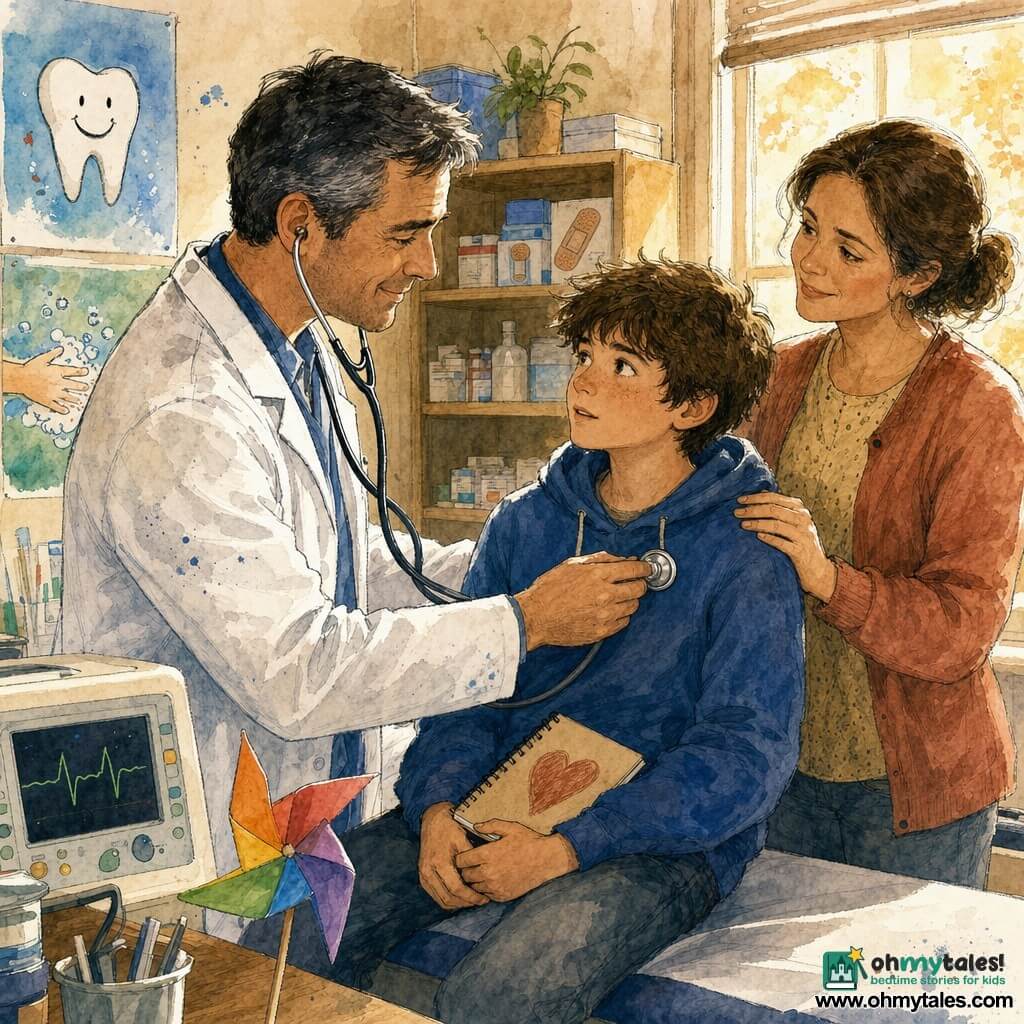
Chapter 1: The Doctor Who Keeps the Thread
Dr. Samir Lane's bike bell rang twice as he rolled up to Maple Street Clinic. It was early evening, the kind of time when the sky turns soft like watered-down paint and the streetlights blink awake one by one.
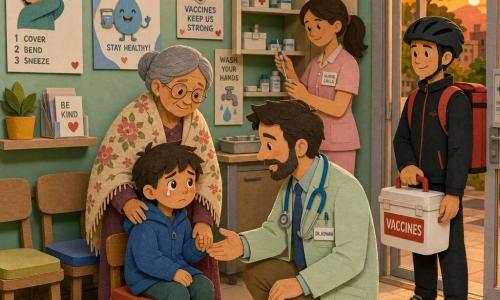
Inside, the waiting room was quieter than usual. A poster of a smiling tooth waved from the wall. Another one showed hands covered in soap bubbles.
Dr. Lane hung his jacket on the hook and checked the board at the nurses' desk. His name was written next to a note: “On-call tonight.”
Mira, the nurse, slid him a clipboard. “Ready, Guardian of the Link?”
That was their nickname for him. Dr. Lane didn't just treat coughs and scrapes—he kept people connected. Connected to their own bodies. Connected to their families. Connected to the idea that health wasn't a punishment, but a teamwork project.
He grinned. “I'm ready. What's our first mission?”
Mira lowered her voice in a dramatic whisper. “A brave preteen who swears he can feel his heart ‘doing parkour.'”
“Parkour, huh?” Dr. Lane tapped the clipboard. “Send him in.”
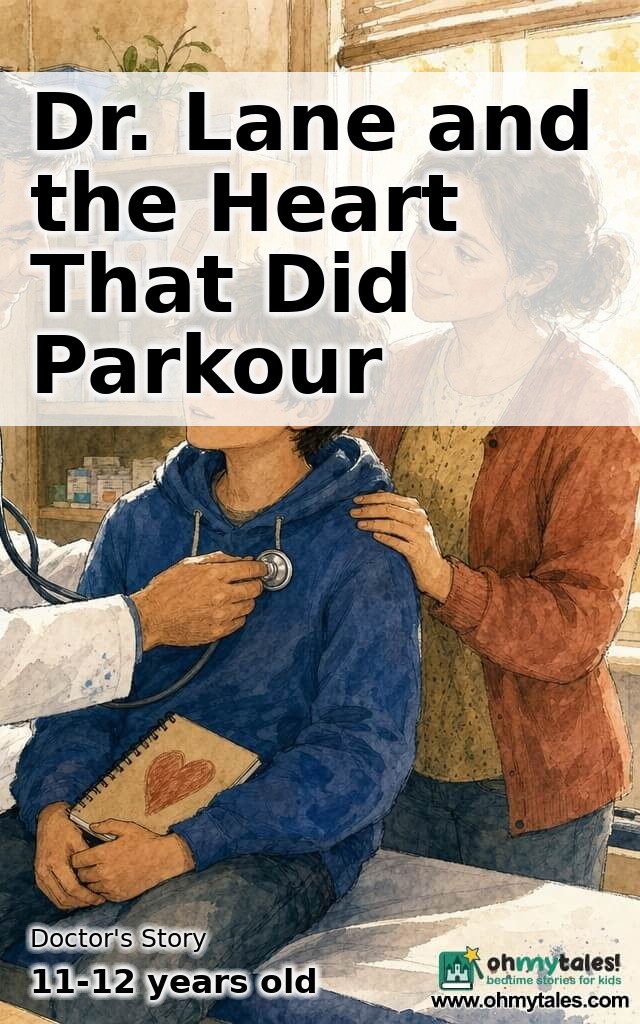
A boy about twelve walked in, shoulders up near his ears. His hoodie sleeves covered half his hands. Behind him came his aunt, Mrs. Campos, holding a water bottle like it was a rescue rope.
The boy sat down fast, then shifted again, as if the chair might suddenly bite.
Dr. Lane leaned forward, gentle as a blanket. “Hi. I'm Dr. Lane. What should I call you?”
“Leo,” the boy mumbled.
“Nice to meet you, Leo. I'm hearing your heart has been doing… athletic tricks?”
Leo's eyes flicked up. “It's like… thump-thump… then it goes thumpTHUMP like it's trying to win a race.”
Mrs. Campos sighed. “It started after his soccer practice. He got scared.”
Dr. Lane nodded. “Okay. First: you did the right thing by coming in. Second: hearts can be noisy sometimes, especially when we're growing. Let's investigate together—no surprise attacks.”
Leo's shoulders loosened a tiny bit. “No needles?”
“Not unless we truly need them,” Dr. Lane said. “And if we do, we'll talk about it first. Your body has its own rhythm, and we respect that.”
He placed the stethoscope in his palm. “May I listen to your heart?”
Leo hesitated, then nodded.
As Dr. Lane listened, the room felt like a small boat in calm water. He counted the beats. He listened for extra sounds, like a shoe tapping on a hallway floor. He heard a steady rhythm—fast from worry, but steady.
He sat back. “Good news: your heart sounds strong. It's beating faster because you're anxious right now—totally normal. After sports, it can also beat hard for a bit, like a drum after a big song.”
Leo blinked. “So it's not… broken?”
“Nope,” Dr. Lane said. “But we'll still be smart. I'm going to check a few things, and I'll teach you how your heart works so it feels less mysterious.”
Leo nodded again, slower this time, as if his head had found the right pace.
Outside the door, the clinic lights hummed softly—like they were listening too.
Chapter 2: The Heart Is a Pump, Not a Monster
Dr. Lane rolled his stool closer to Leo. “Have you ever used a bike pump?”
Leo's mouth twitched. “Yeah. Mine squeaks.”
“Perfect example,” Dr. Lane said. He held up his hands, shaping an invisible tool. “Your heart is like a pump, except it's made of muscle and it doesn't inflate tires. It squeezes blood to send oxygen and nutrients all over your body. Every squeeze is a ‘thump.'”
Leo leaned in, curiosity fighting with worry. “So it's pumping like… all the time?”
“All the time,” Dr. Lane said. “Even when you're asleep. Especially then, it's like a quiet night shift worker, steady and loyal.”
Mrs. Campos smiled. “That sounds like you, Leo. Loyal.”
Leo rolled his eyes, but he didn't look upset.
Dr. Lane continued. “When you run in soccer, your muscles need more oxygen. Your brain sends a message: ‘Pump faster!' So your heart squeezes faster. When you get nervous, your body also thinks it needs extra energy—like it's preparing you to run from a pretend tiger.”
Leo snorted. “There are no tigers at school.”
“True,” Dr. Lane said. “But your body doesn't always know the difference between a tiger and a scary thought. That's why learning about it helps. Knowledge is like turning on a flashlight.”
He took Leo's pulse gently at the wrist. “Feel that?”
Leo touched his own wrist with his fingers, eyes widening. “It's like… a tiny drum.”
“That's your pump sending waves through your blood vessels,” Dr. Lane said. “Now, let's slow it down together. Not because it's dangerous—because it's a skill.”
He placed a small paper pinwheel on the desk, the kind kids got at health fairs. “This pinwheel is your breath coach. Breathe in through your nose… then blow slowly to spin it.”
Leo stared at it like it might judge him, then tried. The pinwheel turned lazily, then steadier.
Dr. Lane counted quietly. “In… two… three… Out… four… five… six…”
After a few breaths, Leo's shoulders dropped. His cheeks changed from stormy-red to normal.
“How do you feel?” Dr. Lane asked.
“Less… buzzy,” Leo admitted.
“Excellent,” Dr. Lane said. “Doctors don't only treat problems. We teach people tools. That's part of my job—keeping the link between what you feel and what your body is doing.”
Mrs. Campos squeezed Leo's shoulder. “So what happens next?”
“Next,” Dr. Lane said, “we check for simple things that can make the heart feel jumpy: dehydration, too much caffeine, not enough sleep, stress. Then we decide if we need tests. We do things step by step—your rhythm matters.”
Leo frowned. “Caffeine counts as… cola?”
“It sure does,” Dr. Lane said, raising an eyebrow. “How many?”
Leo glanced at his aunt.
Mrs. Campos sighed again, but there was humor in it. “Two cans today. He said he was ‘hydrating.'”
Dr. Lane pretended to write a very serious note. “Diagnosis: confusing soda with water.”
Leo finally smiled. It wasn't a huge smile, but it was real, like a small light clicked on.
Chapter 3: Night Call and the Rainbow Bandage
The sun had fully dipped away when Dr. Lane's phone buzzed. Mira handed him the message. “Home visit. Mrs. Okoye's grandmother. Dizziness.”
Dr. Lane tucked his stethoscope into his bag. “Let's go.”
Mira pointed at him. “You need a snack first. Guardian of the Link does not run on air.”
Dr. Lane accepted a banana with a mock bow. “Wise counsel.”
On the way, streetlights made bright circles on the pavement. Dr. Lane's bike tires whispered along the road. He liked night calls. They were quieter, and people often listened more carefully when the world slowed down.
Mrs. Okoye opened the door with relief. “Thank you for coming, Doctor.”
Inside, her grandmother, Nana Ife, sat on the couch with a knitted blanket and a face that looked annoyed at her own dizziness.
“I'm fine,” Nana Ife said at once.
Dr. Lane smiled politely. “Of course. And I'm here to make sure ‘fine' is truly fine.”
He spoke calmly and slowly, the way you'd approach a skittish cat. “May I sit near you?”
Nana Ife narrowed her eyes. “If you must.”
Dr. Lane asked simple questions: when it started, what she ate, how much water she drank, whether she took her medicine. He didn't rush her answers. He waited while she searched for words. Respecting someone's pace wasn't only kind—it helped him get better information.
He checked her blood pressure, listened to her lungs, and looked at her ankles for swelling. Then he asked her to stand up—carefully, with Mrs. Okoye on one side and Dr. Lane on the other, like two sturdy bookends.
Nana Ife swayed.
“Sit,” Dr. Lane said gently. “No trophies for standing too fast.”
Nana Ife huffed, but she sat.
Dr. Lane explained, “Sometimes dizziness comes from standing up quickly, especially if you're dehydrated or if your blood pressure medicine is a little strong. Your body needs time to adjust. It's like when you turn on a faucet and the water sputters for a second.”
Mrs. Okoye looked worried. “Is it dangerous?”
“It can be if she falls,” Dr. Lane said. “So we prevent falls. Tonight, we'll slow down standing up—sit, breathe, then stand. We'll also increase water unless there's a reason not to. And I'll message her main doctor to review her medication dose.”
Nana Ife eyed him. “You're not taking me to the hospital?”
“Not tonight,” Dr. Lane said. “Your exam is reassuring. But we'll stay connected. If anything changes—chest pain, fainting, severe shortness of breath—you call immediately.”
Mrs. Okoye nodded, relieved.
As Dr. Lane packed up, Nana Ife surprised him by reaching into a small tin and pulling out a bandage decorated with tiny rainbows.
“For you,” she said. “Doctors always give bandages. Today you get one.”
Dr. Lane laughed. “Fair trade. Thank you.”
Outside, the air was cool and clean. Dr. Lane felt that quiet satisfaction—like he'd tightened a loose knot in the world.
Chapter 4: Leo's Question, Dr. Lane's Map
Back at the clinic the next day, Leo returned with a notebook. He held it like he was delivering important secrets.
Dr. Lane blinked. “Ah. You've brought evidence.”
Leo plopped into the chair. “I wrote down when my heart felt weird. Like you said.”
Mrs. Campos handed Dr. Lane the notebook. There were neat times, little notes, and one drawing of a heart with sneakers.
Dr. Lane chuckled. “This is excellent. You're doing real medical teamwork.”
Leo pointed. “It happens mostly after I drink cola or when I'm stressed about tests.”
Dr. Lane nodded. “That pattern is useful. It means we can change the ingredients.”
“Ingredients?” Leo echoed.
“Like a recipe,” Dr. Lane said. “Your day is made of sleep, food, water, movement, and thoughts. The heart responds. We can adjust the recipe and see what changes.”
Leo chewed on his sleeve. “What if I can't stop being stressed?”
Dr. Lane didn't pretend it was easy. “You don't have to stop. Stress is a normal signal. But you can learn to turn down its volume.”
He pulled out a simple diagram—heart in the center, arrows to lungs, muscles, brain. “Here's the map. When your brain worries, it sends messages through nerves and hormones. Your heart—our pump—responds. If we breathe slowly, we send a message back: ‘No tiger. We're okay.'”
Leo stared at the map. “So breathing is like… texting my brain?”
“Exactly,” Dr. Lane said. “A calm text.”
Mrs. Campos laughed softly. “Can I get that app?”
“You already have it,” Dr. Lane said. “It's called ‘lungs.' Works offline.”
Leo snorted again, then grew serious. “Do I need a test?”
Dr. Lane considered the notebook, his exam notes, and Leo's family history. “I'd like to do a simple heart tracing called an ECG. It doesn't hurt—stickers on your skin, and a machine records the electrical signals. It helps us confirm what we suspect: a healthy heart reacting to normal triggers.”
Leo's eyes widened. “Electric?”
Dr. Lane raised both hands. “No shocks. Only listening. Like taking a picture of your heart's rhythm.”
Leo hesitated. “How long?”
“Five minutes,” Dr. Lane said. “And you can decide when we start. Your pace matters.”
Leo took a breath, then nodded. “Okay. But I want to see the screen.”
“Deal,” Dr. Lane said.
Mira came in with the ECG machine. She showed Leo the sticky pads. “These are like tiny high-fives for your chest.”
Leo's face scrunched. “That is a weird sentence.”
“It's a weird job sometimes,” Mira said brightly.
They placed the stickers while Leo watched, and Dr. Lane explained each step before it happened. No surprises. No rushing. The machine printed a wiggly line like a bored snake.
Dr. Lane traced the pattern with his finger. “See? This is your rhythm. Strong and normal.”
Leo leaned closer, the fear in his eyes melting into fascination. “So my heart is… okay.”
“It is,” Dr. Lane said. “And now you know how to help it feel okay too.”
Leo sat back, finally letting the chair hold him.
Chapter 5: A Tiny Plan for a Big Pump
Before Leo left, Dr. Lane wrote a “Heart-Friendly Plan” on a small card.
1) Water before cola.
2) Sleep like it's training.
3) Warm up and cool down after sports.
4) Slow-breath pinwheel trick when worry shows up.
5) Tell an adult if symptoms change.
Leo read it, lips moving. “Sleep like it's training.”
“It is,” Dr. Lane said. “Your body grows when you rest. Even your pump likes quieter nights.”
Mrs. Campos tucked the card into Leo's notebook. “We can do that.”
Leo lifted his chin. “If I do all this, will my heart stop doing parkour?”
Dr. Lane smiled. “It will probably stop showing off so much. But remember—some thumps and flutters happen to everyone. The goal isn't to be a robot. The goal is to understand your body and respond kindly.”
Leo paused. “Kindly?”
“Yes,” Dr. Lane said. “To yourself. Some days your body is speedy. Some days it's slow. You're allowed to have different rhythms.”
Leo looked thoughtful, like the idea was new and slightly surprising. “At school, everything's fast.”
“Then it's extra important to practice slow,” Dr. Lane said. “Slow is not lazy. Slow is careful.”
As they stood to leave, Leo stopped at the door. “Dr. Lane?”
“Yes?”
“Why do you like being a doctor?”
Dr. Lane considered the question, hearing the buzz of the clinic and the far-away squeak of someone's sneakers in the hallway.
“I like fixing what hurts,” he said. “But more than that, I like making the scary parts less scary. I like helping people understand the signals their bodies send. And I like working with nurses, families, teachers—everyone—so no one has to do it alone. That's the link I try to guard.”
Leo nodded slowly, like he was tying that sentence into his own memory.
That night, Dr. Lane went home, made herbal tea, and placed Nana Ife's rainbow bandage on his desk like a tiny flag of appreciation.
Chapter 6: The Thank-You Email
Two days later, Dr. Lane opened his laptop at the clinic. His inbox held appointment reminders, lab results, and one message with the subject line: “Thank you from Leo.”
He clicked it. Mira, passing by, leaned over his shoulder. “Read it out loud. I need something nice today.”
Dr. Lane cleared his throat and read:
“Hello Dr. Lane,
This is Leo (the heart parkour kid). Thank you for not freaking out and for explaining stuff in a way that made sense. I told my friend the heart is like a pump and he said his is like a ‘super soaker' which is gross but funny. I drank more water and only had cola once. My heart still thumps after soccer but I did the pinwheel breathing and it got less scary. Also thank you for letting me go at my speed with the stickers. I thought it would hurt but it didn't.
Please thank Mira too for the ‘tiny high-fives' comment even though it was weird.
From, Leo”
Mira pressed a hand to her chest. “My heart is doing parkour in a happy way.”
Dr. Lane smiled, warm and quiet. “That's the best kind.”
He replied with a short message—simple, steady, respectful:
“Hi Leo,
I'm proud of how you listened to your body and tried new habits. Keep respecting your rhythm, especially with sleep and water. Tell your friend the heart is a pump, not a super soaker.
See you at your follow-up,
Dr. Lane”
He sent it, then looked out the window. The afternoon sun lay across the street like a soft scarf. Somewhere, kids were running, laughing, stopping, starting—each with their own pace.
And inside many chests, faithful pumps kept working, quietly proud of their job.