Chapter 1: The Careful Hands
Milo loved old stories, but he didn't love breaking old things.
On the dig site, his gloves always looked too clean compared to everyone else's. He moved like a cat near a vase—slow, quiet, and ready to freeze if someone shouted, “Careful!”
“Archaeology isn't about being brave,” Dr. Sayeed reminded him kindly as they stood beside a neat grid of string lines. “It's about being careful.”
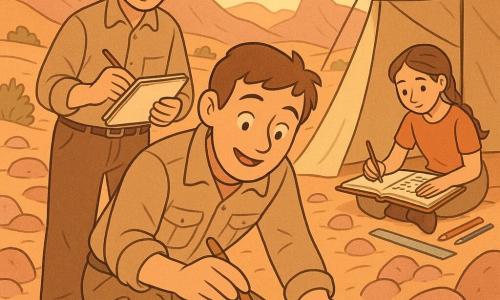
Milo nodded, though his stomach still felt wobbly. The ground in front of him was divided into squares, like a giant checkerboard. Each square had a label: A1, A2, B1, B2. It made Milo feel a little better—like the past could be understood one small piece at a time.
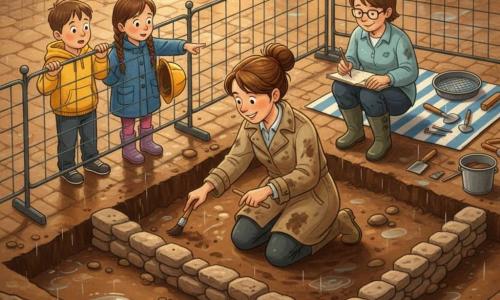
He knelt in square B2 and used a small trowel to shave the soil gently, as if he were spreading butter on toast. Not too thick. Not too fast.
“Remember,” said Lani, another archaeologist, “we don't pull history out of the ground. We let it come to us.”
Milo smiled at that. Then he frowned again, because what if it came to him and he ruined it?
A breeze rolled over the site, smelling of wet earth and pine. Beyond the trees, the lake lay quiet and pale, still mostly frozen. The locals said the ice had started to crack early this year.
Dr. Sayeed checked her notebook. “Tomorrow, we'll visit the lake's edge. The thaw is revealing something.”
Milo looked up. A frozen lake revealing secrets sounded magical.
It also sounded… fragile.
Chapter 2: The Grid of Memories
That evening, Milo sat in the small field cabin with a mug of warm tea and the team's camera on the table. The photos from the day were his job. Milo didn't mind that part—photos didn't crumble in your fingers.
He opened the folder on the laptop: “DIG_SPRING.”
Inside were hundreds of pictures. Dirt. Strings. Tools. Close-ups of soil layers that looked like chocolate cake. Tiny bits of pottery. A dark stain that might be an old fire pit.
Milo worked the way Dr. Sayeed had taught him: steady and organized.
First, he made folders named after the squares: A1, A2, B1, B2, and so on. Then he renamed each photo with the square and the number: “B2_037,” “B2_038.” He added short notes: “edge of stone,” “possible bone fragment,” “soil change near north string.”
Lani leaned over his shoulder. “You're like a librarian for dirt.”
Milo laughed softly. “A librarian wouldn't drop the books.”
“That's why you're good at this,” Lani said. “Rigor matters. If we mix up where something came from, we mix up the story.”
Milo clicked another photo. A tiny piece of carved wood, hardly bigger than his thumbnail, lay on a measuring scale.
He swallowed. “How do you stay calm when you find something important?”
Dr. Sayeed looked up from her notes. “By remembering it's not ours. We're just borrowing it from the ground long enough to learn, then we protect it. We write everything down so others can check our work. That's how we respect the past.”
Milo stared at the screen, at the little carved lines in the wood. A human hand had made those marks long ago. Someone who laughed, got tired, and ate dinner, just like him.
He carefully dragged the photo into the right folder: B2.
One small, correct step.
Outside, the lake ice made a distant popping sound, like a giant cracking its knuckles.
Chapter 3: The Lake That Let Go
In the morning, the team walked toward the lake with backpacks and a calm, serious mood. The sun was bright, but the air still pinched Milo's cheeks.
At the shore, the ice had pulled back in a wide, uneven ring. The water near the edge was dark and glassy. The melting had left a strip of wet mud and stones—and in that strip, something didn't look natural.
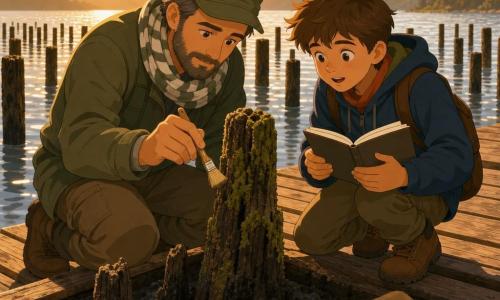
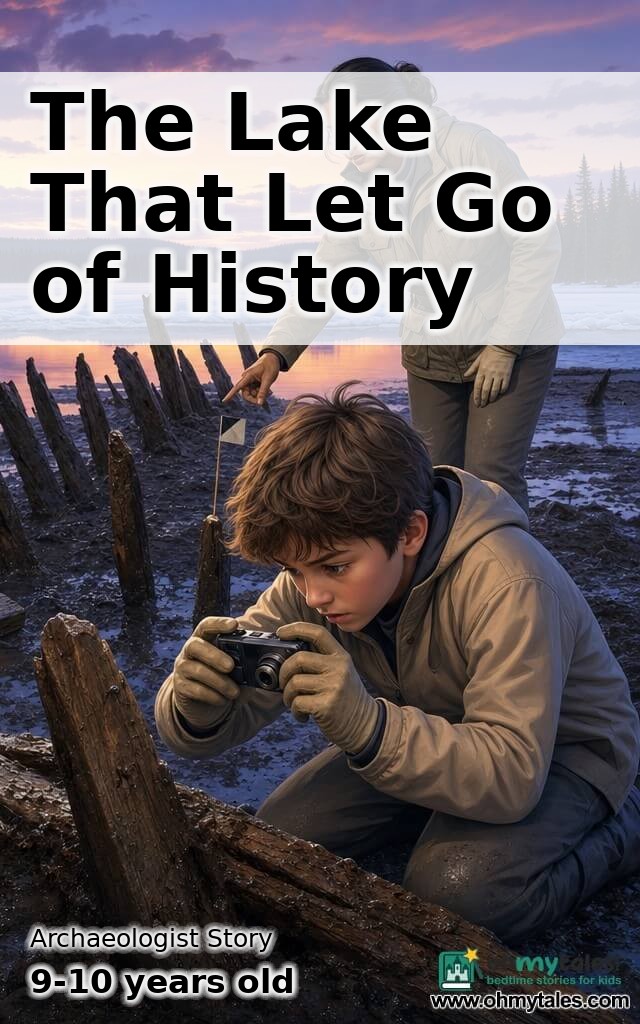
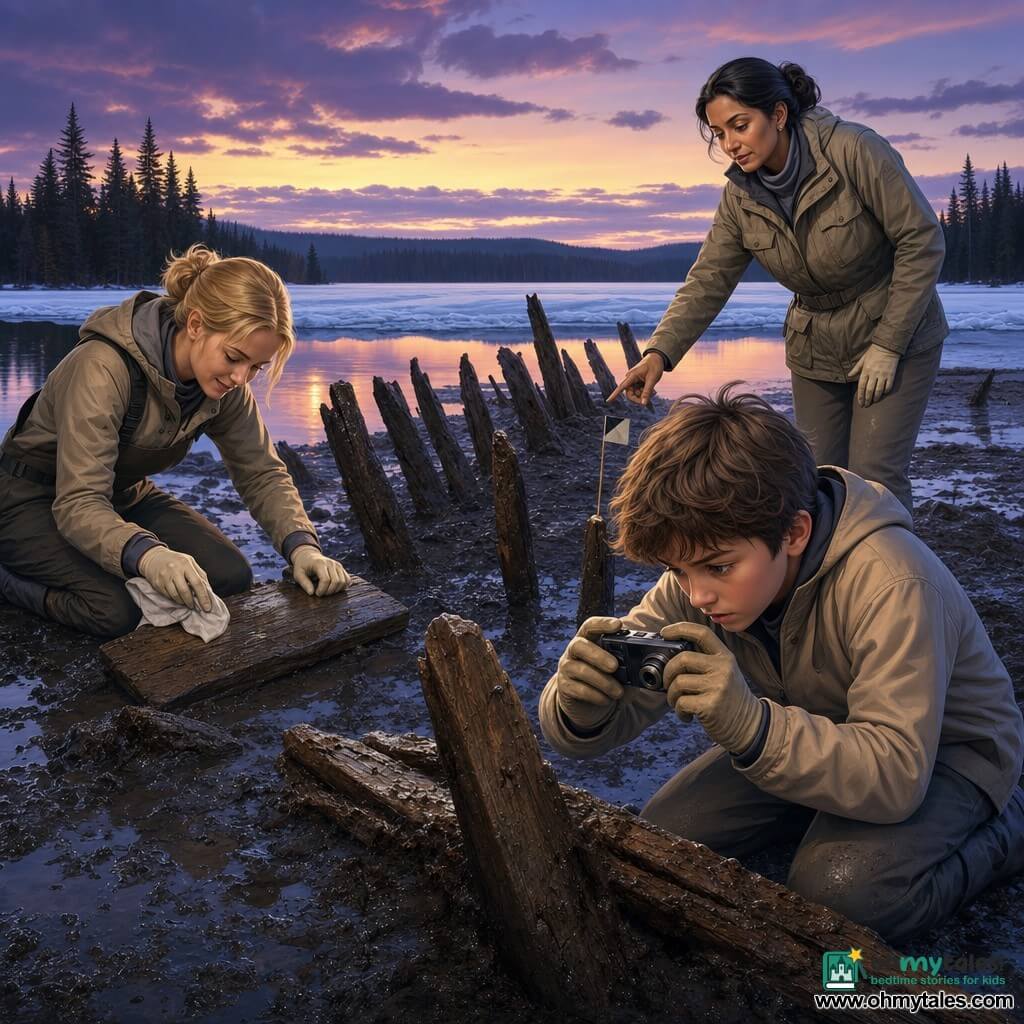
Milo crouched. A line of wooden posts poked out of the mud, tilted like old teeth. Nearby, a flat piece of wood lay half-buried, as if the lake had tried to hide it again.
“Wow,” Milo breathed.
“An ancient lakeshore structure,” Dr. Sayeed said, voice quiet with excitement. “Maybe a walkway, maybe a fishing platform. The thaw revealed it, but the air will start to damage it quickly.”
Milo's fear arrived right on time. Wood that had been underwater for centuries could crack and crumble when it dried. One wrong touch could turn a clue into dust.
His hands hovered uselessly. “What if I ruin it?”
Dr. Sayeed handed him a clipboard. “Then you don't touch first. You record first.”
The team moved like a gentle machine. Lani stretched measuring tape along the line of posts. Dr. Sayeed marked points on a map. Another teammate took wide photos of the whole area.
Milo's job was close-up photos. He stepped carefully, boots sinking a little in the mud. He knelt where Dr. Sayeed pointed.
“Square it,” she said.
They laid a small grid frame over the mud, dividing the area into smaller squares. Even here, on the lake's edge, the checkerboard returned—order against chaos.
Milo took photos square by square, making sure the labels were visible: “L1,” “L2,” “M1.” His camera clicked softly, like a tiny clock counting seconds.
He noticed something lodged beside a post: a round stone with a hole through it.
“A net weight?” Milo whispered.
“Good thinking,” Lani said. “Fishers used stones like that to sink nets.”
Milo felt a warm spark of pride, quickly wrapped in carefulness. He didn't grab it. He photographed it. He drew its position on the map. He watched Dr. Sayeed place a small flag beside it.
“Patience,” she said, as if reading his mind. “First we understand. Then we move, only if we must.”
Milo breathed out slowly. The lake had let go of a secret, but it didn't mean they could snatch it.
They were guests here.
Chapter 4: Saving a Soft Secret
Clouds drifted over the sun, and the wind picked up. Milo's fingers went cold even inside his gloves. The exposed wood looked darker now, wet and shining.
“We need to protect it today,” Dr. Sayeed said. “Not by taking it all away, but by keeping it safe.”
They brought out soft brushes, clean water, and damp cloths. Milo watched as Lani gently cleared mud from the top of a post—no scraping, no poking, just patient brushing as if grooming a sleepy animal.
Milo's heart beat hard when Dr. Sayeed nodded to him. “You can help cover the plank. Slow and steady.”
He knelt beside the flat wood. Up close, it was not smooth. It had faint grooves—maybe tool marks, maybe wear from feet.
Milo whispered, “Hello,” though he wasn't sure why. It felt polite.
He dipped a cloth in water, wrung it so it was damp, and laid it over the plank as gently as a blanket. Another cloth followed, then a sheet of protective wrap on top to keep the moisture in.
“Why keep it wet?” Milo asked, voice small.
“Because it's been wet for a very long time,” Dr. Sayeed answered. “Drying too fast can make it shrink and crack. We slow the change, like helping someone wake up slowly instead of yanking them out of bed.”
Milo nodded. That made sense. The past wasn't a toy you could toss around. It was more like a quiet friend you had to listen to.
They marked everything again—photos, notes, measurements. Milo wrote carefully, pressing the pencil just enough. He checked the labels twice.
Rigor, he reminded himself. The kind of rigor that protects stories.
Before they left, Milo stood at the shore and looked back at the cloth-covered shapes. The lake water lapped softly nearby, as if it approved.
Or as if it was saying, “Be kind.”
Chapter 5: A Promise Under the Evening Sky
That night, Milo sat at the laptop again, cheeks warm from the cabin heater. He uploaded the lake photos and made new folders: “LAKE_L1,” “LAKE_L2,” “LAKE_M1.” He renamed each file and added notes: “post alignment,” “net weight near L2,” “plank with grooves.”
He compared wide shots with close-ups, checking that every square had a matching set. When he finished, the folders looked tidy, like drawers in a well-run workshop.
Lani peeked in. “Still being the librarian?”
Milo grinned. “A librarian who knows where every muddy page belongs.”
Dr. Sayeed sat across from him and sipped tea. “You did good work today.”
Milo hesitated. “I was scared the whole time.”
“That's not a problem,” she said. “Fear can make you rush, but it can also make you careful. You chose careful.”
Milo thought of the plank under its damp cloth blanket, resting safely because nobody had hurried. He thought of the stone weight, still exactly where it had been, waiting for its turn to be studied.
He opened one photo again: the line of posts stretching into the mud, like a path leading into yesterday.
“Archaeology is like listening,” Milo said slowly. “You don't interrupt.”
Dr. Sayeed smiled. “Exactly. And when we share what we learn—with the local community, with museums, with schools—we help people feel connected. The past can teach us how humans solved problems, how they lived with nature, how they cared for each other.”
Outside, the sky turned deep blue. The stars appeared one by one, quiet and patient.
Milo closed the laptop and stepped out for a moment. The lake was mostly dark water now, with a thin rim of ice glowing under the moon.
He breathed in the cold, clean air and felt something settle in his chest—not the fear, but the purpose underneath it.
“I'm going to stay curious my whole life,” Milo whispered to the night, “and careful, too.”
The wind brushed past like a gentle page turning, and the world felt full of stories—waiting to be treated kindly.