Chapter 1: The Square That Hid a Secret
Mara Velasquez liked questions more than quick answers. She liked how a good question could sit in your pocket all day, warm as a pebble, and then suddenly—click!—fit into place.
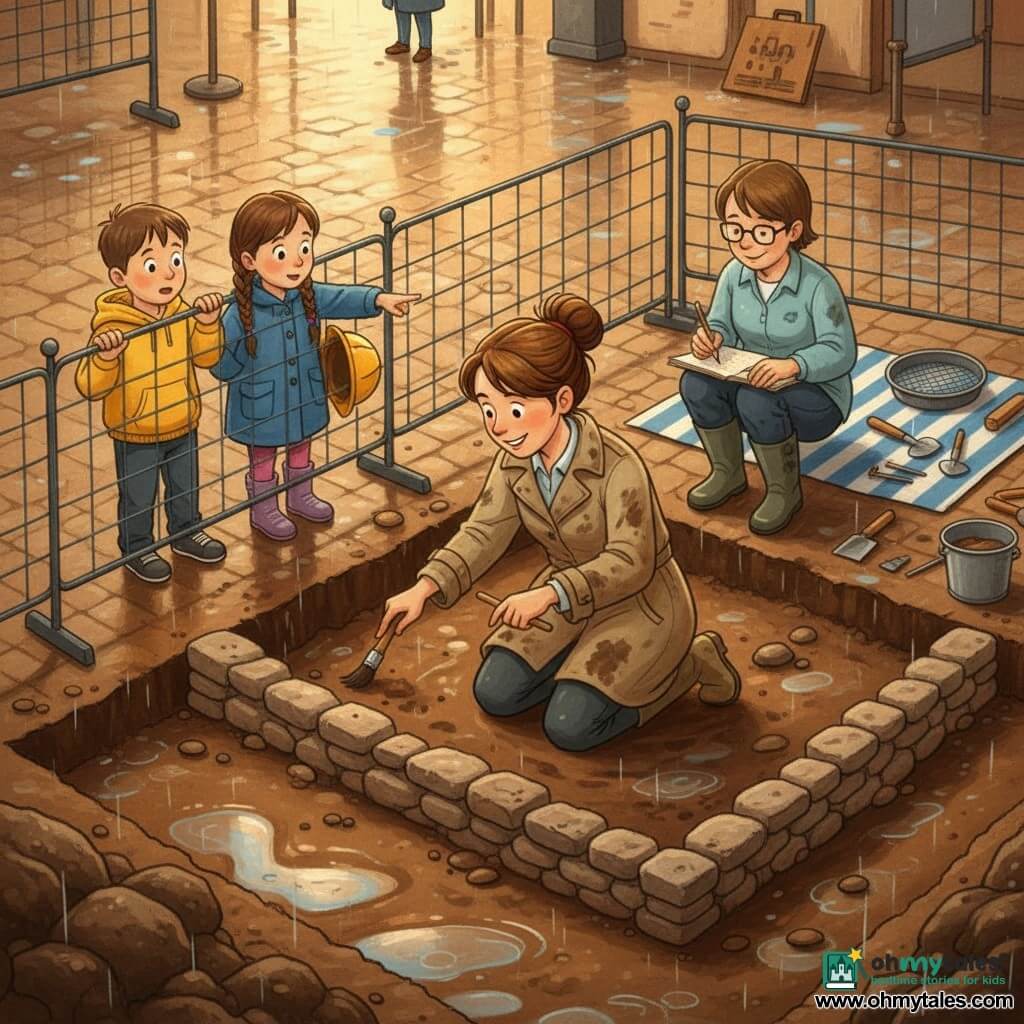
This morning, she stood in the middle of Greystone Square, where people usually bought apples, fed pigeons, and hurried to school. But today the square was fenced off with bright orange barriers, and a careful rectangle of ground had been opened like a window.
Mara was the archaeologist in charge. She wore muddy boots, a soft scarf, and a calm smile that made even worried grown-ups breathe easier.
“Remember,” she told the team, “we're not treasure hunters. We're listeners. The ground is telling a story. We have to hear it correctly.”
Tariq, who took photos, raised his camera. “The ground tells stories?”
“It does,” Mara said. “Just quietly. And sometimes it whispers in broken pieces.”
Beside the trench, a group of children watched from behind the fence, their noses almost pressed to the mesh. A boy called Leo waved.
“My teacher said you might find gold!” Leo shouted.
Mara chuckled. “Gold is possible,” she said, “but not the point. A cracked bowl can be more important than a shiny coin.”
The children blinked, as if she had said broccoli was better than cake.
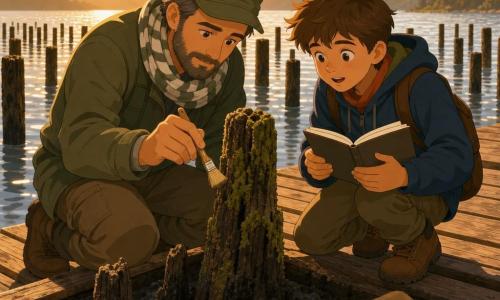
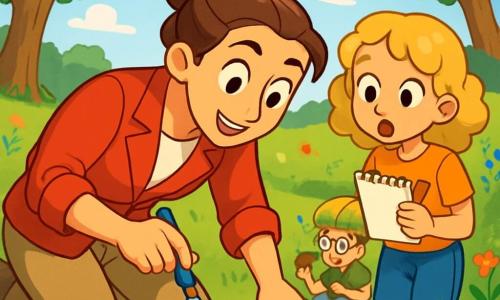
Mara stepped down into the trench. The air smelled like damp soil and old stone. The workers had already removed the top layers carefully, using shovels only at first. Now the delicate work began: trowels, brushes, patience.
Mara knelt and ran her fingers over a line of dark wood stains in the earth. “See this?” she said to her assistant, Nina. “These are postholes. Something stood here.”
“A building?” Nina guessed.
“A big one,” Mara said. “And right under the square. Isn't that a delicious mystery?”
Mara loved that word: mystery. Not the loud kind with car chases. The quiet kind, where you find a clue the size of a fingernail and it changes what you think you know.
Above them, clouds gathered. Mara glanced up. “Rain later,” she murmured, and filed the thought away like a note in a notebook.
Because rain, she knew, could be another kind of clue.
Chapter 2: The Rain That Drew a Map
After lunch, the first raindrops fell—soft at first, then steadier, tapping the barriers and darkening the soil.
Most people would have hurried to cover everything and complain about wet socks. Mara did cover the trench, of course—archaeologists protect what they uncover—but she didn't complain. She watched.
She stood under a small tent with Nina and pointed toward the edge of the excavation. “Look at the water,” Mara said.
Nina leaned out. “It's running downhill.”
“Yes. But look closer. It's choosing paths.”
Tiny streams slid over the soil like shining threads. Some pooled in shallow dips. Some raced along a narrow groove.
Mara's eyes brightened. “That groove wasn't made by our boots,” she said. “It's older. The water is showing us the shape of something hidden.”
Tariq came over, holding a clipboard over his head like a hat. “Mara, we've got puddles forming near the north wall.”
“Exactly where?” Mara asked, already stepping toward it.
They watched a puddle gather, round as a coin, right beside a line of stones. The water seemed to hug that line, as if the stones were guiding it.
Mara crouched. “Stone foundation,” she said. “And the water is telling us where it starts.”
Nina looked impressed. “So rain helps archaeology?”
“Sometimes,” Mara said. “If you pay attention. The site is like a puzzle. Rain can highlight the pieces.”
The storm passed quickly, leaving the square shining. The team carefully removed the protective covers. The soil, now darker, made shapes easier to see—different colors, different textures, faint lines like drawings on old paper.
Mara took out her notebook. She sketched the way the water had flowed, where it had pooled, where it had avoided.
Leo and the other children still waited at the fence, wide-eyed and dripping under their hoods.
“Did you find anything?” Leo asked.
Mara held up a small object in a clear bag. It was a thin piece of greenish metal, bent like a leaf.
Leo squinted. “Is that… treasure?”
Mara smiled. “It's a clue. Maybe part of a clasp from clothing. It tells us people lived here, worked here, walked here. Real people with cold fingers and warm food and stories to tell.”
The children grew quieter, as if the square had turned into a place that deserved whispering.
“Tomorrow,” Mara said, “we might step into a building that hasn't seen daylight for hundreds of years. But we will do it gently. Like opening a book with fragile pages.”
Chapter 3: The Medieval Hall Beneath the Stones
The next day, sunlight returned. The air smelled clean, like rinsed leaves. Mara climbed into the trench, and her heart gave a small, happy jump.
More stones had been uncovered, forming a wide rectangle. At one end, thicker stones curved slightly, like the mouth of a fireplace.
“A hall,” Nina said, voice soft.
“Yes,” Mara answered. “A medieval hall. Under a modern square. Two worlds stacked like pancakes.”
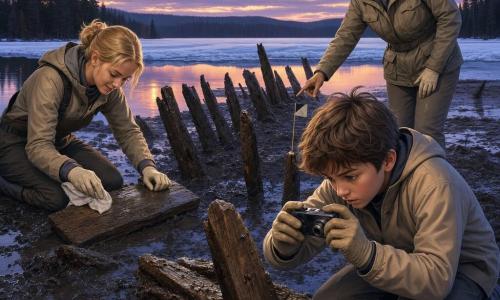
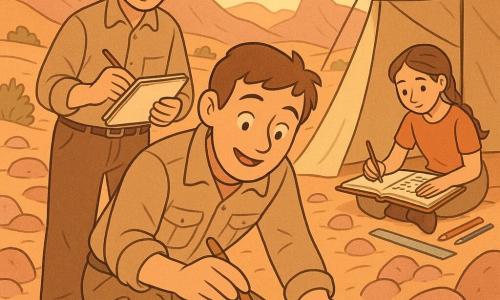
They worked slowly. Someone used a trowel to shave thin layers of soil. Someone else brushed carefully with a soft brush. Tariq took photos from above, and Nina wrote notes: depth, location, soil color, every detail.
Mara reminded the team, “If we take something out of the ground, we take its information too. That's why we record everything. The story matters as much as the object.”
As they uncovered the floor, they found a patch of hard-packed clay, smoother than the surrounding soil. Near it lay bits of charcoal and burnt bone.
“Cooking area?” Nina guessed.
“Or a hearth used for warmth,” Mara said. “Imagine a winter night. People gathered. Someone telling a joke. Someone mending a sleeve.”
Tariq grinned. “Someone complaining that the stew tastes like socks.”
Mara laughed. “Probably.”
In a corner of the hall, Mara spotted a line of small holes. Not big enough for posts, but too neat to be random.
She leaned in. “What are you?” she murmured, as if the holes might answer.
Nina crouched beside her. “Maybe… a rack? For hanging things?”
“Or a screen,” Mara said. “Or something we haven't imagined yet.”
Mara loved that part of archaeology: admitting you didn't know—yet. It wasn't a weakness. It was honesty.
Leo arrived with his class for a planned visit, escorted by their teacher. Everyone wore hard hats that made them look like tiny construction bosses.
Mara greeted them at the fence. “Welcome to the past,” she said.
The children peered down. A girl named Samira raised her hand. “If it's medieval, does that mean knights were here?”
“Maybe,” Mara said. “But knights didn't live everywhere. More often, ordinary people lived here. Cooks, builders, traders, children like you.”
Leo pointed at the fireplace stones. “So this was someone's house?”
“Or a hall used for gatherings,” Mara explained. “A place where people met, ate, talked, and made decisions. Like a community room.”
Samira frowned. “How can you tell what happened if you weren't there?”
Mara tapped her notebook. “We collect clues. We map them. We compare them with other sites. We ask careful questions. And we work together. Archaeology is teamwork.”
She paused, then added, “And we always respect what we find. This is part of everyone's heritage. It doesn't belong to one person. It belongs to all of us.”
The children grew thoughtful. Even Leo stopped hoping for gold, at least for a moment.
Chapter 4: The Puzzle of the Runaway Water
That afternoon, Mara noticed something that didn't match the rest of the hall.
Along the southern edge, the soil was strangely washed, as if water had been sneaking through for a long time. The stones there were darker, and a faint channel ran beside them.
Mara called Nina over. “This doesn't look like a normal floor edge,” she said.
Nina traced the line with her eyes. “Could it be a drain?”
“Maybe,” Mara said. “Or damage from later years. Let's not guess too fast.”
That was Mara's rule: Don't glue the puzzle pieces before you're sure they belong together.
They did what archaeologists do when they face a question: they measured, recorded, and looked for more evidence.
Tariq set a small ruler next to the channel while he photographed it. Nina marked it on the site plan. Mara examined the soil carefully.
She noticed tiny fragments of brick mixed in—different from the medieval stonework. And the channel seemed to lead toward the modern street drain at the edge of the square.
Mara's mind began to weave connections. “I think,” she said slowly, “this hall was partly disturbed when the modern square was built. Rainwater from the street may have been leaking down along this path.”
Nina's eyebrows rose. “So rain has been messing with the site?”
“Yes,” Mara said. “And that means we have a responsibility.”
“Like… fixing it?” Nina asked.
“Protecting it,” Mara corrected gently. “We can't rebuild the past, but we can prevent more harm. We need to tell the city engineers where the water is getting in. Maybe they can redirect it. That way, the hall stays safe.”
Leo, who was still nearby with his class, had been listening. He raised his hand without meaning to, like he was in school.
“So you're kind of like… history doctors?” he asked.
Mara smiled. “That's a wonderful way to put it. We check what's hurting the site, and we try to stop it. Carefully.”
Samira tilted her head. “But you don't keep the things you find, right?”
“Right,” Mara said. “We don't take souvenirs. Objects go to a museum or a safe storage place, with labels so people know where they came from. The important thing is to share what we learn.”
Leo looked disappointed for half a second, then curious again. “So what happens next?”
“We finish recording,” Mara said. “We write reports. We meet with experts. And we tell the story—truthfully, kindly, and clearly—so everyone can understand.”
She glanced at the hall below, the stones quiet in the sun. “Because these people from long ago can still teach us something: how communities worked, how they solved problems, how they lived through storms.”
And storms, Mara thought, always came again—rain on roofs, rain in hearts, rain in cities. Understanding the past could help the present build smarter, safer places.
That felt like responsibility. Heavy, but in a good way. Like holding a lantern.
Chapter 5: A Story Woven for Tomorrow
By evening, the site was covered and secured. Tools were cleaned. Notes were checked twice. The square, once noisy, felt peaceful again.
Mara went home to her small apartment with its shelves of books and jars of pencils. She washed the soil from her hands, but she didn't mind that a little stain stayed under one fingernail. It reminded her of the day's work—patient, careful, real.
She made a cup of warm tea and sat by the window. Outside, streetlights glowed on the modern stones of Greystone Square. People crossed it without knowing what rested beneath.
Mara opened her notebook. She looked at her sketches of water paths and foundation lines. She reread her own words: “Possible drain,” “Later disturbance,” “Hearth area,” “Postholes suggest large hall.”
So many questions still. But the questions didn't make her nervous. They made her feel alive.
She thought of Leo and Samira, their faces pressed close to the fence, their voices softer when they realized the past wasn't just battles and crowns. It was also bread and laughter, muddy shoes, and warm fires.
Mara imagined the medieval hall as it might have been: long wooden beams, a smoky hearth, voices rising and falling like waves. She imagined rain drumming on a roof of wooden shingles. Someone noticing a leak, someone placing a bowl beneath it, someone saying, “We'll fix it tomorrow.”
Tomorrow. That word mattered in archaeology. The work never belonged to one day. It belonged to many days, many hands, many careful decisions.
In bed, Mara lay under her blanket and let her thoughts slow down. She did something she often did after a big day: she wove a story in her mind, like threading beads onto a string.
Not a dramatic story with secret tunnels and cursed jewels. A true story, fair and kind.
A story where the ground was not a hiding place for treasure, but a library.
A story where rain was not an enemy, but a messenger.
A story where a medieval hall under a modern square reminded everyone that cities are made of layers—of work, and hope, and ordinary lives.
Mara pictured herself standing with the children tomorrow, explaining the site again. She would tell them about the careful brushes, the maps, the teamwork. She would tell them about responsibility: how you don't grab and run, you protect and share.
Her breathing grew slow. The questions in her pocket grew warm and quiet.
And with the gentle weight of tomorrow's story waiting to be told, Mara fell asleep.