Chapter One: The Lantern Village
In a small village bent like a willow by a river, the houses kept their secrets in tatami mats and bamboo chests. Every summer, when the moon wore a paper kimono and the air smelled of rice and peppered tea, the village prepared for Obon. Lanterns were made from thin white paper, painted with tiny boats and cranes. They were meant to guide the little drifting memories back home.
Aya lived in a house with sliding doors that sighed in the wind. She was gentle and quiet, the sort of person who listened as if the world were telling stories with its leaves. Her hands were soft from folding paper, and her eyes were patient like salted water. Aya wanted to learn kintsugi—the art of mending broken pottery with gold—because she believed that if she could join broken things, she could join hearts.
One evening, as lanterns bobbed like jellyfish along the river, Aya walked to the shrine where the old woman of the village watched over the offerings. The old woman, Nori, had hair like rice-straw and fingers that moved like falling rain. She kept a box of cracked bowls, each sealed with threads of stories.
“You wish to learn,” Nori said, tapping a bowl with her nail so it sang a small bell-note.
Aya bowed. “My grandmother said every broken thing remembers how it was held. I want to learn how to listen and stitch those memories back.”
Nori smiled, her face creased like a map of small islands. “Kintsugi is patience, child. It teaches humility. You must be ready to speak softly to the cracks.”
That night the lanterns sailed down the river in a slow, shining stream. Aya watched them go and thought of mending—how gold could make a scar beautiful, not hide it. In her chest, a small, warm light opened like a bean sprouting.
Chapter Two: The First Crack
Winter came wrapped in fog and carried a hush. Aya practiced with clay pieces Nori gave her: cups with lips chipped, plates with spiderweb breaks. She mixed lacquer, then powdered gold, and learned to move slowly so the glue would listen. The village would sometimes send a child or an elder with a bowl that meant too much to throw away.
One morning, a lantern boy arrived at Aya's door. His name was Kenji. His family's teapot, passed down through three mothers, had split down the middle during tea. He held the broken pot like it was a bird.
“Can you fix it?” he asked, voice small as a pebble.
Aya felt the pot's history under the glaze—pics of mountains, a small wave. She promised to try. For three days she worked, talking to the porcelain as if it were a person. “Tell me where you hurt,” she would murmur, and the pot would reply with the soft sound of drying clay.
On the fourth day, as she lifted the pot to see her work, a thin hairline crack whispered away from her repair and down the belly of the teapot. Aya's heart dropped. She had been so careful, and yet the pot had another pain.
Kenji stood silent. Tears shone like tiny moons on his cheeks. “It's ruined,” he said.
Aya pressed her palm to the cold porcelain. She could have blamed the lacquer, the varnish, the weather, even the teapot. Instead she said, “No. It is changed. It will tell more stories now.”
Nori visited with a small, folded paper crane. “You cannot force the gold to hide every scar,” she said in a voice like wind through bamboo. “Kintsugi is not about making things perfect. It is about honoring how they have been broken.”
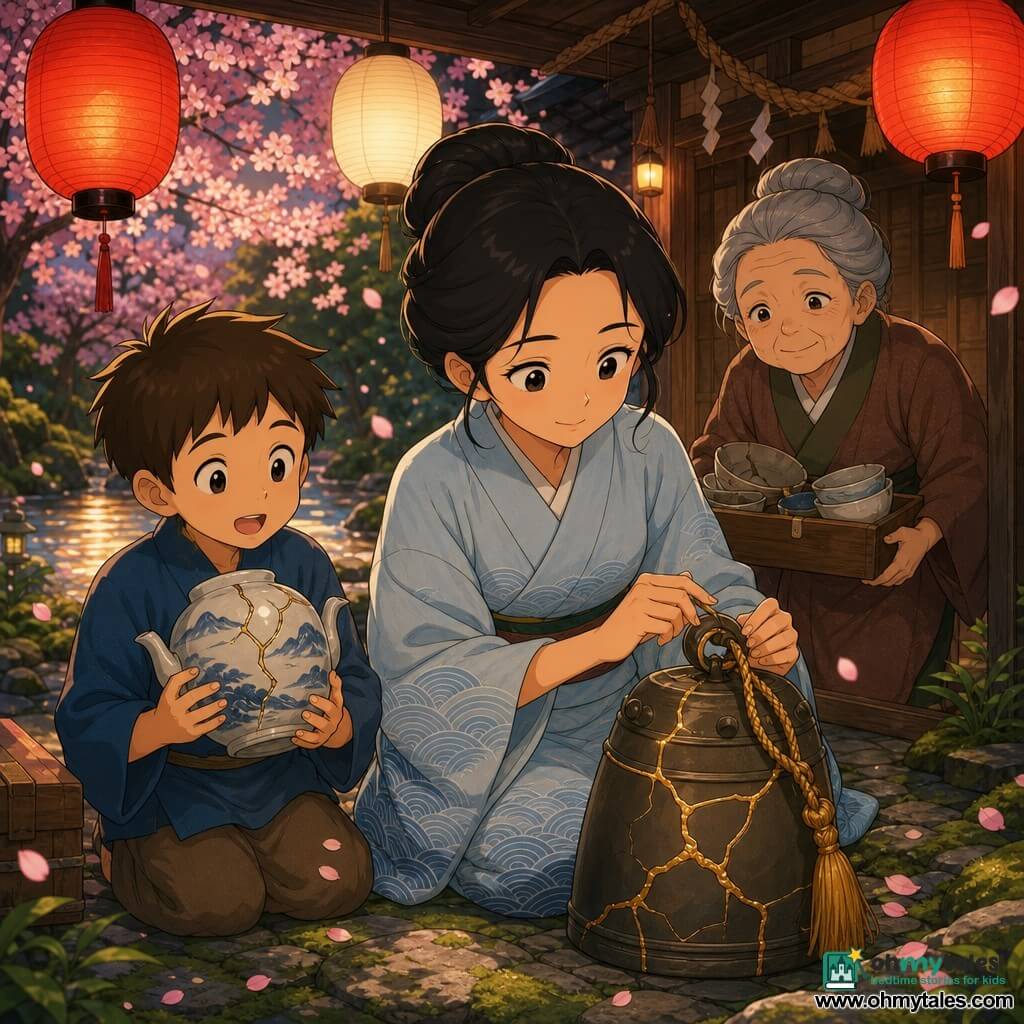
Aya learned to be humble in her hands. Instead of hiding the new crack, she filled it with gold too, letting it catch the light like a river tracing its own banks. When Kenji returned, he cradled the teapot and smiled through surprised tears. “It's like the sea met sun,” he said.
“A sea can be full of storms,” Aya answered, “and still shine.”
Chapter Three: The Key in the Ash
Spring came soft and green. The village burned the old calendars in a small fire to make room for new days. Aya sat with Nori by the ashes. Hidden in that gray bed was a small, iron key, black as a crow but warm from the fire. Nori picked it up and handed it to Aya.
“This key was in an old shrine,” Nori said. “It opens something that has been closed for a long time.”
Aya turned the key over like a moon in her palm. She felt a tug in her ribs, as if the key were a compass pointing toward a closed door in her memory. She remembered a story her grandmother told: that once, when people forgot how to listen to each other, a bell was hidden behind the shrine door so its sound could be kept safe until ears were ready again.
“I will find the door,” Aya promised.
With the key tucked into her kimono, she wandered between rice paddies and cedar trees. Spirits—little white foxes and willow sprites—watched her from the edges of moss. In places where lantern light pooled like honey, small offerings of steamed rice and plum blossoms waited on stones. A river spirit called Kobu followed her with the patter of minnows underfoot, nudging her along.
At the old shrine by the swan pond, Aya found a wooden door swallowed by ivy. It was small, only large enough for secrets, with a rusted lock that sang when the key touched it. The key turned with a sound like tiny bells being released. The door opened onto a tiny room where lantern light and dust mixed into a slow snow.
Inside, the bell sat on a low stand. Its surface was clouded and its rope frayed. Aya touched the bell and felt the echo of laughter, anger, sorrow, and forgiveness folded into its rim. She thought of all the bowls and teapots and hands she had held. Beside the bell was a list of names—villagers who had hurt or been hurt, written in careful, patient strokes.
A voice like wind through paper said, “Why do you come?”
Aya bowed. “To learn how to tie the bell back to the village. Its sound can remind people to listen.”
The bell answered with a memory: a family fighting over a small patch of land, a child storming away with a broken toy, an old woman closing her shutters and refusing lanterns for Obon. Aya understood then that the bell was not only for objects but for hearts. It had been hidden when people used the sound to hurt rather than heal.
She lifted the bell. Its clapper was loose, the rope thin. Aya could have rung it hard and loud, forcing attention. But she remembered Nori's words about humility. So she mended the rope with a thin strip of golden thread she had left over from kintsugi—small, careful stitches, each one a promise to listen.
When she rang the bell, the sound was small and round, like a pebble dropped into a bowl of water. It spread outward, not shouting but nudging—gentle as a hand on a shoulder. Around the village, shutters cracked open, footsteps paused, and the scent of miso and tea thinned. People looked up from their lists and their stubbornness and walked toward the shrine.
Chapter Four: The Golden Seam
The villagers gathered under lantern light as if called by the tide. Aya stood by the bell with the key still warm in her hand. Faces were lined and honest—some shy, some proud, some heavy with apologies they could not yet say. Kenji was there, holding his mended teapot as if it were a child. Nori stood a little behind Aya, smiling like someone who had read the last line of a long book and liked the ending.
Aya spoke softly. “This bell remembers everything we have been,” she said. “It remembers how we have hurt and how we have been healed. Tonight, let us listen.”
One by one people stepped forward. An old man who had refused his brother's invitations for years placed a bowl on the shrine and whispered, “I was proud.” A woman who had hidden a letter under her tatami confessed her fear of saying sorry. A child who had stolen plums returned them with sticky fingers and an earnest look.
Aya touched each broken thing people brought—photographs with tears, a fan with a cracked rib, a small wooden box split in two. She repaired what she could with her gold and her words. For pieces that could not be glued, she tied them with ribbon and set them on the shrine. She did not make the repairs perfect. Instead she celebrated the seams. The gold traced each crack like a river drawn into daylight.
A hush fell. The golden lines glowed under lantern light, not proud but honest, like scars that had turned into maps. Children reached toward the shining seams and giggled. Someone began to hum a tune that had no words, and one by one, people joined until the tune became a chorus that wrapped the village like a warm blanket.
Nori whispered, “You have learned quickly, Aya. Not to hide the break, but to show it kindly.”
Aya thought of the key in her pocket—the small thing that opened more than a door. She gave it to Kenji, for his family needed to unlock a trunk of memories. “Keep it,” she said. “It is a tool, not a prize.”
Kenji bowed. “I will use it well.”
The night felt like a slow breath. Lanterns swam like sleepy moons along the river and spirits drifted close enough to touch with the tip of a sigh. Aya looked at the villagers' faces, soft with new understanding. She realized that humility was not about smallness but about making space—space to admit a mistake, space to say sorry, space to accept help and to give it.
Before the lanterns were carried out to the river, an old woman stepped forward with a small bag. Inside was a broken comb that had belonged to Aya's grandmother. Aya remembered the hands that had braided her hair, the songs that had smelled of citrus and rain.
“You have mended many things tonight,” the woman said. “Now let someone mend yours.”
Aya's hands trembled. She placed the comb on the shrine. When she took it back, the comb's cracks shimmered with gold. “Thank you,” she whispered, and for the first time she admitted to the village and to herself how much she had missed her grandmother's stories.
The lanterns set sail. People walked to the river in pairs and trios, each carrying a small paper light. Aya released hers, and as it drifted away, she thought of the bell's quiet ring and the golden seams that had joined more than pottery.
In the days that followed, the village wound itself with a new rhythm. Arguments were softer; debts of pride were repaid with apologies like coins placed carefully on a shrine. Aya continued to mend, not to fix like a doctor mends a bone, but to make space for the story the object carried. She found small joy in being the quiet seam between people.
One autumn afternoon, as maple leaves like coins fell, a mother brought a basket of broken cups and a child who had thought himself too important to listen. Aya sat with them and began to stitch gold into porcelain. As she worked, the child watched her hands like a map. When she paused, he asked, “Why gold? Why not silver?”
Aya smiled and answered, “Gold does not hide the crack. It lights it. The gold tells us that something was once broken and is now part of our story. We remember that we can be mended, and that remembering makes us kinder.”
The child nodded slowly, learning the shape of humility. It was not a cloak to be worn, but a doorway to step through. Aya looked toward the river where the lanterns sometimes drifted like answered prayers, and she felt a small, steady satisfaction—one that did not boast, but rather whispered that the world was held together, strand by golden strand.
And when evening came, she would sit by the shrine, listen to the bell's low voice, and promise the next person who came to her table that she would meet their cracks with quiet hands and an open heart.