Strings in the Mild Night
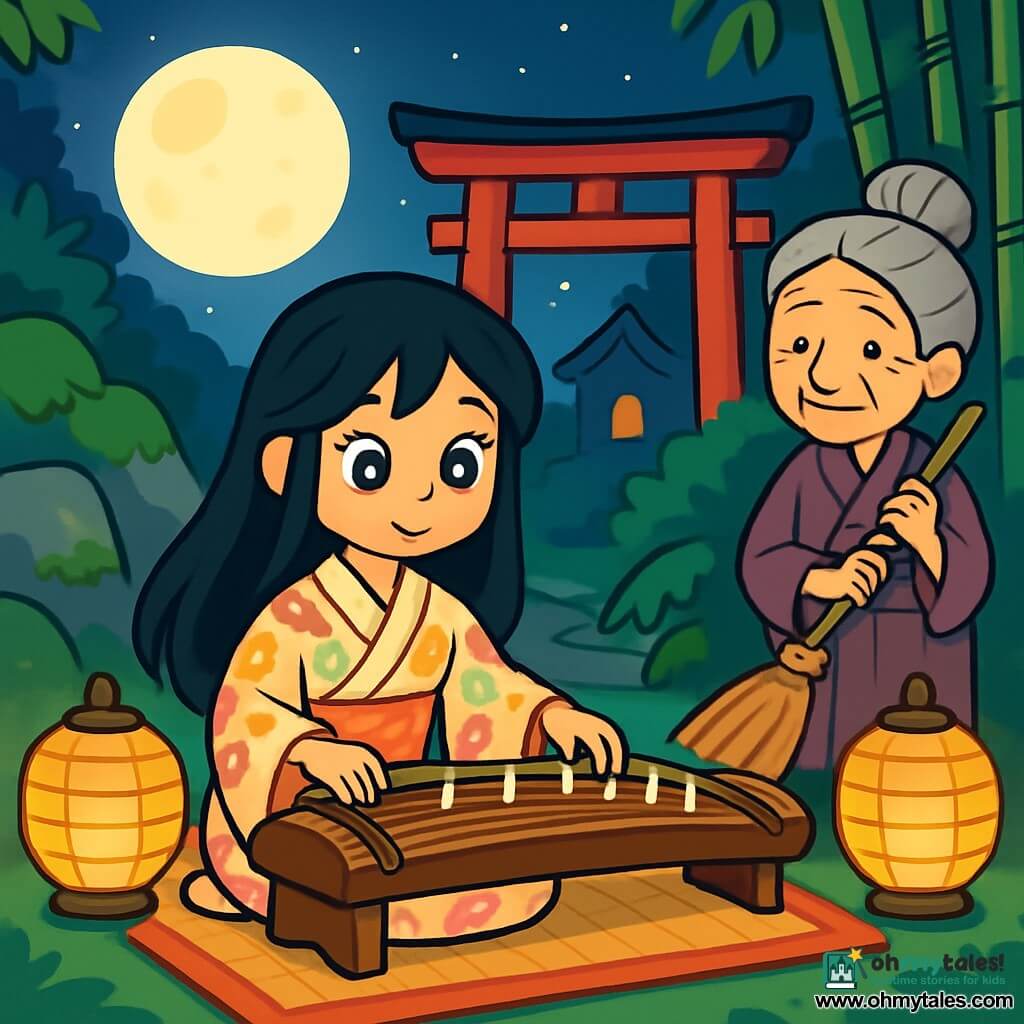
On the edge of a small village, where bamboo leaned like whispering friends and the river combed the pebbles with silver fingers, a young woman named Sayo rested her koto across her lap. Night air, soft as a silk sleeve, brushed her cheeks. When Sayo played, the notes rose like clear water, each one a trembling star.
“Your chords are like moonlight,” said Old Nana, the shrine keeper, as she swept the stone steps. “Maybe the spirits will listen.”
“I hope they do,” Sayo replied, smiling. “I have a wish.”
The village had been restless for a season. Two neighboring hamlets had argued over water and rice bundles. The bowl that sealed alliances, the one used in every peace ceremony for generations, had vanished. Without it, promises felt thin, like paper left in rain.
“They say the bowl was shaped by a potter who listened to winds,” Old Nana told her. “It carries harmony, like a cup holds tea. Without it, words spill.”
Sayo plucked the low strings, and the sound trembled like a distant bell. “I will find it,” she said, her eyes reflecting the lanterns. “I will bring it home.”
A moth circled the flame once, twice, like a tiny priest. The bamboo leaves shivered. Sayo heard a faint note among the notes—a sound like a breath behind her music.
“Follow the quiet between chords,” the night seemed to say.
Sayo tied a red cord around her wrist, the color of sunrises and temple seals. “Then I will listen,” she whispered.
When dawn blushed the clouds, she bowed to Old Nana and passed under the torii, its gate bright as cinnabar. “Come back safe,” called the shrine keeper.
Sayo smiled, brave and gentle at once. “I will, with the bowl,” she promised, and the promise felt as bright as the first note of a song.
Whispers in the Bamboo
The road turned to a narrow path where moss made the stones soft. Sayo walked and listened, holding silence like a cup. Birdsong bubbled, and wind stitched the bamboo stalks together with sighs. She paused at a bend and set her koto on her knees.
She played three clean notes. They rose and melted. In the space between the last one and the next, she thought she heard a tiny voice.
“Help me,” it squeaked.
Sayo followed the whisper until she found a fox caught in a tangle of vine, its golden eyes bright but calm. Its tail twitched, more embarrassed than afraid.
“Well,” Sayo said, kneeling, “vines have poor manners.”
“This one does,” the fox agreed. “I was napping in a patch of sun.”
Sayo freed the fox with quick fingers. The fox shook itself, leafy necklace falling away, and sat with dignity. “Thank you,” it said. “You plucked me free as if I were a knot in your music.”
“I'm searching for the bowl that seals alliances,” Sayo told it. “Do you know where it went?”
The fox tilted its head, ears like two sharp leaves. “I know a secret,” it said. “The thing you seek hides where sound is born without a sound.”
Sayo blinked. “Is that a riddle?”
“Of course,” said the fox, amused. “Listen for a voice that doesn't speak.” It flicked its tail and trotted into the bamboo, vanishing like a thought.
At noon, the sun painted the world in honey. Sayo reached a river, its surface a mirror broken by small, silver tongues. A fallen bridge lay there, half-dragged by the current. On the other side stood a crane, thin as a brushstroke, peering at her.
“I can't fly today,” the crane called softly. “A wind ruffled my feathers the wrong way.”
Sayo looked at the river, heard the fox's riddle, and set down her koto again. She played a note, then listened. Between the note and the next, she heard a lick of hush, and in that hush she noticed the smooth backs of stepping stones, exactly her foot's length apart.
“You are there,” she told the stones, and smiled. With care, she crossed, the river murmuring like a friendly old man. She reached the crane and offered a bow.
“I will remember you,” said the crane, gifting her a pale feather. “If you need me, hold this up where the wind can see.”
Sayo tucked it into the red cord on her wrist. “Thank you,” she replied, and went on, guided by what she heard in the spaces between the notes.
The Mountain's Question
By evening, the path climbed into the mountain's shadow. Pines stood like watchful brothers. The air smelled of cedar tea and cool stones. Sayo found a small shrine that had forgotten its caretaker. Moss curled around the fox statues, and a bell hung silent as a sleeping snail.
She struck the bell gently, and the sound traveled into the trees, round and warm. Then Sayo sat, her koto across her knees, and played a song of water and wind, the way she remembered them from home. The chords moved like slow fish; the quick notes flickered like fireflies.
A mist collected around her ankles and rose, sheet by shining sheet, until a figure stepped from it—tall as a cedar, quiet as snow. The mountain spirit wore a robe of shadows and dawn. Its eyes were two caves filled with stars.
“You play kindly,” the spirit said. Its voice was an old river, smooth from long travel. “Why have you come up where the stones keep secrets?”
Sayo bowed. “Honored spirit, I seek the bowl that seals alliances. Without it, people snap like dry branches.”
“Bonds,” mused the mountain. “Are they not ropes that can make you stumble?”
“They can be if tied too tight,” Sayo agreed. “But if tuned like strings, bonds sing. The bowl does not trap; it gathers. It is a moon's cup that holds light so neighbors can share it.”
The spirit's lips curved, not quite a smile. “Once, I hid a certain bowl,” it said. “I grew tired of noise and big promises that people tossed like pebbles.” It lifted a stone hand. “Behind my ribs is a door. It will open only for many hands, moving as one. If you are patient and true, you will find it. If not, you will find your own echo and nothing more.”
Sayo's heart fluttered, a small bird in a tall tree. “Then I will be patient,” she said. “And I will try.”
“Try as long as you need,” the mountain said, fading to mist again. “Keep your ears open between your notes.”
For three nights, Sayo returned to the shrine. She played under a mild moon that swam in the black river of the sky. She listened for something that wasn't a sound. The forest breathed. A deer's hooves wrote soft commas in the leaves. Sayo slept with her cheek on her koto and woke with dew in her hair.
On the fourth morning, she placed her palm against a rock wall set with a circle of pale stones. She pushed. Nothing. She pulled. Nothing. She sang and felt her voice return to her, like a rolled-up scroll.
“I can't do this alone,” she admitted to the cedar trees. The trees answered with a tremble of needles that sounded almost like applause.
Many Hands, One Heart
Sayo set the crane's feather between two strings and played a quick, bright call that danced up the path. The mountain held the sound gently and passed it along. Down in the bamboo, the fox lifted its head. In the river, fish flicked their tails. In the village, Old Nana paused, broom leaning on her shoulder.
“Listen,” said a farmer, standing by the rice paddies. “It's Sayo's song.”
“Her song is saying please,” Old Nana said thoughtfully. “Let's go.”
A boy who fetched water heard the tune and ran to tell his aunt. A woodcutter rubbed his beard. “I owe Sayo,” he said. “She once found my lost hat in a storm.” He took his tool and followed the path.
By noon, a small crowd gathered by the shrine: villagers carrying lanterns, a pair of fishermen with ropes, the fox with bright eyes, the crane with mended feathers, even a band of fireflies that glowed like floating sparks.
Sayo bowed, surprised and glad. “I needed help,” she said simply.
“You gave it first,” said the fox. “Now it returns, as it should.”
They stood before the circle of pale stones that marked the hidden door. “Many hands,” Sayo murmured, remembering. “Moved as one.”
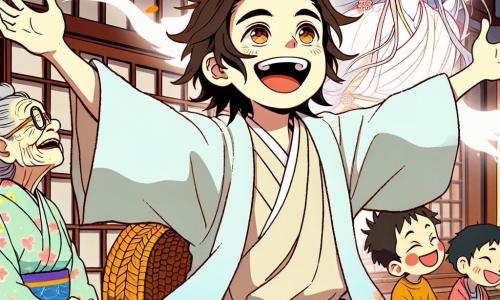
Old Nana placed her palm on a stone. “We move together,” she said. The boy placed his hand next. The woodcutter, the fishermen, the crane's wingtip, the fox's paw, the careful bump of the fireflies—all touched the circle. Sayo pressed the center with her red-corded wrist.
“Now,” said Sayo softly.
They pushed in the same breath, their effort one long, steady note. The stones quivered, then slowly rolled apart with the deep sound of earth yawning awake. Cool air poured out, tasting of clay and old seasons.
Inside, a small room waited, quiet as a held breath. On a pedestal sat a bowl. Its surface was simple, as if the potter had wanted to leave space for everyone's face. A faint rim of blue circled it, like water around an island.
Sayo stepped forward on bare feet. “Hello,” she whispered to the bowl, as if greeting a friend. She lifted it with both hands, and it felt warm, as if it had been keeping its own careful heart.
“Before you carry it,” the mountain spirit's voice hummed from the walls, “wash it in a river that knows many names.”
Sayo looked at the fishermen, and they nodded. Together they bore the bowl down to the river where stones had listened all morning. The villagers formed a line, passing buckets filled with bright water. The crane dipped its beak and sprinkled droplets, while the fox brushed the rim with a sprig of new leaves. Sayo held the bowl steady as faces and hands reflected in it, a soft lantern of skin and sky.
When they finished, the bowl glowed with a quiet that felt like the first snowflake landing on a sleeve. Sayo smiled, and her smile was a lantern too.
The mountain's mist formed into the shape of a nod. “Go,” it said. “Tune your strings; remember what you learned.”
The Bowl Returns
The path home wound through evening. Fireflies floated like small boats across a dark sea. The village had prepared lanterns and hung strands of folded cranes across the shrine gate. The air smelled of grilled rice and pine smoke. When Sayo appeared with the bowl, an exhale swept through the crowd, the release of a held note.
“You did it,” Old Nana murmured, eyes bright with tears that looked like dew. “You carried patience like a lamp.”
“Not alone,” Sayo said. “Never alone.”
They set the bowl on a red cloth, the same color as Sayo's cord. The elders poured sweet tea into it, a gift from the tea fields, and lifted it carefully. “For bridges stronger than pride,” said one elder. “For water shared,” said another. They took a sip, then offered the bowl along.
The fishermen sipped, remembering the river's mood. The farmers sipped, remembering the bowl's weight in many hands. The woodcutter sipped, remembering his hat and the storm and how someone had helped him once. Even the fox lapped delicately, and the crane dipped a beak with great form. Each mouthful felt like a note blending into a song.
Sayo tuned her koto and began to play. Her chords were limpid, like clear springs. They moved through the night, soft and sure, like a cat that knows the way home. Children yawned into sleeves; old men leaned back and let the sound comb their worries like gentle fingers.
She looked at the bowl and thought of the mountain's question. “Bonds can stumble us when we pull too hard,” she said quietly to the children nearby, who watched her hands. “But when we keep them like strings—neither too tight nor too loose—they sing.”
The moon rose big and kind, a rice cake in a black bowl. The bowl of alliances shone like a second moon, smaller and closer. Sayo tied her red cord loosely around its foot, a reminder of how a promise can be kept with room to breathe.
Old Nana sat beside her. “What did you learn, Sayo?” she asked, voice as soft as winter sunlight.
“That even a small hand can knock on a mountain's door,” Sayo said. “And the door opens easier when many hands push. Perseverance is a path, not a wall.”
“And the spirits?” Old Nana asked, a smile hiding in her wrinkles.
“They listen,” Sayo said, plucking a final note that trembled like the last leaf on an autumn branch. “Especially between the notes.”
The night settled like a kind blanket. Crickets stitched their tiny songs across the dark. The bowl rested at the shrine, where tomorrow's sunlight would greet it. Sayo laid her koto across her knees and watched the village breathe in and out, as gentle as a sleeping forest.
“Good night,” she said to the bowl, to the mountain, to the river, to all the small and bright lives around her. The spirits, pleased, walked the paths with quiet feet. And far away, in the highest cedar, the wind kept a promise, humming the tune of many hands and one heart, the song that made a door in stone and led everyone through.