Chapter 1: The Sealed Scrolls and the Quiet Square
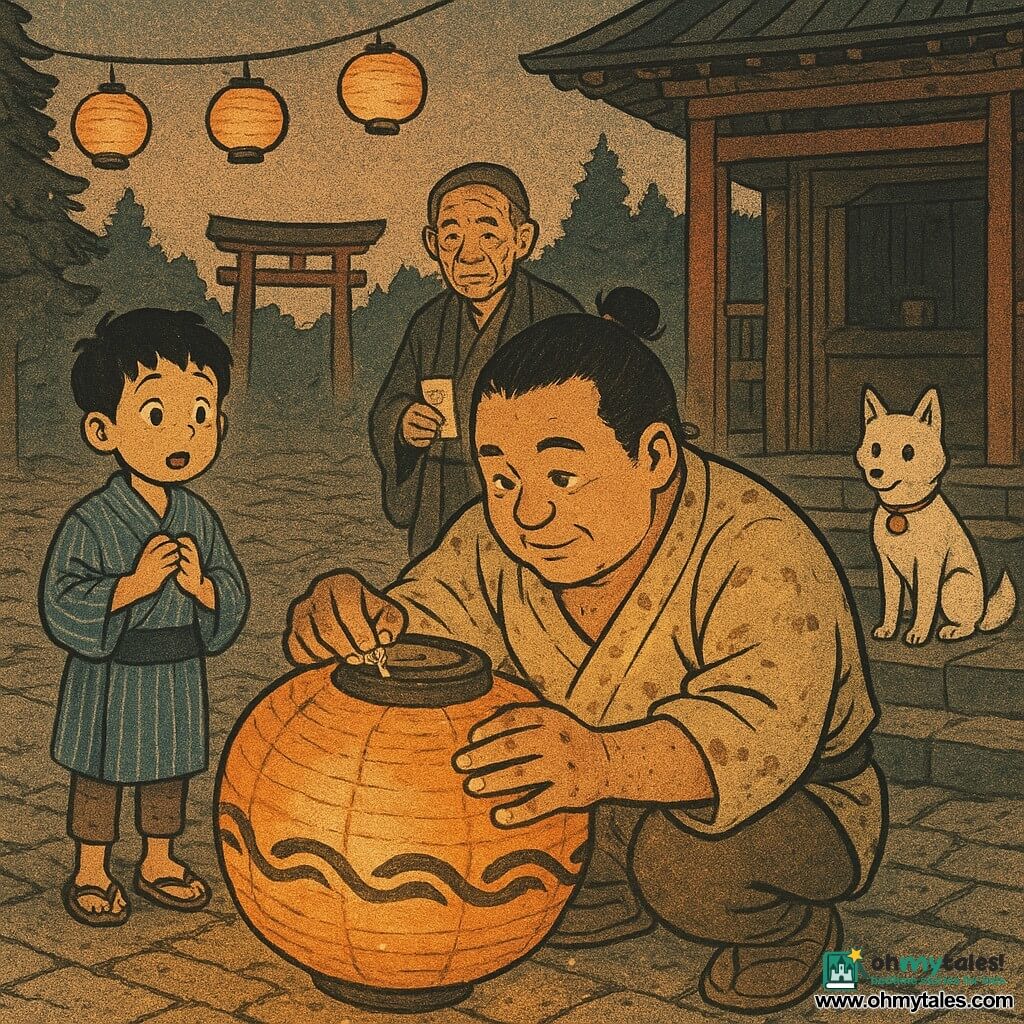
In a town folded between green hills and rice fields that shone like mirrors, there stood a square with a great lantern. It was taller than a grown man, painted the color of persimmons, and banded with black ink-swirls like river currents. On festival nights it glowed like a captured sunset, and even on ordinary evenings it kept the dark from feeling too brave.
But now the lantern was broken.
Its paper skin had torn in a storm, its wooden ribs had cracked, and the light inside—once steady as a grandmother's lullaby—had become a shy wink, then nothing at all. The square felt different without it, as if someone had taken a warm bowl away from winter hands.
Renji, the town's messenger, crossed the square each morning. He was a man with strong calves from walking mountain paths, and a voice that could carry news gently, the way a stream carries leaves. Across his back he wore a box of sealed scrolls: letters tied with string, stamped with red wax seals that looked like tiny moons.
Renji carried news for everyone. Births, apologies, invitations, and “I miss you” messages that were too heavy to trust to the wind. He knew how words could be lanterns, too—lighting up a person's face from the inside.
One dawn, he paused beneath the broken lantern. Above him, the torn paper fluttered like a tired flag.
“We need you,” Renji murmured to it, as if it could hear. “Not just for festivals. For evenings. For children. For old people who don't like the dark creeping in.”
He had no fancy tools, no great workshop. He only had patient hands, a roll of paper, a pot of rice paste, and the stubborn kindness that comes from delivering good news for years and refusing to believe the world must stay dim.
The town elder saw him studying the lantern and said, “Renji, you already carry the town's words. Will you also carry its light?”
Renji bowed. “I will try.”
And when he said try, it sounded like a promise made to the stars.
Chapter 2: Paper, Paste, and Whispering Leaves
Renji began at the shrine at the edge of the square, because old things liked being greeted properly. The shrine's torii gate stood like a red doorway into silence. He washed his hands, rinsed his mouth, and offered a small coin. Then he stood very still.
A breeze slid through the cedar trees. Leaves shivered, and the air smelled of moss and rain. Renji did not hear words exactly, but he felt a gentle pressure, like someone placing a warm palm on his shoulder.
“Thank you,” he whispered anyway. “For watching over our town.”
He went to work.
He measured the ribs and replaced the cracked ones with thin bamboo, smooth and pale as moonlight. He patched the frame with twine, knotting it carefully, as if each knot were a small prayer.
For the lantern's skin he chose strong paper, not too thick, not too thin—paper that could breathe and glow. He brushed rice paste in soft strokes and laid the paper down, smoothing it like a blanket over a sleeping child. The torn edges he overlapped with extra strips, because resilience, he believed, was not pretending you never tore. It was learning how to hold yourself together again.
All day he worked, while people passed through the square with baskets and sandals and giggles. Some stopped to watch.
A boy asked, “Renji, why fix it yourself? Why not wait for a lantern maker from the city?”
Renji smiled. “If we wait for every solution to arrive on someone else's feet, we forget our own legs.”
The boy looked at Renji's legs and laughed. “Your legs are famous.”
“Then they can carry this job, too,” Renji said.
As evening settled, Renji climbed down from his ladder. The lantern was not finished, but it stood straighter. It looked less like a wounded thing and more like a warrior resting.
Renji packed his tools and lifted his scroll box. The seals inside clicked softly, like little teeth. He started toward home, and the dark followed at a polite distance, as if waiting to see what he would do.
Halfway across the square, the wind changed.
It did not blow hard. It breathed.
And with that breath came a sound like paper being folded by invisible hands.
Renji turned. On the shrine steps, a small figure sat as quietly as a pebble: a fox, white as rice, with eyes like two drops of night. Around its neck hung a tiny bell that did not ring, but seemed to remember ringing.
The fox stared at Renji as if it had been expecting him for a long time.
Then it stood, bowed—yes, bowed—and padded away, its tail painting a white comma in the air.
Renji's skin prickled.
In Japan, everyone knew: when a fox bowed, the world was about to write a new line.
Chapter 3: The Gods' Test on the Mountain Path
The next morning Renji set out to gather more bamboo from the hillside grove. His scroll box was lighter today—only one letter remained, sealed with wax the color of plum blossoms. It was addressed to the shrine keeper, a simple thank-you note from a traveler who had been given shelter during a storm.
Renji liked carrying thank-you letters. They felt like warm chestnuts in his hands.
The mountain path curled upward, a brown ribbon stitched through green. Sunlight fell in patches, and each patch felt like a blessing you could step into.
Soon Renji heard footsteps behind him. He looked back.
An old man climbed the path with surprising speed. His robe was plain, his sandals worn, and he leaned on a walking stick carved with swirling clouds. His face was wrinkled like dried persimmons—sweetness hidden in folds.
“Good morning,” the old man said.
“Good morning,” Renji replied, bowing.
The old man nodded toward Renji's box. “A messenger.”
“Yes. I carry sealed scrolls.”
“And the lantern?” the old man asked, as if the lantern were also a person Renji delivered.
“I am repairing it,” Renji said. “It broke in the storm.”
The old man hummed. “A storm breaks many things. Some are easy to mend. Others”—he tapped his stick against a stone—“are not.”
Renji kept walking. The old man kept pace, though his steps made no sound.
After a while they reached a place where the path split. One way led to the bamboo grove. The other led to a small clearing with a stone basin and a single pine tree that leaned as if listening to the earth.
The old man pointed to the clearing. “Sit with me.”
Renji hesitated. He wanted to finish the lantern soon. He wanted the square to glow again. But something in the air felt like a held breath, and he knew some moments should not be hurried.
They sat beneath the pine.
The old man looked up at the branches, then at Renji. “Why do you want the lantern lit again?”
“So children can walk without fear,” Renji said. “So elders can see their steps. So the town feels… held.”
The old man's eyes glittered. “A noble answer.”
Renji added, quieter, “And because when it went dark, it felt like we had forgotten something.”
The old man smiled as if that was the true key. He reached into his sleeve and took out a tiny sealed scroll, no longer than Renji's finger. The wax seal was not red, but gold, shining like a drop of sunlight caught and cooled.
“Deliver this,” the old man said. “To the great lantern.”
Renji blinked. “To the lantern?”
“Yes,” the old man said simply. “When it is repaired, place this inside. But do not open it. Do not show it. Do not lose it.”
Renji accepted the scroll carefully. It was warm.
A laugh came from somewhere—high and bright, like wind chimes. Renji glanced around, but saw only leaves and shadow.
“Who are you?” Renji asked.
The old man's smile widened. For a moment, his face seemed to change, like mist taking different shapes. Renji thought he saw a river, a mountain, a fox's white tail, and a moon all at once.
“A traveler,” the old man said. “And perhaps… a question.”
Then the old man stood. The pine needles above them rustled without wind.
“One more thing,” the old man added. “This is a test.”
Renji swallowed. “A test from whom?”
The old man tapped his stick again. The sound rang like a bell struck in the bones of the mountain.
“From those who watch over lanterns,” he said. “From those who watch over hearts.”
Before Renji could speak, the old man stepped behind the pine tree.
And vanished.
Renji stared at the empty space. He walked around the tree. Nothing. Not even footprints.
He held the tiny golden-sealed scroll in his palm. It pulsed with quiet importance.
Renji's mouth felt dry, but his spine felt straighter. Whatever this was, it had chosen him.
He bowed to the pine tree anyway. “I will do my best.”
And he continued up the path, the forest watching like a thousand patient eyes.
Chapter 4: The Night of Wind, Doubt, and a Fox's Bell
By late afternoon, Renji returned with bamboo and a mind full of questions. He worked until his shoulders ached and his fingers were sticky with paste. The lantern's new paper skin dried smooth and clean, ready to glow.
Only the light remained.
The lantern had always been lit with a simple flame protected inside a glass chamber. But after the storm, the chamber had cracked, and the wick holder was bent. Renji replaced them carefully. Still, when he tried to light it, the flame trembled like a frightened rabbit and died.
Again and again he tried. Again and again—dark.
The square grew quiet as people went home. The sky turned the color of ink washed thin. A few early stars appeared, cautious as shy guests.
Renji sat on the lantern's wooden base, staring at his hands. For the first time, the thought came like a cold drop down his back:
What if I cannot fix it?
He imagined the town walking in shadows for months. He imagined children holding their breath. He imagined the festival coming with no great glow, like a song without a chorus.
His scroll box sat beside him. The seals inside were silent. Even good news felt heavy when you didn't believe in tomorrow's light.
Renji took out the thank-you letter for the shrine keeper and held it against his chest. He remembered the traveler who wrote it—soaked, shaking, yet grateful. Renji had seen that before: people could be broken and still offer warmth.
Resilience, he thought, was not a shout. It was a candle you protected with your hands.
Wind slipped into the square. The broken-lantern darkness moved closer, curious.
Then a small bell rang.
Just once.
Renji looked up.
The white fox sat on the shrine steps again. This time its bell truly chimed, and the sound was like a tiny drop of silver falling into a pond. The fox tilted its head, then looked toward the lantern, then back at Renji, as if saying, Well? Are you going to stand there all night?
Renji almost laughed. Almost.
The fox rose and padded into the square. It stopped beneath the lantern and looked up, its eyes reflecting starlight. Then it jumped lightly onto the lantern's base, sniffed around, and pawed at a small wooden panel Renji had not noticed before. The panel shifted, revealing a hidden compartment inside the lantern's body.
Renji stood. “There's a compartment?”
The fox blinked slowly, the way an old teacher blinks when a student finally understands something obvious. It nudged the compartment with its nose.
Renji remembered the old man's golden-sealed scroll.
His fingers trembled as he took it out. The fox watched, still as a statue.
“Do not open it,” Renji whispered, repeating the instruction. “Do not show it. Do not lose it.”
He slid the tiny scroll into the compartment.
At first, nothing happened.
Then the air around the lantern changed. It did not grow warmer, exactly. It grew more awake. The shadows loosened their grip, as if the square had inhaled.
Renji struck the flint and lit the wick again.
This time the flame caught—small but steady. It did not tremble. It stood like a brave soldier guarding a gate.
The lantern began to glow.
Not blazing, not harsh. A soft amber light spread through the paper skin, turning it into a gentle sun that had decided to live among people. The persimmon paint deepened, the ink swirls looked like dancing rivers, and the square's stones shimmered as if they had been waiting all day to be seen.
Renji let out a long breath he hadn't known he was holding.
The fox's bell chimed again—two light notes, like laughter that didn't want to wake anyone.
Then the fox jumped down, circled once, and disappeared into the dark as neatly as a thought slipping back into a dream.
Chapter 5: Light Carried Forward
News travels faster when it is good.
Even before dawn, someone saw the lantern glowing and woke a neighbor. A neighbor woke another neighbor. Soon the square filled with slippers, sleepy eyes, and delighted whispers.
“It's lit!”
“It's really lit!”
Children spun in circles under the warm glow. An old woman held out her hands as if the light were something you could catch like falling snow. The town elder approached Renji and bowed low.
“You repaired more than paper and wood,” the elder said. “You repaired our courage.”
Renji rubbed the back of his neck. “It was… not only me.”
He thought of the old man's gold seal and the fox's ringing bell. He thought of the shrine's quiet watching. He did not know the true names of what had helped him. But he felt their kindness like invisible lanterns along a road.
The shrine keeper arrived and received the thank-you letter. He read it under the lantern's glow, and his eyes softened.
“Words are light,” the shrine keeper said.
Renji nodded. “And light is a kind of word.”
That evening, after his deliveries were done, Renji returned to the lantern alone. He sat beneath it and listened. The night insects sang. The wind moved gently, careful not to disturb the flame.
Renji touched the lantern's wooden base, feeling the steady warmth above. The world still had storms. Paper would tear again someday. Wood would crack. Hearts would bend.
But the lantern glowed anyway.
Renji understood something simple and strong: resilience was not being unbreakable. It was being willing to mend, again and again, with patience, with help, and with hope tucked safely inside—like a sealed scroll waiting in a hidden compartment.
Above him the lantern shone, and the square looked like a little island of peace in the wide, mysterious sea of night.
Renji closed his eyes. The light painted his eyelids gold.
Somewhere, very faintly, a bell chimed once more, and the darkness, politely, kept its distance.