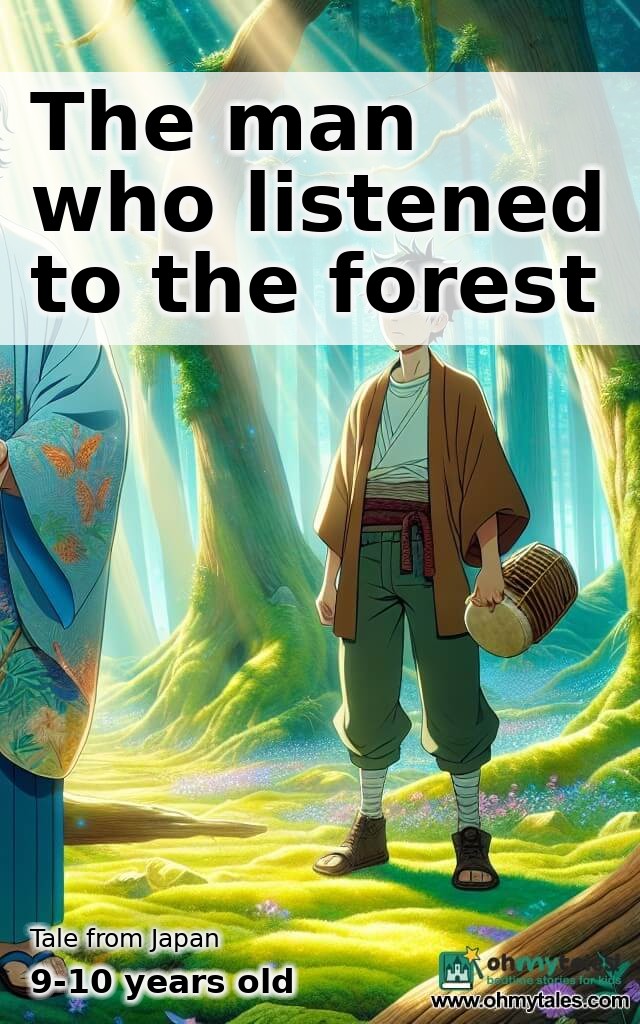
The Watchful Man by the Pine
In a small village folded like a paper crane at the foot of a great green hill lived a man named Takumi. He was an ordinary man who made special things: simple ladles carved from maple, rope baskets braided like braided rivers, and wooden masks that caught the sun on their smiles. Takumi moved slowly as if his hands remembered the speed of seasons. He learned by watching—how the crane rested on one leg, how the children listened to their grandmother's stories, how the moon tilted its straw hat on the rice fields. The village learned by watching too. They learned to greet the morning, to sweep the paths, and to leave a tiny pile of rice at the shrine gate as thanks for small kindnesses.
Beyond the fields, the forest breathed with its own counting of years. The trees kept secrets like old books, and sometimes they exhaled a sigh that smelled of moss and rain. The people spoke of the forest with soft voices, for the forest was home to a kami, a spirit that watched over the trees and the water. Long ago, the villagers hung little paper wishes from the branches and tied thin strips of white to a torii gate to say thank you for the sky's rain, for the foxes that pranced the rice, for the cool shade in hot summers. Takumi, who respected all old things, answered the forest's coughs with bowls of steamed rice and a soft song hummed beneath his breath.
But lately the village's sleep had been thin. Mist came earlier, like the breath of a sleeping giant, and leaves shivered though no wind moved them. Rice turned pale at the edges. The family dogs lifted their heads and howled at nothing. Takumi felt the change in the way a pot feels heat—slow, inevitable. He had a secret dream he kept like a tucked coin in his pocket: he wanted to soothe the forest spirit, to lay a hand on the sore place of the woods and see the village breathe easy again. That dream was not loud. It simmered in him like a kettle, warming everything around it.
Each morning he walked to the old torii, a wooden gate half swallowed by ivy. He bowed, left a grain of rice, and wiped his palms on his apron to show thanks. He copied the way the elders bowed, how the child ran a thumb along the gate's old paint. He practiced listening—listening not just with his ears but with his feet and fingers and eyes. In the quiet, Takumi began to hear a different sound: the forest's sorrow, threaded like a thin song through the trees. He promised the forest, in the small, certain language of gratitude, that he would try to soothe the sorrow, not by driving it away but by meeting it with thanks and care.
The Loud Promise
One bright morning, when the clouds looked like boiled rice gliding in the sky, a stranger came to the village. He rode with quick steps and brighter speech, a young man named Haruto who carried maps and plans in the folds of his coat. Haruto had not grown up with the hush of old torii or the slow lessons of the elders. He saw things in straight lines: a problem had a tool, and a noisy tool could fix many things. When he saw the mist and the pale rice, he clenched his hands and declared that the forest spirit must be scared away or chained with new rules.
He called a meeting in the square. He spoke with a voice like a bell cracked but loud. "We will chase away the spirit," he said. "We will clear the deep trees, build a lamp to keep it scared, and no more mischief." Many villagers nodded. Fear makes decisions quick like a fox. Some thought it would be easier to fix their troubles with a single bright stroke.
Takumi listened. He felt a small stone roll inside his chest. He tried to explain to the village how gratitude worked: watching, thanking, small mending that taught hands how to care. "The forest remembers our kindness," he said softly. "If we learn to say thank you again, the spirit may stop hurting." But his words were leaves in the wind beside Haruto's drumbeat.
Haruto, eager to prove he could solve the problem, marched to the edge of the forest with bright banners and a handful of villagers. He began to hammer stakes and set up loud lanterns and drums to scare what he called the "trouble-maker" away. The drums boomed like thunder made of wood. Takumi stood a little distance back, his palms folded as if cupped over a small flame. He watched the drums wake the forest. The old trees answered with a low rumble, and the mist gathered like a crowd of ghosts. Something in the underbrush twitched and scolded. The spirit, woken in alarm, slid like a cold shadow between the trunks and stirred the roots with its restless feet.
That night the rain came heavier, pounding the village roofs in a steady, impatient drum. The villagers murmured in fear. Takumi realized that rushing at the spirit was not like mending a cracked bowl with gentle glue—it was like pouring boiling water on a frostbitten hand. He tucked his secret dream deeper, and decided he would go into the forest alone. He would not wrestle the spirit with drums. He would listen, like the old willow, and show it the simple language of thanks.
The Heart of the Forest
Takumi prepared in quiet ways. He braided thin ribbons from straw, cooked a small portion of rice with three salt grains, and borrowed a worn bell from the shrine that rang like a tiny sunbeam. He tied on his coat and walked where the path thinned and the trees leaned like old storytellers. The deeper forest was a cathedral of green—light fell through the leaves in strips, and moss softened each step into a hush.
He followed the signs of the spirit: a circle of mushrooms arranged like a crown, a tree whose bark had a crescent-shaped scar, the faint echo of a child's laughter that belonged to no child. Takumi bowed to each sign, whispering his thanks. He set a small bowl of rice before a young cedar and left a strip of cloth on a limb. He imitated the wind's slow cadence with his own breaths, as if saying, "I know you, and I thank you."
Soon he came upon a small clearing where the torii had once stood strong. Now it leaned at an angle, rope frayed, and a stone lantern had been tipped by careless feet. The earth around it sighed as if tired. Takumi knelt and ran his fingers through the moss. He found tiny holes where roots had been cut, and plastic twine tangled around an oak's ankle like a mean belt. His heart ached, not from anger but from a gentle sorrow. The spirit had not been angry at the village for no reason; it had been wounded by forgetfulness, by things taken and not thanked for, by the breaking of small promises.
He called softly, in the old manner, and rang the small bell. The sound was a clean pebble dropped into a deep pool. From the black shadows stepped a shape like a tree with a face, like smoke with eyes. The spirit was not large. It was the size of a man's sorrow, and its voice sounded like a creek under ice. It watched Takumi with cautious, ancient eyes.
At that moment, Haruto burst into the clearing, blowing his whistle and pounding his drum. His arrival was like a wind that scatters papers. "Leave!" he shouted. "We will force it away, and the village will be safe!" The spirit, startled and shaking, stirred the leaves into a whirl. Birds fled. Takumi stepped forward between Haruto and the spirit. This was the important turning of the tale: a choice between force and patience.
The Quiet Offering
The spirit swelled into a sigh that made Takumi's hair lift like grass. It had been hurt and frightened. It moved as if to lash at the village with a cold breath, and Haruto, feeling brave with his drum, urged it on without knowing the language of apology. The wind carried dust and the sound of broken shells from rooftops. Takumi thought of the old torii and the pieces of spirit tied up in the roots. He thought of the rice bowls placed in gratitude, of the small mending of hands.
He set down his basket and folded his hands. Not a single person in the clearing moved. Takumi breathed slowly and began to speak, not loud but with each word wrapped like a gift. He thanked the spirit: for the shade in summer, for the wild herbs that had saved a sick child, for the fox that had guided a lost elder back to the path. He apologized for the times the villagers had taken wood without asking and for the plastic twine that had hurt the roots. He spoke of small things—how a child's laugh was a treasure, how the rain was a blessing—and he offered the spirit his mended tools, a new rope for the torii, and the bowl of rice, salted and bright.
Haruto paused. He had never heard thanks said like that—careful, precise, a string of little lights. The spirit listened. Its eyes, once full of cold stars, softened. It breathed in the rice's warm smell and tasted the thread of apology. Takumi did not demand the spirit's forgiveness like a coin; he showed gratitude for what the forest had done before and promised to keep learning to give thanks. He imitated the fox's small steps and the rustle of fallen leaves until the spirit's breath slowed into a small river.
In that hush, Haruto felt something shift. His chest, tight with certainty, loosened like a knot being untied. He looked at the tipped lantern, at the rope he had ripped down in his rush, and his face, which had been proud and bright, reddened with a new feeling—shame softened by a wish to mend. He walked to Takumi and offered his own hand with a quiet bow. "Show me," he said. "Teach me how to thank."
The spirit touched Takumi's palm like a mist and left a faint warmth in his hand, like the memory of sunlight. It did not vanish, nor did it roar away. It sighed and moved back into the trees, smaller and quieter, as if learning again how to live with the villagers.
The Year of Many Thanks
When Takumi and Haruto returned, they did not march into the village as conquerors. They walked slowly, carrying the new rope and the mended tools, their pockets full of small seeds to plant. They showed the elders what had been done and how to braid rope by watching and imitating Takumi's hands. Children came to see the torii being righted, and the old women taught them the songs of the shrine, songs that folded thanks into rhythm like fingers into a basket.
From that year forward, the village learned a different way to live. They placed small bowls of rice on the shrine each evening and left a note of thanks—tiny calligrams tied to branches like bright fish. People learned to speak to the plants, to apologize when they took, to thank when they received, and to choose mending over breaking. Haruto learned to sit with silence sometimes, and the drums were played now only for festivals, their boom used to celebrate, not to chase shadows. The spirit of the forest visited in quiet hours, and when it passed, it left behind leaves arranged in pleasant patterns, like laughter drawn on the ground.
Seasons turned in the village like pages of a gentle book. Spring painted the fields with green calligraphy, summer bent the rice like murmured secrets, autumn scattered orange coins, and winter taught the village how to watch for small kindnesses. Takumi taught by doing; people copied his patience and turned it into habit. He taught that learning comes from observing, from imitating the careful ways of elder trees, and from thanking each small thing as if it were a bright bird feeding your hand.
At night, when children were tucked under quilts that smelled of cedar, parents told the story of the man who learned the language of thanks and the young rival who changed his drum into a lullaby. They said the forest kept listening, and if you stand very still, you might hear it answer with the rustle of a thousand tiny thank-yous. The moral wrapped itself around the village like a warm shawl: gratitude is not a single word but a long, patient song sung with hands, with bread, with mended rope, and with the steady beating of quiet hearts.