Chapter 1: The Girl Who Listened to Stones
High above the clouds, where the Andes wore snow like white crowns, the city of Cusco glimmered with gold and shadow. Terraces climbed the mountainsides in neat green steps, and stone walls fit together so perfectly that even a blade of grass couldn't squeeze between them.
Killa ran her fingertips along one of those walls as she hurried through a narrow street. The stones felt cool, but underneath, they thrummed—soft as a drumbeat heard through water.
“Don't look at the walls like they're going to talk back,” teased Mayu, her friend, jogging beside her with a bundle of dyed yarn under one arm. “People will think you're odd.”
Killa's mouth twitched. “They do talk back,” she murmured. “Just… not in words.”
Mayu snorted. “Then ask them where my missing sandal went.”
Killa almost laughed, but the humming in the stones changed. It tightened, like a song pulling its belt too hard. A shiver crawled up her neck.
They passed a courtyard where a small fountain spilled into a basin. The water was supposed to sing. Today it sounded like it was arguing with itself.
Killa's secret was not the kind you boasted about, not even to your best friend. She didn't want gold. She didn't want fame. She didn't even want to weave the finest cloth in the empire.
She wanted peace for spirits.
Not the tidy kind adults spoke of—no, this was older. The kind that belonged to mountains, rivers, forgotten warriors, and the quiet dead. Lately, the air around Cusco felt crowded, as if unseen feet paced the rooftops at night.
A voice, thin as a reed, brushed her ear.
Girl-of-the-listening-hands…
Killa froze. Mayu kept walking, then turned back. “What now? Did a wall insult you?”
Killa swallowed. “No. I—”
The fountain water jerked, as if something beneath it had taken a sharp breath. Then the surface went still. Too still. Smooth as polished obsidian.
In that dark mirror, Killa saw the sky… and, for a blink, a face beneath it. Not her own. An old face, eyes shut tight as if refusing to wake.
Mayu peered over her shoulder. “What are you staring at?”
Killa stepped back quickly. The basin returned to normal, the water chattering as if nothing had happened. But the humming in the stones persisted, urgent and uneasy.
From the far side of the courtyard, a priest of the Sun walked past, his gold ornaments catching light. He paused, looking at Killa as if he could smell her fear.
“You,” he said sharply. “Girl. Do you hear them too?”
Killa's heart kicked. “Hear who?”
“The restless ones,” the priest murmured, and for the first time his voice was not stern but tired. “They stir in places that should be quiet. The Sapa Inca has ordered offerings, ceremonies, music. Still the night grows heavy.”
Mayu squeezed Killa's arm. “We should go,” she whispered.
The priest leaned closer. “If you truly hear… then you may be useful. The quipu-keeper at the Temple of the Sun is seeking someone with unusual senses. Go at sunset.”
He walked away without waiting for an answer.
Mayu stared after him. “Useful? That sounds like a trap dressed up in a compliment.”
Killa stared at the stones. Their hum had turned into a clear direction in her bones, like a path made of vibration.
“A trap,” she agreed softly, “or a doorway.”
Mayu lifted her yarn like a shield. “If you're walking into a doorway, I'm coming. Someone has to make sure you don't apologize to an angry ghost and accidentally make it worse.”
Killa breathed in the thin, sharp mountain air. Above, a condor circled—patient, watchful, as if it had all the time in the world.
At sunset, she decided, she would go. Not because a priest told her to.
Because the stones had started to sing in warning, and Killa could no longer pretend she didn't understand the tune.
Chapter 2: The Quipu of Unfinished Names
The Temple of the Sun rose like a sunrise made of stone. Its walls caught the last light and held it, glowing warmly while shadows deepened in the city below.
Inside, air smelled of smoke, herbs, and polished gold. Lamps flickered, painting the corridors in wavering bands of amber. Killa walked carefully, Mayu at her side, both of them trying not to look like they had no right to be there.
A guard watched them with narrowed eyes.
“We were told to come,” Mayu said brightly, as if she was delivering yarn to her aunt. “By… a priest. A tired one.”
The guard blinked, as if that description made perfect sense. He pointed down a corridor. “Quipu room.”
They followed the sound of soft clicking—cords being counted, knots being tested. The room was lined with hanging quipus, bundles of cords in earthy reds, browns, and sun-yellow. They swayed gently, like vines in a cautious breeze.
At a low table sat an older woman with silver in her braid. Her hands moved quickly over a quipu stretched across her lap. Her eyes were sharp enough to cut rope.
Without looking up, she said, “Killa.”
Killa stopped. “How do you know my name?”
The woman finally raised her gaze. “Because the cords told me you were coming. And because people who listen to stones leave a particular kind of footprint in the world.”
Mayu whispered, “That's… unsettling.”
The woman's mouth twitched. “Good. Unsettling keeps you awake.” She set the quipu down and stood. “I am Mama Ocllo's quipu-keeper, but you may call me Sumaq. Sit.”
Killa sat. Mayu sat too, though she perched like she might sprint away at any moment.
Sumaq reached behind her and lifted a quipu unlike the others. Its cords were pale, almost the color of moonlight, and the knots seemed to shimmer as if they remembered a different sky.
“This is not for counting llamas,” Sumaq said. “Or taxes. It is a record of names.”
Killa leaned forward. The air around the quipu felt colder, the way air feels near a cave mouth.
“Names of spirits?” Killa guessed.
“Names of the unsettled,” Sumaq corrected. “Those who should have crossed into silence. They have not. Their anger leaks into rivers. Their grief wedges itself between stones. It makes people wake up with fists clenched and no idea why.”
Mayu rubbed her arms. “Why don't you just… do the right ceremonies?”
Sumaq's eyes softened, just a little. “We have tried. The ceremonies require something we cannot provide: justice.”
Killa's stomach tightened. Justice was a word people used like a spear. Everyone claimed to hold it. Few held it without cutting someone.
Sumaq tapped the moon-colored cords. “There is a place beneath the old road where an offering chamber collapsed long ago. In the chaos of building, bones were moved and names were lost. Some were not honored. Some were… taken advantage of.”
Mayu frowned. “Taken advantage of how?”
Sumaq's gaze sharpened again. “Greed. Someone stole grave goods meant to guide the dead. Someone used the confusion to bury a crime. Spirits remember when the living try to cheat them.”
Killa heard it then—not with ears, but with that strange listening inside her. A faint chorus, like voices behind a thick wall. Not words. Feelings: betrayal, cold fury, loneliness that had hardened into a blade.
Sumaq reached into a pouch and pulled out a small object: a stone carved into a spiral, smooth and heavy.
“This is an echo-stone,” she said. “It stores the sound of the past. Touch it to the right place, and it will show you what was hidden.”
Killa hesitated. “Why me?”
“Because you want peace for spirits,” Sumaq said plainly. “Not because it will make you important. Not because it will make you rich. That desire is rare. Spirits can smell it.”
Mayu lifted a finger. “I'd like to be clear: can spirits also smell fear? Because I have a large amount of that.”
Sumaq's eyes flicked to her. “Yes.”
Mayu lowered her finger. “Wonderful.”
Sumaq held the echo-stone toward Killa. “Go to the old road at first light. Find the collapsed chamber. Listen. Witness. Then bring me the truth. Only then can we offer justice—and the spirits can rest.”
Killa took the stone. It was colder than she expected, and it pulsed faintly, like a sleeping heartbeat.
In the hallway outside, as they left the quipu room, the lamps flickered. For a moment, Killa saw shadows shift into tall shapes—men with feathered headdresses, women with hair like flowing ink, children who looked solemn as old people.
Mayu whispered, “Did you see—”
“I did,” Killa whispered back. “And they saw us.”
A gust of wind slid through the corridor though no door was open. It carried the scent of wet earth and distant thunder.
The echo-stone in Killa's palm warmed, as if it was waking up.
Chapter 3: The Road That Remembered
Morning in the mountains arrived fast, like someone yanking a curtain. One moment the sky was gray-blue, the next it blazed, and the peaks looked close enough to touch.
Killa and Mayu slipped out of Cusco before the streets filled. They followed an old road that wound between terraces and boulders, past fields where farmers bent like question marks among the crops.
Mayu tried to sound casual. “So. Collapsed offering chamber. Haunted road. Easy walk. We'll be back before lunch.”
Killa glanced at her. “Your voice is doing that thing where it pretends your stomach isn't trying to climb out.”
Mayu huffed. “My stomach is dramatic. Ignore it.”
The road stones under Killa's sandals felt different from the city walls. They were older, rougher, and they carried a long, tired vibration, as if they had been walked on by centuries of feet.
As they climbed, the air thinned. The world grew wider. Far below, Cusco looked like a woven pattern of rooftops and courtyards.
They reached a section where the road cracked. Part of it had slid down the slope long ago. A scatter of stones lay like broken teeth. Beside it yawned a dark opening half-hidden by scrub and fallen rocks.
Mayu swallowed. “That's not an opening. That's the mountain's mouth.”
Killa held up the spiral echo-stone. It tugged slightly toward the darkness, like a dog pulling a leash.
They crawled inside.
The chamber smelled of dust and cold stone. Their footsteps sounded too loud. Light from the entrance faded quickly, so Mayu lit a small oil lamp. Its flame made the shadows jump.
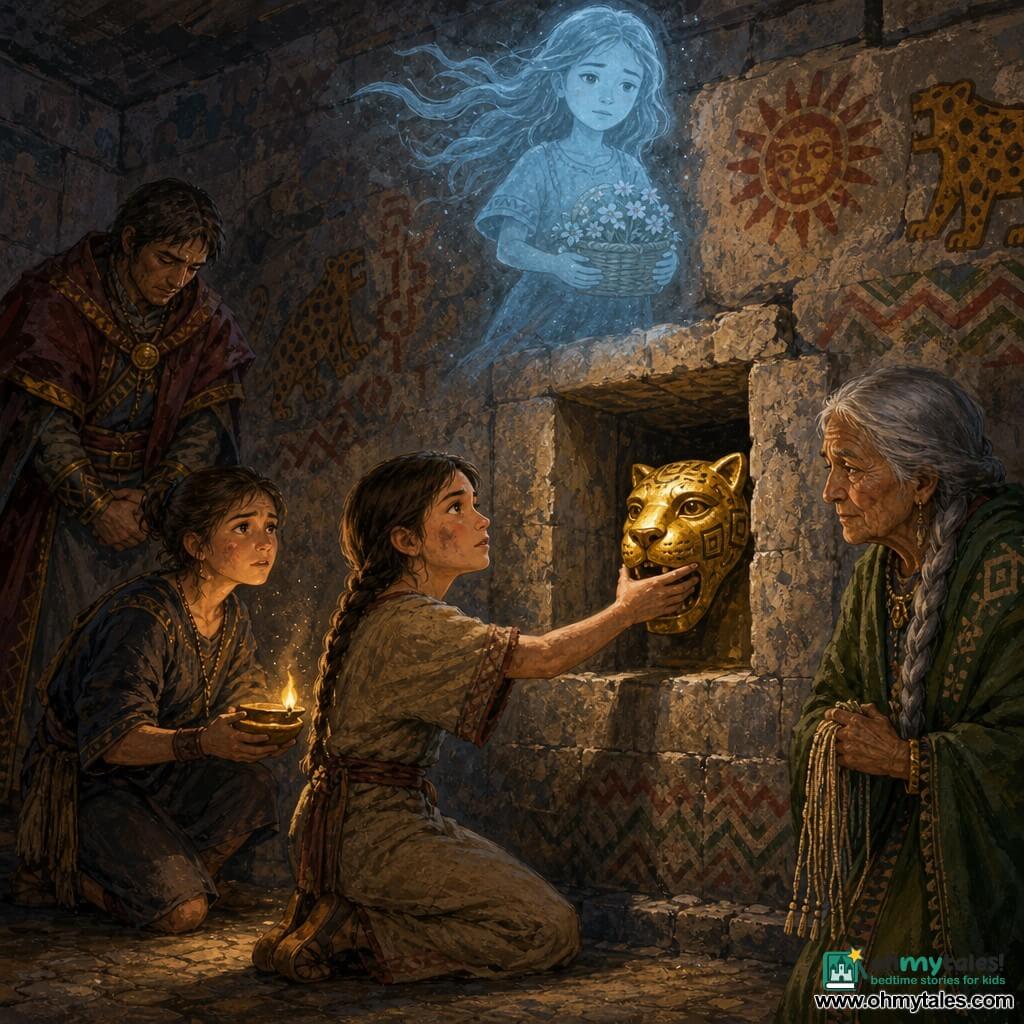
Painted symbols still clung to the walls—faded suns, zigzag rivers, a jaguar with watchful eyes.
Killa knelt near a pile of collapsed stones. The humming here was intense. It buzzed through her knees, her fingertips, her teeth.
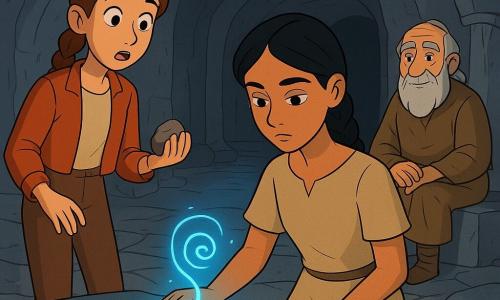
She pressed the echo-stone against the wall.
At first, nothing happened. Then the stone warmed abruptly, and the air thickened as if time itself took a deep breath.
The chamber blurred.
Killa blinked and suddenly she wasn't seeing the chamber as it was, but as it had been.
Bright torches. Fresh paint. Offerings laid neatly: bowls, woven cloth, shining ornaments. People moved through the room—priests murmuring, workers carrying stones.
Killa saw a young guard at the entrance, bored and sleepy. She saw a man in a fine cloak speaking softly to another, slipping something into his hand.
Mayu gasped. “I can see it too.”
The fine-cloaked man glanced around, then stepped toward a small side niche. Inside it was a bundle wrapped in cloth, marked with a symbol of a noble family.
He opened the bundle. Gold glinted. He smiled, quick and sharp.
Then a noise—a footstep. A girl about Killa's age entered, carrying a small basket of flowers. Her eyes widened.
“Hey!” she said. “Those aren't yours!”
The man's smile disappeared. He grabbed her wrist.
Killa's chest tightened. “No,” she whispered, though she knew she couldn't change what had already happened.
In the vision, the girl struggled. The man shoved her toward the collapsed section where workers had left stones stacked loosely. She hit the pile hard.
Rocks shifted. A rumble shook the chamber. Workers shouted. Someone cried out. The ceiling cracked, and stones began to fall.
The man fled, clutching stolen gold. The girl lay half-buried, dust coating her lashes. Her hand reached out weakly toward the basket of flowers, now crushed.
The vision sharpened on her face. Her lips moved without sound, but Killa felt the meaning like a knife: My name.
Then the vision snapped away.
Killa jerked back, breathing hard. The chamber returned—broken, dark, silent except for the drip of water somewhere deeper inside.
Mayu's eyes were wet. “He killed her,” she whispered. “And everyone thought it was just an accident.”
Killa pressed her palm to the floor. Under her hand, the stone felt like it was trembling.
The spirits here were not only angry. They were lonely. Forgotten.
Killa's throat tightened. “We need her name,” she said. “She asked for it. She needs to be known.”
Mayu wiped her eyes with the back of her hand, smearing a bit of soot. “How? The vision didn't say it.”
Killa listened. Not to the air. To the stone.
Slowly, she stood and walked deeper into the chamber, past the collapsed section. The lamp light caught something faint on the wall: a small carving, almost hidden behind dust and old spiderwebs. A simple mark, like a crescent moon above three dots.
Killa touched it. The humming shifted, forming a pattern. A name, not spoken, but felt—like recognizing the taste of a fruit you loved as a child.
“Chaska,” Killa said aloud.
The chamber answered with a low sigh—wind moving through cracks, or something else releasing its grip.
Mayu exhaled shakily. “Chaska,” she repeated, as if anchoring it in the world.
Killa looked back at the rubble pile where the girl had died. “We'll bring the truth,” she promised. “And we'll bring justice.”
As they turned to leave, the lamp flame bent sharply, though there was no breeze.
In the shadows, a figure appeared—tall, thin, and blurred at the edges like smoke. It wasn't Chaska. This presence felt older, heavier, like a storm cloud that had learned to walk.
A spirit with a warrior's outline stood in their path. Its eyes glowed faintly, not with fire, but with the pale light of the echo-stone.
A voice filled the chamber without sound. Truth is not enough.
Killa's fingers tightened around the echo-stone. “What else do you want?”
The spirit's shape wavered. Images flickered in Killa's mind: a gold ornament—unique, carved with a jaguar—being hidden in a clay jar; a man's hands; a noble's seal.
Return what was stolen. Name the thief. Balance the scales.
Mayu whispered, “I don't like the part where the spirits give homework.”
Killa almost smiled, despite everything. “Neither do I,” she whispered back. Then, to the spirit, she said, “We'll do it.”
The warrior spirit stepped aside, dissolving like mist. The way out was clear again.
Outside, sunlight hit Killa's face like a blessing and a challenge at once. The mountains stood huge and silent, as if waiting to see whether two girls could fix what powerful men had broken.
Killa began the walk back to Cusco with the echo-stone heavy in her pocket and Chaska's name steady on her tongue.
Chapter 4: The Jaguar Ornament
Cusco was louder after the quiet of the mountains. Traders called out prices. Children darted between legs. Drums sounded somewhere, practicing for a festival that suddenly felt too cheerful, like laughter in the wrong room.
Killa and Mayu headed straight for the Temple of the Sun.
Sumaq listened without interrupting as Killa described the vision: the theft, the shove, the collapse, Chaska's dying plea for her name. The older woman's jaw tightened, but her eyes stayed calm in the way of someone who had carried heavy truths before.
When Killa finished, Sumaq nodded once. “Chaska,” she said, and the quipu cords near her seemed to shiver.
Mayu blurted, “So what now? We can't exactly march up to a noble and say, ‘Excuse me, a ghost says you're guilty.'”
Sumaq's gaze slid to Killa's pocket. “The spirits demanded more: the stolen item. The jaguar ornament.”
Killa took out the echo-stone. “The warrior spirit showed me… hands hiding it in a jar. And a seal. I didn't recognize it.”
Sumaq stood and moved to a hanging rack of quipus. She chose one with dark green cords and ran her fingers over the knots, counting silently. “A jaguar ornament carved in a particular style,” she murmured. “Such work was made for one family: the House of Amaru.”
Mayu made a face. “Amaru… like the noble with the tall hat who complains that the wind is disrespectful?”
Sumaq's lips pressed together. “Yes. Lord Amaru's household.”
Killa's stomach dropped. Lord Amaru was powerful enough that even priests measured their words around him.
Sumaq's voice turned hard. “Justice is not always gentle. It is, however, necessary.”
Mayu crossed her arms. “And how do two girls deliver necessary justice to a household full of guards?”
Sumaq reached for a small bundle and unwrapped it, revealing two plain tunics and woven belts—clothes for servant girls. “By being overlooked,” she said. “People do not see what they do not respect.”
Mayu looked offended. “I respect servants. They have access to kitchens. That's real power.”
Killa couldn't help it; she laughed, a quick burst that loosened the knot in her chest.
Sumaq handed Killa a small pouch. “Coca leaves,” she said. “Not for chewing. For offering. Spirits accept what is given sincerely.”
Killa took it carefully. “And if Lord Amaru truly is the thief?”
“Then he must face the truth,” Sumaq said. “In a way even he cannot ignore.”
By midday, Killa and Mayu approached the House of Amaru. Its walls were taller than most, topped with carvings of serpents and jaguars. A courtyard inside gleamed with polished stone. Servants moved quickly, eyes down.
Killa pulled on the plain tunic and tied her hair back. Mayu did the same, though she muttered, “I look like a sad potato.”
“You look like someone no one will question,” Killa whispered. “Which is the point.”
They slipped in with a group of servants carrying baskets. No one stopped them. No one looked twice.
Inside the household, the air smelled of roasted meat and incense. A fountain bubbled in the center of the courtyard, and Killa's skin prickled. The water here was too loud, as if it was trying to warn her.
They moved toward a storage room near the back, where clay jars were stacked along the walls. Killa's echo-stone pulsed in her pocket, tugging her like a compass.
Mayu stood watch at the doorway, pretending to adjust her belt. “If anyone asks, we're looking for… uh… the rare spice of minding our own business.”
Killa crouched by the jars. Most were sealed with cloth and twine. She moved her hand close to them without touching, listening with her strange sense. One jar felt wrong—its vibration was sharp, nervous, as if it had a secret with teeth.
She untied the cloth.
Inside, wrapped in wool, was the jaguar ornament.
It was stunning: gold shaped into a jaguar's head, eyes inlaid with dark stone. The carving was so detailed it looked ready to snarl. But the moment Killa lifted it, a cold rush ran up her arms.
The air thickened. A whisper rose like smoke.
Mine… stolen…
Killa's knees went weak. She set the ornament down gently and pulled the coca pouch from her belt. “Chaska,” she whispered. “We found it.”
Mayu hissed from the doorway, “Hurry.”
Footsteps approached. Heavy ones. A guard's voice: “What are you doing in here?”
Killa's heart slammed. She grabbed the ornament and wrapped it quickly. Mayu stepped into the doorway with a bright, fake smile.
“Oh! We were sent to fetch jars for the kitchen,” Mayu said. “The cook said the chili paste tastes like regret without the right pot.”
The guard frowned. “I didn't hear anything about—”
Behind him, a man entered. He wore a fine cloak and a belt clasp shaped like a serpent. His face was smooth, his eyes sharp. Killa recognized him from the vision, older now but unmistakable.
Lord Amaru.
His gaze flicked to Killa's hands. “What do you have there?”
Killa's mouth went dry. The echo-stone in her pocket throbbed like a warning drum.
Mayu, bless her reckless heart, said, “A jar. Possibly two. We're still counting.”
Lord Amaru ignored her. He stepped closer, and the air seemed to bow around him. “Show me.”
Killa could have lied. She could have hidden the bundle. But Chaska's name burned in her mind, and the warrior spirit's message echoed: Balance the scales.
She held the wrapped ornament up.
Lord Amaru's eyes narrowed. For a heartbeat, he looked afraid. Then his face hardened. “Put that down,” he said quietly. “You don't know what you're holding.”
“I know it was stolen,” Killa replied, her voice steadier than she felt. “And I know someone died because of it.”
Lord Amaru's lips curled. “Careful, girl. Words can be dangerous.”
Killa met his gaze. “So can injustice.”
For a moment the storage room went strangely silent. Even Mayu stopped breathing.
Then the fountain in the courtyard outside roared, though no one had touched it. A gust of wind slammed the door half-shut. The lamp on the wall flickered, and shadows stretched long, twisting into shapes that didn't match the people casting them.
Lord Amaru glanced around, and his confidence faltered.
Killa felt the spirits gathering, drawn by the ornament like moths to flame.
Mayu whispered, barely audible, “I really, really don't want to be haunted in a storage room.”
Killa swallowed. “Neither do I,” she whispered back. Then she lifted her chin and spoke clearly.
“Chaska deserves her name. And the truth deserves daylight.”
Lord Amaru's eyes flashed with anger. “Guards—”
But before he could finish, the echo-stone in Killa's pocket grew hot, and a sound burst into the room—an echo trapped for years: a girl's shout, clear and furious.
“Those aren't yours!”
Lord Amaru jerked as if struck.
The room filled with the rumble of falling stones, the panicked cries from the past, the choking dust. The echoes wrapped around him like a net.
He staggered back, pale. “Stop,” he hissed. “Stop that!”
Killa's hands shook, but she held the ornament tight. “Come with us,” she said. “To the Temple. To Sumaq. You will answer.”
Lord Amaru's jaw clenched. He looked toward the door, calculating, but the shadows at the edges of the room had thickened into the outline of a tall warrior spirit. Its eyes were moon-pale, unblinking.
Lord Amaru swallowed. His voice came out smaller. “Fine,” he snapped. “I will come.”
Mayu leaned toward Killa. “Did we just arrest a noble with a ghost and good manners?”
Killa whispered, “Don't ruin it.”
Together, they walked Lord Amaru out into the courtyard, the wrapped jaguar ornament held like a torch that could not be put out.
Chapter 5: The Trial Beneath the Sun
The Temple of the Sun did not welcome lies.
They brought Lord Amaru through its golden halls, past priests who stared with tight mouths and startled eyes. Sumaq met them in the quipu room, her expression unreadable.
Lord Amaru tried to stand tall. “This is absurd,” he said. “Dragging me here like a common thief—”
Sumaq lifted a hand. “Common theft harms common people,” she replied coolly. “This theft harmed the dead.”
Killa placed the wrapped ornament on the table. The air around it shimmered faintly, as if heat rose from it though it was cold.
Sumaq unwrapped it with care. The jaguar head gleamed under lamplight, fierce and beautiful.
A priest entered—the same tired priest from the courtyard days before. Behind him came two officials, faces stern. Word had traveled fast. In Cusco, secrets ran faster than messengers.
Sumaq said, “Speak the truth, Lord Amaru. Or the truth will speak itself.”
Lord Amaru's eyes flicked to Killa. “This girl—she claims to hear stones and spirits. Are we truly letting childish superstition—”
Killa stepped forward. Her heart hammered, but she lifted her chin. “It's not superstition to admit harm,” she said. “You stole from an offering chamber. When Chaska saw you, you shoved her. The collapse hid what you did. You let her be forgotten.”
At the name, the lamp flames fluttered.
Mayu added, “Also, for the record, she brought flowers. So you're also guilty of crushing flowers, which is just rude.”
One official blinked, confused by the sudden turn. The tired priest almost smiled, then caught himself.
Lord Amaru's face tightened. “You have no proof.”
Sumaq placed the echo-stone beside the ornament. “We do,” she said.
She pressed the echo-stone against the jaguar head.
The room filled with sound—richer and clearer than before. The echo-stone sang the past: the soft scrape of cloth, the clink of gold, the girl's footsteps, her protest. Then the harsh shove. The rumble of falling stone. Choking coughs. A final whisper, small and desperate:
“Chaska…”
Silence slammed down afterward.
Lord Amaru looked as if the air had been punched out of him. His mouth opened, but no words came.
One official's voice was low. “Is this true?”
Lord Amaru's shoulders sagged, just a fraction, like a tower finally admitting it was built on sand. “I took it,” he said hoarsely. “It was only an ornament. A gift meant for the dead—wasted. I thought… no one would know.”
“And the girl?” Sumaq asked.
Lord Amaru's eyes darted away. “She—she surprised me. I panicked. I didn't mean—”
Killa's voice cut through. “But you did.”
The tired priest stepped forward, and his gold ornaments flashed like hard sunlight. “In the name of justice,” he said, “you will return what was stolen. You will offer restitution to the family of the dead girl. And you will make public confession, so her name is carried again.”
Lord Amaru flinched at the word public. For a noble, shame could bite deeper than punishment.
One official nodded. “And you will be removed from duties that place you near sacred sites.”
Mayu whispered to Killa, “That means he'll never be allowed near a temple storeroom again. Which is probably for the best.”
Killa didn't answer. Her attention was on the air itself.
The room felt crowded. The spirits were near, listening.
Sumaq turned to Killa. “Is this enough?” she asked softly, so only Killa could hear.
Killa closed her eyes and listened. The humming in the stones was changing. The tight, angry vibration loosened slightly, like a fist unclenching. But not fully. Something still snagged.
Chaska had her name now. The thief faced justice. The stolen guide for the dead had been found.
Yet the chamber was still broken. The bones were still misplaced. The road still remembered the collapse.
Killa opened her eyes. “We must return the ornament,” she said. “To the chamber. With offerings. And we must mark Chaska's resting place properly.”
Sumaq nodded once. “Then we will go,” she said, and the decision settled like a stone laid in a wall—firm, final.
Lord Amaru swallowed. “I am not climbing a mountain for a… ghost.”
The tired priest's eyes hardened. “You will. Not for a ghost. For justice.”
Mayu leaned close to Killa. “I can't believe we're making a noble do community service with the afterlife.”
Killa whispered, “Be polite.”
Mayu sighed. “Fine. Your Excellency, please enjoy your haunted hike.”
That evening, they prepared: offerings of coca leaves, flowers, woven cloth, and a small bowl of maize beer. Sumaq brought the moon-colored quipu, its pale cords gleaming softly.
As the sun slid behind the peaks, Cusco's lights flickered on like scattered fireflies. The mountains beyond stood dark and immense, holding old stories in their ribs.
Killa looked up at the first stars. “Chaska,” she whispered. “We're coming.”
The night air stirred, and for a moment it felt like an unseen hand brushed her shoulder—gentle, almost grateful.
Chapter 6: The Offering and the Opened Door
They reached the collapsed chamber at dawn, when the world was hushed and the sky was still deciding what color it wanted to be. Even Lord Amaru was quiet, though his face looked like it had been carved from sour stone.
Mayu carried the lamp and muttered, “If a condor drops something on him, I'll call it the spirits' sense of humor.”
Sumaq shot her a look. Mayu added quickly, “Respectfully.”
Inside the chamber, the air was colder than before. The stones hummed, not angry now but alert, like guards at a gate.
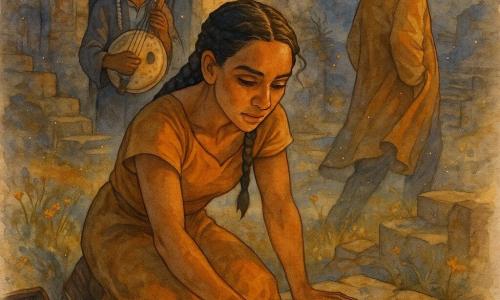
Killa knelt at the rubble where Chaska had fallen. She set down flowers—fresh this time, bright against the gray dust. She placed coca leaves beside them and whispered, “For your journey.”
Sumaq unrolled the pale quipu and held it carefully, as if it was a living thing. “Chaska,” she said, voice steady. “Your name is carried. Your story is witnessed. Your death is not hidden.”
Killa unwrapped the jaguar ornament and set it in the niche where it belonged.
Lord Amaru's hands trembled as he placed a woven cloth beside it, his offering. He cleared his throat. “Chaska,” he said stiffly. Then, with a visible effort, he bowed his head. “I wronged you. I wronged what was sacred. I will speak your name before the people.”
The words sounded heavy, but they were words. Spoken into the world. That mattered.
The chamber shivered.
Killa pressed her palm to the floor and listened. The old tightness in the stones eased, like ice cracking on a river. A sound rose—soft, almost musical—like wind passing through reeds.
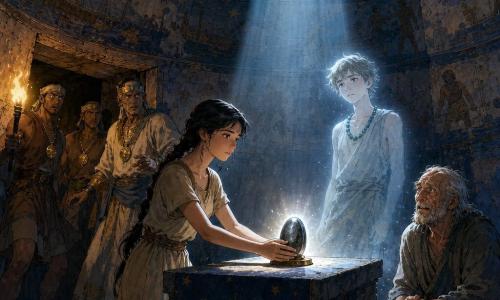
A glow gathered near the rubble, pale and silver-blue. It formed slowly into the outline of a girl, translucent as morning mist. Her face was young, solemn, dustless now. In her hands she held a basket of flowers, whole again.
Mayu sucked in a breath. “Chaska,” she whispered.
Chaska's gaze moved to Killa. There was no anger in it now, only an aching tiredness and a thin thread of relief.
Killa's throat tightened. She wanted to say a hundred things: I'm sorry. You deserved more time. I wish I could give you back your life.
Instead she said the truest thing she had: “You are remembered.”
Chaska's lips curved into a small smile. The air warmed slightly, as if sunlight had found a crack in the stone.
Then the warrior spirit appeared behind Chaska, tall and calm. Its presence no longer felt like a storm but like a mountain—firm, steady. It lifted an arm, and the shadows in the chamber shifted, aligning themselves like soldiers laying down weapons.
The humming in the stones changed into a smooth, deep harmony.
Sumaq began to chant softly, not loud or grand, but steady like footsteps on a long road. The quipu cords trembled, and for a moment, Killa saw faint light traveling along them, knot to knot, as if each knot was a remembered name being touched awake.
Chaska turned toward the niche with the jaguar ornament. She placed her ghostly flowers beside it.
The air rippled.
A doorway seemed to open where there had only been stone—no physical door, but a sense of space unfolding. The scent of rain and clean earth flowed out. The chamber felt suddenly less like a tomb and more like a threshold.
Chaska looked back once more. Her eyes met Lord Amaru's. He flinched, then bowed his head again, slower this time, as if he meant it.
Chaska nodded—just once.
Then she stepped into the unseen doorway. The warrior spirit followed, and as it passed, Killa felt something brush her mind: gratitude, and a quiet approval, like a judge closing a book.
The glow faded. The doorway folded shut. The chamber was stone again—old, broken, but no longer haunted in the same sharp way.
Mayu let out a long breath she'd apparently been saving for a year. “So,” she said, voice shaky, “we just… helped a ghost cross over.”
Sumaq's eyes shone. “We helped justice be done,” she corrected.
Killa pressed her hand to the wall. The humming now was gentle, like a lullaby. The stones felt less burdened, as if they had been forgiven for holding pain so long.
Outside, the morning sun poured over the mountains, turning the peaks pink and gold. The road stones warmed under their feet.
On the walk back, even the wind sounded kinder.
Lord Amaru walked a few steps behind, quiet and subdued. At one point he said, not looking at Killa, “How did you… hear them?”
Killa thought of her secret wish, the one she kept folded inside her like a hidden cloth. She could have shrugged. She could have avoided the question.
Instead she answered honestly. “I listened,” she said. “And I cared enough to keep listening even when it hurt.”
Lord Amaru nodded once, as if that was the hardest lesson of all.
When Cusco came into view, its stone walls shining, Killa felt the city differently. Lighter. The air no longer seemed packed with pacing feet. The fountains sounded like laughter again, not arguments.
In the Temple courtyard later, the tired priest passed Killa. His eyes were clearer than before. “The night feels quieter,” he said.
Killa looked up at the sky, where a condor traced wide circles. “Not empty,” she replied. “Just… at peace.”
Mayu bumped her shoulder. “So what do you want now, Spirit Listener?”
Killa smiled, and the smile felt like sunrise. “Harmony,” she said. “For them. For us.”
And somewhere deep in the stones of Cusco, in the bones of the mountains, a calm, ancient music answered back—steady as justice, gentle as rain, returning the world to balance.