Chapter 1 — The Book That Hummed
The city of red earth and gold bells woke with the sun, and the sun woke with drums.
Safi walked along the palace wall where shadows stayed cool and long. Below her, the market was already bright with cloth like spilled paint—indigo, saffron, deep green—while traders called and laughed and argued as if bargaining was a sport. Above her, the air smelled of smoke from morning fires and the sharp sweetness of crushed tamarind.
She carried a bundle wrapped in plain goat leather. It looked ordinary enough to fool a stranger. But Safi felt it the way you feel a storm coming, even under clear skies. The bundle was warm, and from inside it came a faint vibration—as if a tiny instrument had been plucked and was still humming.
She paused at a slit of a window in the wall. Inside, the palace library was dim and calm, a quiet sea of shelves. The old librarian, Mama Nala, glanced up from her mat.
“You're late,” Mama Nala said, without sounding angry. Her voice was dry as old paper.
“I had to take the long path,” Safi replied. “Someone followed me yesterday.”
Mama Nala's eyes sharpened. “And did you let them see your hands?”
Safi held up her palms. Ink stains clung to the lines of her skin like secrets. “No. I kept them in my sleeves.”
“That's wise,” Mama Nala murmured. “The wrong eyes on the wrong ink can open doors that should stay closed.”
Safi's throat tightened. She remembered another door: her mother's hut, years ago, its doorway bright with firelight, her mother bent over a book that did not belong to the living. The smell of smoke. The sudden silence. The absence after.
Nostalgia is a strange animal. It bites and comforts at the same time.
Safi slipped into the library and knelt beside Mama Nala. “It's here,” she whispered.
The librarian did not ask which “it.” In the kingdom of Kemburu, some words were safer unspoken.
Safi unwrapped the bundle. A grimoire lay within—its cover dark as river stones, its edges sewn with copper thread that caught the light like trapped sunsets. No title. Only a symbol pressed into the leather: a spiral with a dot at its heart.
The book hummed louder when the air touched it.
Mama Nala exhaled through her nose. “Still singing.”
“It never stops,” Safi said.
“It's not singing,” Mama Nala corrected. “It's calling.”
Safi flinched. “Calling whom?”
“Anyone who thinks power is a shortcut.” Mama Nala's fingers hovered over the cover but did not touch it. “Or anyone hungry enough to pretend they're not afraid of what they might become.”
Outside, a horn blew—a long note that rolled over rooftops. Then another, and another, like a warning spelled in sound.
Mama Nala's gaze snapped to Safi. “Do you remember the old proverb?”
Safi swallowed. “When the horns speak thrice, the road changes.”
Mama Nala nodded once. “And a changing road can lead thieves to a locked door.”
Safi tightened the leather wrap again. “Then I'll move it.”
“Where?”
Safi looked at the shelves, at the scrolls sleeping in clay jars, at the dust motes floating like tiny spirits. She loved this place. It had saved her after the fire. It had given her work and words and a life built from quiet.
But the grimoire did not belong to quiet. It belonged to storms.
“To the ruins,” Safi said, surprised to hear it aloud. “To Mawu-Lani. The old city.”
Mama Nala's expression softened, just a little, like stone warmed by sun. “The light still touches those ruins at dusk,” she said. “Even now.”
Safi tied the bundle to her back. “Then I'll take it where the light can watch it.”
“And you,” Mama Nala said, “will need more than light.”
Safi tried to smile. “I have legs.”
Mama Nala's dry laugh rasped. “Legs are useful. Peace is wiser.”
“Peace?” Safi echoed.
Mama Nala leaned closer. “If you meet those who chase the book, don't feed their fire. You're not carrying a weapon. You're carrying a temptation.”
Outside, the horns fell silent. The silence felt too neat, like a cloth pulled over something messy.
Safi stood. “I'll leave before the city remembers how to whisper.”
Mama Nala finally touched the cover, just once, with two fingers. The grimoire's hum rose, then settled, as if listening. “Go,” she said. “And bring it back to a world where children don't inherit ash.”
Safi stepped out of the library, the bundle warm against her spine, and the day suddenly felt older than it looked.
Chapter 2 — The Griot at the River Gate
Safi reached the River Gate by noon, when the sun sat high and proud. The gate was a thick arch of mudbrick and carved wood, painted with patterns that told stories even if you couldn't read. Beyond it, the river stretched wide, slow, and shining—like a long, patient creature wearing a necklace of light.
A ferry waited at the bank, its planks tied together with rope as thick as Safi's wrist. The ferryman—a man with shoulders like boulders—watched people board with the calm of someone who had seen every kind of hurry.
Safi joined the line. She kept her hood low.
A boy behind her muttered, “They say the king's seers saw smoke in the future.”
A girl answered, “My aunt says smoke is always in the future. People love burning things.”
Safi almost smiled, but the grimoire's warmth reminded her not to relax.
When she stepped forward, a voice rang out from the shade of a fig tree.
“Traveler with the heavy back,” the voice called, “do you carry a drum, or a secret?”
Safi turned. Under the fig tree sat a griot, older than the tree looked, with braided hair streaked silver. A kora rested against his knee, and his eyes were bright as polished seeds.
People gave him space the way they gave space to fire: respectful, careful, curious.
Safi's mouth went dry. Griots heard histories the way hunters heard footsteps. “Just a bundle,” she said.
The griot plucked a string. The note danced, then landed softly. “Bundles can be drums,” he said. “And secrets can be heavier than drums.”
Safi glanced around. The ferryman was busy. The line moved. She could pretend she hadn't heard. She could step onto the ferry and let the river swallow the conversation.
But the griot's gaze held her like a hook.
“You're Safi of the palace library,” he said, casually, as if naming the weather.
Safi's hand went to the leather strap across her chest. “I don't know you.”
“I know your story,” the griot replied. “And your mother's story. And the story of the book that eats the pride of kings and spits out ruins.”
Safi's pulse thudded in her ears. “Lower your voice.”
The griot chuckled. “Ah, yes. The language of fear. It makes even brave people whisper.”
Safi leaned closer, angry and frightened at once. “Why are you saying this?”
He tapped the kora's wooden body. “Because a story is a river, and you are stepping into it whether you like wet feet or not.”
Safi clenched her jaw. “If you know so much, tell me this: who is coming?”
The griot's smile vanished. “A man named Bemba, with a mouth full of honey and a heart full of knives. He calls himself a peacekeeper. He is not one.”
Safi's stomach tightened. “I've heard that name.”
“He's gathering men,” the griot continued. “Not soldiers, not exactly. People who want a quicker life. He believes your book can bend time the way a smith bends metal.”
“It can't,” Safi said, too quickly.
The griot's eyebrows lifted. “Can't? Or shouldn't?”
Safi's throat burned. She remembered her mother's hands, stained with ink. Her mother had believed she could bargain with the past. The past had taken payment.
“It shouldn't,” Safi said. “That's why I'm taking it away.”
“To the ruins,” the griot said, as if reading her thoughts.
Safi froze.
He shrugged. “Your eyes looked west when you spoke. And your shoulders carry the weight of someone walking toward old stones.”
Safi forced herself to breathe. “Why help me?”
The griot plucked another note, softer. “Because empires are made of people, not walls. And people are made of choices. I would rather sing of a woman who chose peace than of a man who chose fire.”
A shout rose from the riverbank. The ferryman waved. “Last crossing!”
Safi stepped toward the ferry, but the griot called again, quieter now. “Take this.”
He held out a small charm: a bead carved from pale wood, etched with the same spiral-and-dot symbol as the grimoire.
Safi stared. “Where did you get that?”
“A story gave it to me,” the griot said. “And now I give it to you. It won't fight for you. It will remind you.”
“Remind me of what?”
“That the past is not a chain,” he said. “It's a teacher. Don't let anyone turn it into a weapon.”
Safi took the bead. It felt cool, even in the heat.
As she boarded the ferry, the river wind lifted her hood. For a moment, she saw the city behind her—towers, courtyards, banners fluttering like bright birds—and she felt a sharp ache for everything that could be lost.
The ferry pushed off. Water whispered against wood.
Halfway across, Safi looked back. The griot sat under the fig tree, small now, but his kora's music still floated over the river like a bridge made of sound.
Chapter 3 — Honey-Mouth Bemba
The road west ran through savanna grass that waved like a thousand hands. Here and there, baobab trees stood like elders watching young ones run. Safi walked with the sun at her shoulder, the grimoire warm against her back, the carved bead in her pocket.
She tried not to think of the book. Thinking made the hum louder, as if it enjoyed attention.
By late afternoon, she reached a village built in a circle around a well. Children chased a woven ball, their laughter skipping over the dust. Smoke rose from cooking fires, carrying the smell of millet and roasted groundnuts.
Safi's feet ached. Her water skin was light. She approached the well, nodding politely to a woman drawing water.
“Traveler,” the woman said, “you walk like someone carrying a stubborn goat.”
“A book,” Safi answered.
The woman snorted. “Books are stubborn goats. Sit. Drink. Rest your bones.”
Safi thanked her and knelt by the well. Cool water soothed her throat. For a moment, she let herself feel ordinary.
Then the village grew quiet in a way that did not belong to evening.
A man entered the circle with a smooth stride and a bright robe. His smile arrived before he did. Two others followed, hands resting near their belts as if they were always ready to grab the world.
The smiling man bowed to the villagers. “Peace to you,” he said warmly. “May your wells never dry.”
Some villagers nodded, cautious. A child hid behind a pot.
The man's eyes found Safi as if they had been looking for her all day. He walked closer, hands spread in friendliness.
“You,” he said, voice sweet. “You look tired. Let my men buy you supper.”
“I have supper,” Safi replied. She stood slowly.
He laughed. “Pride is a thin blanket at night. I'm Bemba.”
Safi kept her face still. “I don't trade names with strangers.”
“Yet your name is Safi.” Bemba's smile widened. “And you walk from Kemburu with a bundle on your back. You're famous.”
Safi's fingers curled. “Famous for what?”
“For being loyal,” Bemba said, as if that were adorable. “For guarding something precious. I admire loyalty. It's rare. Like a lion that eats grass.”
A few villagers shifted uneasily. The woman from the well tightened her grip on the rope.
Safi forced her voice to stay calm. “What do you want?”
Bemba's expression turned sorrowful, almost gentle. “I want to protect our people,” he said. “The world is restless. Rival kings sharpen their spears. Traders bring strange weapons. The future is a storm.”
He took one step closer. “But the past,” he whispered, “the past holds answers. I've heard of a book that can show what was, and what could have been, so we can choose the best path.”
Safi's back prickled as if ants crawled under her skin. The grimoire's hum pulsed once, like a heartbeat.
“It's a story,” Safi said.
Bemba sighed. “Stories shape nations. Give me the book. I will use it to keep peace.”
Behind Bemba, his men spread out a little, as if the air itself belonged to them.
Safi looked at the villagers—at the children, the elders, the cooking fires. If she fought here, someone would bleed. The grimoire felt heavier, as if it understood her hesitation and pressed down on her shoulders.
Mama Nala's words came back: You're carrying a temptation.
Safi lifted her chin. “Peace isn't made by stealing,” she said. “It's made by listening.”
Bemba's eyes narrowed just a fraction, like a smile cracking. “Listening is slow,” he said softly. “And the world is fast.”
He snapped his fingers. One of his men stepped forward.
Safi's mind raced. Her mother had once tried to use the grimoire's spells. Safi had learned enough from the margins—enough to know the book responded to emotion like dry grass to a spark.
No. Not here.
She reached into her pocket and pulled out the carved bead. It was cool, steady. A reminder.
Safi looked Bemba in the eye. “If you want peace,” she said, “start by leaving this village untouched.”
Bemba laughed again, but it sounded hollow. “Very well. I'm a reasonable man.”
He stepped back, then pointed down the road. “We'll walk with you,” he said. “To keep you safe.”
Safi's stomach sank. A cage can be made of politeness.
She could run, but they would chase her. She could shout, but the villagers would pay the price.
So she nodded once, as if accepting kindness.
“Thank you,” she said, and hated how smooth the words tasted.
They set out together as the sun lowered, painting the grass with copper light. Bemba walked beside her, chatting about trade routes and rival courts as if they were friends on a stroll.
Safi listened, not to his words, but to the spaces between them.
In those spaces, she heard hunger.
Chapter 4 — The Night of Borrowed Time
They camped near a stand of acacia trees. Bemba's men made a small fire. Bemba offered Safi dried meat and sweet cakes.
“Eat,” he said. “You'll need strength.”
Safi took a cake and pretended to nibble. Her thoughts ran like startled gazelles.
The grimoire's hum had changed since Bemba appeared. It was sharper now, like a note held too long. Safi could almost feel the book leaning toward him, curious, wickedly interested.
Bemba leaned back on his elbows, staring at the stars. “Do you ever miss your mother?” he asked lightly.
Safi's breath caught. “Don't say her name.”
“I didn't,” Bemba said, smiling into the dark. “But you heard it anyway.”
Safi's hands trembled. She forced them still. “Why are you doing this?”
Bemba turned his head, his face half-lit by fire. For a moment, the honey was gone, and something cold looked out.
“Because I am tired of being small,” he said. “Tired of watching other men write history while I carry it like a basket. If the past can be opened—if time can be persuaded—then no one has to be small again.”
Safi's voice came out rough. “And who decides what ‘again' looks like?”
Bemba's smile returned. “The one with the key.”
He stretched, stood, and clapped his hands. “Sleep. Tomorrow we reach the old road that leads to Mawu-Lani. The ruins you love so much.”
Safi lay down at the edge of the camp, pretending to sleep. Bemba's men talked quietly, then their voices faded. The fire crackled. A night bird called, lonely and sharp.
When the camp finally settled into snores, Safi sat up.
The grimoire was strapped to her back. She slipped it off carefully and held it in her lap. Its copper stitching glinted faintly. The cover felt warm, almost feverish.
Safi whispered, “Don't,” as if the book could understand. Then she realized it could.
She opened it.
The pages were thick, darker than normal paper, like pressed bark. The writing shimmered, not with light but with depth—as if the ink was a doorway rather than a stain.
Safi's mother had taught her the first rule before she died: Never read the grimoire aloud when you are angry.
Safi wasn't angry.
She was afraid.
That might be worse.
She found a spell in the margins, scribbled in a hurried hand—her mother's hand. It was a small spell, meant to blur footsteps, to confuse eyes, to make a person look like a shadow among shadows. Not a weapon. A hiding place.
Safi touched the carved bead in her pocket. “Peace,” she whispered. “No harm.”
Then she traced the ink with her finger and spoke the words under her breath, as softly as wind.
The air around her seemed to tilt. The fire's light flickered, then steadied. Safi looked down at her hands and gasped.
Her fingers were still there, but the edges of them looked… uncertain. Like smoke trying to hold a shape.
She closed the book quickly, heart pounding. The hum softened, satisfied.
Safi stood and stepped away from the camp. Her feet made almost no sound on the dry ground. She moved between acacia trunks, her breath held, her whole body a question.
One of Bemba's men stirred. He sat up, blinking.
Safi froze.
The man looked around, confused, then scratched his head and lay back down.
Safi moved again, faster now, slipping into the tall grass beyond the trees. The spell did not make her invisible, not truly. It made her forgettable—like a face seen in a crowd and lost the next second.
She walked all night, guided by starlight and stubbornness. The road grew rougher, stones rising through the earth like knuckles. In the distance, she saw a faint line of hills, dark against the paling sky.
By dawn, her legs shook. The spell's edges frayed; she could feel it loosening like a knot in wet rope.
When the first sunlight spilled over the land, Safi stopped on a ridge and looked back.
Far behind, a thin thread of smoke rose where the camp had been.
She could not hear them, but she could imagine Bemba's voice, sweet as ever: “Find her.”
Safi tightened the straps of the grimoire. “You won't,” she whispered. “Not if I reach the ruins first.”
The sun climbed. The past waited.
Chapter 5 — Mawu-Lani, City of Broken Crowns
The ruins of Mawu-Lani appeared at midday, and Safi's breath caught as if she'd been punched by beauty.
Stone towers lay half-fallen, their carved faces worn by wind and time. Wide steps led to courtyards filled with grass and tiny yellow flowers. Old walls were painted with faded murals—hunters, queens, spirits with star-eyes—still proud, even in ruin.
Safi walked slowly, as if entering a shrine.
Nostalgia wrapped around her like a cloth. She had never been here, not in her own life, yet she felt she knew the place. Mama Nala had told stories. The griot's songs had painted pictures. And the grimoire… the grimoire hummed like it had come home.
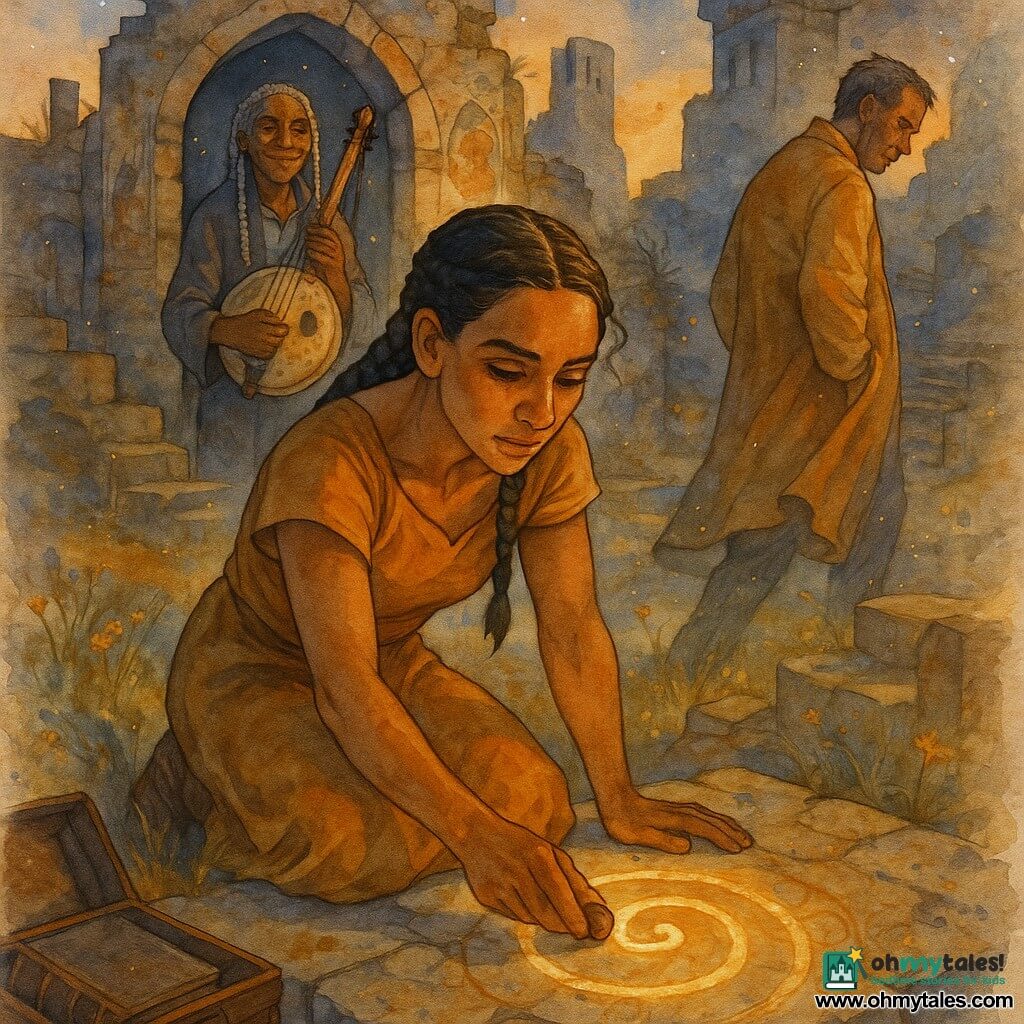
At the center of the ruins stood a broken archway, its top cracked but still standing. Beneath it lay a circular platform of stone, scorched black in a spiral pattern.
The same spiral-and-dot.
Safi's skin prickled. She pulled the grimoire off her back and held it with both hands. “This is where you want to be,” she murmured. “Isn't it?”
The book hummed in reply, low and eager.
A breeze moved through the ruins, carrying dust and the faint smell of rain far away. Safi stepped onto the platform. The stone felt warm under her feet, as if it remembered fire.
She opened the grimoire, careful, respectful, like handling a sleeping predator.
The pages fluttered though there was no wind.
Safi saw images—not exactly drawings, not exactly visions—moving in the ink. A palace. A queen lifting a staff. A crowd cheering. Then the same queen, older, her eyes hollow, the crowd gone.
Power, the grimoire seemed to whisper without words, always asks for more.
Safi's throat tightened. “I won't be like my mother,” she said, though the words hurt. She missed her mother fiercely, not for the choices she'd made, but for the warmth of her laugh, the way she'd braided Safi's hair and told her the stars were holes punched in the sky so ancestors could peek through.
Safi lowered herself to sit on the stone platform. “I wish you were here,” she whispered to the air. “Not the book. You.”
For a moment, the ruins were silent except for distant birds.
Then the grimoire's hum changed—slower, deeper. The air on the platform thickened, like water without wetness. The spiral scorch marks glowed faintly, not bright, but as if moonlight had soaked into them.
Safi's breath came fast. She hadn't spoken any spell.
The grimoire, it seemed, did not always wait to be asked.
A shape formed at the edge of the platform—light gathered into a figure, soft and trembling. A woman's outline. Braids. Familiar shoulders.
Safi's eyes filled instantly. “Mama?”
The figure's face sharpened—beautiful, sad, and not quite solid. It was her mother, or something wearing her memory.
The figure spoke, but the voice sounded like wind through reeds. “Safi.”
Safi surged to her feet, reaching out, then stopping herself. “Is it really you?”
The figure smiled, and the smile was the same one Safi had carried in her mind for years. “You called,” it said.
Safi's heart slammed. “I didn't mean—”
A laugh echoed from the broken archway.
Bemba walked in, clapping slowly. His robe looked dusty now, his eyes bright with triumph. Behind him, three men with drawn blades scanned the ruins.
“Beautiful,” Bemba said. “You ran so well. You led me straight to the door.”
Safi's blood went cold. The mother-figure flickered, as if startled.
Bemba stepped onto the platform, careful and reverent. “So this is Mawu-Lani's heart,” he murmured. “And this,” he added, looking at the glowing figure, “is proof.”
Safi grabbed the grimoire and slammed it shut. The glow dimmed. The figure wavered.
“No,” Safi breathed, terrified. She hadn't meant to lure him here. She had meant to hide the book, to bury it in old stones.
Bemba held out his hand. “Give it to me, Safi. Don't make this ugly.”
Safi's voice shook. “You're already ugly. You just wear a pretty smile.”
Bemba's eyes hardened. “And you,” he said quietly, “are standing between me and a future where my name matters.”
Safi's hand went to the bead in her pocket. She squeezed it, grounding herself. “Names matter when people live in peace,” she said. “Not when they're forced to kneel.”
Bemba's men moved closer.
The mother-figure flickered again, and Safi suddenly understood: it wasn't her mother. Not truly. It was the grimoire's bait, shaped from Safi's longing.
Nostalgia, sharpened into a hook.
Safi took a step back off the platform, pulling the book to her chest. “You won't have it,” she said.
Bemba's voice turned silky. “Then I'll take it.”
He lunged.
Chapter 6 — The Choice That Ended the Chase
Safi dodged, but Bemba's hand caught the strap of the grimoire. The pull jolted her shoulder. Pain flashed hot.
One of Bemba's men grabbed her arm. Another raised a blade.
Safi's mind screamed: Spell! Fire! Storm!
The grimoire vibrated violently, hungry for the chaos in her chest. Its copper threads gleamed like they were waking.
Safi clenched her teeth. If she let the book feed on fear, it would give her something terrible and strong.
And it would want payment.
She looked past Bemba, past his men, to the murals on the ruined walls: queens and farmers, children and elders, all painted with the same steady dignity. This city had once been powerful. Now it was quiet. Yet the quiet felt… peaceful, not defeated.
Maybe that was the lesson of ruins: even greatness must learn to rest.
Safi stopped struggling.
Bemba blinked, surprised. “Good,” he said, still gripping the strap. “Finally.”
Safi lifted her chin. “You want the past?” she asked, voice steady. “Then listen to it.”
Before Bemba could reply, Safi stepped back onto the platform—dragging him with her because he still held the strap.
The spiral scorch marks flared softly.
Bemba's smile faltered. “What are you doing?”
Safi opened the grimoire—not wide, just enough. The pages breathed out a gust of cold air that smelled like old rain and ash.
Bemba leaned in greedily. His eyes darted across the ink as if he could swallow it with a glance.
Safi spoke clearly, not the spell of hiding, not the spell of fire. She chose the simplest words she knew, the words Mama Nala had made her repeat when she was young and angry.
“I refuse,” Safi said. “I refuse to harm. I refuse to rule by fear. I refuse to use the past as a whip.”
The grimoire's hum stuttered, confused—like a drumbeat interrupted.
Bemba laughed sharply. “Pretty vows,” he snapped. “Vows don't stop blades.”
“No,” Safi agreed. “But they stop me from becoming you.”
She turned the book so Bemba could see a page that shimmered darker than the rest. The ink stirred, forming a scene: a man with a bright robe standing on a platform, lifting a book like a prize. Behind him, the city burned. People ran. A child fell.
Bemba's breath caught.
Safi's voice lowered. “The book shows possibilities. Not just victories. It shows costs.”
Bemba's eyes flicked, frantic, as the ink shifted again: Bemba crowned, alone; Bemba surrounded, betrayed; Bemba old, hunted by the very men who once followed him.
His mouth opened, then closed. His honey-words dried up.
“This is a trick,” he whispered.
“It's the truth you didn't want,” Safi said. “Power doesn't keep you from being small. It just makes your mistakes bigger.”
One of Bemba's men hesitated, blade wavering. Another glanced at Bemba, doubt rising like smoke.
Bemba yanked at the strap again. “Enough!” he shouted, the sweetness cracking completely. “Give me the book!”
Safi felt the grimoire surge, eager to explode into something violent. The platform's spiral glowed brighter. The mother-figure began to form again at the edge—ready to tempt, ready to lure.
Safi slammed the grimoire shut and pressed her forehead to its cover. “No more,” she whispered. “No more bait. No more bargains.”
Then she did something that felt like ripping out a piece of her own heart.
She took the carved bead from her pocket and placed it on the spiral scorch mark at the center of the platform.
The bead clicked against stone.
The glow steadied—not brighter, but calmer, like a lantern protected from wind.
Safi spoke again, not to the grimoire, but to the ruins themselves. “Ancestors of Mawu-Lani,” she said, voice trembling yet clear, “take this hunger away. Let what is forbidden sleep.”
For a breath, nothing happened.
Then light rose from the spiral—not a harsh blast, not a weapon. A quiet radiance, pale gold, like dawn filtered through dust. It wrapped around the grimoire and Safi's hands, warm and gentle.
Bemba stumbled back, shielding his eyes. “What are you doing?” he rasped, suddenly afraid.
Safi felt the book's hum soften, as if lulled. The copper stitching dulled. The warmth against her palms faded into coolness.
The grimoire was still a book. Still dangerous. But the platform's light seemed to pull the sharp edge out of its calling, the way water pulls heat from metal.
Bemba's men backed away, muttering. One dropped his blade as if it had become too heavy.
Bemba looked around, seeing for the first time that the ruins were not empty. They were full of watchful silence, full of history that did not belong to him.
He took one step forward, then stopped. His smile tried to return and failed.
“This isn't over,” he said, but his voice had lost its shine.
Safi met his gaze. “It is,” she replied. “Go home. Build something that doesn't need ashes.”
Bemba's jaw worked. For a second, Safi thought he might charge again.
But the light on the platform brightened just a little, and in it Bemba's face looked plain—no longer heroic in his own mind, just tired.
He spat into the dust, turned sharply, and strode away. His men followed, not quite looking at him, not quite looking at Safi.
When their footsteps faded beyond the broken archway, Safi's knees gave out. She sat on the warm stone, holding the closed grimoire like a sleeping creature.
The light did not disappear.
It stayed, pouring softly over the ruins, touching cracked murals and fallen pillars, making them look less like bones and more like memories that had chosen to forgive.
Chapter 7 — Light on the Ruins
Evening came slowly, as if the sky wanted to linger over Mawu-Lani.
Safi walked through the ruins with the grimoire tucked under one arm. The platform's light followed her—not chasing, not clinging, simply spreading outward like calm.
Where it touched stone, details woke: carved patterns on a fallen column, the outline of a doorway, the faint blue of old paint.
Safi found a small chamber half-collapsed, its roof open to the sky. In the center was a stone chest with a lid cracked but intact. On its surface was the spiral-and-dot.
A place made for keeping.
She knelt and brushed away dust. “So this is where you were meant to sleep,” she murmured.
The grimoire did not hum now. It was quiet, almost sulky, like a child told to sit still.
Safi opened the chest. Inside lay only dry air and a few curled leaves blown in by wind. She placed the grimoire inside gently.
Her hands lingered on the cover. She thought of her mother again—of the love and the loss, of the fire and the silence. Safi could not change that. She could only decide what to do with the ache.
“I miss you,” she said softly. “But I won't chase you into darkness.”
She closed the lid.
The light from the platform streamed through the broken roof, laying a golden path across the chamber floor. Dust motes floated in it like tiny planets.
Safi sat against the wall and listened. No horns. No shouting. Only wind, and distant birds settling for night.
For the first time in days, she felt her shoulders loosen.
Footsteps crunched outside. Safi's muscles tensed—then relaxed when she saw who it was.
The griot stood in the doorway, silhouette framed by sunset. His kora hung from his shoulder. His eyes crinkled with quiet relief.
“You made it,” he said.
Safi exhaled a laugh that was half a sob. “You followed me?”
“I follow stories,” the griot replied, stepping in. He looked at the chamber, the golden light, the stone chest. “And I feared this one would end with fire.”
“It almost did,” Safi admitted.
The griot nodded toward the light. “But it didn't.”
Safi stared at the beam cutting across old stone. “I thought power would come with a roar,” she said. “But this… it feels like a hand on your shoulder.”
“That's the kind of strength empires forget,” the griot said gently. “The kind that makes room for others.”
Safi frowned. “Will Bemba return?”
“Maybe,” the griot said. “People like him circle back the way vultures do. But now he has doubt in his belly. Doubt can be a seed.”
Safi looked toward the chamber's open roof, where the first star had appeared. “I don't want to be a guard forever,” she confessed. “I want to live. I want to teach children to read. I want to laugh without listening for footsteps.”
“Then do that,” the griot said. “Peace is not a prize you win once. It's a path you keep choosing.”
Safi nodded slowly.
Outside, the ruins glowed with the last light of day and the steady radiance that had risen from the spiral. It spread across broken crowns of stone, across fallen walls, across murals of long-gone queens.
Not to erase what had happened here.
To illuminate it.
Safi stood and walked to the doorway. She looked out over Mawu-Lani as dusk deepened. The ruins were washed in gold, and in that light they seemed less like a warning and more like a promise: that even after collapse, something gentle could remain.
The griot began to play, a soft melody that curled through the air like incense.
Safi listened, feeling the past settle into its proper place—not a chain, not a weapon, but a story.
And as night arrived, the light stayed on the ruins, quiet and watchful, like peace refusing to be forgotten.