Chapter 1: The Doubt Beneath the Sun
The sun over Thebes did not simply shine. It commanded. It turned the river into a blade of bronze and the temple stones into pale fire. Men in linen moved like white birds between columns painted with gods who never blinked.
Nebamun paused in the shade of a doorway and pressed his thumb against the smooth clay of a broken seal. He was a temple scribe—good with reeds, ink, and careful words—but lately his hands had begun to hesitate as if they were listening to a fear no one else could hear.
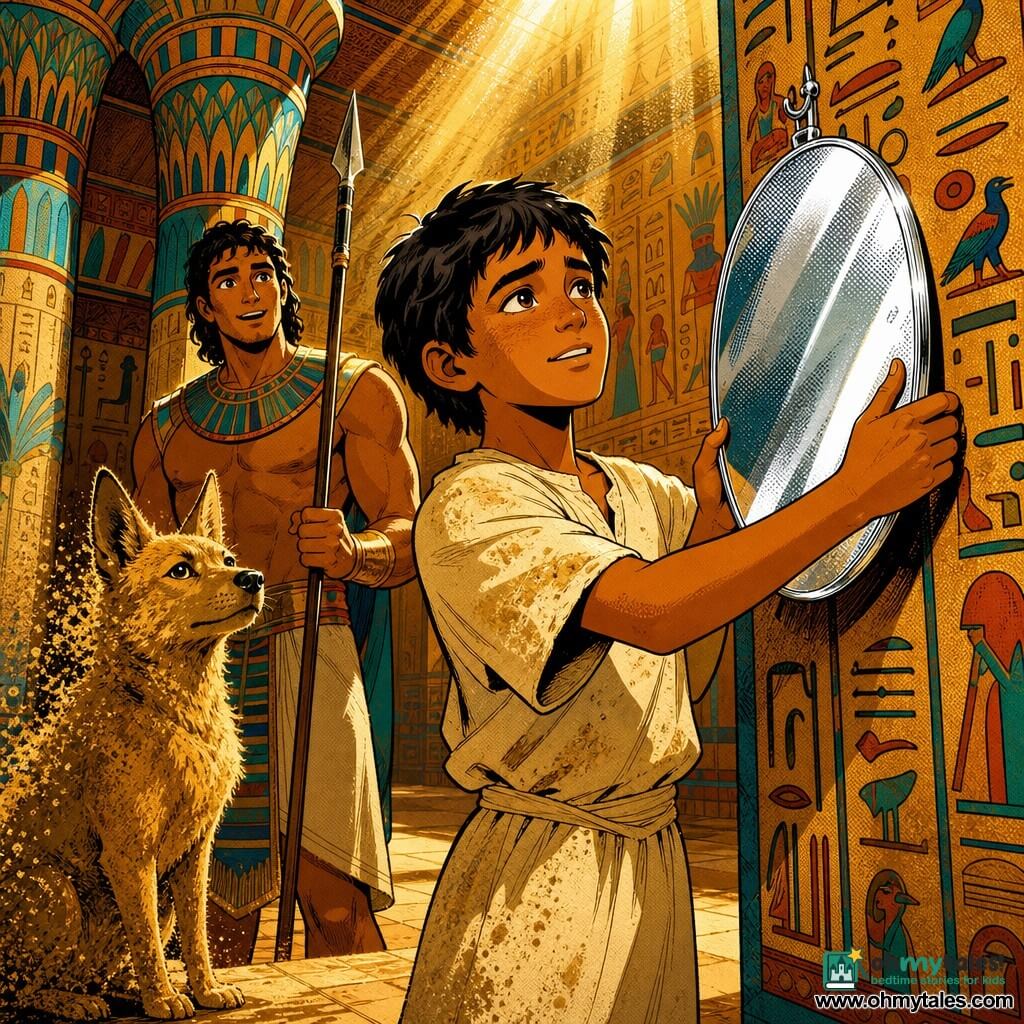
“You're staring again,” said Hori, a guard with a grin as sharp as a chisel. He leaned on his spear as if it were a walking stick. “If you keep squinting at the sun, it'll start charging you rent.”
Nebamun managed a small laugh. “I'm not staring at the sun.”
“Then what?”
Nebamun looked toward the far edge of the temple grounds, where the desert began—an ocean made of sand instead of water. “I'm thinking about what's missing.”
Hori's grin softened. “Ah. That.”
Everyone knew about the relic. The Mirror of Seshat—an old, silver-bright disk said to remember every word ever written. Legends insisted it once hung in a hidden chamber, guarded by prayers and clever traps, until a storm of politics and envy swept it away. Some said thieves stole it. Others whispered that the Mirror walked off on its own, bored of human hands.
Nebamun had been told the story as a child. He had loved it. Then he grew older, learned the weight of rules, and began to doubt stories that sounded too clean.
And yet—every time he wrote a name wrong and had to scrape it away, every time he watched a priest speak of certainty as if certainty were a robe you could put on—Nebamun felt the empty space where the Mirror should have been, like a missing tooth.
He had asked the High Priest once, careful and polite. The man's eyes had become two hard stones. “Some things are not meant to be found,” the priest had said, and the conversation ended like a door slammed in a corridor.
But that only fed the doubt, which grew into a quiet hunger.
That afternoon, Nebamun returned to the scribes' room, where papyrus lay stacked like sleeping reeds. He took out a small wooden box from beneath his mat. Inside was a shard of polished metal, no larger than his palm, dulled with age. He had found it years ago behind a collapsed wall near a storeroom. It held a faint engraving: the feather of a goddess.
Seshat.
When he tilted the shard, he did not see his own face. He saw a corridor of stars, as if the sky had been folded and hidden in a piece of old silver.
Nebamun swallowed. “If you are a piece of the Mirror,” he whispered, “then tell me where the rest of you is.”
The shard did not answer with words. It answered with a feeling—like wind tugging at a curtain. A pull. A direction.
From somewhere beyond the temple, beyond the city, beyond the polite borders of ordinary days.
Nebamun's doubt did not vanish. It tightened like a belt before a long walk.
And he stood up anyway.
Chapter 2: A Map Written in Light
At dawn, Nebamun moved through the waking city. Bakers lifted warm loaves from ovens. Donkeys complained loudly about being donkeys. Water carriers shouted offers that sounded like songs. The air smelled of yeast and river mud and the first heat of day.
He carried only what he could hide: a waterskin, dried dates, a knife with a bone handle, and the metal shard wrapped in cloth. He told no one but Hori, because secrets were heavier when carried alone.
Hori met him near the docks, squinting at him as if trying to read tiny writing on his forehead. “You're really doing this.”
“I am,” Nebamun said, and surprised himself with how steady it sounded.
Hori exhaled, then tapped Nebamun's shoulder with two fingers. “I'll walk you to the edge of the city. Not because I believe in magic mirrors,” he added quickly, “but because if you get eaten by a crocodile, I'll have to listen to your mother complain.”
Nebamun smiled. “A heroic reason.”
“Exactly. Now. Show me the thing.”
They found a quiet spot beside a shrine where small offerings of flowers and bread sat like patient gifts. Nebamun unwrapped the shard. In the dim shade, it still held a cold gleam.
Hori leaned in. “That's… not normal metal.”
“It doesn't reflect right,” Nebamun agreed.
He tilted it. Light slid across its surface, gathering into a thin, bright line. The line lifted off the shard like a thread pulled from cloth and hung in the air, trembling.
Hori's jaw fell open. “By all the gods' sandals.”
The thread of light stretched toward the desert, pointing as clearly as a finger. Then it began to twist, shaping itself into symbols—simple at first, then more complex: a river bend, a cluster of palms, a jagged mark that looked like a broken tooth.
A map, written in light.
Nebamun felt his breath catch. “It wants me to go.”
“It?” Hori repeated, offended. “Like it's a pet ibis?”
Nebamun's voice turned softer. “Like it's… a memory that learned to call.”
The thread of light flickered and settled into a final image: a black triangle beneath a crescent moon.
“The pyramid,” Hori whispered. “Not the great one in the north. The old one out past the western cliffs. People avoid it. They say the sand there listens.”
Nebamun wrapped the shard again, but the pull remained in his chest. Doubt rose, as it always did, with its familiar questions: What if this is foolish? What if you are chasing a story because you can't bear ordinary life?
He looked at the river. Boats glided like beetles. Life continued, unbothered by his private storm.
Hori clapped him on the back. “If you insist on walking into cursed sand, at least do it properly. Follow the river west until the palms thin. Then keep the cliffs on your left. And if the sand starts talking, tell it to use shorter sentences.”
Nebamun laughed—really laughed—and for a moment the doubt loosened.
He stepped beyond the last mud-brick houses and into the open land where the desert began. The world widened. The sky felt larger. The past seemed close enough to touch.
The shard, hidden in cloth, rested against his ribs like a second heartbeat.
Chapter 3: The Desert That Remembers
The first day was manageable. The desert still held traces of the river's kindness: low shrubs, occasional tracks, a lizard that watched Nebamun pass with the calm judgment of an old librarian.
By the second day, the sand grew paler, the air hotter, and the silence thicker. Nebamun walked when the sun was low and rested when it climbed and turned the world into a shimmering mirage.
That night, he camped beside a boulder shaped like a crouching lion. The stars came out sharp and crowded, as if the sky had spilled a jar of beads.
Nebamun ate two dates and chewed slowly. He did not want to waste water. He also did not want to admit that he was afraid.
The shard tugged him onward, but it offered no comfort.
“Why me?” he muttered into the dark. “I'm not a warrior. I'm not a priest. I'm barely certain about anything.”
The desert answered in its own way.
A whisper rose from the sand—not a voice exactly, more like the sound of reeds rubbing together. Nebamun sat up, his heart knocking hard.
He held his breath.
The whisper became words. Faint. Broken. Like a story remembered after a long sleep.
“…write… what is lost… or be lost…”
Nebamun's throat tightened. He stared at the sand as if it might sprout a mouth. “Who's there?”
The whisper shifted into laughter—dry, amused, and not unkind. A small shape lifted from the shadow beside the boulder: a jackal with fur the color of old gold and eyes like polished obsidian.
Nebamun froze. Jackals did not usually appear in the middle of campfires and whispered sentences.
The jackal sat neatly, tail curled around its paws, and tilted its head.
Nebamun's voice came out thin. “Are you… real?”
The jackal yawned, displaying teeth that looked too white for the desert. Then, to Nebamun's shock, it spoke—clear as a person.
“Real enough to bite. Imaginary enough to ignore. Which would you prefer?”
Nebamun's mind scrambled for sense. “A talking jackal is not—”
“Not convenient for your doubts?” the jackal offered. “Yes, I know. Doubt loves to wear sensible shoes.”
Nebamun stared. “Who are you?”
“I have had many names,” the jackal said, sounding pleased with itself. “Some call me a guide. Some call me a nuisance. You may call me Setem, because it is short and you look like someone who gets tired of long words.”
Nebamun blinked. “Setem. Why are you here?”
Setem's ears flicked toward the wrapped shard. “Because you carry a piece of something that should not be lonely. And because the desert enjoys an audience.”
Nebamun swallowed. “Do you know where the Mirror is?”
Setem's eyes gleamed. “I know where a path begins. That is often more useful than knowing where it ends.”
Nebamun wanted to demand answers, but the desert did not feel like a place where demands worked. He took a slow breath. “Then show me.”
Setem stood, stretched like a cat, and trotted a few steps away. “Come. Before your doubt grows roots.”
Nebamun hurried after him, leaving his small camp behind. The jackal led him between dunes that rose and fell like waves frozen mid-crash. The moon painted the sand in silver.
As they walked, Setem spoke as if telling a bedtime story. “Long ago, the Mirror of Seshat was not just a relic. It was a promise. That knowledge would endure. That words could outlast bodies.”
Nebamun listened, his feet sinking slightly with each step. “So why was it hidden?”
“Because people began using it like a weapon,” Setem replied. “To prove others wrong. To trap them with their own mistakes. Even the purest magic can be turned sharp.”
Nebamun thought of the High Priest's hard eyes. He felt a flicker of anger, quickly followed by uncertainty. “What if I find it and I'm not… worthy?”
Setem glanced back. “Worthy is a word people use when they want to stop someone from trying. The Mirror does not ask for worth. It asks for honesty.”
The dunes parted, revealing dark cliffs ahead. They looked like broken teeth against the sky.
At their base, half-buried in sand, was a stone door carved with delicate writing—hieroglyphs that seemed to shimmer, as if the moonlight was afraid to touch them.
Setem sat before it. “Here begins the remembering.”
Nebamun's doubt surged again, loud as a drum. He placed his hand on the stone. It was cold, as if it had been waiting for centuries.
He pulled out the shard.
The shard warmed in his palm, and the hieroglyphs on the door answered with a quiet glow.
The stone door sighed—an ancient, dusty sound—and slid open.
Setem's voice turned gentle. “Perseverance, scribe. Step through.”
Nebamun stepped into the dark.
Chapter 4: Trials of Ink and Stone
Inside, the air smelled of old dust and something stranger—like rain remembered by a desert. The corridor slanted downward. Nebamun's sandals scuffed on stone worn smooth by time.
Setem padded ahead without fear. “Try not to touch anything that looks like it wants to bite,” he said.
“That narrows it down,” Nebamun muttered.
The corridor opened into a chamber supported by columns carved to resemble bundled papyrus stalks. On the far wall, a painted scene showed Seshat herself, tall and calm, marking notches on a palm branch as if counting years.
In the center of the chamber stood a low table. On it lay a reed pen and a small bowl of black ink—fresh-looking, impossibly so.
Nebamun approached carefully. “No one's been here for—”
“Magic is a tidy housekeeper,” Setem said. “Go on.”
Nebamun picked up the reed. His fingers trembled.
A voice—neither male nor female, neither loud nor soft—filled the chamber as if the stones were speaking.
“WRITE WHAT YOU DOUBT.”
Nebamun flinched. Setem watched him with bright, patient eyes.
Nebamun swallowed. He dipped the reed into the ink. It clung thickly, dark as the space between stars.
On a sheet of papyrus that had not been there a moment before, Nebamun began to write. His hand moved faster than his thoughts, as if something inside him had been waiting for permission.
I doubt that my words matter.
I doubt that I am brave.
I doubt that I deserve to seek what is sacred.
I doubt that the past cares about me at all.
The moment he finished, the papyrus lifted off the table and folded itself into a small bird—an ink-black swallow. It flapped once, twice, and flew straight into the painted wall.
The paint rippled like water. The swallow disappeared.
The chamber shuddered. A new door opened where the wall had been.
Nebamun stared. “Did my doubt… unlock it?”
Setem's tail twitched. “You named it. Doubt hates being named. It loses some of its teeth.”
They moved into the next passage. This one was lined with small alcoves, each holding a clay jar sealed with wax. Nebamun walked slowly, reading the symbols scratched into the jars: LIE. PRIDE. FEAR. ENVY.
One jar sat open, its wax seal cracked. The word on it was DOUBT.
A cold breeze leaked from it like a sigh.
Nebamun's stomach dropped. “That's mine.”
Setem's ears flattened. “It belongs to many. But yes, you carry a piece.”
From the open jar, a shadow rose—thin and twisting, shaped like a question mark that refused to settle. It circled Nebamun's head, whispering in his own voice.
“You will fail. You will get lost. You will be laughed at. You are only a scribe.”
Nebamun clutched the wrapped shard as if it were a talisman. His knees felt weak.
Setem stepped between him and the shadow. “Oh, hush,” the jackal snapped. “If you're going to torment him, at least be creative.”
The shadow hissed and swelled, pressing close to Nebamun's face. He could feel its coldness on his skin.
Nebamun forced himself to speak, though his throat felt tight. “Yes,” he said, voice shaking. “I might fail.”
The shadow paused, as if confused.
Nebamun continued. “Yes, I might be laughed at. Yes, I am only a scribe. But scribes build bridges out of words. And I have walked this far.”
The shadow trembled, thinning.
Nebamun took a step forward. Then another. His fear did not vanish, but it stopped blocking his feet.
The shadow shrank back toward the jar.
Nebamun reached out, grabbed the jar lid from the floor, and pressed it into place. The moment it sealed, the whispering stopped.
The air grew warmer.
Setem looked impressed in a way that made Nebamun suspicious. “Well done. Perseverance is not loud. It's stubborn.”
They walked onward, deeper into the hidden place beneath the cliffs.
At last, they reached a final door. It was covered in hieroglyphs so fine they looked like threads. In the center was a circular indentation—the size of the shard.
Nebamun unwrapped it with careful hands.
The shard gleamed, eager.
He placed it into the indentation.
Stone and silver met with a soft click, like a lock deciding to trust.
The door dissolved—not crumbling, not breaking, but turning into light that drifted away like dust caught in sunbeams.
Beyond it lay darkness so complete it seemed to have weight.
Setem's voice lowered. “This is where the relic rests. And where your doubt will try one last trick.”
Nebamun's heart thudded. He stepped into the dark.
Chapter 5: The Mirror of Seshat
The darkness was not empty. It was full—of hush, of patience, of something ancient listening without judgment.
Nebamun's eyes adjusted slowly. The chamber was round, its ceiling high and unseen. The air tasted faintly of metal, like a coming storm.
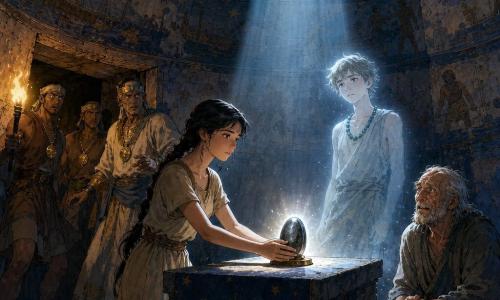
In the center, floating above a stone pedestal, hung the Mirror of Seshat.
It was larger than Nebamun expected—wide as a shield, thin as a moon. Its surface did not reflect firelight or faces. It reflected time.
Nebamun took a step closer, and the Mirror showed him scenes as clear as water: a child learning to write, a king signing a decree, a mother whispering a lullaby, a soldier carving a name into a wall before a battle. Words, words, words—threading human lives together.
Nebamun's throat tightened. “It remembers everything.”
“It remembers what was given to it,” Setem corrected quietly. “And it remembers without cruelty. That is the difference between memory and punishment.”
Nebamun reached out, then stopped. His doubt rose like a hand on his shoulder.
What if you touch it and ruin it?
What if it judges you?
What if it shows you the truth you can't bear?
The Mirror shifted.
Now it showed Nebamun himself—standing in the temple, scraping away a mistake. It showed him lying awake at night, feeling small. It showed him today, sweating in the desert, almost turning back, then taking another step.
Nebamun felt exposed, as if his thoughts had been written on his forehead.
“I'm not brave,” he whispered.
Setem sat beside him, unusually still. “No one is brave all the time. Bravery is what happens in the moment you decide not to stop.”
Nebamun's hands curled into fists. He stared at his reflection-in-time: a man shaped by hesitation and effort. Not a hero from songs. Just himself.
He drew a slow breath. Then another.
“I didn't come to own you,” he said to the Mirror, voice steadying. “I came to return you. To stop the emptiness. To let the temple remember what it lost.”
The Mirror's surface brightened, not like a lamp but like dawn. A single hieroglyph appeared in its center: a feather.
Seshat's sign.
A warmth spread through Nebamun's chest, loosening something knotted there for years. It did not erase his doubt. It placed it in its proper size—small enough to carry without being crushed.
The pedestal beneath the Mirror rose slightly, as if offering it.
Nebamun hesitated only once more. Then he lifted his arms and took the Mirror into his hands.
It was lighter than it looked. It felt like holding cool water in a bowl that could not spill.
The moment he touched it, a soft voice brushed his mind—gentle as fingers on papyrus.
KEEP WRITING. KEEP WALKING. KEEP TRYING.
Nebamun's eyes stung. He blinked hard. “I will.”
Setem stood. “Good. Now we leave before the chamber decides to test your patience with collapsing ceilings. Ancient places love drama.”
Nebamun let out a shaky laugh. “Do you always joke at moments like this?”
“Only when people start getting too serious,” Setem said. “Seriousness makes you heavy. Heavy people sink into sand.”
Nebamun held the Mirror close and turned toward the way out.
The darkness behind them seemed to exhale, relieved, as if a long-held breath had finally been released.
Chapter 6: The Silence of Rest
The journey back was not easier, but it was different. The desert still burned under the sun, and the wind still tried to steal moisture from Nebamun's skin. Yet the pull in his chest had changed. It no longer yanked him forward like a hook. It guided him like a steady hand at his back.
Setem walked with him until the cliffs fell behind and the first thin line of palms appeared on the horizon. At the edge of that greener land, the jackal stopped.
“This is where I leave you,” Setem said.
Nebamun tightened his grip on the Mirror. “Will I see you again?”
Setem's eyes gleamed, amused and old. “If you listen at the right time, perhaps. Or if you get yourself into another impossible story.”
Nebamun hesitated, then bowed his head—a gesture of respect, not to a jackal, but to the strange guidance that had met him in the dark. “Thank you.”
Setem made a sound that might have been a laugh or a snort. “Don't thank me. Thank your own feet. They did the hard work.”
With that, the jackal turned and trotted back toward the dunes. After a few steps, it seemed to blur, as if the heat had swallowed it, and then it was gone.
Nebamun walked on alone. The Nile welcomed him with its familiar scent and its slow, powerful voice. When he reached Thebes, the city looked the same—busy, loud, alive—but Nebamun felt as if he had returned from inside a myth.
Hori spotted him near the docks and nearly dropped his spear. “You look like you wrestled a sandstorm and lost.”
Nebamun's smile was tired but real. “I did wrestle something. It was shaped like a question.”
Hori stared at the Mirror, eyes wide. “You actually—”
Nebamun nodded. “I found it.”
For once, Hori did not joke. He simply stood there, breathing as if the air had changed.
They went to the temple together. The High Priest met them at the entrance, drawn by the commotion. His gaze landed on the Mirror, and something flickered in his face—shock, fear, maybe even relief.
Nebamun held the relic carefully, like a sleeping child. “It belongs here,” he said.
The High Priest's voice was rough. “You should not have—”
“I should have persevered,” Nebamun replied, surprising himself with his calm. “We cannot guard knowledge by burying it. That is not protection. That is forgetting.”
A long silence stretched between them, filled with incense and distant footsteps.
Then the High Priest lowered his eyes. He did not apologize. He did not praise. He simply stepped aside.
Nebamun walked into the inner chamber where the relic had once hung. Priests and scribes gathered, whispering. The air trembled with awe.
With careful hands, Nebamun placed the Mirror onto its ancient hooks. It settled as if it had never left, as if the years of absence were only a blink.
For a moment, the Mirror shimmered. Symbols drifted across its surface like fish beneath water. Nebamun saw, just for an instant, the feather of Seshat and the curve of a smile.
Then the shimmer faded.
The Mirror became still.
Not dead—resting.
The crowd's whispers quieted until even Hori held his breath.
Nebamun stepped back. The doubt that had once gnawed at him was quiet too, not defeated, but lulled. He felt the ache in his legs, the dryness in his throat, the weight of exhaustion settling into his bones like sand into a footprint.
He sat on the cool stone floor, leaning against a column painted with stars. The temple around him seemed enormous and gentle, a shelter built from time and devotion.
Hori crouched beside him. “So,” he said softly, “what happens now?”
Nebamun looked up at the Mirror. Its surface held no scenes now, no bright commands, no flashing maps. Only a calm, silent gleam, like moonlight on still water.
“Now,” Nebamun whispered, “it rests.”
And in that quiet, in the deep hush of ancient stone and patient magic, Nebamun let his eyes close.
The past did not roar.
It simply breathed—slow, steady, and silent at last.