Chapter 1: The Boy Who Listened
Fog clung to the river like a wool cloak, and the wooden palisades of the Merovingian town sweated with morning dew. Roosters shouted. Smiths hammered. Somewhere, a dog argued with a goose and lost.
Aedan kept to the edges, where people rarely looked. He was sixteen—old enough to carry water, young enough to be ignored. That suited him. Watching was safer than speaking, and he had learned that words could fall like sparks onto dry straw.
He crossed the market with a basket of flax, head bowed, eyes open.
“Hey, Quiet Crow!” a baker's son called. “Did your tongue run away again?”
Aedan lifted one shoulder in a shrug. The boy laughed, pleased with himself, and turned away. Aedan let the moment pass. Let everything pass—except what mattered.
What mattered was the whisper he heard beneath the loud, ordinary day.
Not a human whisper. Not quite.
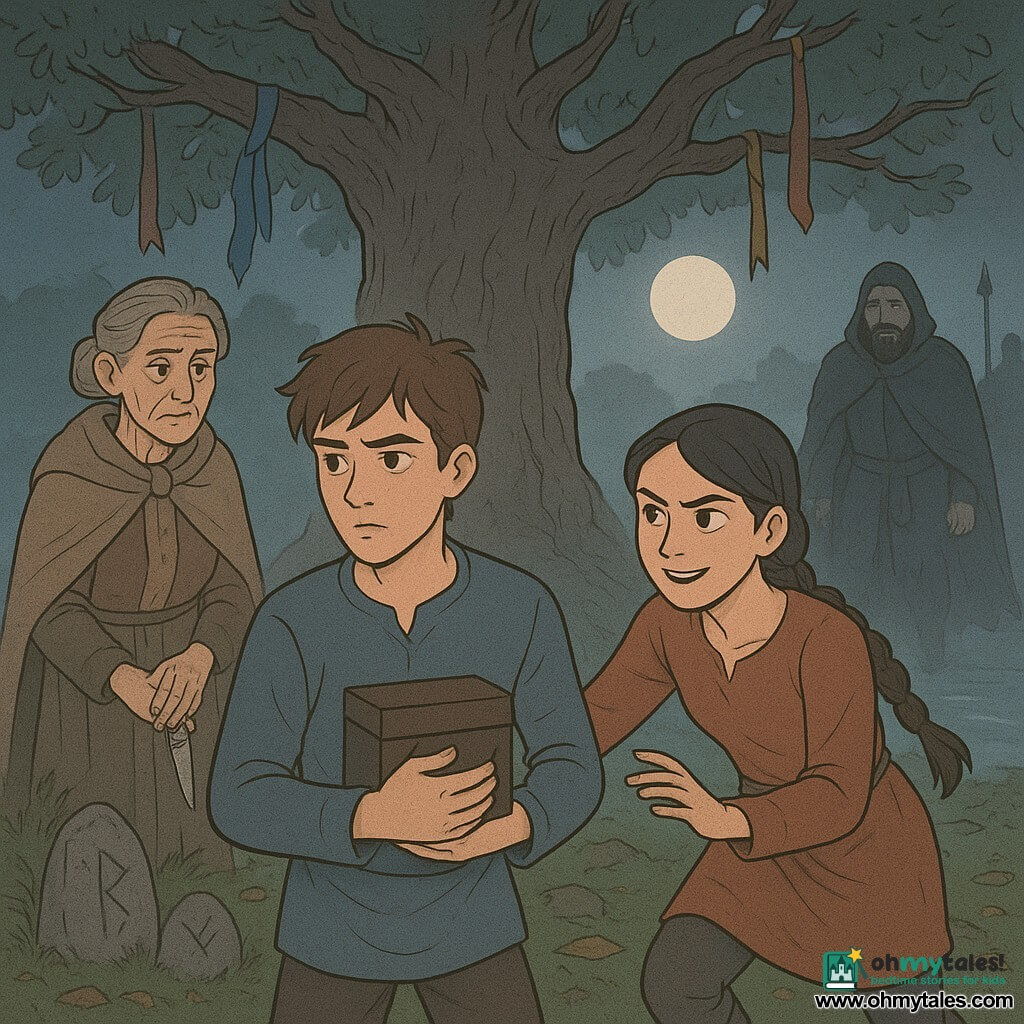
At the shrine near the oak—half-Christian cross, half-old stones—an old woman was tying ribbons for luck. Her hands trembled, but her voice did not.
“Empire,” she murmured, as if tasting a bitter berry. “It falls when memory breaks.”
Aedan slowed. The air around the shrine felt colder, as if winter had pressed a finger there. A faint shimmer moved along the carved stones—like sunlight under water. He blinked. The shimmer blinked back.
The old woman's gaze snapped to him. Her eyes were pale, sharp, and too knowing.
“You're the one who hears,” she said.
Aedan's throat tightened. He could have pretended not to understand. He usually did. But something in her words hooked his ribs from the inside.
“I… I don't know what you mean,” he managed.
She leaned closer, and her breath smelled of dried herbs and smoke. “You know enough. Come tonight, when the town sleeps and the river speaks. Bring no torch. Bring no friend. Bring your stubborn heart.”
Aedan swallowed. “Why me?”
“Because you will not shine,” she said, almost kindly. “And sometimes the world is saved by those who do not shine.”
That evening, while men drank and bragged and argued over whose horse was faster, Aedan slipped away. He walked to the riverbank under a sky bruised with purple clouds. No torch. No friend. Only the steady thump of his own pulse.
The river breathed. The reeds shivered.
The old woman stood at the water's edge as if she had grown there, rooted and waiting. Beside her lay an object wrapped in linen: long and narrow, like a sword, but too quiet for steel.
“You are late,” she said.
“I'm… not,” Aedan replied, though he wasn't sure.
She didn't smile, but something softened in her face. “Good. Listen, Aedan. The Merovingian kings sit on shaky benches. Blood and pride and fear—those are saws. They cut legs from thrones.”
He stared at the river. “What does that have to do with me?”
“Everything,” she said. “Because tonight the Memory-Lock stirs. And if it breaks, the empire does not only fall—it is forgotten. Not stones crumbling. Names crumbling. Stories vanishing. Like footprints in rain.”
Aedan's fingers curled into his palms. He had always believed memory was a kind of magic. Maybe it was.
The old woman unwrapped the linen. Inside lay a narrow strip of gold—thin as a leaf—etched with tiny runes and swirling knots. It was not bright. It was deep, like sunlight trapped in honey.
“This is a seal,” she said. “And a key. The Romans buried the Memory-Lock when their roads still held the world together. They buried it under the oldest stone, where the river meets the bones of the past.”
Aedan felt the runes tug at his eyes, as if they wanted to be read. “I can't read that.”
“You can,” she said. “Not with your mind. With your listening.”
Aedan's stomach sank. “So… I have to find it.”
“You have to keep it from opening,” she corrected. “There are those who want a clean fall. They think it will make room for their own rule. They do not care that without memory, rule is only noise.”
The reeds sighed. Aedan looked up. “Who are you?”
The old woman's pale eyes reflected starlight. “A keeper. A name is a door, and I do not open mine easily.”
He almost smiled. “That's fair.”
She placed the gold seal into his hand. It was warm. Too warm.
“Go at dawn,” she said. “Follow the river west to the old Roman mile-stone, the one split by lightning. Beneath it is a stair that goes down into a place the world pretends not to have.”
Aedan closed his fist around the seal. “And if I fail?”
“Then no one will remember you did,” she said. “And that is the cruelest kind of silence.”
Aedan's chest tightened, but not with fear alone. With purpose. He nodded once.
“I'll go,” he said. Quietly. Like a promise he couldn't take back.
Chapter 2: The Roman Stair
Dawn arrived smelling of wet earth and woodsmoke. Aedan slipped out before the town fully woke. He left no note. No one expected him to have plans.
The river guided him like a long, cold hand. On its surface, the sky lay broken into pieces. Birds skimmed low, quick as thoughts.
By midday he found the Roman mile-stone. It leaned at an angle, cracked down the middle, blackened where lightning had kissed it. Moss grew in the letters, but he could still make out the neat, stubborn lines of an older world.
He pressed his palm to the crack. The gold seal in his other hand warmed again, as if pleased to be near its home.
A whisper rose—not in his ears, but behind his eyes.
Down.
Aedan took a breath and wedged his fingers into the crack. The stone shifted with a reluctant groan. A chill gust poured out, smelling of metal and old rain. Below was darkness shaped like a doorway.
“Well,” Aedan muttered, “that's inviting.”
He climbed down.
The stair was Roman-made: smooth, precise, and unforgiving. His footsteps echoed like small drumbeats. The deeper he went, the more the air changed—less river, more stone; less living world, more waiting.
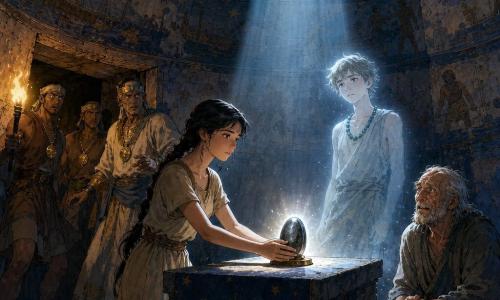
At the bottom, a corridor opened into a chamber where a single round slab lay in the floor, carved with spirals and a ring of runes. The chamber walls held faded paintings: soldiers, ships, a city with seven hills, and a crowned figure with a laurel wreath. Over everything, time had brushed a gray veil.
In the center of the slab was a shallow groove shaped exactly like Aedan's gold seal.
He knelt. His hands shook slightly. “Okay,” he whispered. “I'm listening.”
He placed the seal into the groove.
Nothing happened for a heartbeat.
Then the runes glowed—not bright like fire, but soft like moonlight caught in stone. The chamber hummed, low and steady, like a giant sleeping animal.
Aedan leaned closer. The whisper returned, clearer now, threading through his thoughts like riverweed.
Memory is not kept. Memory is carried.
Aedan swallowed. “Carried by who?”
The slab's spirals shifted, not moving exactly, but changing the way they looked, like an illusion turning inside out. A circle of light appeared on the far wall, outlining a hidden door.
Footsteps above.
Aedan froze. He killed the glow by snatching the seal back. The light faded, but the door outline remained faint, as if it had been drawn in chalk.
The footsteps grew louder, faster. Someone was coming down the stairs.
Aedan backed into the shadows by the wall paintings. He pressed himself flat and tried to breathe like stone.
A figure entered the chamber: a man in a dark cloak, with a narrow face and sharp beard. He carried a lantern shaded so it gave only a small pool of light. His eyes moved quickly, hunting.
“Show yourself,” the man called, voice like a knife laid gently on a table. “I know you're here. I smelled the seal's warmth.”
Aedan held his breath.
The man walked to the slab and crouched, fingers tracing the groove. “So the keeper chose a child,” he murmured. “How poetic. How foolish.”
Behind him, two more men appeared, heavier, armed with short spears. They looked like hired muscle—faces set in the flat expression of people paid not to care.
“Aedan,” the bearded man said suddenly, as if tasting the name. “Come out, Quiet Crow. You can't keep an empire standing with silence.”
Aedan's stomach flipped. How did he know his name?
He thought of the old woman by the river. A keeper. Names are doors.
The bearded man smiled into the dimness. “I am called Ragnulf,” he said. “Remember it. It will be the last clear thing you do.”
Aedan's fingers found a loose pebble by his boot. He flicked it across the chamber. It skittered, clattering near the stairs.
One spear-man turned his head. “There!”
They rushed toward the sound.
Aedan moved the other way, quiet as a shadow slipping off a wall. He darted to the faint outline of the hidden door and pressed the gold seal to it.
Warmth flared. The door sighed open like a mouth releasing a secret.
Aedan slipped through and pulled it shut behind him. The lantern light vanished.
In the darkness beyond, a new corridor stretched forward, and the air tasted like storms.
Behind the stone, Ragnulf's voice snapped, furious. “Find him!”
Aedan ran.
Chapter 3: The Hall of Echoes
The corridor ended in a vast underground hall supported by thick columns. Water dripped from the ceiling with slow patience. The floor was scattered with broken tiles and bits of old glass that caught faint light from nowhere.
Aedan slowed, trying not to trip. His breath came fast, loud in his own ears.
Then he heard it: voices.
Not living voices. Echo-voices—thin, overlapping, like many people speaking through a wall. The sound swirled around him, forming half-words, half-sighs.
He raised the gold seal. It pulsed softly, as if responding.
On the far end of the hall stood a statue of a Roman soldier, taller than any man, with a cracked face and an empty stone gaze. At its feet was a shallow basin filled with dark water.
Aedan approached carefully. The echo-voices grew clearer.
“…roads…”
“…oaths…”
“…crowns turn to dust…”
He knelt by the basin and looked into the water.
Instead of his reflection, he saw a scene: a wooden hall, torches blazing, men shouting. A Merovingian noble slammed a cup down, wine spilling like blood. A boy—no, a young man—stood behind a curtain, listening. His face was Aedan's, but older, sharper, haunted.
Aedan jerked back. “That's—”
The water rippled. The older Aedan looked straight at him through the surface and mouthed a word.
Persevere.
Aedan's skin prickled. The basin wasn't showing the future exactly. It was showing a path—one possible thread. It was asking him to keep walking even when the hall got loud, even when fear made his bones feel brittle.
A soft clink echoed behind him.
Aedan spun. A girl stood between two columns, half-hidden. She was about his age, with dark hair braided tight and a small knife tucked at her belt. Her eyes were bright and curious.
“You're not one of Ragnulf's men,” she said.
Aedan's mouth opened, then closed. He didn't know how to answer quickly.
She tilted her head. “Right. You're the quiet kind. That's fine. I talk enough for two.”
Aedan's lips twitched. “Who are you?”
“Branwen,” she said. “And before you ask—no, I'm not lost. I followed them. Someone has to stop fools from breaking old things.”
Aedan glanced toward the corridor he'd come from. “They're close.”
Branwen stepped nearer, eyeing the gold seal in his hand. “That's the key, isn't it? The thing the river-keepers guard.”
Aedan hesitated.
Branwen snorted softly. “If I wanted to steal it, I'd have tried already. Besides, I've got my own reason.”
“What reason?”
“My father is a scribe,” she said, and her voice changed—less playful, more solid. “He says the new lords don't want Roman records. They want people to forget there was ever law beyond their swords. They burn scrolls. They call it ‘cleaning.'”
Aedan's fingers tightened around the seal. “Ragnulf wants the Memory-Lock open.”
“Or broken,” Branwen said. “Open is messy. Broken is permanent.”
From the corridor came a distant shout. Then the scrape of boots.
Branwen grabbed Aedan's sleeve. “Come on, Quiet Crow. If you're going to save an empire, you'll need more than listening. You'll need legs.”
Aedan didn't argue. He followed.
They crossed the hall toward the statue. Branwen plunged her hand into the basin without flinching and pulled out a small stone disk engraved with the same spirals as the slab upstairs.
“Ha!” she whispered. “Knew it.”
Aedan stared. “You just… reached into cursed water.”
Branwen shook her wet hand. “It's only cursed if you don't respect it.”
Aedan almost laughed—almost. “What is that?”
“A map,” she said. “Or a promise. Look.”
She held the disk near the seal. Lines of light crawled across it, forming a simple route: a path leading deeper underground, then rising to a mark shaped like an oak leaf.
“The old oak shrine,” Aedan breathed.
Branwen nodded. “The keeper sent you down here, but the answer climbs back up. Very dramatic.”
Boots thundered closer now, echoing from the corridor.
Aedan looked at the towering Roman statue, cracked and silent. “How do we lose them?”
Branwen grinned. “We don't. We distract them.”
She picked up a loose tile and threw it hard into the darkness across the hall. It shattered with a sharp crack.
“Over there!” one of the spear-men shouted from the corridor.
Branwen seized Aedan's wrist. “Now!”
They sprinted behind the statue. A narrow gap yawned in the wall—another hidden passage, disguised by old fallen stones. Branwen slid in first. Aedan followed, heart pounding like a war drum.
As the darkness swallowed them, Aedan heard Ragnulf's voice ring through the hall, calm again, like a knife returned to its sheath.
“Run,” Ragnulf called. “The past has long corridors. You will tire before I do.”
Aedan didn't answer.
He just kept going.
Chapter 4: The River Below the River
The hidden passage sloped downward until the air turned damp and cold enough to bite. Soon the sound of flowing water rose around them—deeper than the river above, as if the earth had its own hidden bloodstream.
They emerged onto a ledge overlooking an underground stream. The water glimmered with a faint blue light, like crushed stars stirred into it. The ceiling arched high, studded with mineral crystals that winked when they moved.
Branwen whistled softly. “If my father could see this, he'd try to write it down and his ink would faint.”
Aedan crouched, peering into the stream. The light wasn't from the stones. It was from the water itself, moving as if it remembered being sky.
The map-disk in Branwen's hand pulsed. The oak-leaf mark hovered ahead, across the stream, where a stone bridge—old and narrow—spanned the glittering flow.
They crossed carefully. The bridge was slick, and the water below whispered in layered voices. Aedan couldn't make out words, but he felt meaning in the sound—like a crowd murmuring before a great announcement.
On the far side stood a carved archway. Above it, a Latin phrase curled in stone. Aedan couldn't read it, but the gold seal grew warm in his palm, and understanding slipped into him as smoothly as breath.
What is remembered still stands.
Branwen watched his face. “You understood that, didn't you?”
Aedan nodded. “I… heard it.”
“Useful trick,” she said. Then, more quietly: “Scary too.”
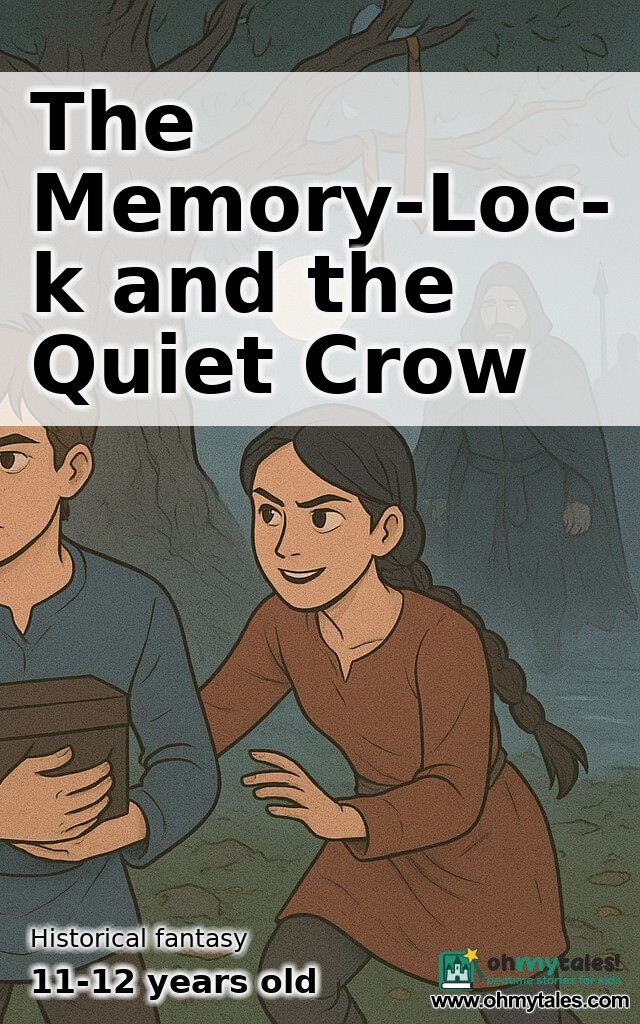
Aedan pushed open the archway. Inside was a chamber shaped like an upside-down bowl. In the center rose a pedestal holding a small chest of dark wood bound with iron. Around it, the floor was inlaid with tiny mosaics—people dancing, writing, building, singing—each scene a frozen spark of life.
Aedan's throat tightened. This wasn't treasure. It was proof.
Branwen stepped closer, reverent despite herself. “So that's the Memory-Lock.”
Aedan approached the chest. The gold seal tugged toward it, as if eager to complete itself. He set the seal into a matching slot on the lid.
The chest clicked open.
Inside lay not jewels, but a bundle wrapped in linen: thin tablets of wax, a small roll of vellum, and a tiny glass vial filled with silver dust. On the wax tablets were scratched names—Roman, Frankish, Celtic—mixed together like braided hair.
Branwen exhaled. “Records.”
“Memory,” Aedan whispered. “Portable.”
A voice echoed from the archway behind them. “How touching.”
Ragnulf stepped into the chamber with his two spear-men. His lantern light bounced off the mosaics, making the tiny figures seem to move.
Branwen's hand went to her knife. Aedan's went to the chest.
Ragnulf's smile was thin. “You've done the hard part for me. Hand it over, boy. And girl—go home. This is a game for rulers.”
Branwen raised her chin. “Rulers? You're a man who likes to kick ladders down after he climbs.”
Ragnulf chuckled. “And you're a child who thinks bravery is armor.”
Aedan stared at the wax tablets. Names. Lives. Voices trapped in scratches. If Ragnulf destroyed them, the empire's fall would become a blank space—easy to rewrite, easy to twist.
Aedan heard the river below the river, whispering without words. Persevere, it seemed to say. Not with strength. With steadiness.
He looked at the silver dust vial.
“What is that?” Branwen whispered, following his gaze.
Aedan didn't fully know. But the seal warmed, and understanding slid in again: a memory-ink, meant to bind words to minds, not to paper.
Ragnulf stepped forward. “Enough. Give me the chest.”
Aedan lifted the vial. “If I break this,” he said softly, “you'll never be sure what people remember.”
Ragnulf paused, eyes narrowing. “You wouldn't.”
Aedan met his gaze. He was trembling, but he did not look away. “I'm quiet,” he said, “not harmless.”
Branwen blinked at him as if seeing him for the first time.
Ragnulf's expression hardened. “Take them,” he ordered his men.
The spear-men advanced.
Branwen moved first—quick as a startled cat—kicking one man's knee and darting aside. The other lunged for Aedan.
Aedan flung the vial—not at the man, but at the mosaic floor.
Glass shattered. Silver dust burst upward like a small storm.
For a moment, the chamber filled with drifting sparks. They clung to skin and hair and breath. Aedan tasted metal and rain. The air thickened with images—faces, streets, laughter, a legion marching, a monk writing by candlelight.
The spear-men staggered, swatting at the glittering haze. One cried out, “I— I can see—”
Ragnulf cursed, pulling his cloak over his mouth. “Fools! Don't inhale it!”
Branwen grabbed the chest and shoved it into Aedan's arms. “Run!”
Aedan ran.
They dashed through the archway and back across the bridge. Behind them, Ragnulf shouted orders, his voice breaking against the whispering water.
Aedan's legs burned. His lungs felt too small. But he kept going, the chest heavy and real against his ribs.
Persevere, he thought, and the word felt like a hand on his back.
Chapter 5: The Oak and the Oath
They climbed for what felt like hours, following the glowing lines on Branwen's disk until the underground stream's whisper faded and the air warmed. At last, a narrow stair led up into moonlight.
They emerged near the old oak shrine. The town lay in the distance, quiet under a scatter of stars. The oak's branches stretched like dark arms, hung with ribbons that fluttered in the night breeze.
The keeper stood waiting by the stones, as if she had never moved since the riverbank.
“You opened it,” she said, eyes on the chest.
Aedan set it down carefully. His hands were shaking from effort and leftover fear. Branwen stood beside him, breathing hard, face smudged with dust and stubbornness.
Ragnulf's shout echoed faintly from below, far but not gone.
“He's coming,” Branwen warned.
The keeper nodded once. “Of course he is.”
Aedan looked at the chest, then at the shrine stones, then at the town beyond. “How do we stop him? If he gets those tablets—”
“He won't,” the keeper said. “Not if we do what the Lock was made for.”
Branwen frowned. “Which is?”
The keeper reached into her cloak and drew out a small knife with a bone handle. She held it out to Aedan.
Aedan stared. “No.”
“It won't take your life,” she said. “Only a drop. An oath needs a door. Blood is one kind.”
Aedan swallowed. He didn't like the idea, but he liked forgetting even less.
He pricked his finger. A bright bead formed. He let it fall onto the shrine stone.
The stone drank it, and the runes on the gold seal—still set in the chest—glimmered faintly.
The keeper spoke, voice low and rhythmic, like an old song. Branwen, after a hesitant moment, pricked her finger too and added her drop.
The air around the oak trembled. The ribbons lifted, as if the tree exhaled.
Aedan felt something open—not the chest, but the world. A quiet space inside him made room, like a shelf being cleared.
“Now,” the keeper said, “choose.”
Aedan blinked. “Choose what?”
“What form memory will take,” she said. “If it stays in objects, it can be stolen. If it goes into flames, it can be scattered. If it goes into people, it can travel—but it can also change.”
Branwen whispered, “People are messy.”
Aedan looked at the town. At the sleeping roofs. At the lives inside them, each one a small story. He thought of scribes and songs, of children repeating tales they only half-understood. He thought of Ragnulf, wanting blankness so he could write his own truth in its place.
He lifted the wax tablets from the chest. The scratched names caught moonlight like tiny scars.
“I'll carry it,” he said.
The keeper's pale eyes softened. “You already do.”
Aedan shook his head. “Not in my hands. In me.” He looked at Branwen. “And in you, if you'll have it.”
Branwen swallowed. “I… yes. I'd rather be messy than empty.”
The keeper began to chant again. The gold seal warmed, almost hot. The runes on the shrine stones lit, one by one, like stars waking.
Footsteps approached—fast, angry. Ragnulf burst into the clearing, cloak torn, lantern swinging. Behind him, his spear-men stumbled, faces pale, eyes unfocused as if the silver dust still swam in their thoughts.
“There!” Ragnulf snarled. His gaze locked on the chest. “Give it to me!”
Aedan stood, holding the tablets close to his chest. His voice was quiet, but it did not shake.
“No,” he said.
Ragnulf advanced. “You think an oath and a tree will stop me?”
The oak's leaves rustled, though there was little wind. The ribbons snapped like tiny flags.
The keeper lifted her hand. “This tree has watched kings rot and new kings rise. It does not hurry.”
Ragnulf lunged.
Aedan felt the chant surge through him like the underground river. The scratched names on the tablets seemed to lift, turning into threads of light that slipped into his skin—not painful, but intense, like stepping into cold water.
Branwen gasped as light-thread brushed her too. Her eyes widened. “I— I can hear them,” she whispered. “The names.”
Ragnulf staggered as a ribbon whipped across his face. He struck at it, furious, but more ribbons tangled around his arms. Not tight enough to harm—tight enough to delay.
The keeper's voice rose. “Memory is not yours to command.”
Ragnulf fought, snarling, but the oak held him like a patient giant holding a tantrumming child.
Aedan's knees wobbled. The weight of the empire's names pressed behind his eyes. He saw roads and laws and songs, and also betrayals, hunger, winter. Memory was not pretty. It was true.
He breathed through it. Persevere.
When the chant ended, the wax tablets in his hands had gone dull—blank, as if scraped clean. The chest held only linen and ordinary air.
Ragnulf stared, wild-eyed. “What did you do?”
Aedan's voice came out steady. “I listened,” he said. “And I remembered.”
Chapter 6: What the Future Keeps
By dawn, Ragnulf was gone. The oak released him when the keeper let it, and he fled—empty-handed, cursing the old magic and the stubborn children who wouldn't play quietly.
Aedan and Branwen sat on the riverbank where the fog returned like a familiar cloak. The keeper had vanished before sunrise, as if she were made of night and duty.
Branwen poked the water with a stick. “So now you're… what? A walking library?”
Aedan snorted softly. “A quiet one.”
She leaned back on her hands. “I can still hear some of it. Not all. But pieces. My father's going to think I've become strangely wise overnight.”
Aedan glanced at her. “Has that ever happened to anyone?”
Branwen grinned. “No. It's suspicious.”
Aedan looked across the river. The town was waking: smoke rising, doors opening, the ordinary day beginning again. The empire would still have wars, plots, and foolish rulers. He couldn't freeze time. He couldn't make everyone kind or wise.
But he could keep the fall from becoming a disappearance.
He touched his chest lightly, feeling the strange new fullness there—like carrying a song you can't forget.
Branwen's smile faded into something thoughtful. “Do you think it will be enough?”
Aedan watched a pair of children chasing each other along the bank, their laughter bright against the morning. “Not all at once,” he said. “But… I won't stop.”
Branwen nodded. “Good. Because if you do, I'll talk at you until you start again.”
Aedan's lips quirked. “That sounds terrible.”
“It is,” she said proudly.
The river flowed on, indifferent and endless. Yet in its surface, the sky held together—piece by piece—like a mosaic repaired.
Aedan stood and adjusted the strap of the empty chest across his shoulder. He would keep it anyway, as a reminder: objects could be lost, but an oath carried in living hearts could travel through ruins and winters.
He didn't need a crown. He didn't need applause. He needed perseverance—quiet, stubborn, daily.
As he and Branwen walked back toward the town, Aedan began to speak—not much, not loudly, but enough.
He told her a name from the tablets. Then another. And Branwen repeated them, carefully, like placing stones in a wall.
Behind them, the oak shrine stood watching, ribbons fluttering, holding its own silent laughter at how the world was saved again—not by a shining sword, but by memory preserved in two determined young people who refused to let the past be stolen.