Chapter 1: The Promise Under the Broken Obelisk
The sun lay heavy on the Nile, turning the river into a ribbon of hammered gold. Beyond it, Thebes shimmered—temples, pylons, and columns rising like stone forests. To most people, the late dynasties felt like a long afternoon: hot, slow, and watched over by statues that never blinked.
To Nefra, it felt like a held breath.
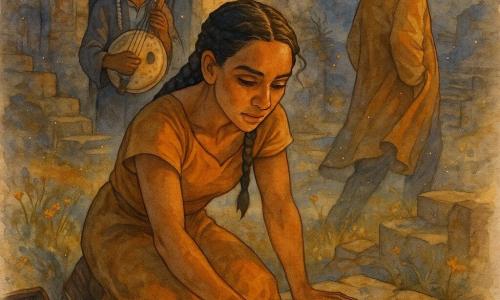
She moved through the market with a basket on her arm and sand in her sandals, her dark braid swaying against her shoulder. Sellers called out over figs and fish, carved beads and bright linen. A boy chased a runaway goat. Somewhere, a scribe argued with a donkey.
Nefra stopped near a fallen obelisk half-buried in the dust behind a row of pottery stands. The obelisk had cracked years ago. Its carved hieroglyphs were worn like old scars. It was also the quietest place in the loudest part of the city.
An old man waited there, his cloak the color of ash, his eyes sharp as a hawk's.
“You came,” he said.
“I said I would,” Nefra replied, setting her basket down. “I keep my word.”
The man's name was Bek, a temple record-keeper who had once served in the House of Life before politics shoved him aside like a cracked jar. He wasn't her family, but he had fed her when she was younger, taught her to read when ink was too expensive, and treated her like she mattered.
Now his hands trembled as he held out a small pouch of linen. “This belongs to the past. And the past is waking.”
Nefra took the pouch. Something inside was cool as river-stone. “What is it?”
“A cartouche,” Bek whispered. “Not of a king you know. Not written in the lists. It was erased.”
Nefra frowned. “Erased?”
Bek glanced around, then leaned closer. “A ruler who promised freedom to those bound to temples and estates. He broke chains. The powerful hated him for it. When he died, they scraped his name away so it would never be spoken again.”
Nefra's fingers tightened around the pouch. In her mind, she saw temple workers bent like reeds, carrying stone until their backs became questions nobody answered. Freedom was a word people used carefully, as if it might bite.
Bek's voice grew thinner. “I swore an oath long ago. I would return his name to the scales of truth. But I am old, Nefra. I cannot travel. I cannot fight what comes.”
“You want me to do it,” she said, and it wasn't a question.
“I want you to honor my word—our word—before my breath runs out.” Bek's eyes shone, fierce and tired at once. “Take the cartouche to the Tomb of Unfinished Stars, beyond the western cliffs. Place it on the altar where the moonlight falls. The name will wake. Balance will answer.”
Nefra swallowed. She had her own quiet wish tucked behind her ribs like a secret amulet: to honor the promises made in a world that forgot them easily.
“You're asking me to walk into the land of the dead,” she said.
Bek's mouth twitched. “Only the edge of it. Try not to get lost. The dead are terrible at giving directions.”
Despite herself, Nefra snorted. “That's reassuring.”
Bek pressed his palm to his chest. “Will you do it?”
Nefra looked at the cracked obelisk, the missing piece that would never return. She imagined a name scraped away, a promise left unfinished. Then she nodded. “I will.”
As she spoke, the air around the pouch seemed to deepen, like water over a hidden stone.
“Good,” Bek breathed. “Then the past has a chance to breathe again.”
Chapter 2: Papyrus Maps and a Crocodile With Opinions
Nefra left at dusk, when the city's heat softened and the sky turned the color of pomegranate skin. She carried a waterskin, dates, a small knife, and Bek's pouch tied beneath her tunic. Bek had also given her a rolled papyrus map that looked older than most jokes.
On the riverbank, a narrow boat waited—more reed than wood. The ferryman, a woman with silver rings in her ears, raised an eyebrow at Nefra's pack.
“Going to the west?” the ferryman asked.
“Just visiting,” Nefra said.
The ferryman gave her a look that said, Visit all you like, but don't complain if the spirits serve you sand for supper. Still, she took Nefra across. The Nile lapped against the boat like a patient animal.
Halfway over, something surfaced beside them: a crocodile, its eyes two dark coins above the water. It floated for a moment, watching.
Nefra froze.
The crocodile opened its mouth. “You're rowing like you're stirring soup,” it said, voice low and raspy.
Nefra nearly dropped her paddle. The ferryman didn't even blink.
“Do not talk back to river-thoughts,” the ferryman murmured. “They get insulted.”
The crocodile continued, unbothered. “If you're going to the cliffs, you'll need more courage than that.”
Nefra found her voice. “Are you… real?”
“Define real,” the crocodile replied. “I'm real enough to bite. That usually settles arguments.”
The ferryman sighed, as if crocodiles giving advice was simply another part of her job. “Pay no mind. The river repeats what it hears.”
But Nefra couldn't ignore it. The animal's gaze seemed to press through her, searching for truth.
“I'm going because I promised,” she said quietly.
The crocodile blinked slowly. “Promises are heavy stones. Some people toss them in the water and walk away.”
“I'm not some people.”
“Good,” it said, and slipped under with barely a ripple. The water smoothed itself as if embarrassed.
When they reached the western bank, the ferryman accepted her payment and leaned closer. “The desert listens. Keep your thoughts tidy.”
“My thoughts are never tidy,” Nefra admitted.
“Then make them brave,” the ferryman said, and pushed off without another word.
Nefra stood alone at the edge of the desert. The west was the color of bone. Somewhere beyond those cliffs were tombs carved into stone, and stories buried under centuries of dust.
She took a breath, adjusted her pack, and stepped into the sand.
Chapter 3: The Gate of Whispering Sand
The path to the cliffs wound between low hills and scattered acacia trees that looked like they were holding up the sky with skinny arms. The wind wrote fast messages on the dunes, then erased them before anyone could read.
As night fell, the stars came out sharp and bright, as if the heavens had been polished. Nefra followed the map by starlight, counting ridges and dry gullies. The air smelled of stone and distance.
Near midnight, she reached a narrow pass where the cliffs rose on either side. At its entrance stood two broken statues—jackal-headed guardians with missing noses and chipped ears. Between them, the sand swirled in a slow spiral, even though the wind had died.
Nefra's skin prickled.
The spiral tightened, and a voice slid out of it like a thread pulled from cloth. “Name your master.”
Nefra lifted her chin. “I have none.”
The sand paused, as if surprised.
“Name your price,” the voice hissed.
“I'm not selling,” she said, and her heart thumped hard. “I'm walking.”
The spiral widened, forming a thin curtain of sand. Behind it, darkness waited.
“Many enter,” the voice said. “Few leave. The dead dislike interruptions.”
“I'm not here to interrupt,” Nefra replied. She touched the pouch beneath her tunic, feeling the cool shape inside. “I'm here to return something that was stolen.”
Silence. Then the sand-voice chuckled, dry as old parchment. “Stolen names are the tastiest.”
“That's disgusting,” Nefra muttered.
“Truth often is,” the voice said. “Pass, then. But know this: the tomb does not test your strength. It tests your freedom. Chains can be made of gold, fear, and even kindness.”
Nefra stepped forward. The sand curtain brushed her skin like cold smoke. For a moment she saw nothing—only darkness full of tiny sparks. Then her feet found stone again, and the pass opened into a hidden valley.
In the valley's center stood a temple half swallowed by rock, its doorway shaped like a wide open mouth. Above it, carved stars filled the lintel, and some of them seemed to shift when she wasn't looking.
Nefra approached, the air growing cooler with each step. On the temple steps lay a cracked bowl, as if waiting for an offering.
She placed a date inside, then felt silly. “For hospitality,” she told the stones.
A faint whisper tickled her ear. Not words—more like a sigh of approval.
She squared her shoulders and entered the Tomb of Unfinished Stars.
Chapter 4: The Hall Where Time Holds Its Breath
Inside, the tomb was not a simple tunnel but a maze of halls painted with fading scenes: boats carrying the sun, gods with animal faces, kings raising hands to blessings that looked like beams of light. The air tasted of dust and old incense.
Nefra's footsteps echoed, then softened, as if the tomb was learning her weight.
At the first junction, three corridors branched like fingers. Her map showed only one line, and it trembled in her hands like it was nervous.
“Helpful,” she whispered.
A voice answered from the shadows, calm and amused. “Maps are brave on tables and cowardly underground.”
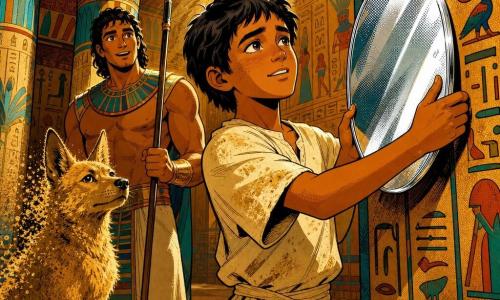
Nefra spun. A figure stood leaning against the wall—a boy about her age, wearing a linen kilt and a necklace of blue beads. His hair was cut short, his eyes bright. Too bright.
“You're lost,” Nefra said, because it felt safer than asking, Are you dead?
“I'm waiting,” he corrected. “It gets boring. The afterlife could use more games.”
She narrowed her eyes. “What are you?”
He tilted his head. “A question. A memory. A guard. Choose one.”
Nefra didn't like riddles, especially when they walked and talked. “Do you want something from me?”
“I want to see if you deserve to pass,” he said. “People come here for treasure. For power. For secrets. They leave with… less.”
“I didn't come for any of that.”
“No one believes that,” the boy replied, then smiled. It wasn't cruel—more like curious. “Prove it.”
“How?”
He pushed off the wall and walked toward a painted scene of workers pulling a giant statue on sledges. “These halls remember what was done. And what was undone.” He tapped the wall. The painted ropes shimmered, then slid free like snakes.
Nefra stepped back as the painting became real. The hall filled with the scrape of stone and the groans of men. Workers appeared—thin, sweating, eyes downcast—pulling a colossal block. A foreman raised a whip.
Nefra's stomach tightened. “This is a trick.”
“It's a lesson,” the boy said. “They are bound. What will you do?”
Nefra glanced at the corridor behind her. She could run. She could ignore it. She could tell herself it wasn't real.
But she had seen enough real suffering in the city to recognize the shape of it anywhere.
She marched forward and grabbed the whip from the foreman's hand.
The foreman turned, eyes empty as jar lids. “Obey,” he said.
“No,” Nefra replied, and snapped the whip over her knee. The crack sounded like a small thunderclap.
The workers paused, blinking as if waking from a bad dream.
The boy watched closely. “And now?”
Nefra breathed fast. “Now they choose.” She turned to the workers. “Drop the rope if you want. Walk away. Nobody owns your bones.”
For a moment, nothing happened. Then one worker loosened his grip. Another followed. The rope fell in a soft heap.
The hall shuddered. The scene peeled away like wet paint, leaving only the original wall—faded, silent, but somehow lighter.
The boy's grin widened. “Interesting. You didn't take control. You gave it away.”
“That's what freedom is,” Nefra said, surprised by how steady her voice sounded. “It's not a gift you hold over someone's head.”
The boy's eyes softened, and for a moment he looked almost alive. “Then you may continue. But the tomb will ask harder questions.”
Nefra nodded. “I'll answer as best I can.”
“Most people answer with their fear,” he said, and stepped back into the shadows. “Don't.”
Chapter 5: The Cartouche That Wanted to Sing
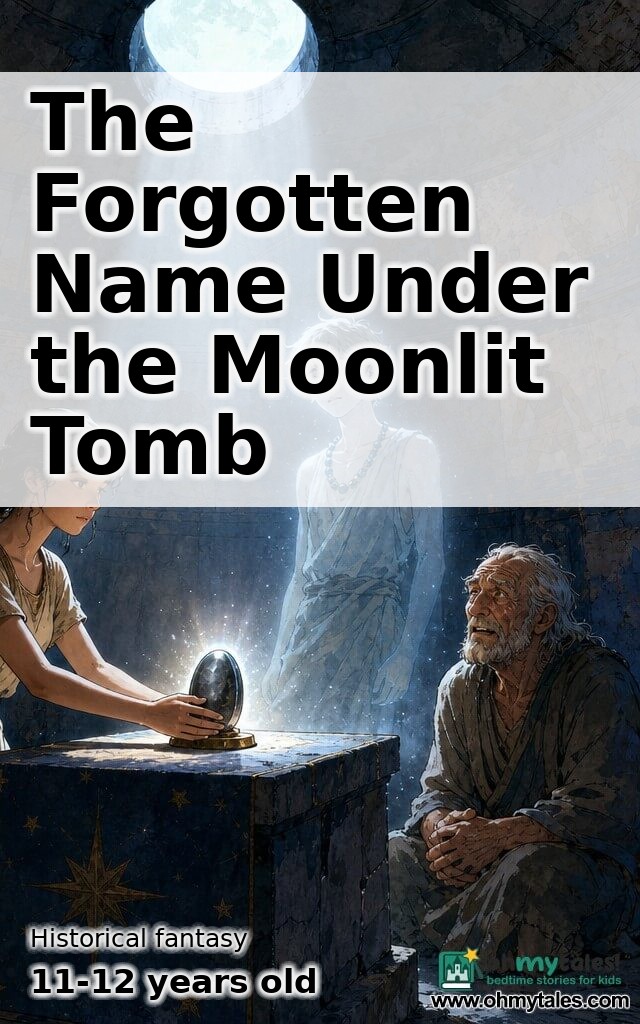
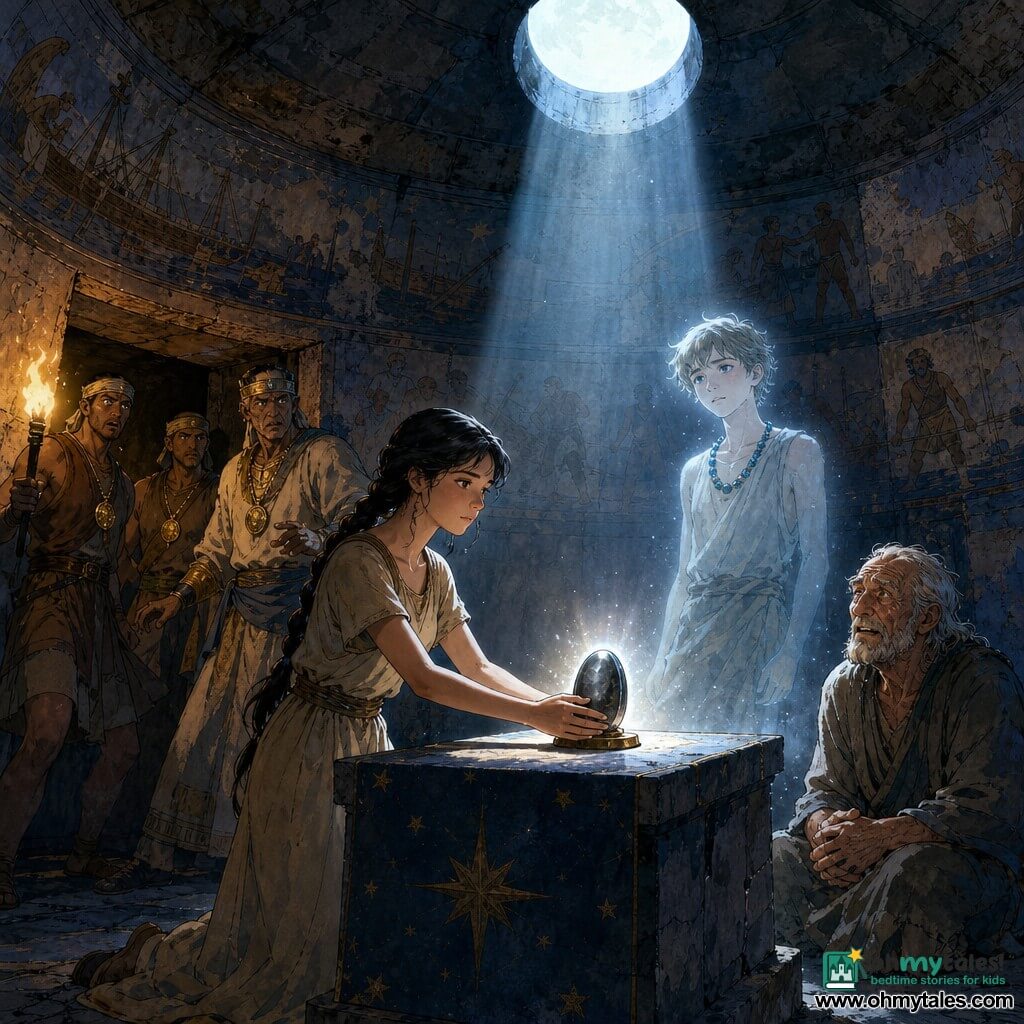
Deeper in, the corridors narrowed, then opened into a chamber shaped like a dome. A hole in the ceiling revealed a slice of night sky. Moonlight poured down in a pale column, landing on a stone altar carved with stars.
This was it—where the moonlight fell, just as Bek had said.
Nefra approached, her pulse loud in her ears. The air here felt different, almost awake. The walls hummed faintly, like a drum heard from far away.
She untied the linen pouch and drew out the cartouche.
It was a small oval of dark stone, smooth except for the carved name. The hieroglyphs seemed to shift when the light touched them, as if the symbols were trying to remember how to be read.
The moment the cartouche met moonlight, it grew colder—then suddenly warm, like a hand holding hers.
Nefra sucked in a breath. “All right,” she whispered. “I'm here. I kept the promise.”
A voice rose from the altar, not loud but deep enough to feel in her ribs. “A promise binds two souls. Whose word do you carry?”
“Bek's,” Nefra said. “And mine. He swore to restore a forgotten name. I swore to honor his oath.”
Moonlight brightened, turning the chamber silver. The boy from the halls appeared at the edge of the light, watching with a serious face.
The altar-voice continued. “Names are not just sounds. They are doors. Why do you open this one?”
Nefra thought of Bek's shaking hands. The erased ruler who had freed workers, then vanished from history like a footprint in wind. She thought of people in Thebes who worked their whole lives without choice, and called it duty because it hurt less than calling it unfair.
“Because freedom deserves to be remembered,” she said. “Because erasing a name is like locking a bird in a box and pretending the sky never existed.”
The chamber fell silent. Even her breath sounded too loud.
Then the cartouche vibrated, a tiny shiver like a plucked string. The hieroglyphs began to glow—not bright like fire, but steady like dawn.
The boy stepped closer, eyes wide. “It's waking.”
The altar-voice became gentler. “To restore balance, the forgotten must be spoken. But the speaking has a cost. If you free this name, another chain must break. Whose chain?”
Nefra's throat went dry. “Mine?”
“Perhaps,” said the voice. “Perhaps Bek's. Perhaps the city's. Freedom is never cheap, child of the river. It asks for courage, not coins.”
Nefra looked at the cartouche. It felt alive now, restless, as if it wanted to sing its name into the stone.
“I'm not doing this for reward,” she said. “Tell me what to do.”
The voice answered, “Place it. Speak the name as it was meant to be spoken.”
Nefra set the cartouche on the altar. The moonlight wrapped it like a cloak.
She leaned in, reading the symbols the way Bek had taught her—slowly, respectfully, letting each curve and line become sound. The name came to her mouth like a bird returning to its nest.
“Neferkha… Setepen… Ma'at.”
The chamber rang. Not with noise, but with meaning—like a bell made of truth.
Outside the hole in the ceiling, clouds slid across the moon, and for a heartbeat the light dimmed. The walls seemed to inhale.
Then the tomb exhaled.
Chapter 6: The Ones Who Tried to Keep the Past Locked
A harsh scraping echoed from the corridor, and torchlight flickered at the entrance of the chamber. Three men stepped in—temple guards, their faces stern under linen headcloths. Behind them stood a priest with kohl-lined eyes and a gold amulet shaped like a chained falcon.
Nefra's stomach dropped. “How did you—”
“The old record-keeper talks too much,” the priest said smoothly. “And you walk too loudly, girl.”
“I'm not stealing,” Nefra snapped, planting herself between them and the altar.
The priest's gaze slid to the glowing cartouche. Greed and fear flashed across his face like twin shadows. “That name was buried for a reason.”
“Because powerful people didn't like what it stood for,” Nefra said.
The priest lifted his chin. “Order must be protected.”
“Order for whom?” Nefra shot back. “For those already holding the ropes?”
One guard stepped forward. “Move aside.”
Nefra's hands shook, but she didn't move. “No.”
The boy beside her whispered, “This is the harder question.”
The priest raised his amulet. The chained falcon glinted. “Then you will be bound by your own stubbornness.”
A cold pressure spread through the air, like invisible cords tightening. Nefra's arms felt heavy. Her knees wanted to fold.
The priest smiled. “See? Chains can be made of magic too.”
Nefra clenched her teeth. She looked at the cartouche, still glowing steadily under moonlight, and understood something with sudden clarity: freedom wasn't just breaking chains. It was refusing to hand someone the key.
She took a slow breath and thought of Bek's voice: I swore an oath. I would return his name to the scales of truth.
“I won't be owned,” she whispered.
The words didn't sound magical. They sounded human. But the tomb heard them.
The painted stars on the walls brightened. A wind rose inside the chamber—impossible, clean, smelling of rain that had not yet fallen. The altar's glow sharpened, and the cartouche's light spilled outward like water poured from a jar.
The guards staggered back, shielding their eyes.
The priest hissed, forcing his amulet forward. The chained falcon seemed to twitch, alive with binding spells. But the tomb's wind struck it, and the gold chain in the carving cracked straight down the middle.
The amulet shattered in the priest's hand.
He stared, stunned. “Impossible.”
“No,” Nefra said, her voice steady now. “Just balanced.”
The boy grinned, fierce and delighted. “Tell him again.”
Nefra lifted her chin toward the priest. “You can't keep freedom buried forever. Names find their way back.”
The priest backed away, face pale. The guards followed, suddenly less eager. They retreated into the corridor, their torches wobbling like frightened fireflies.
As they vanished, the wind settled. The chamber returned to quiet moonlight.
Nefra's legs went weak, and she sank onto the cool stone floor. “I thought I was going to turn into a statue.”
The boy sat beside her, swinging his feet as if they weren't in a tomb. “If you did, at least you'd look heroic.”
“That's not comforting.”
“It's slightly comforting,” he argued.
Despite everything, Nefra laughed—a short, breathless sound that felt like opening a window in a stuffy room.
Then the boy's smile faded into something tender. “You did what the ruler did,” he said softly. “You broke a chain without becoming its new owner.”
Nefra looked at him. “Who are you really?”
He touched his chest where a heart would be. “I was one of the ones he freed. My family carried stone for other people's dreams. When his name was erased, our freedom began to fade, like ink in sun. I stayed here—unfinished—waiting.”
Nefra swallowed hard. “And now?”
The cartouche's glow pulsed, gentle as breathing. The chamber felt warmer, as if the stone itself had softened.
“Now the story is remembered,” the boy said. “And I can go.”
Chapter 7: Balance Returned Like Morning Light
The moon slid fully into view again, brighter than before. Its light poured onto the altar, and the cartouche lifted a finger's width off the stone, hovering as if buoyed by song.
The altar-voice returned, calm and vast. “The name is restored. The scales settle.”
Nefra rose slowly, dusting sand from her skirt. “What happens to the city?”
“What always happens,” the voice answered. “People will argue. The powerful will resist. The weak will hope. But a true name cannot be erased twice. It will be spoken again. In whispers, then in songs.”
Nefra looked up at the open slice of sky. She imagined Bek hearing that, his tired eyes finally easing.
“And Bek?” she asked.
“His word is honored,” said the voice. “So is yours.”
The boy stood in the moonbeam. Light threaded through him now, making him look like he'd been drawn with silver ink. He gave Nefra a small bow. “Thank you,” he said, simple and sincere.
Nefra's throat tightened. “I didn't do it alone.”
“No,” he agreed. “You did it freely. That's rarer.”
He stepped backward into the moonlight, and the light folded around him like wings. For a moment, Nefra thought she heard laughter—children running by the river, unafraid. Then he was gone, leaving only quiet and the faint scent of lotus.
The cartouche drifted back onto the altar, its glow settling into the stone as if it had found its home.
Nefra turned to leave. The corridors no longer felt like a trap. The tomb seemed to guide her, opening the correct turns, softening shadows. Even the jackal statues at the pass looked less broken, as if time had remembered how to be kind.
Outside, dawn was spreading across the desert. The sky turned pale gold, and the cliffs blushed rose. The wind at her back felt warm, almost approving.
When she reached the riverbank, the same ferryman waited, as if she had never moved.
“You're back,” the ferryman said, eyeing her. “You look like you wrestled a myth.”
“It wrestled me first,” Nefra said, then added, “I think I won.”
The ferryman chuckled. “Did you bring treasure?”
Nefra patted her tunic where the pouch had been. It was empty now, as if it had never held anything at all. “No,” she said. “Just a name.”
The ferryman nodded slowly, as if that made perfect sense. “Names are heavier than gold. Sit. I'll take you across.”
As the boat glided over the Nile, the water caught the new sunlight and scattered it in bright shards. Nefra watched the city grow closer—temples and homes, people and noise, all the ordinary things that kept life moving.
She thought of chains made of fear, of gold, of silence. She thought of Bek, and the promise she had carried like a hidden stone.
On the far bank, the crocodile surfaced again, eyes gleaming.
“Well?” it rasped.
Nefra smiled. “I rowed better this time.”
The crocodile snorted. “Did you keep your stone-promise?”
“Yes,” she said. “And I didn't trade my freedom to do it.”
The crocodile sank, satisfied. “Good. The river hates unpaid debts.”
When Nefra found Bek, he was sitting beneath a sycamore near the temple wall, his face turned to the breeze. He looked smaller than she remembered, as if his body had been waiting for news.
She knelt beside him. “It's done.”
Bek opened his eyes, and something bright moved behind them. “You placed it?”
“I spoke the name,” Nefra said. “Neferkha Setepen Ma'at.”
Bek inhaled sharply, like a man tasting water after thirst. Then he let out a long breath that seemed to carry years with it. “Ma'at,” he murmured. “Balance.”
Nefra nodded. “Balance. And freedom—at least the memory of it.”
Bek's smile was slow, deep, and peaceful. “A memory is a seed. You have planted it.”
Nefra looked out at the city, at the river, at the endless sky above ancient stone. The past did not feel dead anymore. It felt like a great sleeping lion, awake enough to purr.
And in that purr was a promise: that what was true could return, that what was right could be spoken, and that freedom—quiet, stubborn freedom—could find its way back into the world, like morning light sliding over the Nile.