Chapter 1 – The First Snowfall
Noah woke up because the world was too quiet.
Usually, winter mornings at his house were full of sounds. The rumble of the bus on the main road. A dog barking at nothing. His little sister singing out of tune in the bathroom.
Today, everything felt… muffled.
He lay still for a moment, staring at the ceiling. Then a strange pale light drew his eyes to the window.
He pushed his blanket away, swung his legs out of bed, and shuffled across the cold floor in his socks. When he pulled the curtain aside, his breath caught in his throat.
The sky was full of tiny white flakes, drifting down in slow, gentle lines.
“Snow,” he whispered.
He had seen snow in pictures and on TV, but where they lived it almost never snowed. Sometimes there was frost, like sugar on the grass, but never this. Never real snow, falling in quiet, steady waves.
The street outside looked different. The parked cars were wearing soft white hats. The roofs had pale blankets. The tree in front of his building, black and bare yesterday, now held little piles of white on every branch.
Noah pressed his nose against the cold glass. A flake landed right where he was looking and melted into a tiny silver droplet.
He felt a jump of happiness in his chest, like a tiny firework.
“Mom! Mom!” he called, already running for his door. “It's snowing!”
In the hallway he almost crashed into his little sister, Emma, who was hopping from one foot to the other.
“I know!” she squealed. “I saw it first! It's like we're in a movie.”
Their mom appeared at the kitchen door, tying her robe. Her hair was messy, and she was smiling.
“So you noticed,” she said. “Go on, look from the balcony.”
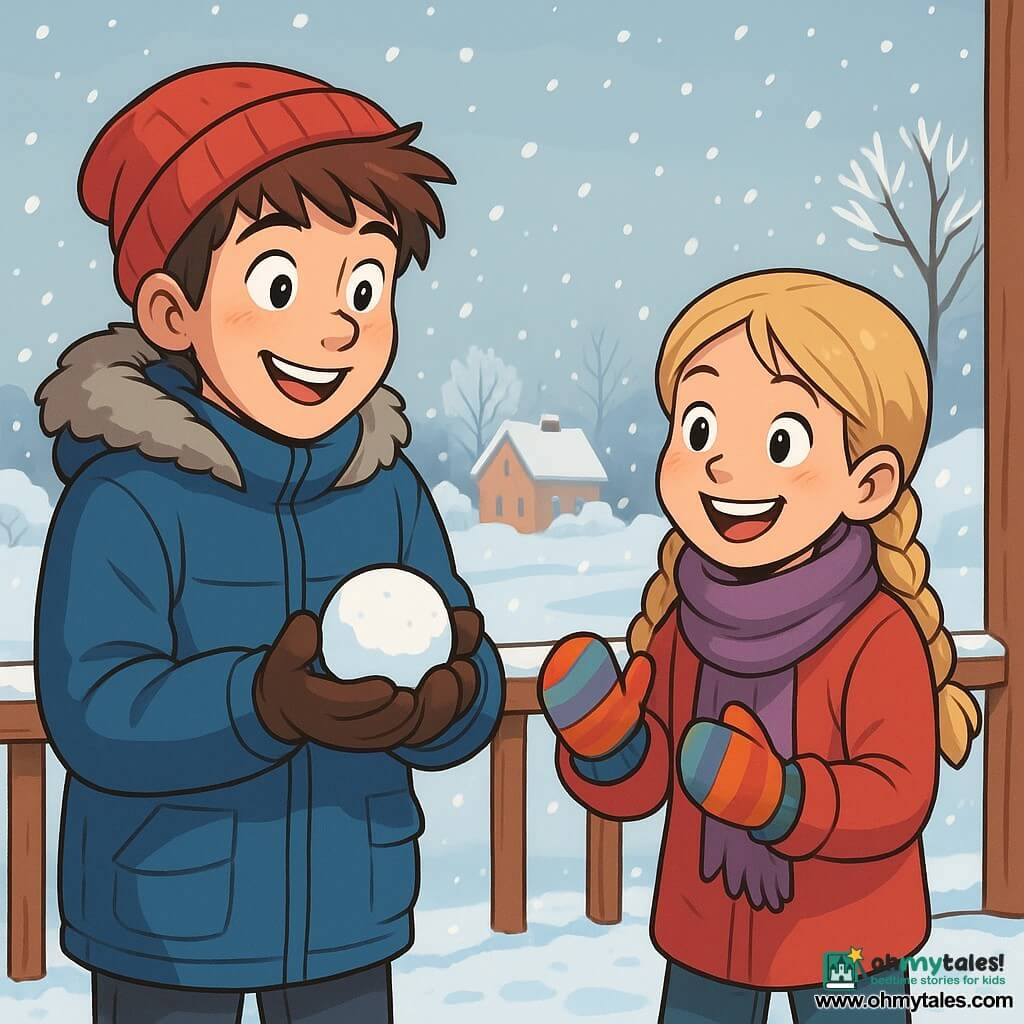
They hurried to the small glass door that led to the shared front porch walkway of their building. Their apartment opened onto a long, covered porch that ran along the outside of the second floor, with a railing that looked down onto the courtyard below.
Noah slid the door open and stepped out. The air was sharp and cold on his cheeks, but the porch roof kept most of the snow off. The cold smelled clean, like metal and pine trees and something he didn't have a word for.
From the porch he could see the whole courtyard, the parking lot, and the row of little houses across the street. Everything was slowly being covered by white.
“It's like the world has been erased,” Emma said in a whisper.
“No,” Noah said, feeling something steadier inside him. “It's like it's been rewritten.”
He wrapped his arms around himself, shivering a little in his thin pajamas. But he didn't want to go back in yet. He didn't want to miss a second.
Snowflakes blew under the roof and landed on his hair and eyelashes. They felt like tiny cold kisses and disappeared as soon as he blinked.
His mom came out behind them with a big mug of coffee wrapped in both her hands. “Beautiful, isn't it?” she said.
Noah nodded. “Can we go out in it? Like, really out?”
His mom looked at him carefully, the way she did when she was about to say something important.
“Yes,” she said. “But winter is serious. Snow is beautiful, and it's also cold and wet and slippery. You need to respect it. And you need to dress properly.”
“I will,” Noah said quickly. “I promise. I want to feel it.”
He didn't know why he said it like that. But it was true. He didn't just want to watch the snow. He wanted to feel the air on his face, hear the crunch under his feet, find out what snow really was beyond windows and screens.
Emma tugged at his sleeve. “We can build a snowman!” she said.
“If there's enough,” Mom laughed. “First, you both eat breakfast. Then we'll see.”
As they went back inside, Noah looked over his shoulder one more time at the snow drifting down in the pale winter light. He had a feeling that this day was going to change something. Maybe not something huge. But something in him.
He liked that feeling.
He liked it a lot.
Chapter 2 – Getting Ready for the Cold
By the time Noah finished his toast and hot chocolate, the snowfall had grown heavier. The sky had turned a bright, cloudy white, like a gigantic lamp shade.
He stood by the window again, bouncing on his heels.
“Slow down,” Mom said, smiling as she cleared the table. “Winter isn't going to run away. And snow falls slower than rain, remember?”
“It's like it's floating,” Noah said. “Even gravity is slower.”
Mom laughed. “Put on some socks that actually match this time. Then come to the hallway.”
Noah hurried to his room, pulled on his warmest socks—green with little blue rockets—and grabbed his jeans. He added a long-sleeved shirt and the thick hoodie his grandma had knitted, the one he always said was “too much” when she visited in autumn.
He hesitated with it in his hands.
“Too much,” he murmured to himself, remembering his own words, and felt his ears get a bit hot. Maybe it hadn't been too much. Maybe he just hadn't needed it yet.
He slipped it on. It was a little scratchy at the neck, but it felt like a hug. A woolly, stubborn hug.
In the hallway, Mom had placed a small pile of winter things on the bench.
“There,” she said, “our mighty collection of warm stuff.”
There were two wool hats, a pair of thick black gloves, some knitted mittens, two scarves, and a pair of snow boots that used to belong to his older cousin.
“These are going to save your toes,” Mom said, holding up the boots.
Noah eyed them. They looked huge, with thick rubber soles and dark blue fabric that made them look like something an explorer would wear.
“They're kind of… cool,” he said, surprised.
Mom raised an eyebrow. “Cool? Boot approval from the almost-teenager?”
“Don't say ‘almost-teenager',” Noah groaned, but he was smiling. “It sounds weird.”
“You are weird,” Emma announced, appearing with one of Dad's huge scarves dragging behind her like a blanket.
Mom laughed. “Okay, listen. When it's this cold, you don't worry about looking stylish. You worry about staying warm. Warm is smart. Warm is strong.”
“Warm is smart,” Noah repeated. He liked the sound of that. It felt like a rule for more than just weather.
He sat down on the bench, pulled on the thick socks properly, then forced his feet into the snow boots. They were snug, but not too tight. When he stood up and stomped, they made a solid, deep sound on the floor.
“Whoa,” he said. “I feel like I could climb a mountain.”
“You're starting with the porch,” Mom said. “Then the courtyard. Maybe later we'll talk about mountains.”
She wrapped a long gray scarf around his neck. “Not too tight?” she asked.
He shook his head. He liked how it protected the space between his jacket and his chin. It was like building a small wall against the cold.
He pulled on the black gloves, then the dark blue wool hat. The hat covered his ears, and suddenly the world sounded softer, like it was wrapped in cotton.
“Look at you,” Mom said. “Almost ready for the Arctic.”
“Arctic?” Noah said. “Really?”
“Okay, more like ‘the courtyard of our building,'” Mom corrected, grinning. “But the rules are the same. Respect the cold. Listen to your body. If you feel too cold or too wet, you come back under the porch and warm up.”
“Yes, Captain,” Noah said, giving a little salute.
Mom's face softened. “Noah, I know you're excited. But remember, winter can surprise you. Don't try to prove anything. Just be careful and enjoy it, okay?”
Noah looked at her and nodded. He understood. This wasn't like running out in summer in shorts and flip-flops. Winter asked for more care. It asked for a little courage too.
“Okay,” he said quietly. “I'll be careful. And… brave in the right way.”
“That's my boy,” Mom said. “Now go discover your first snowfall.”
Emma bounced next to him, her red hat sliding over one eye. “Race you to the door!” she shouted.
“No running indoors,” Mom said automatically.
But she was still smiling.
Chapter 3 – Under the Porch Roof
The moment Noah opened the front door to the covered porch, the cold slipped around his cheeks like a curious animal. It wasn't as fierce as he had imagined. It was sharp, yes, but also clean. Awake.
The porch stretched left and right, with other apartment doors along it. A metal railing ran along the edge. Beyond that, the courtyard lay open, already covered in a thin, sugary layer of snow.
He stepped onto the concrete floor of the porch. Snowflakes drifted in from the open side, but most of them landed beyond the railing. The roof above him crackled softly as new snow settled on it.
Emma ran to the railing, then stopped because of Mom's look. She grabbed it with mittened hands and leaned forward.
“Look, Noah,” she said. “The cars look like marshmallows. Giant marshmallows on wheels.”
He joined her and peered over the edge. Her description fit. The cars were rounded and soft, their colors hidden under white.
The grass in the courtyard had disappeared. The little playground slide was now a white ramp. The benches wore thin stripes of snow on their backs.
A few neighbors were out already. Mrs. Khan from downstairs, wrapped in a long coat, was walking her small brown dog. The dog lifted its paws high and shook them, clearly not impressed by winter.
“Poor dog,” Emma giggled.
“He's just learning about snow too,” Noah said.
They stayed under the porch for a while, just looking. There was something soothing about watching the flakes fall from a dry, safe place. The roof above them made soft ticking sounds as old flakes slid off and new ones landed.
A gust of wind sent a group of flakes under the porch roof. They whirled around Noah's face, caught in the air in front of his nose and mouth.
He held out his gloved hand and watched them melt into tiny dark spots on the fabric.
“It's like they disappear,” Emma said.
“No,” Noah answered slowly. “They change. They turn into water.”
He thought about that for a moment. Snow looked so solid and white, but it was really just water in a different form. It made him think of people. How someone could look a certain way on the outside, but be something else completely on the inside.
“You're doing your thinking face,” Emma said.
“I'm allowed to think,” he replied.
“About snow?” she asked.
“About everything,” he said.
Emma rolled her eyes in a dramatic way. “You're weird,” she said again, but her voice was fond.
Down below, Mrs. Khan looked up and waved at them. “First snow, children!” she called.
“Yes!” Emma shouted back. “It's amazing!”
“Enjoy it,” Mrs. Khan said. “But don't forget your hats.”
“We already have hats!” Emma said, pointing at her head.
Mrs. Khan laughed and kept walking her unhappy dog, whose little paws left tiny crisscrossing tracks in the soft white layer.
Noah leaned his elbows on the railing. Some snow had blown onto it, a narrow strip of white along the top. He drew a line through it with his glove.
“Cold?” Emma asked.
“A bit,” he admitted. “But I like it. It feels… fresh.” He looked down at his clothes. “I'm glad I have all this stuff on.”
The thought made him feel strangely thankful. He looked at Emma's red hat, at his own boots, at the gray scarf around his neck. Without them, the cold would be painful, not fun. These ordinary objects were like quiet helpers.
He heard the glass door slide open behind them.
“You two okay?” Mom asked.
Noah straightened. “We're good,” he said. “Just getting used to it. It's different out here.”
“How?” Mom asked, stepping beside him.
“It's quieter,” he said. “And also… louder.”
She tilted her head. “Explain.”
“It's quiet 'cause there aren't many cars,” he said slowly. “The snow kind of eats the sound. But the little sounds are louder. Like the snow hitting the roof. Or the dog's paws. Or Emma's humming.”
“I'm not humming,” Emma protested.
“You totally are,” Noah said.
Mom smiled. “Winter changes what we notice,” she said. “When it's cold and still, the small things stand out more.”
Noah thought about the way his gloves felt, the weak winter sun on the railing, the soft hiss of the falling flakes.
“I like that,” he said.
“Ready to go down to the courtyard?” Mom asked. “We'll stay near the porch at first. If you get too cold, we come back up here to warm up.”
“Let's go,” Noah said, a bit of nervous excitement curling in his stomach.
The porch felt like a border between two worlds: the inside world of warmth and familiar things, and the white, unknown world outside.
For the first time in a long time, he didn't feel shy about crossing a border. He felt curious.
He pushed off from the railing and headed for the stairs.
Chapter 4 – Stepping into the White
The metal stairs down from the porch were dusted with snow, each step outlined in white. Mom went first, testing each step with her boot.
“Hold the handrail,” she said. “Metal is extra cold, so don't touch it with bare skin. And don't rush.”
Noah followed carefully, his boots making slow, heavy thumps. Emma came behind him, holding onto his jacket.
At the bottom, the courtyard stretched out like a soft field. Snow was still falling, but not too fast. It landed on Noah's shoulders and hat. He could feel tiny cold points where it hit his neck.
“Can I try walking?” he asked.
“Of course,” Mom said. “Remember: short steps. The ground can be slippery.”
Noah took a step. The snow under his boots made a gentle crunching sound, like biting into a fresh cookie. He took another step, then another, listening.
Crunch. Crunch. Crunch.
Emma squealed with delight as her own boots left little dents behind her.
“We're making footprints!” she shouted.
Noah looked back. Their tracks crisscrossed behind them, dark shapes pressed into the white.
“It's like we're writing on the ground,” he said.
“Writing what?” Emma asked.
“Our path,” he answered. “Where we've been.”
He tried a bigger step. His boot sank a little deeper. Snow slid up the sides and stuck there.
“It's colder when it touches my leg,” he said.
“That's why we tuck your pants into your boots,” Mom reminded him. “Keeps the snow out.”
He wiggled his toes. They still felt warm. The boots really were doing their job.
They stopped a few meters from the porch steps. From here, the building looked like it was wearing a new coat too. Snow had gathered on the window sills and along the edges of the roof.
“Okay,” Mom said. “Stay where I can see you. Don't throw snow at anyone's face. And remember, snow near the street can be dirty. Stay in the clean parts.”
Emma had already bent down and scooped up a handful.
“It's so fluffy!” she said. “And cold.”
She squeezed it and tried to make a ball, but it crumbled and fell apart.
“Why is it not working?” she asked.
“It's the wrong kind of snow,” Noah replied, repeating something he'd heard in a movie.
Mom smiled. “Smart answer. Sometimes the snow is too dry or too cold to stick well. Maybe later it will be better for snowballs.”
Noah crouched down and picked up some snow himself. It was lighter than he expected, like holding a scoop of icy feathers. His gloves protected his skin, but he could still feel the cold pressing through.
He held his breath and lowered his face to look more closely. Each tiny piece wasn't just a piece. Some of them had clear shapes, like little stars or crystals.
“Whoa,” he whispered. “Look, Emma. Little patterns.”
Emma knelt beside him, her nose almost touching her handful of snow. “They're like tiny frozen flowers,” she said.
A soft wind blew, and a flurry of flakes landed on Noah's eyelashes. He blinked and laughed.
“Snow is attacking my face,” he said.
“It likes you,” Emma replied.
He straightened up and looked around. A boy from the next building, Malik, was out with his older sister. They waved.
“Hey, Noah!” Malik called. “First snow for you too?”
“Yeah!” Noah answered. He felt his usual shyness tugging at him, but something about the snowy air made it lighter. “It's… cooler than I thought.”
“That's a terrible pun,” Malik's sister groaned, but she was smiling.
Noah grinned. The words had just popped out without him thinking.
Emma tugged his sleeve. “Come on,” she said. “Let's explore. But we don't go too far.”
He remembered Mom's words. Respect the cold. Listen to your body. Be careful and enjoy.
“Okay,” he said. “We'll go around that tree and back. It's still close to the porch.”
They walked together, their boots squeaking in the fresh layer of snow. Every step was a new sound, a new feeling.
The world was the same as yesterday, but also completely different. The benches, the trash cans, the little lamppost—they were all still there, but changed. Softer. Quieter. Calmer.
As they circled the tree, Emma slipped a little and grabbed Noah's arm.
“Careful,” he said, steadying her.
“I'm fine,” she replied, but her eyes were wide. “The ground is sneaky.”
“Snow hides the ice,” Noah said, like someone who knew things now.
He felt something small and proud in his chest. He was learning how winter worked. Step by step. Crunch by crunch.
Chapter 5 – The Wind and the Wobble
By the time they got back near the stairs, Noah's nose felt colder, and his breath came out in little white clouds.
Emma's cheeks were bright pink. “My face feels like a snowball,” she announced.
Mom stood under the porch, watching them. “You're doing well,” she called. “Do you want to stay out a bit longer, or take a break under the porch?”
“I want to explore a tiny bit more,” Noah said, then added quickly, “but we'll stay close.”
“Five more minutes,” Mom agreed. “Listen to your fingers and toes. If they start to hurt, you come in.”
He flexed his fingers inside his gloves. They were a bit stiff, but not painful. His toes still felt snug and warm.
“Okay,” he said. “Deal.”
He and Emma walked along the side of the building, where fewer people had stepped. The snow there was smoother, a white sheet untouched by footprints.
“Let's be the first ones here,” Emma said. She lifted her foot dramatically like an explorer.
A sudden gust of wind swept around the corner of the building, stronger than before. It rushed into Noah's face, stealing his breath for a second. Snowflakes stung his cheeks and slipped under his collar.
He gasped and stepped back.
“Whoa,” he said. “That was… strong.”
Emma shivered. “It bit my nose,” she said.
They moved closer to the wall, where the wind was a little weaker.
For a moment, Noah felt a flicker of something inside his chest. The air didn't feel gentle now. It felt wild. The white sky seemed lower.
What if the wind got too strong? What if they suddenly couldn't see the porch?
He took a deep breath. The air was cold in his lungs, but it helped him think.
“We stay close to the building, okay?” he told Emma. “That way, we always know where we are. And if the wind is too much, we just go back under the porch.”
Emma watched his face. “Are you scared?” she asked quietly.
He thought about it. His heart was beating a bit faster. The snow in his hair felt extra cold now. But there was also a new feeling, one that said: You can handle this. You're dressed for it. You're not alone.
“A little,” he admitted. “But I'm also okay.”
“That doesn't make sense,” Emma said.
“It kind of does,” Noah replied. “Being brave isn't not being scared. It's doing the thing anyway, but carefully.”
She frowned, then nodded. “Okay,” she said. “We can do that.”
They took smaller steps now, staying in the shelter of the wall. The wind rushed by above them, carrying thin sprays of snow. Each gust made the flakes dance in circles.
Noah noticed that his gloves were a bit damp from touching the snow. His fingers felt colder than before.
He stopped and looked back at the porch. It was only a short distance away. He could see Mom, still standing there, one hand on the railing.
His mind offered him two choices: pretend he wasn't cold and keep going, or listen to what his body was telling him and head back.
For a moment, he imagined slipping and falling because his fingers were too stiff to catch himself. He imagined Emma slipping too.
Then he imagined being back under the porch roof, shaking the snow from his hat, warming his hands with Mom's help.
Being sensible didn't feel weak, he realized. It felt smart. Like what Mom had said: warm is smart. And smart is strong too.
“Emma?” he said.
“Yeah?”
“My fingers are complaining,” he said with a small smile. “We should go under the porch for a bit.”
“Mine too,” she said at once, relieved. “They feel like frozen carrots.”
“Okay, frozen-carrot-hands,” he said, “let's go.”
They turned back. The wind pushed at their backs now, as if it had decided to help. They walked quickly but carefully, and soon the dark shape of the porch roof stretched above them.
Mom met them at the bottom of the stairs.
“Good call,” she said, looking at Noah's face. “You're getting red around the nose.”
“It's not frostbite,” he said, half joking, half checking.
“No,” she said gently. “But coming in before it's too much—that's what smart people do.”
As they climbed the stairs, Noah felt a quiet glow inside. He hadn't stayed out just to show off. He'd listened to himself. He'd made a choice that kept both him and Emma safer.
At the top, under the shelter of the porch, the wind was softer again. Snow still drifted in, but not as fiercely. It felt like stepping back from the edge of something and finding firm ground.
Noah held out his gloved hands. Mom took each one and rubbed them gently.
“Good gloves,” she said. “Doing their best. Let's give them a break.”
He peeled them off slowly. His fingers were pink, but they started to warm up in the still air.
Emma shook her hands and made little blowing sounds. “Thawing,” she said. “Thawing complete.”
They both laughed.
Noah looked out from under the porch roof at the falling snow. The world beyond still looked beautiful and a bit wild. But now, standing here with his family and his winter clothes, he didn't feel small anymore.
He felt ready to meet winter in his own way. On his own time.
Chapter 6 – A Porch-Side Snow Adventure
After a few minutes under the porch, the cold that had crept into Noah's fingers and cheeks started to fade. Mom made them both wriggle their toes and touch their noses.
“Functional?” she asked.
“Still attached,” Noah said.
“They work,” Emma agreed.
“Good,” Mom said. “You can go out again if you want, but stay close to the stairs and the porch. This roof is your little winter base.”
“Our winter base,” Noah repeated, liking the phrase.
He pulled his gloves back on. The porch really did feel like a base—a safe place they could always return to. The world beyond might be windy and deep with snow, but the porch was dry and sheltered.
“Let's do something right here,” he said to Emma. “We don't have to go far.”
He knelt beside the railing where a thin layer of windblown snow had gathered on the porch floor and along the metal bars. It wasn't deep, but it was something.
“What are you doing?” Emma asked.
“Mini snowman,” he said. “A porch snowman.”
He scooped together what snow he could find near the edge. With careful hands, he formed a small ball. The snow here was slightly wetter from the warmer porch, so it held its shape.
Emma joined in, giggling. “He's going to be tiny,” she said.
“Tiny but mighty,” Noah replied.
They made three small balls. The largest one was not much bigger than a fist. They stacked them carefully on a clear spot by the railing, where the snow wouldn't slide away.
Emma found two little pieces of broken twig near the wall and stuck them in as arms.
“He needs a face,” she said.
Noah looked around. Near a planter, he found two tiny dark pebbles, freed from the soil by the change in temperature. He pressed them gently into the middle snowball for eyes.
“For a nose…” Emma looked around desperately. “We don't have a tiny carrot.”
Noah unzipped his pocket and pulled out a small orange button he had been fiddling with earlier. It had fallen off his old shirt weeks ago, and he'd kept it because he liked the color.
“You still have that?” Emma said.
“Yep,” he said. “Perfect snowman nose.”
He pressed the button in place. Their tiny snowman looked slightly crooked, but determined.
“Hello, Porch Snowman,” Emma murmured.
Noah studied their creation. It wasn't big. It wasn't impressive like in movies. But they had made it themselves, with what they had, right where they were.
He realized that this was also a kind of courage. Accepting limits. Making something small and good instead of wishing for something huge and impossible.
“Hey, look at you two,” Mom said from the doorway. “You built a friend.”
“He's guarding the porch,” Emma said. “He's our winter guard.”
Mom stepped closer to admire him. “He's wonderful,” she said seriously.
A new gust of wind blew in from the courtyard, but the porch roof caught most of it. Only a sprinkle of snow reached them, landing softly on the little snowman's head like extra hair.
“Do you ever get tired of winter?” Noah asked suddenly.
Mom thought for a moment. “Sometimes,” she admitted. “When the days are gray for too long, and the cold makes everything harder.”
“Then why do people say winter is magical?” Emma demanded.
“Because,” Mom said slowly, “winter makes you notice small things. A warm drink. A thick pair of socks. A porch roof. A tiny snowman.” She nodded toward their creation. “And because you learn that you can handle more than you thought. Even when it's cold and dark, you find light and warmth.”
Noah leaned back against the wall, feeling the rough surface through his jacket.
“I thought winter would just be freezing and horrible,” he said. “But it's… different. It makes me feel alive. And also kind of sleepy at the same time.”
“That's the early sunset,” Mom smiled. “Short days make you want to curl up. That's why we have cozy evenings.”
“Can we have hot chocolate later?” Emma asked at once.
“And maybe a blanket fort?” Noah added.
Mom laughed. “We'll see about the fort. Hot chocolate, definitely.”
Snow kept falling beyond the porch. The world was turning whiter and whiter. But under the roof, with their tiny guard snowman and the cold held at the edge by hats and gloves and boots, everything felt gentle.
Noah watched a single flake land on the railing and stay whole for just a heartbeat before melting.
“You know what?” he said quietly.
“What?” Mom and Emma asked together.
“I'm glad it's winter,” he answered.
He meant it.
Chapter 7 – Evening Glow
By late afternoon, the sky had turned from bright white to a soft, pale gray. The short winter day slid away almost before Noah realized it had truly started.
From the living room window, he could still see the snow falling. Streetlights had turned on early, casting warm yellow circles onto the white ground. Every flake that passed through the light looked golden for a second before disappearing into the shadows.
Noah sat on the couch wrapped in a thick blanket, a mug of hot chocolate warming his hands. His cheeks were no longer red. His fingers felt normal again.
Emma lay at the other end of the couch, her feet pushed against his legs for extra warmth.
“Hey,” he said. “Your toes are ice.”
“They're not ice,” she protested. “They're just… enthusiastic.”
Mom walked in with a basket of laundry and set it down. She sat on the arm of the couch and looked at them, her eyes soft.
“You both did well today,” she said.
“We didn't even go that far,” Noah replied. A part of him felt almost disappointed. He had imagined huge snow adventures, building giant forts and racing across fields.
“You went far enough,” Mom said. “You learned how winter feels. You listened when your body said ‘that's enough.' You came back to the porch instead of trying to be heroes.”
“I kind of wanted to be a hero,” Noah said, staring into his mug. The steam rose in little curls.
“You were,” Mom said. “Heroes don't always charge into storms. Sometimes they know when to step back.”
Emma nodded sleepily. “Noah is a winter hero,” she said. “And I'm the sidekick.”
“You're your own kind of hero,” Mom said. “Tiny, but loud.”
Emma made a half-hearted protest and then yawned wide.
Noah thought about the day. The first quiet moment at the window. The crunch of snow under his boots. The sudden sharp wind that had made him breathe faster.
He remembered how his heart had beaten, how fear had touched him and then moved aside when he chose what to do.
“I was scared for a moment,” he admitted.
“Of the wind?” Mom asked.
“Yeah,” he said. “And of slipping. And of going too far and not being able to get back.”
“And what did you do when you felt that?” she asked.
He shrugged, but he knew the answer. “I stayed near the building. I came back to the porch.”
“Exactly,” Mom said. “That's confidence, you know.”
Noah looked up, surprised. “Confidence?”
“Being confident doesn't mean thinking nothing can hurt you,” she explained. “It means trusting that you can make good choices. Trusting yourself to take care of you.”
He sipped his hot chocolate. The sweetness spread down into his chest like a small sun.
“Warm is smart,” he said again.
Mom smiled. “And listening is strong.”
They sat in quiet for a while, watching the snow outside. The room grew dim, lit only by the soft lamps.
“Do you think our porch snowman is okay?” Emma asked suddenly.
“He has a roof,” Noah said. “He's better protected than the others.”
Mom raised an eyebrow. “Others?”
“The imaginary ones in my head,” Noah explained quickly. “Porch Snowman is the boss of them.”
Emma laughed, then fell quiet again.
“You know,” Noah said after a moment, “I used to think winter was just something to get through. Like a bad level in a game.”
“And now?” Mom asked.
“Now it feels like… I don't know. Like a test.” He searched for the right words. “Not a scary test. Just one that asks, ‘Can you take care of yourself? Can you notice good things even when it's cold?'”
Mom looked proud. “And what's your answer?” she asked.
He thought of his boots, his hat, his scarf. The porch roof above them when the wind grew stronger. The warm blanket around him now.
“I think the answer is yes,” he said softly.
Emma lifted her head. “My answer is yes, too,” she mumbled, then buried her face under the blanket.
Outside, a car passed slowly, its tires making a quiet shushing sound on the snowy road. The sound made Noah feel calm, like someone whispering “hush” to the whole world.
Winter didn't seem so big and frightening now. It was still powerful, still cold, still serious. But it was also full of things that helped: clothes, roofs, warm drinks, careful steps, little courage.
And all of those things were in his life already.
Chapter 8 – Thank You, Little Helpers
Before bed, Noah went out to the porch one last time.
The air was colder now. The night sky was dark, but the snow on the ground glowed softly in the light of the street lamps. It was as if the world had turned into a quiet, shining blanket.
The porch snowman was still there by the railing, a bit more rounded than before as new snow had clung to him. His pebble eyes looked out over the courtyard, keeping watch.
“Good job,” Noah told him quietly. “You survived your first day, too.”
He wrapped his arms around himself and leaned against the wall. From here, he could see the spots where they had walked earlier, though many of their footprints had already been softened by new snow.
The wind was calmer now. Tiny flakes floated down like drifting feathers.
His jacket felt warm against his chest. His scarf tickled his neck. His hat pressed gently over his ears.
He looked down at his boots.
“Thanks,” he whispered.
It felt strange, thanking boots. But he meant it. They had kept his feet dry and warm. Without them, his first steps into the snow would have been painful, maybe even dangerous.
He looked at his gloves, resting on the small table by the door, drying from the day. His eyes moved to the coat hooks, where scarves and hats hung like quiet soldiers.
“Thank you,” he said again, a bit louder this time.
For a second, he imagined they answered back—not with words, but with their simple, steady presence. They were always there when needed, even if he had sometimes complained about them or called them “too much.”
He thought of the porch roof above his head. How it had turned the wild wind into something softer. How it had given them a place to rest and warm up before going back out.
He reached out and touched one of the cold metal posts that held the roof up.
“Thank you, too,” he said.
He wasn't sure if anyone would think he was silly for thanking objects. But it didn't matter. Gratitude felt good. It felt like wrapping the world in a blanket the way he wrapped himself in his hoodie.
Behind him, the glass door slid open.
“You saying goodnight to the snow?” Mom asked gently.
“Kind of,” he said. “And to my stuff.”
“Your stuff?” she echoed.
He gestured at his boots, his hat, the porch roof. “They all helped today,” he said. “They made winter… possible. And not scary.”
Mom leaned against the frame, her breath making small clouds in the cold air.
“That's wise,” she said. “We forget, sometimes, to be grateful for small helpers.”
He nodded, feeling a warm glow under his layers. “I think I trust winter more now,” he said. “Because I trust that I can handle it. Especially with all of this.”
He tapped his boots lightly on the ground. Solid. Safe.
“You trusted yourself today,” Mom said. “That's bigger than any snowstorm.”
He looked out at the quiet white courtyard one more time.
“Do you think it will still be here tomorrow?” he asked.
“The snow?” she said. “Probably. Maybe more, maybe less. Weather changes. That's what it does.”
“I hope there's still enough for our porch snowman,” he said. “I want to say hi again.”
Mom smiled. “We'll check on him in the morning.”
They stood there together for a moment, not talking, just breathing in the cold, calm air.
Then Mom touched his shoulder. “Time for bed, winter explorer,” she said.
As Noah stepped back inside, he glanced again at his winter things—his loyal boots, his brave gloves, his warm hat and scarf.
He felt taller, somehow. Not on the outside, but on the inside. Like he had grown a little bit of winter courage.
In his room, he slid under the covers. The house around him was warm, but he could still remember the clean bite of the cold on his cheeks, the crunch of snow under his boots, the safe shadow of the porch roof.
He closed his eyes and whispered, “Thank you,” one last time—to the day, to the snow, to the simple things that kept him safe and strong.
Outside his window, snow kept falling, soft and steady. It covered the world in white while he drifted toward sleep, feeling ready for whatever the next winter day would bring.