Lists and Layers
The morning had a crisp, chalky smell, like new paper. On Leo's desk, the zipper of his pencil case lay open like a mouth saying “ah,” and inside, four pencils were lined up perfectly—sharp point to eraser edge, light to dark. He straightened each one with a small, satisfied tap, then checked the list he'd written on an index card. He had written it in neat, blocky letters: sketchbook, pencils (HB, 2B, 4B, 6B), kneaded eraser, ruler, scarf, hat, gloves, snacks, water bottle, extra socks (just in case), hand warmers, bus pass, permission slip, phone (charged), kind attitude.
“Left glove, right glove, sketchbook,” Leo murmured, making sure the gloves formed a tidy pair on his backpack. He tucked the permission slip into the clear sleeve of a folder where he could see it at a glance. The zipper closed with a thin, quiet whisper. He zipped it halfway back open to check again for the hand warmers—two little packets like sealed sunshine—then zipped it shut for good.
Mama leaned into the doorway, tying her own scarf. “You'll melt the snow with all this preparation.”
“I'll keep the snow as it is,” Leo said, slipping the ruler into the side sleeve of his sketchbook. He liked knowing where everything was. Unplanned surprises could be fun at the right time—like a good joke—but he preferred that his pencils never surprised him by being missing.
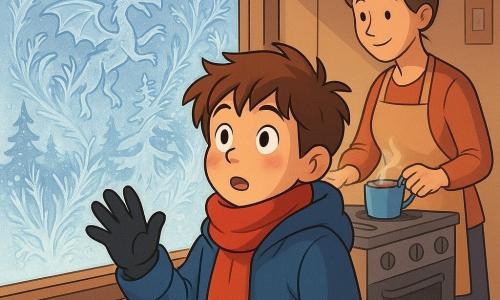
The window showed the street's early light, tin-blue and soft. Frost traced ferns onto the corners like a careful artist had been there first. Leo paused long enough to watch how the frost made starbursts, like faint fireworks that no one had to clean up afterward. It clicked a little in his brain—that first feeling of wanting to draw.
Down the hall, the heater thumped. A bus schedule hung on the fridge: Winter Arts & Nature Day at Riverside Park and the Community Art Barn. The paper had a tiny pencil doodle in the corner—a pinecone and a snowflake. That was Leo's doing, of course.
On the porch, Leo pulled on his hat, adjusted his scarf so it covered his neck but left room to breathe normally, and checked his shoelaces. He liked double knots. He liked double checking his double knots. The cold touched his cheeks without biting them, just a gentle tap-tap of the air. He stepped carefully to avoid the slick-looking patch at the foot of the stairs, stepping on the salted spots where grit crunched under his soles.
At the corner, Amir was already waiting, his breath puffing like little speech bubbles. The streetlamp made a halo right above him. His gloves were navy blue, and his hat had a big gray pom-pom that swayed slightly when he shifted. The wheels of his chair had thin lines of snow from yesterday's dusting, and they made a soft squeak when he turned a little to face Leo.
“You'd make a great astronaut,” Amir laughed, eyeing the way Leo's backpack sat smooth and squared on his shoulders.
“Astronauts have checklists so nothing floats away,” Leo replied, smiling. He glanced at the curb cut near the corner, making sure there wasn't ice hiding somewhere shiny and mean. The city had sprinkled the corners, and the salt made white freckles on the asphalt. That was a relief. He noticed things like that. He liked noticing them.
“My wheels are ready for liftoff,” Amir said, wiggling his shoulders. He had on a jacket with reflective stripes that caught the weak winter light and flickered. A scarf sat around his neck like a small, soft snake.
His mom stood nearby, tugging Amir's hat down over his ears with gentle seriousness. “Call if you need anything. The school will text when you arrive. And take the hot pack if your hands get cold.”
“I will,” Amir said. With a quick smile, he tucked a soft pack near his lap, under the blanket draped over his legs.
Leo's dad stood with a thermos tucked in his elbow. “Bundle, boys. Go slow where you need to, fast where it's fun.” He winked.
“Meet at the corner in ten?” Leo asked, though they were already there, and the buses were supposed to arrive in ten anyway. Requests phrased as plans made him feel like the world clicked into place.
“Ten,” Amir agreed. He spun one wheel a quarter turn to feel the resistance. The chair responded in a smooth arc, familiar and faithful. It wasn't a thing, it was just his way of moving, the same way Leo's feet were Leo's way of moving. They didn't think about it on purpose, usually. They just did their day.
The first bus trundled up, orange letters blinking an unhelpful “OUT OF SERVICE,” and kept going. The second bus was theirs. It breathed when it pulled up, the air brakes sighing like a giant finally settling on a couch. The doors opened with a folding sound, and the interior glowed yellow-lit and warm. A ramp lowered with a hum, small snow crystals scattering like sugar off its edge.
Leo felt a small joy buzz in his chest at how the plan unfolded. There would be a seat near the window for him, and a space saved for Amir's chair where the straps and locks would hold it steady. They would watch the city glide by under winter's hush. They would be going somewhere that wanted them to look closely at things.
As they moved forward toward the bus, a neighbor's dog shook, tags jingling, and wagged a mop tail. “Back by four,” Mama called. “Take pictures,” Dad added. The cold air nipped at their words and made them sound like a soft clatter of porcelain.
On the bus, the driver—cheeks pink, hair tucked under a knit cap with a pom-pom like Amir's—nodded. She wore a jacket with a patch that read BYRNE. A chaperone waved from halfway down, scarf long enough to coil twice around her neck. The driver unfolded the cool metal hooks and tightened the straps with a practiced, quiet rhythm for Amir's chair. Amir clicked his seat belt and tested it with an easy tug.
Leo slid into a window seat where frost crystals framed his view. The radiator under the seat breathed out a low, cozy warmth that seeped through his coat. Through the glass, he saw his dad lift two fingers in a little salute. Leo lifted his gloved hand to mirror it.
This day was a careful shape unfolding. He could almost see the faint outline of it—the slow lines of the bus route, the white path at the park, the warm rectangle of the Art Barn, the soft burst of cocoa steam. Winter didn't have to be only about cold. It could be about attention too, and how attention felt like the softest kind of heat.
The Bus Window Game
The bus drifted from the curb with a soft rumble that vibrated through the seats. On the floor, in a narrow aisle, a stainless-steel water bottle rolled and bumped gently against a sneaker, then returned to its owner with a friendly clink. The windows were a film of fog at the edges where breaths touched the glass, leaving a map of invisible places.
The streets were beaded with light reflected in puddles turned to glass. Bare branches of oaks and maples described careful shapes against the pale sky, pencil lines on paper. Snow gathered in the V's of branches, a clean geometry. The city's colors had faded to quiet: brick, slate, cream, and the bright accents of scarves and traffic signs. Leo leaned his temple against the window and felt the cool through his hat. He didn't mind that cold. It made the warmth of his jacket more noticeable.
“Good morning, winter explorers!” Ms. Byrne called, glancing in her rearview mirror. She handed a stack of rainbow cards back to the nearest student, who passed them down like slices of a soft deck. “Before we get there, I'm organizing a little game. It's called Winter Pattern Bingo. You'll look out your windows and listen with your ears. Each square is something to find or hear. You don't need to shout out when you get a box. Just circle it. We'll see who fills a row first.”
The cards were simple but pleasing, squares with words and tiny line drawings: frost feather, pigeon flock, knit hat with a pom-pom, snowman scarf, dog in a jacket, cloud breath, sun flare, brick pattern, glove on the ground (hopefully not), bell sound, siren far away, plow, sparrow, shoe prints, bike tire trail, bus window star, wool mittens drying on a balcony, someone laughing, someone reading, tree shadows on snow.
“There'll be prizes?” someone asked without much hope. The bus lifted over a small bump and hummed onto the main road that became the route to the river.
“Tiny ones, but mostly pride,” she smiled. “And you'll fill your eyes with good things.”
Leo slid the card onto his knee, anchoring it with his hand so it didn't tilt. The pencil felt familiar, like shaking hands with a friend. Beside him, he heard the small rhythms of the bus: the squeak and settle of the seats, the little vibration when it took a turn, the quiet metal clicking somewhere in the ceiling where the panels met. He thought of the circles in his checklist that he'd fill with his own pencil, and he liked that the day came with circles to fill too. It suited him.
“I can check boxes while moving,” Leo whispered to Amir across the aisle, tapping the edge of his bingo card.
“I'll be your lookout for the rare geese,” Amir said, lifting his chin toward the sky. A few clouds drifted like badly erased chalk lines. He tilted his head to catch reflections, and saw his own hat, his own breath, the tiny details that made a day a particular day.
An older student in the back had a scarf with big red stripes that made Leo think of candy. A little hand somewhere up front tugged a pink hat until the pom-pom perched right above an eye. Someone had brought a plastic bag of clementines, and a peel spiral sat on the floor under a seat for a moment like a thin orange snake before it was scooped up. All these sights were circles on the cards. The game asked for attention. It rewarded it.
The bus hissed as it pulled up to a long light, air brakes sighing again in a sound like a cat lying down. The sound slid through the bus and lingered, and a few heads tilted to see. Leo circled “bus window star” because the frost at the corner of his window had two sharp points. He circled “bell sound” because they rolled past a bicyclist who dinged politely near a crosswalk, and he circled “someone reading” when he saw a person on a bench with a book in mittened hands.
“Stars on the windows,” Leo added softly, and leaned with a small twist so Amir could see the way the frost had made tiny arrows, a perfect geometry. Amir nodded and then looked past Leo to the building behind him, where a fire escape zigzagged down like an iron staircase in a black-and-white drawing.
They passed a bakery that sent a warm, sweet smell to their seats. Even the smell seemed to write something on the air, a story with no words. As the bus slowed for a stop light near the corner where the main road met the river road, a lunchbox on someone's lap tipped and slipped, and the clasp let go with a shout. A fork chimed against a thermos lid. Heads turned. The lunchbox clattered, the bus's hum rose to a gentle whir under the sudden noise, and then it was just the bus again.
The clatter made Leo's spine straighten. The moment had a feeling of edges. But someone caught the lunchbox with a glide and handed it back with a grin. The child who owned it used both hands to close it, cheeks red not just from the cold. The bus's sound was a steady heart again.
They angled down the river road. The water moved slow, heavy as a quilt, with patches of ice hugging the banks like small, thick mirrors. A white heron stood near a bend, tall and fragile-seeming until you looked harder and saw how planted it was, like a stake in the water's memory. On the far bank, a plow idled by a parking lot, waiting for the next job. Its bright lights blinked in a way that felt both official and friendly.
At the front, Ms. Byrne kept one hand on the wheel and one on the microphone switch. She gave little reminders about staying in seats, keeping hands and hats to themselves, and how the ramp would work when they got to the park. All of it sounded like a song Leo had heard a bunch of times. He liked it anyway when the chorus came, the part about noticing small things.
The bus rolled under the metal ribs of a bridge, and the world became the underside of the bridge for a second: echo-thunder, a repeat of its own engine. Leo circled “siren far away” when a faint wail slid through the air from a neighborhood he couldn't see. A shadow of birds passed low across the snow like a moving scribble, and he circled “pigeon flock.” He circled “tree shadows on snow” when the sun came around the edge of a cloud. He traced his pencil across the paper and then he stopped the pencil so he didn't press too hard. The squares filled up like a slow snow of x's and circles.
Amir's bingo card looked different, like a different voice reading the same poem. He had circled “cloud breath,” “dog in a jacket,” and “someone laughing” easily, because laughter crackled across the bus when the lunchbox made its upset sound. He held his pencil a particular way, careful and light. He took the measure of bumps with the calm he always had, feet planted, wheels kissing the floor, belt snug and perfect. He liked going places with motion and noise because he knew how to make a steady inside space for himself.
The river slid past, heavy and important. Far ahead, small buildings in the park grew larger. The Art Barn had big windows like eyes and a chimney that sent out a gray puff for the birds to consider. The bus turned its blinker on, the click-click a sound that might have been on someone's bingo card if they'd been the person who wrote it.
Leo looked down at his card and counted the circles. Eight. Nine. Ten. He did the math, because he liked that too: one more for a full line. He watched. He focused. He waited that patient way he used when he wanted to catch a thing without scaring it away.
Between trees, a thin column of glitter rose in the air. It was sunlight hitting a swirl of snow the wind lifted from a fence rail. It was so small that if you blinked, you'd miss it. He didn't blink. He breathed in quietly, as if not to disturb the air itself. He circled “sun flare,” then felt the small click inside he loved when a thing made a pattern. Everything felt set in the right kind of place when he noticed that small shine.
The bus dropped into the lot with a small hop. The brakes exhaled again. Snow plowed into low hump-rows left borders of the lot. Signs with symbols kept everyone oriented: restrooms, the trail to the river, the barn, the small pond where signs said NO SKATING in polite, firm letters. It felt like the start of a careful treasure hunt, except they'd be making treasure too.
The Texture Trail
The air outside tapped Leo's skin, waking every freckle. The group stepped down, then collected in a tidy cluster near the front of the bus as the ramp hummed. The sound had a smoothness to it like a whale song but mechanical, and Leo decided he liked the ramp's honesty—it told you exactly what it was doing.
“Paths are cleared along the river,” Ranger Colm said, meeting them in a jacket the color of evergreen needles. He had a beard that wind had drawn lines in, and he spoke in that calm way people do when they've been outside for a long time. “We salted this morning. We'll stay where it's wide and flat. There's a blue flag on any bump or root that could be tricky.”
“We'll keep to the paths,” Leo promised without being asked, and his voice felt like a seal on an envelope. He glanced at the blue flags, small triangles like a line of boats ready to sail nowhere because here was good enough.
Students gathered hats, tightened scarves, tucked their chins, and adjusted their mittens. Ms. Patel, the art teacher, brought a soft-sided tub with papers, wax crayons without paper sleeves, tape, and small clipboards. She balanced it easily on the hip of her puffy coat. Her cheeks were pink, her eyes bright as if she'd been keeping excitement in since last week.
“We could try bark rubbings,” Amir suggested, looking at the tub and pondering the tall trunks around them. His eyes tracked the way the bark went in lines and cracks, like topographic maps that told stories about where water ran when the tree was a baby and where it rushed when the tree was old.
“I brought soft pencils and tape,” Leo said, a little proud that his list had matched the day. The pencils were like rods of winter-night sky. He liked the way they felt in his fingers, a good weight, a predictability. He imagined drawing lines that could say “cold” and “quiet” without letters.
“Your kit is like a portable studio,” Colm grinned, nodding at the tidy arrangement.
The trail began at a sign with a map that showed the river's curve and where the Art Barn sat like a square jewel near a cluster of trees labeled picnic. The path shone dull with salt and sand sprinkled on ice patches, and the snow at the edges had thumbnail tracks of birds. A police of crows sat in a maple and turned their heads like people listening to gossip. Their black shapes against white sky wrote bold commas.
“Winter is full of textures,” Ms. Patel said, walking backward a few steps so her voice reached the cluster without making anyone turn their heads in scarves. She pointed at the ground with an open palm. “See how different the snow looks where the wind touches it versus where someone stepped? See the glare here, the grain there? We're going to collect those textures with paper and pencil and crayon, and we're going to notice them with our eyes and ears too.”
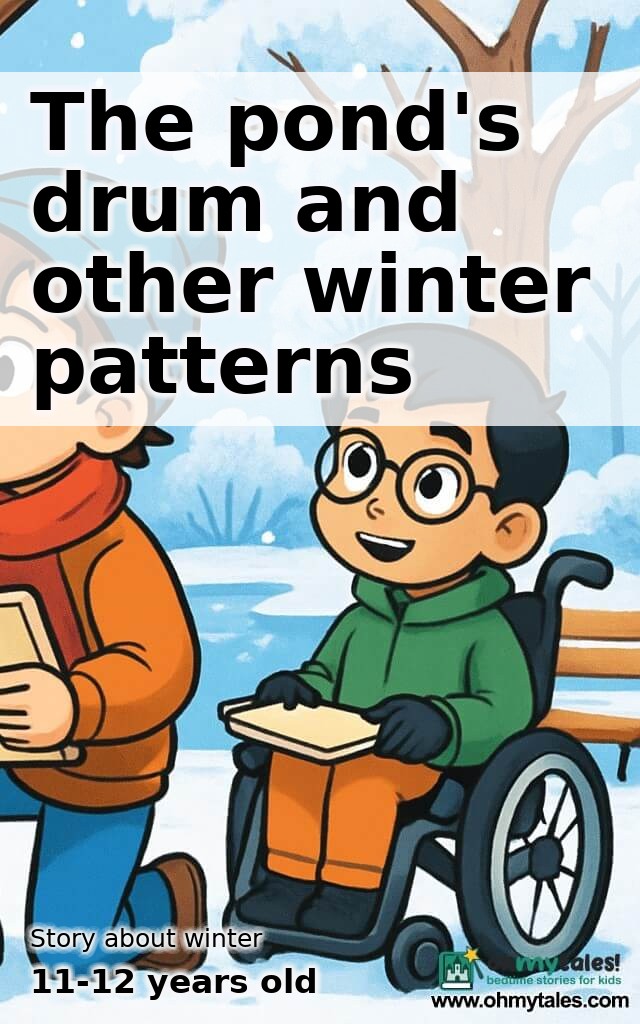
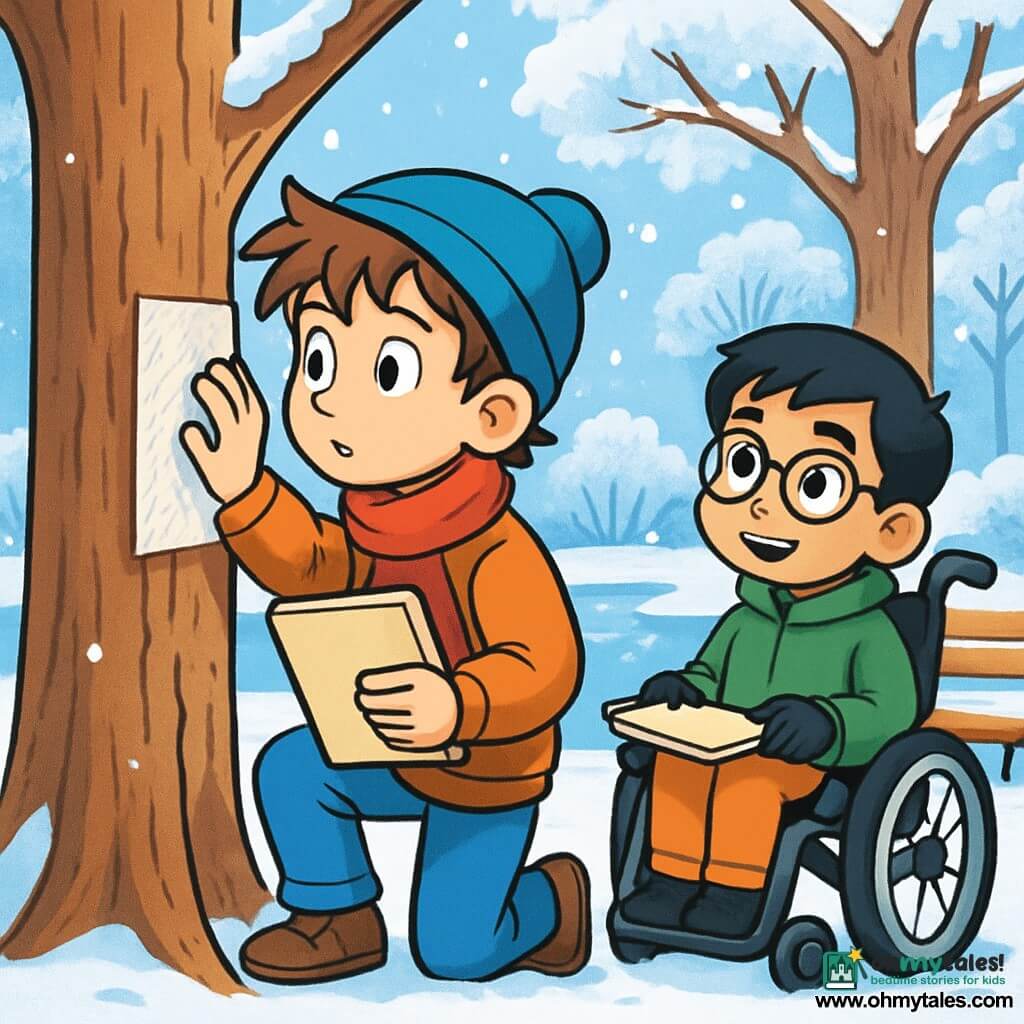
They stopped at a tree with bark like thin plates laid one over the other. Leo chose a place where the bark looked like tiny stacked books. He held the paper with tape at two corners and rubbed the side of the crayon gently across the paper, like he'd been taught, lifting the texture with shadow. The bark appeared in ghost form, a pattern rising without effort. He pressed a little harder, then softer, learning the tree's skin. Beside him, Amir found a spot lower down where the bark stretched smooth, and his rubbing came up more like a stretch-marked cloud.
“You can make a kind of collage with rubbings,” Ms. Patel said, passing by. “Try leaves, wood grain on a bench, even brick near the barn. Nature wears patterns the same way we do.”
Amir's wheels rolled slow on the salt. He went in a wide arc around a puddle that was pretending to be just water but had a thin glass lid. The group moved with practiced care, letting space widen where it needed to. Leo watched how the trail held them steady. He liked the trails that felt reliable, and he liked knowing he could count on the little blue flags to warn about a root or a dip under the snow.
“Bench rubbing,” Amir said, and Leo handed him the tape. Together, they taped the paper to the slat of a bench that caught a triangle of sun. The wood grain made waves on the paper, light to dark, curve to curve. A butterfly of breath puffed up between them and then broke apart.
A sparrow hopped close in small bravery, then darted away. Somewhere downriver, a goose honked like a rusty toy. The small pond near the path sat flat and unmoving. A sign near it had a drawing of a mitten with a happy face and a sentence that said, WEAR YOURS. Leo wiggled his fingers in his gloves and felt how each finger was a little warm room.
They moved as a group to the Art Barn and leaned rubbings against the wall to dry from the dampness of their breath. Inside the barn's windows, artist helpers moved around tables where mugs and markers sat in neat lineups. The barn had barn smell, wood and glue and old paint and something sweet like cinnamon. It felt safe, warm, like a place you could put your brain down on a table and look at it and not be embarrassed.
They went back out because the point of the day was the go-out part. Colm led the class to a field where a low wall curved near a stand of pine. Snow held pine needles like little punctuation marks, and the breeze moved in the trees like someone whispering secrets of different lengths. Leo and Amir pulled out sketchbooks and pencils and looked at branches and the way snow clung to them in soft scoops.
They counted things without saying the numbers out loud. They drew angles because branches were generous with angles. They tried to draw the softness of snow and then looked up at their drawings to see if any pencil could do “soft.” Leo shaded lightly, stopped, rubbed with his finger where a shadow needed to blur, and then put the kneaded eraser down to lift a small highlight. He liked that the eraser could add light the same way a pencil added dark. He liked yakking about this but kept it quiet inside his head today, saving it up.
Amir's lines were confident. He mapped the pines in a way that made their weight believable. He drew the slope of the field with a single line that tipped up very slightly, just enough to make you feel like your body would lean if you walked there. He had a knack for drawing the path edges, the way a good road looked: not bossy but certain.
A student appeared at Leo's elbow to point. “Old cones,” she said, and Leo saw that under the pine branches, a scatter of cones and small sticks had arranged themselves the way everything does when no one tells it what to do. It was already beautiful, someone else's composition, which in this case was the wind and the tree.
“Land art,” Ms. Patel said when she saw where the group's eyes had landed. “We can borrow from nature and leave it there too.” She directed a gentle activity: choose a small space near the path and use only what was already on the ground to make a piece that someone else could find.
Leo and Amir chose a patch of luggage-tag-gravel near a pine where the ground sloped just enough to give shadows more to do. They set to work quietly, collecting with eyes and hands. Leo liked making a pattern from what the world had left. He arranged a ring of pinecones with their pointy scales alternating, then added a line of twigs sprouting from one side like a comet tail. Amir contributed a row of small stones he found with salt dried on their corners, a soft white line that made the stones look like they'd dipped a toe in the ocean of the park.
They turned the cones on their sides and noticed how the scales marked time—the ones open from older days, the ones tighter from a day before the snow. Leo brushed snow from a flat patch and made a long thin groove with the handle of his pencil. Amir rearranged the stones along the groove, a path across the small world they were building. It almost looked like the river's curve from the map, echoing shapes across scales, big to small. That seemed right.
“Leave it so someone could smile at it,” Ms. Patel had said in the morning. They did. Leo took one picture, then pocketed his phone again. In his head, he made a plan to draw the arrangement later in his sketchbook where pencil could keep it forever, but also to be okay that the pine and wind and gravity would change it back without asking.
As they finished, the air under the clouds shifted a little, a colder belly to the breeze. The clouds slid, and the sun found a gap that made everything shine like a new coin. They stood quietly, noting the difference. Colm raised his arm in a small, slow wave toward the pond path. The class gathered.
The day had stayed gentle, like someone humming a familiar tune. Leo's fingers had warmed from work, and his careful mind had relaxed to look around easily. He felt a satisfaction that tasted like something slightly sweet and slightly salty that you couldn't name. It felt like the day moving forward exactly one step at a time.
The Pond's Drum
The pond sat in a scoop of land cradled by low shrubs. Signs reminded everyone of what they already knew, but reminders were good, Leo thought. A row of benches waited under a frost lace on their backs. The path by the pond had the tiny grit of salt that made a song under shoes and wheels.
As the group approached, the surface of the pond looked like glass from a bottle. It was not the deep, transparently blue kind you might drink from in summer, but the thick, milky kind winter makes, with hairline cracks like pale spiderwebs where the ice had shifted minutely and settled again. A branch lay on the surface near the edge like a pencil placed down to rest, and it stayed there because the ice said so.
“What was that?” someone shouted when the air made a sound like a heavy book dropped on a floor no one was standing on. The sound had rolled up from under the ice and through the trees, hollow and startling, like a drum played by a giant with mittened hands.
“It's the pond talking,” Colm called, his voice steady and bright like a hand on a shoulder. He kept his eyes on the group the way the group kept their eyes on him. People stepped close to the edge of the path and then stopped, exactly in the place where they could see without silly danger. “The ice expands when the sun warms it. It shifts a little and makes that booming sound. It sounds like the earth waking up in a myth, but it's just physics. You're safe. You're on solid ground.”
“Are we safe?” a classmate asked again, smaller this time because the roar had already been explained away.
“Yes, you're on solid ground,” he replied. He gestured at the sign that said in capital letters what he had just said in calm voice. “The pond complains when the day changes its temperature. But we'll mind the path anyway. Winter likes people who are careful and brave at the same time.”
Leo's heart had thudded once with the sound, then settled. He liked that. He liked the surge and the settle; it made him feel like his body knew what to do. He also liked that the explanation was simple and exactly right. He wrote a small note in the corner of his card: pond bass, thermal sound. He could ask Ms. Patel later how to draw sounds in pencil.
“It sounded like a drum,” Amir whispered, leaning slightly toward the ice with the precise tilt that gave him balance and view without edging his wheels into the loose snow. His eyes were wide, not with fear but with the thrill of hearing something large speak in a voice no one assigned to it.
“Let's draw the sound,” Leo said, surprising himself a little with the idea. He flicked to a fresh page. He began with a soft bruise of graphite, spreading it like a thin cloud, then sharpened a darker line across it, the way sound carries. He added the small cracks like hair-thin lightning, making sure they moved outward from a point. He drew an echo. He liked drawing an echo.
Amir drew the bench shadows, then a line that traced the boom's path through the air as he imagined it, low and curving. He added faint dots—small disturbances—the way your belly feels a low drum. His drawing didn't make a noise, obviously, but when Leo looked at it, he could almost hear it again.
They both looked up because the sound came again, a roll like a big door somewhere finishing its slide into closed. The class made small noises—oh, woah, huh—and then laughter cracked the ice of the surprise. The world didn't do something dangerous, it just did something loud.
On the far side of the pond, a plow burred along the road that led up to the upper parking lot. The scrape of its blade felt like a sharpened edge on the soft air. That, too, made the day jerk forward for a moment. A crow called like someone calling a name in another language.
Ms. Patel knelt to pick up a glove, small and purple, that had fallen near the bench. “If anyone's missing a left glove…” she held it up. The classmates checked their hands like they were counting to two. No one answered right away, so she pinned it temporarily on the sign with a piece of tape like it was a decoration.
The park felt alive and still at the same time. It's a trick winter plays, Leo thought: everything is paused and everything is moving under the surface. He liked this thought and rolled it around in his mind like a round stone in his pocket.
They followed the path a little farther, went over a small footbridge where ice had been sprinkled with granules that looked like crumbs of sugar, and looked at the patterns of water under the ice where it thinned near rocks. Under the dull lid, the water made slow shapes, a quiet language. It was like looking at a sleeping thing that twitched just now and then.
“Flake shapes, bark patterns, water lines,” Ms. Patel said. “I want you to think about how line can be a temperature. A thin line can feel cold, a thick line can feel warm. Try it. Draw a cold line. Now draw a warm one. The subject can be the same—a pine needle—but the way you draw it changes how someone reading your drawing feels.”
They tried. Leo experimented with pressure, the angle of his pencil, the softness of his lead. He kept notes, like a scientist who also loves poetry. He made small squares of lines—one square of cold, one of warm—like a knitted swatch made of graphite. Amir created a small sequence of pine needles that looked like a little song when you read them from left to right. They looked at each other's experiments and nodded, the way lab partners might nod when something simple works.
The group drifted toward the Art Barn when the breeze decided it wanted to be more of a wind. The door opened with a weighted softness, and a spill of heat rolled out like a gift. Inside, the long tables were set with paper and pencils and paints. A long line of mugs waited near a tray with a big urn and a small sign that said HOT CHOCOLATE in letters that looked hand-painted. Steam made a soft thread to the ceiling. The smell seemed to have color.
They found a table near the windows where they could still see the pond and the shade of pine. Their coats slumped on the backs of chairs like tired pets. Their hats and gloves sat respectfully at one edge of the table, staying out of the way the way things do when they have been placed thoughtfully.
Ms. Patel handed out small squares of thick paper. “Make a winter tile,” she said. “One small piece that could go in a bigger collage. Use your rubbings, your drawings, your ideas from the path. Use glue to attach any rubbings and pencil to tie it together. Pick a palette that whispers more than it shouts. Winter loves the quiet.”
They set to work. Leo cut a rectangle from his bark rubbing and glued it slightly off-center. He drew the pond's crack-noise across it, a gray-green slash that had a ripple to it. He placed three tiny dots near the edge where the sound had made the air ripple. He used his kneaded eraser to pull out a thin line of light like a frozen hair caught in sun.
Amir glued his bench grain and then drew the short shadows the pine made across it. He added small, careful dots of white paint that Ms. Patel supplied like a snow flurry. He took a fragment of twine from the supply bin and glued a short length to the paper. It looked like a path. It felt like a path.
Around them, other tiles were being built: a pattern of footprints in charcoal, a watercolor of a pinecone in diluted brown where the scales became little squares, a rubbing of a brick whose lines made a city for a pencil worm to live in, a cut-out of a glove shape taped at the corner with the found purple glove sketched next to it like a twin. When you looked over the table at all the tiles, you could see winter at this park from twenty kids' eyes at once. It was like seeing a thing all the way around.
Small Victory Warmth
The Art Barn filled with the soft quiet that children make when they're concentrating and pleased. The noise of coats rubbing the backs of chairs, the bump of cups on tables, chairs shifting a centimeter—this was the background. The foreground was pencils and paper, hands moving, eyes narrowing and then widening, the tiny squint that makes a line better.
“Hot chocolate?” Ms. Patel offered from the cart, holding a ladle like a conductor's baton.
“Two, please,” Amir said, and Ms. Patel put two mugs on the table, one in front of each boy. Steam rose and kept rising. Someone nearby tried to blow on their drink too hard and created a cocoa storm, and there was laughter that was careful not to be teasing. A napkin absorbed the small spill and went brown like a leaf after rain.
Leo lifted his mug with both hands and felt the heat through the ceramic. He liked the way hot chocolate filled his chest like the warm breath of a dog. He drank in small sips and thought of his list at home, and how he hadn't written “hot chocolate” on it but maybe should have. He added a little star next to the hand warmers in his mind—the star meant “remember this small heat too.”
On a corkboard near the door, someone had pinned the Winter Pattern Bingo cards. People's nearly-completed grids made a soft mosaic. Ms. Byrne came around with a small dish of tiny pins shaped like snowflakes and a small pack of stickers that were shiny but not sparkly. She checked cards and smiled and asked people to tell her one thing they saw that didn't fit on the card but fit perfectly in their eyes.
“You filled the whole card,” Ms. Byrne beamed when she reached Leo and Amir, one hand smoothing a corner of a card affectionately, the way you pat a dog's head. The boys held up their cards, which had their own little notes in the margins, and her eyebrows made gateways of surprise. She pinned the snowflake to each of their coats near the zipper with a little clink.
“We did it together,” Leo said. He wasn't bragging. It felt like a fact. He thought of how he had circled “sun flare” because he had been looking at the window at the exact moment, and how Amir had caught “dog in a jacket” because he was looking at the street instead of the window when the dog went by. Their eyes had been a team, flipping a view back and forth like a coin.
“This feels like winning twice,” Amir grinned, pointing with his eyes to the board where Ms. Patel had begun to pin finished winter tiles into a larger rectangle. Their two tiles sat near each other, not touching but looking like neighbors who borrowed sugar. The bigger picture was beginning to look like a quilt of textures: bark next to brick, ice next to shadow, a glove next to a pine, a twig next to a bell's ring drawn as a loop.
“Winter saves its loudest cheer for the quietest listeners,” Colm added from the doorway. He leaned on the jamb as if the barn had chosen him for a door decoration. His beard had caught a snow spark or two. He said it softly, like he didn't want to interrupt the hush. “Nice work, everyone.”
People moved through the space like they moved on the path—careful, friendly, capable of making room without thinking too hard about it. Leo noticed, and it made his shoulders soften. He noticed, too, that the purple glove found its owner. The owner tried to be annoyed, then ended up laughing because the glove had been pinned like an art project.
When the time came to go, people suited back up with the steady choreography of winter: hat, scarf, zip, tug, check. Leo watched as Amir adjusted the blanket over his knees with two flicks and a appeal to gravity, then clicked his belt with a sound that felt like a sentence ending. He double-checked the small pouch on the side of his chair where he kept his phone and a tiny notebook he took everywhere. He did this without looking because his hands knew it better than his eyes.
The class walked back to the bus like a flock, talking quietly about which tile had surprised them most. Some mentioned the one with the eraser-lifted light that made a scratch in the air. Some mentioned the simple pine needle that somehow looked like a feather in a hat. The snow underfoot squeaked the way it does when it's cold enough that sound comes up in small predictable pips, like the snow is playing an instrument you only hear in winter.
They loaded smoothly, they sat, the ramp hummed, the straps clicked. The bus warmed them slowly. The sound of the engine was soothing now, a lullaby of mechanics. No one needed convincing that the day had been good, but the bus seemed to murmur it anyway.
Leo slid his winter tile onto his lap and touched the edge of the bark rubbing. It had dried into the paper in a way that made the lines feel like they belonged there. He thought about drawing his list later and adding this day at the bottom like an entry you didn't expect but that made all the earlier items make new sense. He liked drawing checklists for memory, not just for planning. The past could also be arranged.
The bus backed out of the lot. As it did, a new noise ran through it, a squeak-squeal no one had heard earlier. It was small but surprising, like a mouse pretending to be a trumpet. The driver's face in the mirror made a calm line. She tapped a gauge with two fingers and nodded very slightly, like a person who had felt this exact thing a hundred times and knew it wasn't the kind of surprise that needed more than steady hands.
They crossed the bridge again. The underside sound echoed. The sky began to consider later afternoon and gave the world a cooler color. A crow flew along the bus's side at the perfect speed for a few seconds and then flicked up and away, interested in something more interesting.
A few blocks from school, a sudden honk from a car in a side street pushed through the bus's sound like a shout in a library. Heads turned, then turned back. The moment had been quick and had not belonged to them. The bus kept doing its bus job. Leo felt the quick push of adrenaline—like a plug had been stuck in a socket—and then felt it unplug again. The day gave him small thrills and then took them back in a way that felt fair.
He looked at Amir, who looked back with eyebrows up. They didn't need to talk. They both looked down at their mugs and thought about last sips and how the chocolate tasted now that it had cooled a little. They both looked up and out the window at a tiny drift of snow coming off a rooftop where someone had shoveled earlier. The sun had found it and turned it into glitter for a second. They both saw it. They shared the seeing without saying. When they did talk later, it would be about that exact little glitter and how it returned for a second to the air a thing that had been waiting to be air again.
The bus pulled up to the school's awning. People stood, reached for hats, threw scarves around necks like lassos, lifted bags. The ramp made its kind sound. Snow fell off it like smaller ramps for ants. Everyone moved off the bus and into the thin winter light that had softened now, a light that made noses pink and ears careful.
Parents waited like warm coats hung on hangers that had come alive. Siblings did jumps to make their boots clomp. Teachers counted heads and then counted them again, the way teachers do. Leo's dad waved the two-finger salute again. Leo waved back with his mittened hand. Amir's mom held the fence and smiled like someone who had waited with a story to hear. She was the kindness of a living room made out of a person.
They told small pieces of the day on the walk home, then saved the good chunks for the evening when they'd have hot soup and bread you tear with your hands. The kind of bread that makes a soft cloud of flour when it hits the cutting board. They tucked the winter tile into a folder for the wall at school next week. They promised themselves to draw one extra tile at home—just for them—of the pinecone comet they'd made together.
That night, Leo placed his backpack in its square spot by his desk. He took out his list and added a new item at the bottom for the next time there would be a day like this: “Leave space for surprises.” He drew a small box next to it. He drew two. He left them empty on purpose. He turned off his desk lamp and looked at the frost feather outside his window making its slow progress across the glass in the hush.
If tomorrow he drew a cold line and a warm line again, he thought, he might feel both, the way winter is both cold and warm when you're careful and you share it. He slid into bed with the day still in his chest like a small heat he didn't have to hold onto to keep.
On Amir's window, the city made the glass into a mirror. He could see the faint outline of his own hat hung on the chair, the soft curl of his blanket, the label on the pouch by his chair where he kept his necessary small things. He thought about how the pond had a bass note and the bus had a hum and how pencils made whisper sounds that were as important as any. He thought about how he and Leo had looked at the same day and drawn different lines that had made one picture when you pinned them next to each other.
They had been careful. They had been brave. They had been silly sometimes without letting it distract the whole world. They had stayed on the path and stolen nothing but textures and sounds. They had collected small, safe fires and carried them home.
And even though the day had had a few loud parts—metal squeaks, cracking ice, honks—those were like exclamation points in a story that mostly loved commas and ellipses and the kind of period that tells you something lands and rests. The little victory of filling the bingo card and making tiles and leaving a pinecone comet was more like tying a good knot at the end of a rope so that whatever you'd pulled up from the day wouldn't slip back into a lake of forgetting.
Winter, they discovered as sleep came, isn't something to outwait. It's something to read with eyes and fingers and a pencil. It's a season that meets you halfway if you meet it carefully and joyfully. It's an art you can walk through, sit in, draw around, drink after. If you listen, you might even hear it say thank you back in the language of air and ice, in a sound like a drum very far away that makes you feel right here.