Chapter 1: The Quiet Girl and the Early Dark
The first real winter day arrived like a soft knock on the window.
Maya stood by the glass in her apartment and watched the street below. The trees looked thinner, as if they had taken off their leaves to travel lighter. A gray sky pressed down on the buildings. Cars moved slowly, their roofs dusted with frost.
Inside, the living room felt safe. A small lamp glowed on the side table, turning the curtains a warm honey color. The heater clicked, then sighed. The air smelled faintly like tea and clean laundry.
Maya was quiet by nature. Not shy, exactly. More like she had a lot of thoughts and liked to keep them close until they were ready.
A message buzzed on the tablet.
Lina: “You coming to the park? First snow might happen today!!”
Maya stared at the words. Her stomach fluttered in a way she didn't love. The park in winter meant slippery paths, loud games, and cold fingers.
Another message popped up.
Lina: “We can just walk. No snowball war, promise.”
Maya smiled a little. Lina always wrote as if she could hear worries through a screen.
Maya typed slowly: “I can come. Just for a bit.”
Her mom called from the kitchen, “Hat, gloves, scarf. Winter has rules.”
Maya nodded and went to the hook by the door. She chose her thick blue scarf. It was soft, but it still felt like winter was wrapping its hands around her neck.
When she opened the door, the hallway smelled of someone's soup and someone else's shampoo. The building felt like a stack of warm boxes.
Outside, the cold surprised her anyway.
It wasn't painful. It was sharp, like biting into a crisp apple.
Maya walked toward the park. The day was already fading, even though it wasn't late. Streetlights blinked on, one by one, like sleepy eyes opening.
At the park gate, Lina waved both arms so hard her backpack bounced.
“There you are!” Lina's cheeks were pink from the cold. Her curly hair escaped her hat in tiny springs. “Look! My breath is smoke.”
She puffed out a long white cloud and laughed.
Maya tried it. A pale puff floated away.
Lina leaned in. “Okay, today's mission is simple. We find the warmest winter spot in the whole neighborhood. Like… a secret cozy place.”
Maya raised an eyebrow.
Lina grinned. “You know. The place where winter can't boss you around.”
Maya didn't answer out loud, but she liked that idea.
They walked under bare branches that clicked together in the wind. The playground swings hung still, squeaking a little. A dog ran by in a tiny jacket, looking annoyed about it.
Lina said, “Do you feel how quiet it gets in winter? Like the world is holding its breath.”
Maya nodded. The sounds were softer. Even the city seemed to step carefully.
They reached the pond. A thin sheet of ice had formed at the edges, clear as glass.
Lina crouched. “Don't step on it,” she warned, then added, “I know you weren't going to. But I have to say it or my brain explodes.”
Maya almost laughed. Almost.
A few flakes drifted down then, slow and uncertain. They melted as soon as they touched Lina's sleeve.
“It's trying,” Lina whispered. “Winter is practicing.”
Maya watched the flakes disappear. She felt something new under her scarf. Not fear. More like curiosity.
The cold was big and quiet. But maybe it could be learned, the way you learn a new song: one note at a time.
Chapter 2: Socks, Science, and Small Bravery
The next afternoon, Lina came to Maya's apartment right after school.
Maya opened the door to find Lina stamping her boots and holding up a paper bag.
“I brought supplies,” Lina announced. “For our winter mission.”
Maya stepped aside to let her in. “What supplies?”
Lina emptied the bag on the entry bench like a magician revealing secrets: two pairs of thick socks, a small notebook, a pencil, and a packet of hot chocolate.
Maya blinked. “Hot chocolate is not a supply. It's a miracle.”
“Exactly,” Lina said. “Also, the socks are for you. Your sneakers yesterday looked like they were going to cry.”
Maya glanced down at her shoes, as if they might be offended. She didn't say anything, but her cheeks warmed.
They went into the living room. The lamp was on again, and the light made the room look like it was always evening, even when the sun still existed somewhere outside.
Lina dropped onto the rug. “Okay. Here's the plan. We test winter. We don't just let it happen to us.”
Maya sat on the couch with her legs tucked under her. “Test it how?”
Lina flipped open the notebook. On the first page, she wrote in big letters: WINTER REPORT.
“We do experiments,” Lina said. “Simple ones. Like… how long can we stay outside before our fingers feel like fish sticks?”
Maya's mouth twitched. “That's a weird way to measure.”
“It's a scientific unit,” Lina insisted. “One fish stick equals very cold.”
Maya watched Lina write a list:
1) Warm clothing check
2) Safe walking (ice danger)
3) Best warm-up drink
4) Best cozy place
Lina looked up. “You can write too. You're good at noticing things.”
Maya's fingers touched the pencil, but she hesitated. Writing felt easier than speaking, yet it was still like opening a door.
Lina didn't push. She just slid the notebook closer and said, “We can start with socks.”
Maya changed into the thick socks. The warmth spread slowly, like a secret.
Then they went outside.
The sky was pale and low, and the wind rushed between buildings like it had an important job. The sidewalk glittered with tiny ice crystals. Maya stepped carefully, her feet testing the ground before trusting it.
Lina pointed at a patch near the curb. “See that? That's sneaky ice. It looks like wet pavement, but it's actually a trap.”
Maya nodded and walked around it. Her heart beat faster, not from fear, but from paying attention.
They practiced “winter walking,” as Lina called it. Small steps. Hands free. No running like a hero in an action movie.
“Winter punishes drama,” Lina said.
Maya made a quiet sound that might have been a laugh.
They stopped by the bakery on the corner. Warm air whooshed out every time the door opened. The smell of cinnamon rolled onto the street like a friendly animal.
Lina pressed her face close to the window. “Look at those rolls,” she breathed. “They're shiny.”
Maya's stomach rumbled. She hadn't noticed how hungry winter made her.
They bought two small buns and ate them outside anyway, because Lina claimed it was “part of the experiment.”
Maya took a bite. The bun was soft and warm, and the sugar stuck to her lips. The cold air made the sweetness sharper.
Lina said, “See? Winter makes warm things feel warmer.”
Maya looked around. A man in a long coat carried a stack of groceries. A kid pulled a sled with no snow, just because. A woman laughed into her scarf.
Winter wasn't just cold. It was a whole different way people moved through the day.
When Maya and Lina returned to the apartment, their noses were pink and their hands were tired from the cold.
In the living room, the lamp waited like a patient friend. Lina tore open the hot chocolate packet.
Maya's mom passed by and smiled. “Cozy scientists?”
Lina saluted. “We're doing important research.”
Maya held her mug as the warm drink steamed. Her fingers relaxed around it.
Lina sighed loudly. “Conclusion: socks matter.”
Maya, without thinking too much, picked up the pencil and wrote one line in the notebook:
“Winter feels less scary when I prepare.”
Lina read it, then nodded like a serious professor. “Excellent data.”
Maya's chest felt a little lighter.
Chapter 3: The Living Room Lighthouse
Two days later, snow finally decided to stay.
Maya woke up to silence so deep it felt like the whole city had been wrapped in cotton. She went to the window. The street was white, smooth except for a few brave footprints. Parked cars looked like frosted cakes.
She texted Lina: “It's here.”
Lina replied instantly: “I KNOW. Meet at my place? My mom says we can do a ‘winter evening' in our living room.”
Maya arrived after lunch, her boots making crunchy sounds on the snow. The cold air smelled clean, like paper.
Lina's apartment was on the floor below Maya's. When Lina opened the door, a wave of warmth and a smell of tomato soup drifted out.
Lina pulled Maya inside and whispered, “Welcome to the lighthouse.”
Maya frowned. “Lighthouse?”
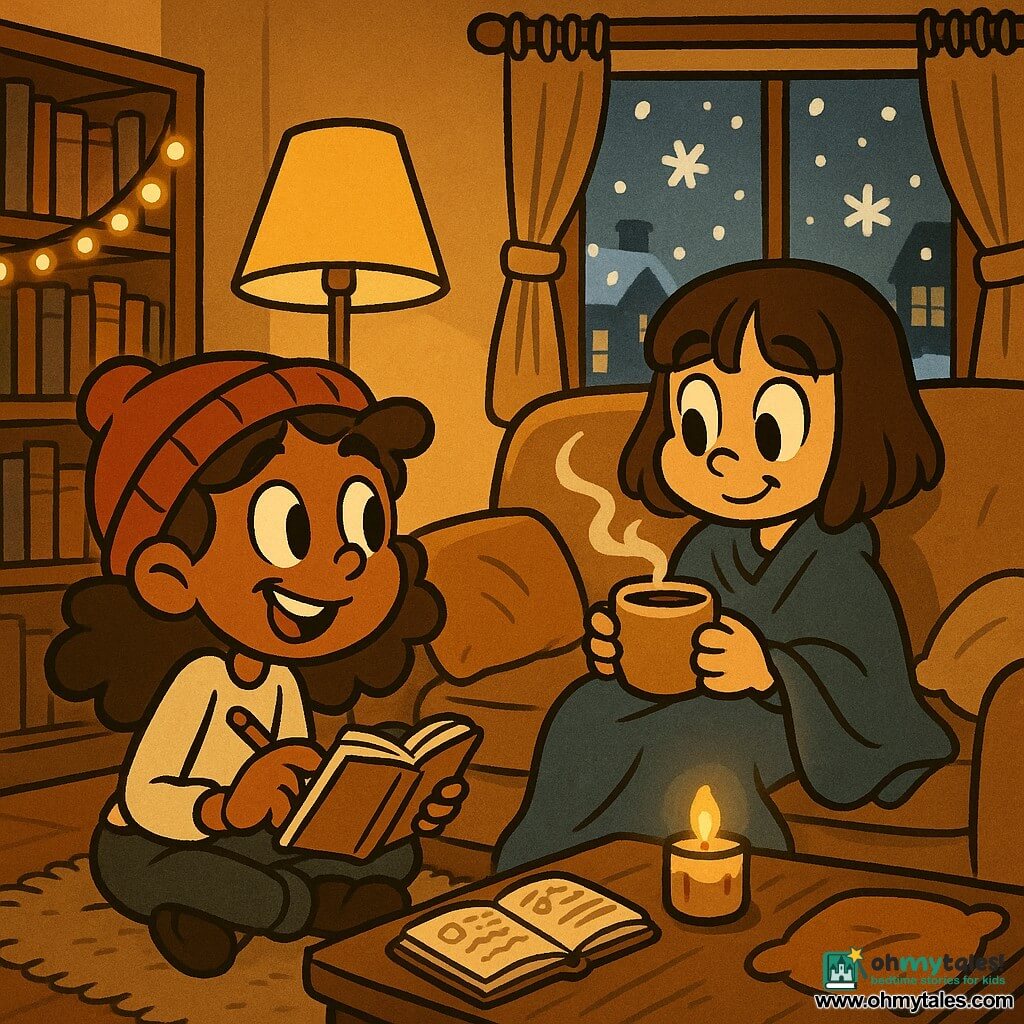
Lina pointed to the living room. A small string of yellow lights was hung along the bookshelf. The lamp was on, and a candle flickered safely in a glass jar on the coffee table. The room glowed in the dim afternoon like a little island.
“When it gets dark at four o'clock,” Lina explained, “you need a lighthouse. Otherwise you might forget the sun exists.”
Maya looked around. The couch had extra blankets. A basket held board games. The windows were slightly fogged from the warmth inside.
Lina's mom set down a tray with two bowls of soup and some bread. “You two look like you came in from an expedition.”
Lina nodded seriously. “We did. We faced the Snow Plains.”
Maya sat quietly and ate. The soup warmed her from the inside out. Her shoulders loosened.
After they ate, Lina pulled out the winter report notebook.
“Today's big test,” Lina said, “is something important.”
Maya waited.
Lina lowered her voice dramatically. “How to be cozy without feeling guilty.”
Maya blinked. “Guilty?”
Lina flopped onto the rug. “My brain tells me I should always be doing something loud and impressive. But winter is like… ‘Please sit down. Please be quiet. Please drink soup.' And I feel weird about it.”
Maya's fingers traced the edge of her bowl. She understood. Winter made everything slow. Sometimes slow felt like doing nothing, and doing nothing could feel wrong.
Lina looked up at her. “Do you ever feel that?”
Maya hesitated. Words lined up in her throat, then got shy.
Instead, she reached for the pencil and wrote in the notebook:
“Quiet can be a kind of rest.”
Lina read it and exhaled. “Yes! Exactly.”
They decided to build a “cozy corner.” Lina made a nest of blankets by the couch. Maya arranged pillows so there was a supportive spot for backs and arms. They placed the notebook and pencil on the coffee table like it was important equipment.
Outside, snow drifted down in small, steady pieces. The window made it look like a slow-motion movie.
Lina turned on soft music, then turned it down again. “Too loud,” she said.
Maya nodded. She liked the quiet.
They played a board game, but halfway through Lina said, “New rule. We can pause whenever we want.”
“Even in the middle?” Maya asked, surprising herself with how clear her voice sounded.
“Especially in the middle,” Lina said. “Winter rules.”
They paused to watch the snow. They paused to drink water. They paused because Lina wanted to show Maya a funny video of a cat sliding on ice like it had forgotten how feet work.
Maya's laugh came out suddenly, a short burst. Lina froze, then grinned like she had discovered treasure.
“There it is!” Lina whispered.
Maya covered her mouth, embarrassed, but her eyes smiled.
When it got darker, the living room became even warmer-looking. The lights on the bookshelf made soft circles on the wall.
Maya thought: This is what winter gives you. Not only cold, but a reason to make your own warmth.
Before she went home, she wrote a few lines about the day on a fresh page of the notebook:
“Snow makes the city quiet. The quiet feels heavy at first, then it feels gentle. The living room light looks like a safe star. I can breathe slower.”
She didn't show Lina right away. She just closed the notebook.
It felt like keeping a small, steady flame.
Chapter 4: The Long Walk and the Short Day
On Saturday, Lina suggested a longer walk.
“Not a hike,” Lina said quickly, seeing Maya's face. “A winter stroll. Slow. We can stop anytime.”
Maya agreed with a nod. She liked that Lina always left space.
They met at the building entrance. The sky was pale blue, but the sun looked weak, like it had stayed up too late.
Lina had a thermos in her backpack. “Hot tea,” she announced. “For emergency warmth.”
Maya carried the notebook this time. It was getting thicker with their notes, doodles, and silly measurements like “two fish sticks.”
They walked along the river path. Snow lay in uneven patches. Some parts were cleared, others crunchy, others slippery and shiny.
Maya watched the ground carefully. Her steps were small and steady.
Lina said, “You walk like a professional winter person now.”
Maya shrugged, but she felt proud.
They passed a man spreading salt on the sidewalk. The salt made small dark speckles on the white snow.
Lina whispered, “He's doing winter magic.”
They reached a bench with a view of the river. The water moved slowly, dark and thick-looking, and little bits of ice bumped against each other like quiet boats.
Lina poured tea into two small cups. Steam rose in thin ribbons.
Maya wrapped her hands around the cup. The warmth went straight into her fingers, then up her arms.
For a while, they didn't talk. It wasn't awkward. It was comfortable, like sitting next to a fireplace you can't see.
A few kids nearby were trying to slide on a frozen puddle. They fell and laughed and fell again. Their laughter sounded bright against the winter air.
Lina murmured, “They're making their own fun.”
Maya watched them. She liked how their game had pauses built in. Fall. Laugh. Stand. Try again.
After a moment, Lina said, “Do you want to try? Just once? We can hold onto the fence.”
Maya's stomach tightened. She didn't love being watched. She didn't love falling.
Lina added quickly, “Or we can not. It's your choice.”
Maya looked at the puddle. It was small. The fence was close. The kids were busy with themselves.
She took a breath. Then she nodded once.
They walked over. Lina held the fence first and slid one foot out like she was testing a dance move.
“See? Controlled chaos,” Lina said.
Maya placed one boot on the ice. It slipped a little, and her heart jumped. She grabbed the fence. Cold metal stung her palm through her glove.
She tried again, smaller. The boot slid, but this time she expected it. Her body adjusted. She didn't fall.
Lina whispered, “That's it. Tiny steps.”
Maya slid both feet a short distance. It felt strange, like the ground had turned into a trick. She wobbled, then steadied.
A laugh bubbled up in her chest. This time it came out, soft but real.
Lina clapped quietly. “One fish stick of fear,” she said, “and you ate it.”
Maya rolled her eyes, but she was smiling.
They didn't stay long on the ice. Maya stepped back onto the snow and felt solid ground again, grateful.
As they continued walking, Maya noticed how the day seemed to shrink. The light faded even though it was still afternoon.
Lina squinted at the sky. “The sun is speed-running.”
Maya wrote in the notebook while they walked, the pencil moving carefully:
“The day is short, but it doesn't have to feel rushed. We can go slow anyway.”
They returned home as the streetlights turned on. Windows glowed with evening life: people cooking, someone watering a plant, someone dancing in socks.
Maya felt tired in a good way, like her body had done something honest.
At her door, Lina said, “Tomorrow, come over again. We'll finish the report.”
Maya nodded. “Okay.”
She meant it.
Chapter 5: Lines on Paper, Warmth in the Air
On Sunday evening, the sky darkened early, and the snow outside reflected the streetlights so the world looked softly lit from below.
Maya went to Lina's apartment with the notebook tucked under her arm.
The living room lighthouse was ready again. The lamp glowed. The string lights twinkled. A blanket waited on the couch like an open invitation.
Lina was already in fuzzy socks. “Good,” she said. “You brought the official documents.”
Maya sat on the couch, and Lina sat on the floor with her back against the coffee table. Lina's mom brought in a plate of sliced apples and crackers.
“Fuel,” Lina declared.
They opened the notebook to the last page. Lina had drawn a messy map of their neighborhood with stars marking “cozy places”: the bakery window, the river bench, the living room.
“We need a conclusion,” Lina said. “A real one. Not just ‘winter is cold,' because everyone knows that.”
Maya looked at the pages. There were notes about socks, ice, tea, and pauses. There were also Maya's quieter lines, written in neat handwriting.
Lina tapped her pencil. “What did you learn, Professor Maya?”
Maya felt her face warm. Lina wasn't teasing. Lina was inviting.
Maya didn't rush. She picked up the pencil and wrote, slowly, while the room hummed with soft light.
“Winter can feel too big at first.
But I can prepare.
I can move at my own pace.
I can take breaks.
Warm places are real.
Quiet is real too.”
Lina read the lines and stayed silent for a moment. Then she said, “That's the best conclusion I've ever seen.”
Maya shrugged, but the shrug was smaller than usual. “It's just… true.”
Lina leaned her head back against the table and looked up at the ceiling. “You know what else is true? You don't have to talk a lot to be fun to be with.”
Maya's fingers tightened around the pencil.
Lina continued, casual but clear. “Some people fill the whole room with words. That's fine. But you make the room calmer. Like the lights. It's… nice.”
Maya swallowed. Her throat felt tight, but not in a bad way.
Lina glanced at her. “Did I say something weird?”
Maya shook her head. Then, carefully, she said, “No. It's… good.”
Lina smiled. “Okay. Because I respect your vibe. Silent winter wizard.”
Maya huffed a laugh. “Wizard?”
“Absolutely,” Lina said. “You notice things. You write them down. You teach me to slow down.”
Maya looked at the notebook again. She thought about the river, the ice, the bakery smell, the way the living room light held the evening gently.
She wrote one last line, smaller than the others, like a promise meant for herself:
“I can be myself and still belong.”
Lina didn't grab the notebook or demand to read it. She just offered Maya a cracker and said, “Want to watch the snow for a bit?”
Maya nodded.
They sat together in the warm living room, listening to the quiet. Outside, the snow fell steadily, patient as a bedtime story.
Maya felt a calm certainty settle in her chest.
Winter could be cold and dark, yes. But it could also be kind.
And she could be quiet.
No one here would judge her for that.