Chapter 1 – The Morning of Frost
Tom woke to a strange, bright light pressing through his curtains.
For a moment he thought it was already morning break at school and he had overslept by three hours. His chest tightened. Then he heard his mum humming downstairs and the familiar clink of plates.
“It's normal morning,” he muttered to himself, breathing out slowly.
He lay still for a few seconds, listening. The house was quiet in that winter way, like it had wrapped itself in extra blankets. The radiator buzzed softly. Someone outside scraped a car windscreen with a rough, grating sound.
Tom pushed back his duvet and shivered as his bare feet met the cold floor.
He crossed to the window and pulled back the curtain a little. The world outside was white and silver. Gardens, roofs, cars, even the worn pavement—everything sparkled with frost.
But what made him stop was the glass right in front of his nose.
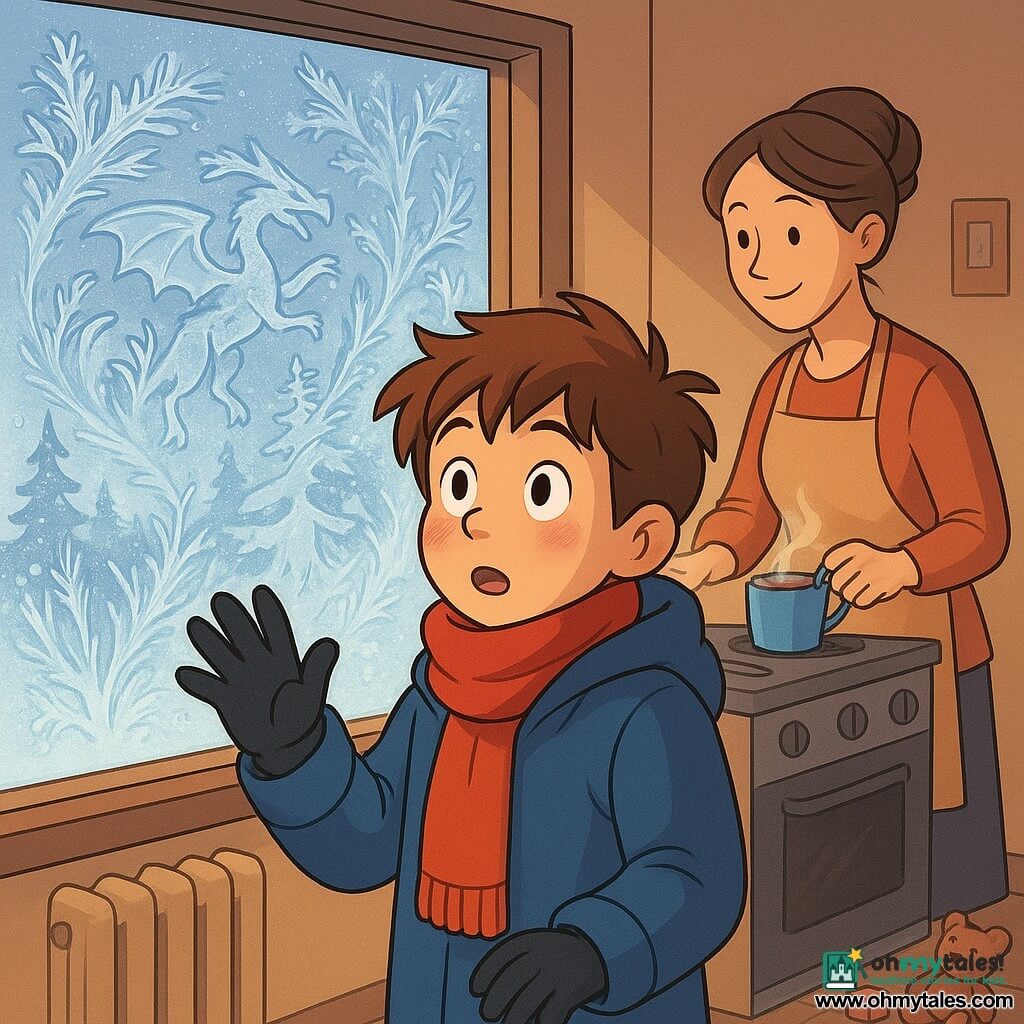
The whole window was covered in frost patterns, like someone had drawn on it during the night with invisible chalk. Ferns and feathers, loops and swirls, tiny sharp stars. Each patch of glass seemed to have its own design.
Tom leaned close, his breath fogging a small circle.
“This bit looks like… a dragon's tail,” he whispered, tracing the spiky curve in the air without touching the glass.
Next to it, another patch of frost rose in straight thin lines, crossing over each other like a careful web.
“And this is more like… a city,” he decided. “Lots of tall buildings. Very serious frost.”
His eyes moved along the window. Some patterns were thick and bold, like they'd been coloured in. Others were so delicate he had to squint to see them. A patch near the corner spread out like a tiny forest of pale trees.
He felt that small, light feeling he sometimes got when he noticed something no one else seemed to be looking at. His head filled up with thoughts faster than he could sort them.
He was still staring when his mum called, “Tom! If you want breakfast, now's the time! The bus won't wait for you just because it's cold.”
Tom winced. The bus.
He grabbed his clothes from the chair but his mind stayed at the window. As he pulled on his jumper, he glanced back again. His favourite bit now was a curved line of frost that reminded him of waves on the sea.
He smiled.
“Coming!” he shouted, hopping as he tried to get his sock on the right way round.
On his way downstairs, he promised himself he'd look at the frost again when he got home. If he remembered. He often meant to remember things. Homework. Gloves. Where he had left his keys. But his thoughts had a way of wandering off, like playful dogs tugging on a lead.
He reached the kitchen and found his older sister Mia already at the table, scrolling on her phone and chewing toast.
“Morning, Frost Boy,” she said without looking up. “You took ages.”
“There's frost on my window,” Tom said, sitting down. “It's amazing. It looks like lots of different pictures, all at once. One part is like a dragon—”
“Eat,” Mum interrupted gently, putting a bowl of porridge in front of him. “You can tell us after.”
Tom picked up his spoon, but his thoughts were still upstairs.
“Some frost is messy,” he said, “and some is neat. Why does that happen? Does it depend on the window? Or the temperature? Or maybe how much you breathe on it at night?”
Mia finally looked up. “Or maybe the frost fairies work in teams,” she said, eyes serious but mouth twitching. “Some are artistic, some are lazy.”
Tom gave a small snort of laughter.
“There are no frost fairies,” he said automatically. “It's just water vapour freezing on the glass. I did a project on it in Year 5. It's about… like… crystals forming. Or something. I forgot some bits.”
Mum smiled as she buttered her own toast.
“You remember more than you think,” she said. “Your brain works in its own way. Just try not to forget your scarf again. It's minus three out there.”
Tom's hand flew to his neck.
“I haven't forgotten it,” he said, then paused. “I think I left it… um…”
“In the hall. On the floor. Where you dropped your bag yesterday,” said Mum calmly. “Eat first. Then scarf. Then coat. In that order, please.”
Tom nodded and took a bite of warm porridge. The heat spread through him, chasing away some of the kitchen's chill.
As he ate, his mind flicked back and forth—frost, bus, science homework he hadn't finished, the roundabout on the way to school that was now covered in winter lights. He liked that roundabout. It looked different every season. Right now the council had set up shining white reindeer and blue-and-white snowflake lanterns. In the dark mornings they glowed like quiet stars in the middle of the road.
“Tom,” Mum said suddenly, tapping the table near his hand. “Spoon.”
He looked down. His spoon hovered in the air. His porridge sat untouched. His brain had wandered again.
“Sorry,” he said quickly. “I was thinking about the frost.”
“I guessed,” said Mum. “Porridge now. Frost later.”
Tom took another bite and tried to focus on the warm, slightly sweet taste. Listening to his stomach rumble helped. It was clearer than his whirling thoughts.
When he finally stepped out of the front door, scarf properly wrapped, he sucked in the cold air. It tasted sharp, like biting into an apple. His breath came out in a small, ghostly cloud.
He glanced back once at his bedroom window. From the street, the frost patterns were just a white blur.
But Tom knew what was hiding there.
He adjusted his backpack and walked towards the bus stop, listening to the crunch of frost under his trainers, and wondered what else the winter morning was quietly making, while no one was looking too closely.
Chapter 2 – Lights on the Roundabout
The bus rumbled through the frozen streets, its windows fogged from inside warmth and outside cold.
Tom wiped a small circle clear with his sleeve so he could see out. The town slid past, all pale roofs and sparkling hedges. Now and then he caught flashes of tiny icicles hanging from gutters, and once he saw a cat placing its paws carefully on the frosty grass, like it was stepping on stars.
“Look, it's like the world's dipped in sugar,” said his friend Jay, leaning over to see. “Everything's crunchy.”
Tom smiled.
“Or like someone pressed pause,” he said. “And every drop of water had to freeze where it was.”
“You and your weird thoughts,” Jay said, grinning. “You doing football club later?”
Tom's stomach did a little flip.
He had said he would. He usually liked football, but lately the late afternoon darkness made him feel strange—like he got too tired too fast. The cold bit through even his thick socks, and his brain seemed to slow down. He missed passes. He forgot who was supposed to run where. He always felt two steps behind the others, like in his head he was still trying to untangle something from earlier in the day.
“Maybe,” he said. “I'll see how I feel.”
Jay shrugged, already distracted by someone two seats back trying to throw a crisp packet into the bin from far away.
As the bus turned the corner towards the big roundabout, Tom pressed closer to the glass.
There it was.
In the middle of the roundabout, where in summer there were flowers and in autumn there were red and gold leaves, now stood a small winter scene. Someone had arranged shapes of wire and lights into reindeer, a sleigh, and tall snowflakes. In the dim morning they glowed softly—white and pale blue and a hint of gold.
Tom always liked how the lights looked from the warm bus. So far away, but also right in the middle of everything. Cars moved around the circle, tyres hissing on damp tarmac, but the centre stayed still and bright, like a quiet thought in a busy mind.
He tried to catch every detail as the bus edged forward in traffic.
One reindeer's light-up antlers tangled a bit, like they'd been mended. The biggest snowflake leaned slightly to the right. Someone had put a simple string of yellow lights along the low wall surrounding the display. Frost had settled on the grass there, making it look like the ground had grown tiny diamonds.
“You're going to crash into the window,” murmured Mia from the seat in front without turning.
Tom ignored her. His eyes jumped from one part of the display to another, trying to memorise it.
He liked to compare the frosty patterns on his window with these human-made patterns of lights. The frost was wild and delicate, changing every day. The roundabout lights were neat and careful, the same every morning, put there on purpose.
He imagined the frost creeping slowly over the metal reindeer at night, filling in the spaces between the glowing lines.
He wanted to stand near the roundabout and look for real, not only from the bus. To see how the frost and the lights met up.
“Hey,” said Jay suddenly, poking his arm. “You dropped your glove.”
Tom looked down. His right glove lay on the floor by his feet.
“Again,” Jay added, rolling his eyes.
Tom picked it up and jammed it into his coat pocket.
“Thanks,” he said. He had forgotten to do up his bag that morning. His maths book was already bent from falling out on Monday. His mum had called him “a little hurricane” when she picked everything up.
“Next stop!” called the bus driver.
Tom gave the lights one last long look, then pulled his gaze away. The bus moved past the roundabout, and the display slipped out of sight.
He told himself he would walk by later. Maybe after school, if it wasn't too dark. He imagined the frost crunching under his feet, the lights shining above.
In his mind, he made a list of things he wanted to notice:
How the lights looked from up close.
Whether the frost made different patterns on metal than on glass.
If standing there, breathing in the cold, would feel as calm as he hoped.
He clung to those thoughts as the bus bounced over a bump and turned towards school, the sound of chattering students filling the space around him.
Chapter 3 – A Day of Almost-Forgetting
By mid-morning, the memory of the frost on his window had faded into the background hum of Tom's mind. Not gone, just pushed behind other things.
There was English, where he nearly forgot to hand in his homework until the teacher said, “Anyone else?” and he jolted and dug through his bag. There was science, where the teacher talked about states of matter and showed pictures of ice crystals.
“That's like my window,” Tom whispered before he could stop himself.
The teacher, Mr Patel, turned.
“Something to share, Tom?” he asked, not unkindly.
Tom's ears heated.
“Just… the frost on my window this morning,” he said. “It looked a bit like that picture. But also different? Some bits were thick and some thin. I was wondering why.”
Mr Patel's eyes lit up.
“Excellent observation,” he said. “Frost crystals can grow in different ways depending on temperature, air moisture, and the surface they form on. What you saw is exactly the sort of detail scientists pay attention to.”
Tom blinked.
“Oh,” he said.
“So,” Mr Patel continued, “maybe you can bring a photo next time it happens. We could look at the different patterns together. Anyone else noticed the frost today?”
Several hands shot up. Stories of frozen cars and slippery steps filled the room for a moment. Tom sat quietly, a small warm knot opening in his chest.
Maybe his noticing wasn't just… drifting. Maybe it could be useful. Or at least interesting.
By lunchtime, the winter sun sat low but sharp in the sky. The air in the playground bit at any bit of skin not covered. Tom pulled his scarf up over his mouth and cheeks.
“Football?” asked Jay, appearing at his side with a ball under his arm.
“Too cold,” said someone else. “My toes will fall off.”
Tom hesitated.
He liked running. It made the buzzing in his head go quiet. But he was also tired. The late nights finishing homework he'd forgotten until the last minute were catching up with him.
His brain did a familiar tumble: I should say yes. They'll think I'm boring if I don't. But I feel slow. I might mess up. But I always mess up a bit. But—
“Hey,” said Jay, peering at him. “Earth to Tom. You in?”
Tom felt his shoulders tense. He tried to hear his own actual answer under all the noise.
His chest felt tight, and his legs already felt like heavy wood just thinking about running.
“I think… I think I'm going to stay in today,” he said at last. The words felt strange, but also slightly like relief. “I'm tired.”
“Tired?” repeated Jay. “You just sit in class all day.”
“Brains can get tired too,” said a girl from their class, zipping up her coat. “My mum says winter is draining. Listen to your body, or you'll get ill.”
“Fine,” said Jay, shrugging. “Your loss. I'll score for you.”
He trotted away with the others, breath puffing in the cold.
Tom stayed near the wall, watching the football game start from a distance. For a moment, guilt pricked him. Then a cold gust of wind slapped his cheeks, and he was suddenly very glad to be still.
As he hugged his arms around himself, he noticed something on the metal bench nearby. A thin line of frost clung to the top edge, catching the pale light.
He moved closer.
This frost looked different from the window frost. The crystals here were shorter, chunkier, like tiny teeth. He ran his gloved finger gently along the line. The crystals snapped and scattered, like breaking glass in miniature.
“Bench frost,” he murmured, amused. “Sturdy.”
“Talking to the furniture again?” Mia's friend Leila joked, walking past with a sandwich.
Tom rolled his eyes, but he was smiling.
In the afternoon, the sky darkened earlier than it did in autumn. By the last lesson, the light from the windows had turned grey-blue. The classroom felt smaller. People yawned more.
By home time, Tom's head felt thick. He nearly left his pencil case on his desk. He did leave his water bottle in his locker until Mia dragged him back.
“You'll complain you're thirsty at midnight,” she said. “And blame the universe.”
Outside, the air had turned even colder. Tom's breath came out in bigger clouds now. His nose burned in that stinging way that meant it would probably go red.
“Football club?” asked Jay as they waited for the bus. “Last chance to change your mind.”
Tom looked at the darkening sky, then at the road leading away from school. He thought of the roundabout lights he had seen that morning, glowing quietly. He imagined walking home instead of taking the bus, so he could pass them up close.
His stomach twisted with the usual fear of being different. But under that, there was a small, calm voice.
I want to see the lights. I want to walk. I am cold and tired and that's okay.
He took a slow breath, feeling the air scratch at the back of his throat.
“I'm going to walk,” he said. “I want to… I want to see something on the way.”
Jay looked puzzled, then shrugged.
“Suit yourself,” he said. “See you tomorrow.”
Mia frowned.
“Mum said we could get the bus together,” she reminded him.
“I know,” Tom said. “Tell her I'm walking. I've got my phone. I'll text her.”
Mia studied his face for a moment.
“You're not just skipping because you forgot your bus card, are you?” she asked.
Tom shook his head. “No. I… I really want to walk. Just today.”
“Fine,” she said at last. “Text Mum. And don't daydream into the road.”
He gave a half-laugh.
“I'll try,” he said.
As the bus pulled away, spraying a fine mist of dirty slush, Tom zipped his coat higher and started walking, his feet crunching on the frosty pavement.
Chapter 4 – The Roundabout in the Blue Hour
The time just after sunset in winter has a special colour. Not fully dark, not properly day. The sky goes a deep, gentle blue, and everything else seems to hold its breath.
By the time Tom reached the big roundabout, the world had slipped into that in-between blue.
Streetlights had clicked on, halos of soft orange along the road. Car headlights moved in smooth lines. The grass on the verges still wore its frosty coat, but now it gleamed under the lights, turning silver.
In the centre, the winter display shone brighter than it had in the morning. The reindeer glowed pure white. The snowflake lanterns looked like they were carved from ice instead of metal and bulbs. A faint hum of electricity buzzed in the air.
Tom stood on the pavement near the crossing, waiting for the green man. Cold seeped through his shoes, nipping at his toes. His fingers ached a little inside his gloves. But something in his chest felt warm and wide.
He had come here on purpose. He had listened to that small quiet wish inside him, even though it meant walking alone in the cold.
The green man flicked on. The sound of the beeping signal echoed faintly in the crisp air. Tom crossed the road, the smell of exhaust and cold metal wrapping around him.
On the small island of pavement nearest the roundabout, he stopped.
This close, he could see details he'd missed from the bus. The frame of the snowflake lanterns was a bit rusty here and there. The strings of lights were held with cheap plastic ties, some slightly loose. The reindeer's lights didn't make a perfectly smooth outline; there were tiny gaps where the bulbs ended and began.
But the frost had done its own decorating overnight.
Delicate white crystals had grown along every edge of metal, like careful lace trimming on a coat. Where the wires bent, so did the frost, creating tiny curls of ice. On the low wall around the display, the frost looked almost like waves, rising and falling in a frozen pattern.
Tom stepped closer to the wall and leaned in to look.
The frost here was different again from his window and the bench. These crystals seemed longer, like little spears all pointing in the same direction. They caught the light from the snowflake lanterns and turned it into soft sparkle.
“Arrow frost,” Tom murmured. “Like it all decided to go one way.”
A car drove past, music thumping from inside, but it felt far away.
He lowered himself carefully to sit on the low wall, making sure he didn't touch the frost too much. The cold from the stone seeped through his trousers, but he didn't move.
From here, the reindeer seemed almost life-sized. Their metal sides glowed, but he could see the empty space inside them, where nothing but cold air sat. The sleigh lights traced a smooth curve in the dark. Somewhere above, a few faint early stars poked through the blue.
For a few minutes, Tom just… sat.
He listened to the sounds of the roundabout: tyres swishing, engines humming, an occasional impatient horn. He watched people in cars, rushing home to warm houses. All around him the town spun and speeded and hurried.
But here, inside the circle of lights, time felt slower.
His mind, usually racing with half-started thoughts and half-finished worries, followed one simple thing at a time.
Frost on the wall.
Light on the reindeer.
Cloud of his own breath in front of his face.
His phone buzzed in his pocket, making him jump.
He pulled it out. A message from Mum: “Mia says you're walking. Everything okay?”
Tom looked at the glowing screen, then at the glowing roundabout.
He thought for a moment before typing, fingers clumsy in the cold.
“Yeah. Just wanted to look at the winter lights. And the frost. Will be home in 15. It's nice.”
He hesitated, then added, “Listening to myself.”
He pressed send before he could feel silly.
A minute later, his phone buzzed again.
“Proud of you. Take your time and watch the road. Dinner will wait. Love you.”
Tom swallowed the sudden lump in his throat.
He put his phone away and went back to looking.
After a moment, he noticed that not all the frost was the same, even here. On the top of the wall, it made those arrow shapes. On the sides, it clustered like tiny beads. On a forgotten plastic cup, it formed messy blobs.
“Wall frost, bead frost, cup frost,” he whispered. “All doing their best.”
His legs were getting numb now. He knew he shouldn't stay much longer. His toes started to feel like little stones in his shoes.
He took one last slow look around.
The cold air on his face.
The roughness of the stone under his gloved hand.
The quiet effort of the lights, shining without making a fuss.
Then he stood up, stamping his feet a little to wake them up, and walked on.
Chapter 5 – Warm Hands, Busy Mind
By the time Tom reached his street, true darkness had settled. A few houses had put up their own winter lights—nothing as grand as the roundabout, but small strings of colour around doors or in windows.
He noticed a simple line of blue lights along Mrs Khan's fence, and a tiny glowing snowman in the window of the house on the corner. Frost edged the bin lids, glittering under the dull orange streetlamp.
The sight made him strangely happy. All these tiny patches of light and frost, everywhere. Ordinary houses quietly joining in with winter.
He pushed open the front door and was hit by a wave of warm air and the smell of tomato sauce.
“You're back,” called Mum from the kitchen. “Shoes off on the mat, please. Coat on the hook, not the floor.”
Tom obeyed, his fingers stiff as he fumbled with the zip.
Mum appeared in the hallway, tea towel over her shoulder.
Her eyes did a quick check of him, like they always did when he came in.
“Cold?” she asked.
“A bit,” he admitted.
“Hands,” she said, holding out her own.
He placed his gloved hands in hers. She peeled the gloves off gently, then wrapped her warm fingers around his.
“Ouch, ice cubes,” she said softly. “Come in. You can tell me about the lights while your fingers defrost.”
In the kitchen, Mia sat at the table doing homework, headphones around her neck. The radiator along the wall clicked and hummed. The windows were steamed up, with thin lines of condensation dripping down.
Tom sat opposite Mia and pressed his hands carefully against a mug of hot chocolate Mum had placed in front of him without asking.
The heat seeped into his fingers with a mixture of pain and relief.
“So,” Mum said, stirring the pot on the stove. “How were the winter lights?”
Tom thought for a moment, choosing his words.
“They were… normal,” he said slowly. “But also special. Up close you can see they're not perfect. Some bits are rusty. But the frost made them look… new. And the lights made the frost look more sparkly. They sort of helped each other.”
Mia smirked.
“Deep,” she said, but her voice was more gentle than teasing.
Tom frowned into his mug.
“I just liked sitting there,” he said. “My brain usually feels… loud. Like a TV with all the channels on at once. But when I was there, I only had one thing to think about at a time. First the frost. Then the lights. Then my breath. It was… quiet inside. In a good way.”
Mum turned off the stove and came to sit with them.
“That sounds like you were listening to yourself,” she said. “Not what everyone else was doing, or what you thought you ‘should' be doing, but what you actually needed.”
Tom stirred his drink, watching the small whirlpool form.
“I nearly said yes to football,” he admitted. “I felt bad for saying no. But I was so tired. My legs felt like blocks before I even started.”
“Bodies talk,” said Mum. “In funny ways sometimes. Heavy legs, busy thoughts, tight chest. Listening to that is a kind of courage.”
“I'm not sure it's courage,” Tom said. “I just didn't want to run.”
“Courage isn't always big and dramatic,” said Mum. “Sometimes it's just choosing what's kind to yourself, even if it's different from what your friends choose.”
Mia clicked her pen.
“And,” she added, “it's more useful than choosing to play football and then being grumpy all evening and blaming everyone else. Which you sometimes do.”
Tom made a face.
“Do I?”
Mia and Mum both nodded.
He sipped his drink, letting the warmth run down his throat.
“I saw different frost again,” he said after a moment. “On the roundabout wall it was all pointing the same way. On the bench at school it was chunky. On my window it was like leaves and feathers. It's all just water freezing, but it looks so different.”
Mum smiled.
“Like people,” she said. “Same basic stuff, lots of different shapes.”
“Some of us more pointy than others,” Mia muttered, poking her maths book.
Tom laughed.
“I like the feather frost best,” he said. “It feels… gentle.”
He glanced at the steamed-up kitchen window. On the inside, drops of water ran down in messy paths. On the outside, he knew, frost was creeping across the glass as the night grew colder.
He stood up.
“Can I go look at my window?” he asked.
“Yes,” said Mum. “Dinner in fifteen. And don't leave your hot chocolate on the floor where someone will kick it. Again.”
“I did that once,” Tom protested weakly, picking up the mug.
Mia snorted.
“Yes, but you did it very well,” she said.
Tom rolled his eyes and headed upstairs, mug in hand, heart already moving ahead of him, back to the frost waiting in the quiet of his room.
Chapter 6 – The Night of Small Joys
Tom found his bedroom darker than the rest of the house. He switched on his desk lamp, and soft yellow light spread across his walls, full of posters and scribbled notes.
His window glowed faintly with the last of the outside light. He placed his hot chocolate carefully on his desk, then walked over.
The frost had grown.
Where in the morning there had been scattered shapes, now the patterns had thickened and spread, joining up like a slow, silent puzzle. One section near the top looked like a whole forest now—tall, thin trees with tiny branches, all made of ice. Another part had formed new curves, more like waves than before.
“Hello again,” Tom whispered, feeling slightly silly and slightly not.
He sat on the edge of his bed, facing the window, and tucked his feet up so they wouldn't get cold on the floor. The house was quiet. Downstairs he could hear a faint clatter of plates and the murmur of the TV.
He breathed in slowly, feeling his chest rise. He breathed out, watching his breath fog a tiny patch of glass. Where the warm mist met the frost, it melted a little, then quickly froze again in a new pattern.
“Breath frost,” he said softly. “Fast change.”
He thought of the day—of nearly forgetting his homework, of choosing to skip football, of sitting by the roundabout in the blue light.
He thought of all the times he had rushed through winter days before, hurrying from warm to warm, complaining about the cold, wishing for summer.
This year, he realised, he had actually looked. Not just seen, but looked. Compared. Wondered.
He lifted his hand, stopping just short of the glass so he wouldn't melt the frost.
Some patterns were smooth and sure, like they knew exactly where they wanted to go. Others were messy, breaking off and starting again, bumping into each other and making new shapes where they met.
A thought came to him, calm and clear, like the moment just before snow starts falling.
Maybe my brain is a bit like frost, he thought. It doesn't always grow in straight lines. It goes in different directions, makes strange shapes. Sometimes it's neat. Sometimes it's all over the place. But it still makes something.
He smiled to himself.
He imagined his thoughts this morning, rushing between frost, bus card, breakfast, science, football. Like crystals sprouting in every direction.
And then he pictured himself on the roundabout wall, watching one thing at a time. Like when the frost on the window had decided to be feathers, not stars.
Listening to himself had been like giving his thoughts a shape.
Downstairs, Mum called, “Tom! Dinner!”
“Coming!” he called back, still watching the glass.
He took one last slow look at the patterns.
Dragon tails.
City buildings.
Feathers and leaves.
Waves.
Tiny trees.
Breath traces.
Each part different, but all part of the same cold, beautiful thing.
He stood up, feeling a small, warm weight of happiness in his chest. It wasn't a fireworks kind of happiness. More like a candle. Steady. Quiet.
On the way out of his room, he paused and looked back.
The frost would probably be gone by midday tomorrow. It always was. The winter lights on the roundabout would be taken down after the holidays. The blue evenings would slowly stretch into later sunsets.
Nothing stayed exactly the same.
But he had noticed. He had been there for it.
And somehow, that felt like enough.
As he went downstairs, the smell of dinner thick in the air and the sound of his family's voices growing clearer, Tom felt glad in a simple, certain way.
He hadn't done anything huge. He hadn't won a race or climbed a mountain. He had just walked through a cold day, listened to his tired legs, watched frost grow and lights shine, and let his busy mind slow down now and then.
He had, he realised, used the winter instead of fighting it. Let it show him things: the different faces of frost, the quiet beauty of a roundabout at dusk, the small courage of choosing what he needed.
At the bottom of the stairs, he stopped for half a second and listened—not to the TV or the clatter of cutlery, but to the soft, steady rhythm inside his chest.
“I really did use today,” he whispered to himself, so low no one else could hear. “I really was there for it.”
Then he stepped into the warm, bright kitchen, cheeks still cool, heart still calm, already wondering what new patterns tomorrow's frost might bring.