Chapter One: The Valley that Forgot to Listen
Rowan kept sheep on the gentle slopes beneath the white-browed hills. He was a man with hands that remembered rope and wool, and eyes that remembered weather. For years he had heard the river sing — a thread of sound that stitched morning to evening, hum to hush. But one spring the music stopped. The river ran as it always had, quick between stones and under willow roots, but its voice had gone thin, like a bell struck with a glove.
Villagers crossed themselves and whispered old stories. Names, they said, were like anchors for things. When a thing lost its name, it could drift. Crops sighed, dogs worried at their leashes, and laundry dried slower than it should. Rowan felt the silence like a missing sock. He could not keep the sheep calm when the river did not sing.
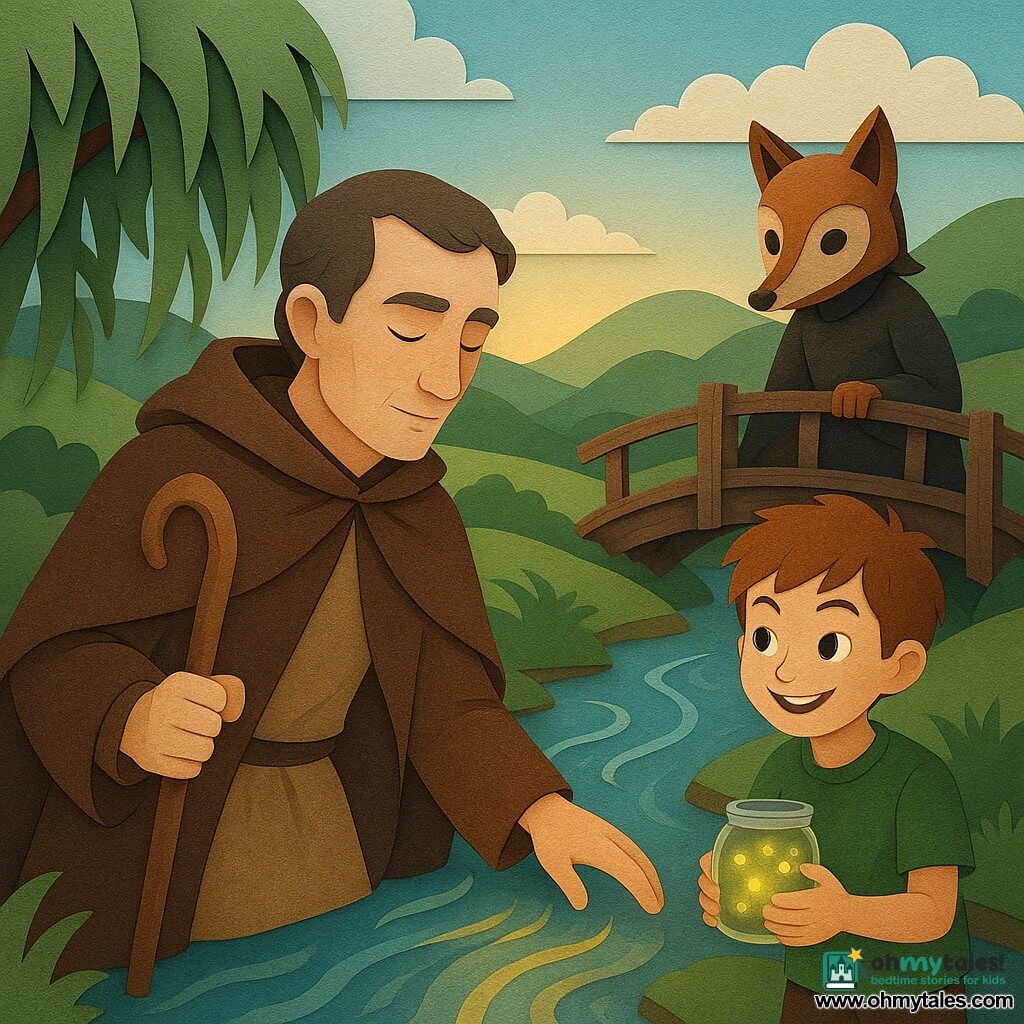
One morning, a boy came to Rowan's gate. Brin was small and quick, with a grin that dared storms to be interesting. He had climbed the hill with a satchel of jars — for fireflies, for wishes, or so he claimed. Brin spoke plainly: “The river forgot its name. I heard Foxmask at the Ford, polishing something like a tooth. He stole the name to wear at night.”
Rowan had met cunning in the markets and clever in the courts, but Foxmask was a thing of tale—half-man, half-fox, all cunning, with a stitched mask and a laugh threaded with mirrors. Most avoided him. Rowan listened to Brin's serious eyes. Promises were a kind of currency in the hills; when exchanged, they weighed more than coin. Rowan felt the pull of a promise he had long kept to his father: to guard the valley. He rose, gathered his crook, wrapped his cloak, and said, “Then we shall ask the river to remember.”
Chapter Two: The Bridge of Borrowed Names
They walked until the path thinned and the world smelled of riverweed and old stones. The Ford was a place where stories stepped across to meet each other, and here Foxmask kept a little shop of nightglass and tricks. He had built a bridge of bargains — thin planks with nails like questions. Each plank held a name borrowed from something real: a child's lullaby, a widow's laugh, a promise that had been said in anger.
Foxmask sat at the middle of his bridge, polishing a small box that gleamed like moonlight caught in a teacup. His mask had a snout that did not belong to any animal alive and eyes like buttons sewn with fog. He invited them with a bow as precise as a trap.
“Names are heavy,” he said, “and heavy things are best kept in small boxes.” He showed them the box's lid: inside, the river's name was written on a strip of riverweed, curling like a letter left too long in the rain.
Brin stepped forward. “Give it back,” he said without the wobble of fear. He had no need to hide anger; it fit him like a cloak too large and made him look taller.
Foxmask laughed, a laugh that scattered pebbles. “And what will you trade, brave little jar-carrier? A sheep? A promise? A sunrise?” He liked word-barter. He liked the way people measured themselves like peaches.
Rowan put his palm against the box. He thought of his father mouthing names beside a dying fire; he thought of his promise to the valley. “We will trade what is fair. Give the river its name, and I will give you the memory of my worst mistake.” He held nothing in his hands but the truth.
Foxmask's grin narrowed. A memory is a shape easily traded, and regrets make sharp currency. But the Trickster found delight in puzzles. He proposed a riddle instead: “Cross my bridge and answer true. If you fail, your names will hang upon its nails. If you answer, the river's name will sing again.”
They crossed. The bridge shifted underfoot like a creature listening. Each plank gave them one question, and each answer pulled at a thread in their own selves: why they loved the valley, what they feared to lose, what they would promise that could not be taken back. Brin answered with bold truth; Rowan answered with a soft, steady honesty that sounded like noon bells. At the middle Foxmask bowed and slid the box forward.
“Then name it,” he said, as if giving was a sort of sport.
Rowan closed his eyes and listened. He could not see the river's name; names were not paper and ink for him. They were echoes, a taste of sunlight on fish scales. So he spoke what he felt: “Singing.” He expected nothing grand, but the box hummed and shivered, and a breeze unrolled over the valley like a carpet. Foxmask's smile hitched, discovering new corners.
“You have guessed a shape,” he said, “not the whole thing. Keep your promise, shepherd.” He reached with clasped fingers for Rowan's memory.
Chapter Three: The Bargain's Bone
The trade began not with thunder but with a sound like wool pulled over a chair. Foxmask wanted memory, and memories have bones. He asked Rowan to take hold of the memory—Rowan's worst mistake—and hand it over. Rowan felt the memory like a pebble in his belly: a day when, as a young man, he had let a storm-washed path lead his flock to the low meadow where foxes had been seen. One lamb slipped into a narrow pocket of river and did not return. He had carried the guilt since like a stone.
Rowan could have lied, could have given a lesser thing. But promises are doors that open only for truth. He closed his eyes, shaped the memory with his hands, and handed it to Foxmask.
The Trickster cradled it like a child and then, with a foxish grin, swallowed it whole. The moment the memory left him, Rowan felt his shoulders unburdened and hollow. He had given sorrow and kept the lesson. It was a strange relief and a rawness all at once.
Foxmask kept his part; he lifted the box and tipped the strip of weed into the river. The water took it like a mouth tasting a long-lost spice. For a heartbeat the valley held its breath.
Then the river sang.
It began like a single string hum: old, patient, and redolent with stones. The song rolled through willows, threaded itself through wool, and found the sheep, who bleated in surprised agreement. It spoke a name that was more like rain's way of saying “home” than a thing you could write. For the first time since spring, mornings fit their edges again.
But Foxmask did not vanish triumphant. He had tasted Rowan's memory and found it sharpened his hunger. He wanted more names, more lives to read like maps. Brin saw this in a slip of fox-silver across the Trickster's face. The boy moved like a small wind.
Chapter Four: The Stitching of Promises
Foxmask rose and took a step toward the bank, planning new bargains. He would not be allowed to leach a valley dry. Brin ran and took the Trickster by the masked lapel, surprising even himself. “You took a man's sorrow,” he said, “and thought it would make you larger. It made you smaller.”
This, more than any grand speech, ruffled the Trickster. It was a truth he had not expected: that size is found in giving back, not eating. Foxmask flinched as though a cold wind had touched the inside of his mask.
Rowan watched the exchange and felt memory like a seam that could be restitched. He did something no bargain had asked for: he laid his palm against the river where the weed had vanished and promised aloud, not to the Trickster, but to the water itself. “I promise to keep you named, to listen when you change, to remember the lamb and learn,” he said, and the words felt like a needle through cloth, binding his past to the valley's future.
Foxmask listened to the promise. He had expected coin or cunning, not this stubborn, ordinary loyalty. The mask slipped, a seam loosened, and for a beat his face looked young and raw—someone who had once been afraid to be small. He laughed, a softer sound now, and returned the bundle of memories he had swallowed. They spilled like pebbles; Rowan took them back with hands that knew how to keep things safe.
The Trickster bowed, not with malice but with the practiced flourish of one who had learned a new trick: to let go. He left the valley to the work of living and wandering, carrying with him the memory of a man who chose to be gentle. The river's song braided itself into the day, a chorus with room for sorrow and joy together.
Chapter Five: The Valley That Remembers
When they returned to the village, the sunlight felt like a coin newly minted. People heard the river and began to speak names again — names for new apples, for babies, for bread that rose with a grin. The sheep slept deeper, and the willow hummed along like an old friend.
Rowan kept his promise small and steady. He taught children how to listen to water, how to fold names into baskets and say them at dawn. Brin made jars for wishes that were not hoarded but released; he would slip a paper boat into the river and watch it carry a name downstream, trusting the current to hold it safe.
Foxmask's bridge remained by the Ford for a long time after, a reminder that bargains must be handled like hot bread. Sometimes, on moon-silver nights, people said they could see a flicker of fox fur by the willow, polishing something that might be a lesson. The valley did not fear the Trickster anymore; it knew names could be lost and found, that promises could mend what was missing.
Rowan stood by his flock and listened. The river sang its name sometimes loud, sometimes a whisper, but always present, a living thread. He had given a memory and received back more than song: a valley that remembered how to care. And Brin, grinning as ever, would paddle a jar-boat into the afternoon, happy that some things, like river names and friendships, were meant to be shared.