Chapter 1: The Fire That Slept
The wind over the saffron hills carried stories the way a river carries boats—softly, steadily, and always onward. In the city of blue-tiled domes and sun-warm stones, people said the sacred fire on Mount Alborz had gone quiet.
Not dead. Never dead. Only sleeping, as if it had closed its bright eyes.
Arasti heard those whispers while she handed out bread at the market, cutting each loaf so it would be easy for small hands and old hands alike. She was the kind of woman who noticed everything: a limp in a donkey's step, a frown hiding behind a merchant's smile, a child pretending not to be hungry. And she was magnanimous in the simplest way—she gave without making anyone feel small.
That morning, a thin man in a dusty robe bowed to her stall. Around his neck hung a tiny bronze sun. “Lady Arasti,” he said, “the Atashgah is dim. The ritual flame needs waking.”
Arasti's eyes lifted toward the far mountains, where the peaks looked like sleeping lions. “If the fire sleeps,” she said, “the cold will feel braver. Shadows will start acting like they own the place.”
The man nodded, worried as a mouse in a cat's garden. “The priests tried their chants. They tried new oil. They tried old prayers. But the flame will not rise.”
Arasti wiped flour from her hands. “Then it needs something older than oil and louder than fear.”
At the edge of the market stood a pomegranate tree, heavy with red fruit like hanging lanterns. Arasti touched its bark. She remembered her grandmother's words: Fire listens. Fire remembers. Fire respects respect.
She went home, packed flatbread, dates, and a small copper bowl. She added a strip of sky-blue cloth, because courage sometimes likes a pretty ribbon. Last, she took a flintstone from her father's box—black and ordinary, yet full of hidden sparks.
When the sun dipped low, she climbed the first path toward Mount Alborz. The world around her turned quiet and wide. The stones under her sandals felt ancient. The air smelled of thyme and distant snow.
Above, the sky deepened into a smooth, dark ink. Stars began to appear, one by one, as if someone careful was setting out lamps for travelers.
Arasti walked on, and as she walked, she spoke softly—not to scare the night, but to greet it. “I come with respect. I come with steady hands. I come to wake a light that belongs to everyone.”
Behind a boulder shaped like a crouching bull, something blinked—two eyes like coins. Then another pair. And another.
Arasti stopped. “Hello,” she said, because hello is a bridge.
A pack of jackals stepped into view, their fur the color of sand. But their tails shimmered with faint silver, like moonlit smoke.
The largest one—its ears ragged, its gaze sharp—tilted its head. “A human climbing at night?” it seemed to say without words. “Either brave, or hungry for trouble.”
Arasti took a date from her bag and placed it on a flat stone. Then another. “For you,” she said. “I'm not here to steal your hill. I'm here to wake the fire.”
The jackal sniffed the dates, then sat down like a judge. The others did the same, forming a half-circle.
The leader's eyes gleamed. In Arasti's mind, a thought arrived like a clear bell: Respect opens more doors than force.
She bowed her head. “Will you let me pass?”
The jackal leader flicked his silver tail. The pack stepped aside, their bodies melting back into the rocks and shadows as if they had been drawn with charcoal and erased.
Arasti exhaled. “Thank you,” she whispered. Then she climbed higher, the path winding like a story that refuses to be rushed.
Chapter 2: The River of Whispering Reeds
By dawn, Arasti reached a valley where a river stitched the land together. The water ran clear and quick, and the reeds along its banks swayed as if they were listening to a song no one else could hear.
A small ferry waited there, tied to a post. No ferryman stood nearby. Only a carved wooden sign that read: PAY WITH A TRUE WORD.
Arasti smiled a little. “That's cheaper than coins,” she said, and then, because the river seemed to be waiting, she spoke into the air.
“I am afraid,” she said. “Not of the mountain, not of beasts, but of failing people who hope.”
The rope untied itself with a neat little tug. The ferry slid toward her, bumping the bank gently like a friendly goat.
Arasti stepped in and pushed off with a pole. The river carried her smoothly. Halfway across, the reeds began to whisper louder, and the sound turned into actual words—soft, many-voiced, and curious.
“Why wake the fire?” they asked. “Why not let darkness be? Darkness is restful. Darkness is quiet. Darkness is easy.”
Arasti rested her hands on the pole. “Easy is not always kind,” she replied. “When the fire sleeps too long, people forget how to gather. They forget to share warmth. They forget to look up.”
The reeds rustled, unhappy. “Fire can burn.”
“Yes,” Arasti agreed. “That is why it must be respected. A sacred flame is not a toy. It is a promise.”
A ripple spread across the water. Something moved beneath the surface—large, slow, and thoughtful. A pale shape rose near the ferry: a water spirit with eyes like green glass, its hair streaming like riverweed. It did not look angry. It looked old.
The spirit watched Arasti for a long moment. Then it lifted one hand. In its palm lay a single pebble, bright as polished amber.
Arasti understood without being told. She set her copper bowl on the ferry's floor and placed in it a piece of bread, a date, and a pinch of salt.
“For the river,” she said. “For carrying me. For not asking me to be perfect, only honest.”
The spirit's lips curved slightly, almost amused. It dropped the amber pebble into her bowl with a soft clink.
At once, the air smelled warmer, as if summer had leaned in. The reed-whispers calmed.
When the ferry touched the far bank, the river spirit sank away, leaving only circles of ripples that shone for a moment like silver bracelets.
Arasti tucked the amber pebble into her pouch. “A gift,” she murmured. “Or a test in a different shape.”
She climbed again, leaving the river behind. The land rose into rocky slopes. Above her, Mount Alborz waited, white-capped and watchful.
As she walked, she repeated the same steady words like footsteps: “With respect. With patience. With light.”
Chapter 3: The Lion Gate and the Feather
Near midday, Arasti reached a cliff where the path ended at an archway cut into stone. Two lions were carved on either side, their mouths open in silent roars. But these were not dead carvings.
Their eyes moved.
When Arasti stepped closer, the lions breathed. Warm air flowed from their mouths, carrying the scent of sun-baked grass and something sharper—like lightning about to happen.
A voice rolled out, deep as a drum. “Traveler, why do you climb?”
Arasti bowed. “To wake the ritual fire.”
Another voice answered, rougher, like stone scraping stone. “Many have come with grand speeches. They offered gold. They offered threats. They offered pride.”
Arasti looked up at the lions' watchful eyes. “I offer none of those.”
Silence. The wind tugged at her blue cloth.
The first lion asked, “What do you offer, then?”
Arasti took out her copper bowl. Inside lay the amber pebble, glowing softly. She placed the bowl on the ground. “I offer truth, respect, and what I have been given,” she said. “Not to buy my way through, but to show I understand this mountain is not mine.”
The lions studied her. Their stone manes seemed to ripple as if remembering they were once real.
The second lion said, “If you wake the fire, it will draw eyes—human eyes, spirit eyes, greedy eyes.”
“I know,” Arasti replied. “That is why the waking must be gentle. A flame can be a torch or a bonfire. A torch guides. A bonfire frightens. I want a torch for everyone.”
The first lion's mouth closed slowly. A rumble passed through the archway, as if the mountain itself had chuckled.
Then the air shimmered. Between the lions, a feather floated into view—long, white, and edged with gold light. It drifted down and landed on Arasti's palm, warm as bread just pulled from an oven.
“The Feather of Simurgh,” the first lion said. “A reminder of wisdom. A reminder of mercy. Carry it well.”
Arasti held it carefully, as if it might be made of sunrise. “Thank you,” she whispered.
The lions' eyes softened. The stone archway brightened, and the rock face beside it cracked with a sigh. A narrow passage opened, twisting upward into the mountain.
Arasti stepped into the passage. Behind her, the lions returned to stillness, but she could feel their watchfulness like a cloak on her shoulders.
In the dim tunnel, the feather glowed faintly, lighting her steps. The light did not shout; it hummed. It did not push; it invited.
Arasti followed it upward until the tunnel ended, and she emerged onto a high plateau where the wind tasted of snow and stars.
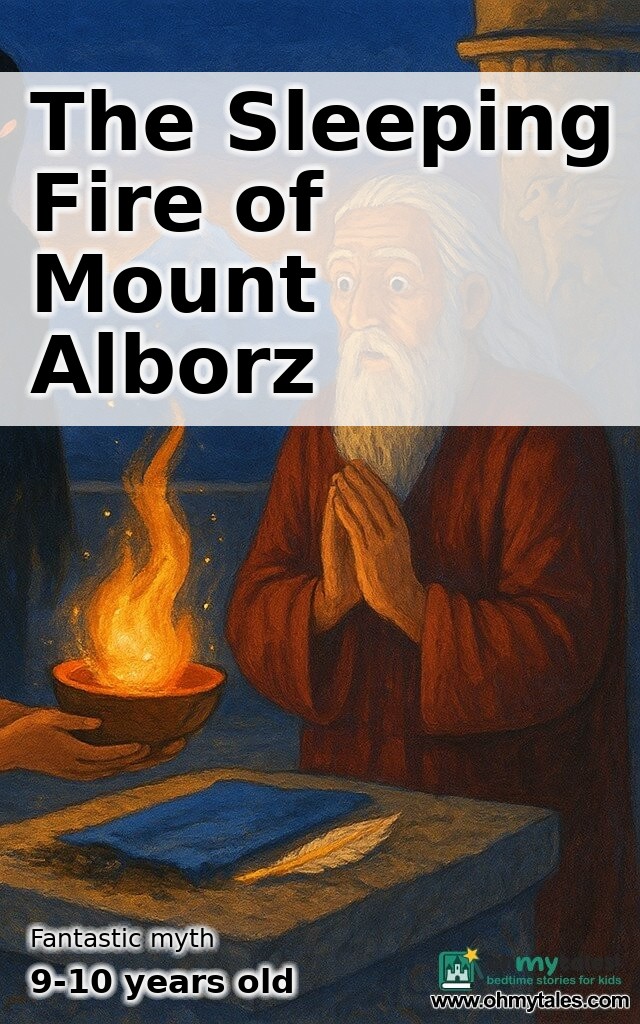
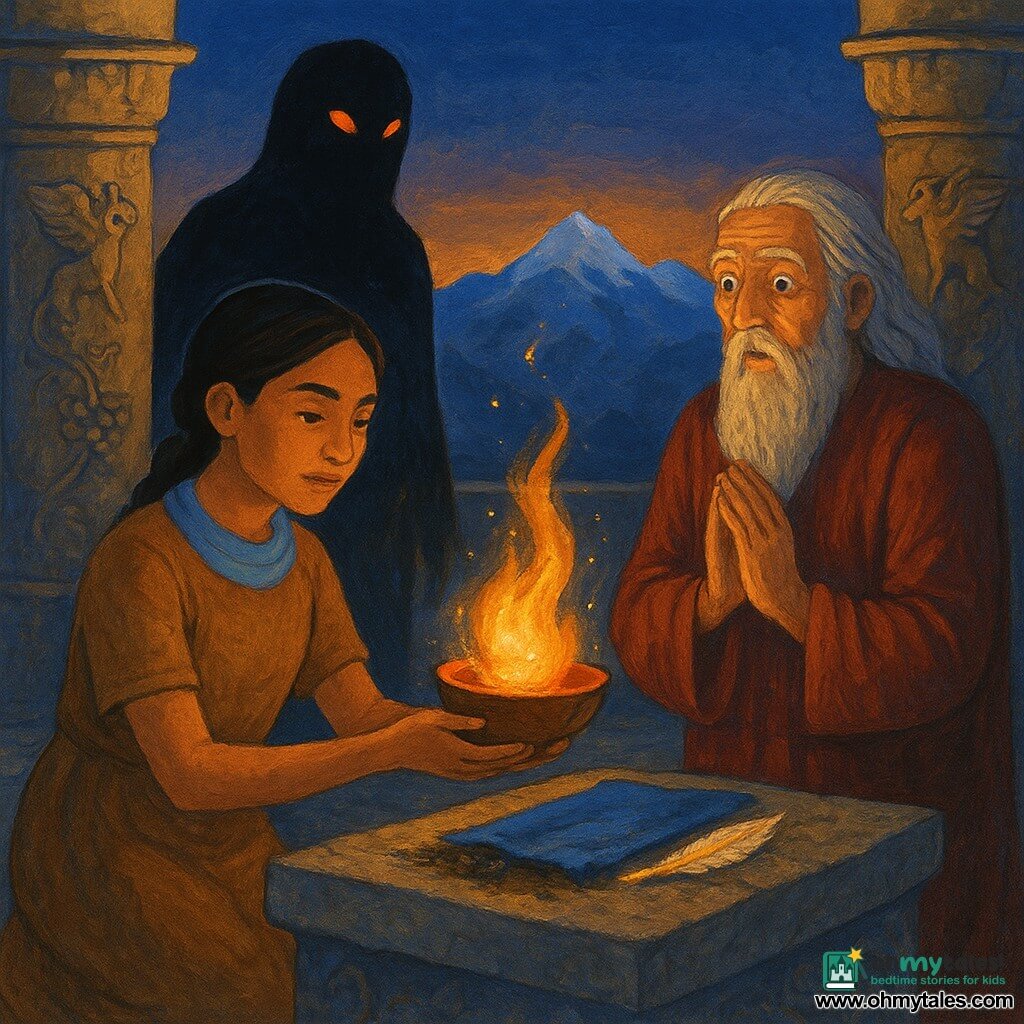
Ahead stood the Atashgah—an old temple of stone, ringed by pillars carved with winged bulls and flowing vines. At its center, on a circular altar, lay ashes as gray as tired clouds.
The sacred fire was there, but only as a memory.
Arasti's heart tightened, then steadied. “All right,” she said softly. “We will wake you the right way.”
Chapter 4: The Ashes and the Oath
The plateau was quiet, yet not empty. Shadows pooled near the pillars, and the air held a feeling like someone holding their breath.
Arasti approached the altar. The ashes were cool. She set down her bag and laid out what she carried: flintstone, copper bowl, amber pebble, and the Feather of Simurgh.
She also placed something else—small, but important. A strip of her sky-blue cloth, folded neatly.
“For gentleness,” she said. “For the people below. For the spirits above.”
A low sound rose from the edge of the plateau—like distant thunder deciding whether to visit. The shadows gathered into a shape: a tall figure made of dusk, with eyes like fading coals.
“I am the Keeper of the Last Ember,” it said, voice soft and heavy. “You are not a priest. You are not a king. Why should the fire listen to you?”
Arasti stood straight. The wind pushed at her hair, but she did not flinch. “Because I listen to the fire,” she answered. “And because I listen to the world it warms.”
The Keeper's dark form leaned closer. “The fire went quiet because it was tired of being used. Tired of proud hands. Tired of careless wishes.”
Arasti nodded. “Then let it wake to a different promise.”
She picked up the flintstone. She did not strike it yet. First she touched the ashes with her fingertips and closed her eyes.
She remembered the market: the hungry child, the tired merchant, the laughing baker, the grumpy old woman who still deserved kindness. She remembered the jackals stepping aside. She remembered the river's gift. She remembered the lions' warning.
Then she spoke, not loudly, but clearly, like a bell that does not need shouting to be heard.
“I will not command you,” she said to the altar. “I will not show you off. I will not feed you with greed. I ask you to rise as a guardian, not a weapon. I ask you to rise as warmth, not as pride.”
The Keeper's eyes flickered. “Words are easy.”
Arasti lifted the amber pebble. Its glow lit her palm. “This was given by the river when I paid with a true word,” she said. “Truth is not easy.”
She lifted the feather. “This was given by the lion gate when I offered respect,” she said. “Respect is not easy.”
She lifted the blue cloth. “This is mine,” she said. “And it will be the first thing I give to the flame, because it is the color of open sky—wide enough for everyone.”
She placed the cloth on the ashes. It did not burn. It simply lay there, as if waiting.
Arasti finally struck the flintstone. A spark leaped out—tiny, sharp, brave. It landed on the cloth.
Nothing happened.
Arasti struck again. Another spark. Another. She kept her hands steady. She did not rush. She did not beg. She did not get angry at the stone for being a stone.
“Wake,” she whispered, not like an order, but like an invitation to a friend. “Wake, and be gentle. Wake, and be bright. Wake, and belong to all.”
The Keeper watched. The wind held still.
On the seventh strike, the spark did not die.
It caught, a small gold thread of fire that trembled like a newborn foal's legs. It warmed the cloth, then the ashes, then the air itself. A scent rose—clean smoke and sweet resin, like the memory of cedar.
The flame lifted its head.
The Keeper stepped back, its shadow-body thinning. “It listens,” it said, sounding surprised. “It listens to you.”
Arasti's eyes shone with relief. “It listens to respect,” she corrected gently. “I'm just practicing.”
The fire grew—not into a roaring monster, but into a steady spiral, bright and calm. Its light spread across the pillars, waking the carvings: winged bulls seemed to breathe again, vines seemed to sway.
The Keeper bowed its head. “Then the old bargain must be renewed,” it said. “Fire and shadow. Warmth and rest. Day and night. None should try to erase the other.”
Arasti nodded. “Agreed. Darkness has its place. But it must not steal what the light is meant to give.”
The Keeper extended a hand made of dusk. In its palm appeared a small coal—black, but pulsing with red inside. “An ember for peace,” it said. “Take it down the mountain. Make an alliance, not a victory.”
Arasti held out her copper bowl. The Keeper placed the coal inside. It did not burn the metal. It rested there like a sleeping heart.
“Thank you,” Arasti said, and she meant it.
The sacred fire behind her crackled softly, as if it had started telling a happy secret.
Chapter 5: The Peace of Shared Light
The journey down felt different. The mountain did not seem less tall, but it seemed less lonely.
As Arasti descended, the jackals appeared again on a ridge. Their silver tails flicked in the morning sun. The leader watched her bowl, where the ember lay, and then met her eyes.
Arasti bowed. “The fire is awake,” she said. “But it will not chase you from your shadows. It will only warm the paths.”
The jackal leader huffed—something like laughter—and turned away. The pack trotted off, leaving pawprints that glittered for a moment, then faded.
At the river, the ferry waited. The sign still read: PAY WITH A TRUE WORD.
Arasti looked at the water and spoke, “I am grateful.”
The ferry rope loosened at once. As she crossed, the river spirit rose beside her, watching the ember with calm, green-glass eyes.
Arasti held the bowl close. “This is not mine,” she said. “It is for the city. For the temple. For every home that needs courage.”
The spirit placed a cool fingertip on the bowl's rim. A thin veil of mist wrapped around the ember, not to smother it, but to protect it from careless wind.
Arasti smiled. “A safe blanket,” she murmured.
Back at the lion gate, the stone lions' eyes opened. The first lion rumbled, “Did you wake it?”
“I did,” Arasti said, “and it woke me too.”
The second lion asked, “What will you do when people fight over it?”
Arasti thought of the market again—how quickly humans can quarrel over crumbs and coins. She lifted the Feather of Simurgh. “I will remind them,” she said, “that a sacred thing is not a prize. It is a responsibility.”
The lions let her pass. Their warm breath followed her like a blessing.
When Arasti reached the city, the streets were crowded. People had heard rumors that the mountain had changed. Faces looked up as if searching the sky for an answer.
Arasti walked to the old fire temple in the center of the blue domes. The priests met her at the steps, eyes wide with hope and worry. Behind them, townsfolk gathered: bakers, potters, children with dusty knees, elders leaning on canes.
Arasti raised her copper bowl so they could see the ember inside—quietly glowing, steady as a heartbeat.
No one cheered at first. It was too sacred for shouting. Even the birds seemed to hush.
Arasti spoke clearly. “This ember is for the ritual fire,” she said. “But hear me: the flame belongs to no one person. Not to me. Not to the priests. Not to the proud. It belongs to all who treat it with respect.”
A boy in the crowd blurted, “Can it grant wishes?”
Arasti's eyes softened. “It can grant work,” she said, and a ripple of gentle laughter passed through the people. “It can grant courage. It can grant warmth—if you share it.”
The head priest stepped forward and bowed, not only to the ember, but to Arasti. “Will you place it upon the altar?” he asked.
Arasti nodded. Together, they walked inside.
The temple's center was a wide stone circle, darkened from many years of flame. Arasti set the bowl down. The priest lifted the ember with a golden spoon and placed it into the waiting bed of clean ash and resin.
The fire caught quickly, like it had been waiting for the right hands.
Light rose—gold and steady—painting the walls with living shapes. The people outside saw the glow spill through the doorway, and a soft “oh” moved through them like wind through wheat.
But something else happened too.
In a corner of the temple where shadows gathered, the Keeper of the Last Ember appeared—not frightening, not towering, just a calm silhouette edged with twilight. It bowed to the flame. The flame answered with a small, friendly crackle.
Arasti stood between them, feeling like a bridge made of breath.
The priest saw the Keeper and tensed, but Arasti lifted her hand. “This is part of the promise,” she said. “Warmth and rest. Light and night. We do not destroy what we do not understand.”
The Keeper's voice slid through the quiet. “We will not smother your fires,” it said. “And you will not hunt our shadows. Let there be lanterns for travelers—and cool dark for those who sleep.”
The priest swallowed, then nodded slowly. “Let it be so.”
Outside, people began lighting their home lamps from the temple's flame—one by one, careful and patient. No one shoved. No one grabbed. Each person waited their turn, and each person thanked the next.
Arasti watched, heart full. The city looked as if it had grown new stars at street level.
That night, when the moon hung over the blue domes like a silver coin, Arasti returned to the market's pomegranate tree. She touched its bark again.
The wind carried a different kind of whisper now—less worried, more hopeful.
Arasti smiled into the dark, knowing the dark could smile back in its own way. The sacred fire burned steadily on, not as a roaring ruler, but as a shared, peaceful light.
And in that bright calm, a new alliance held firm: not a victory over shadows, but an agreement with them—so the world could be warm, and the world could be quiet, and the world could be safe enough for everyone to dream.