Chapter 1: The Woman Who Listened to Hooves
In the wide steppe where the grass waved like green rivers, the night always arrived with a soft thump—like a giant setting down a velvet cloak. Stars pricked through the dark, bright as silver beads on a warrior's belt. The wind carried old songs, and if you listened well, you could almost hear hooves that weren't there.
Alya listened better than most.
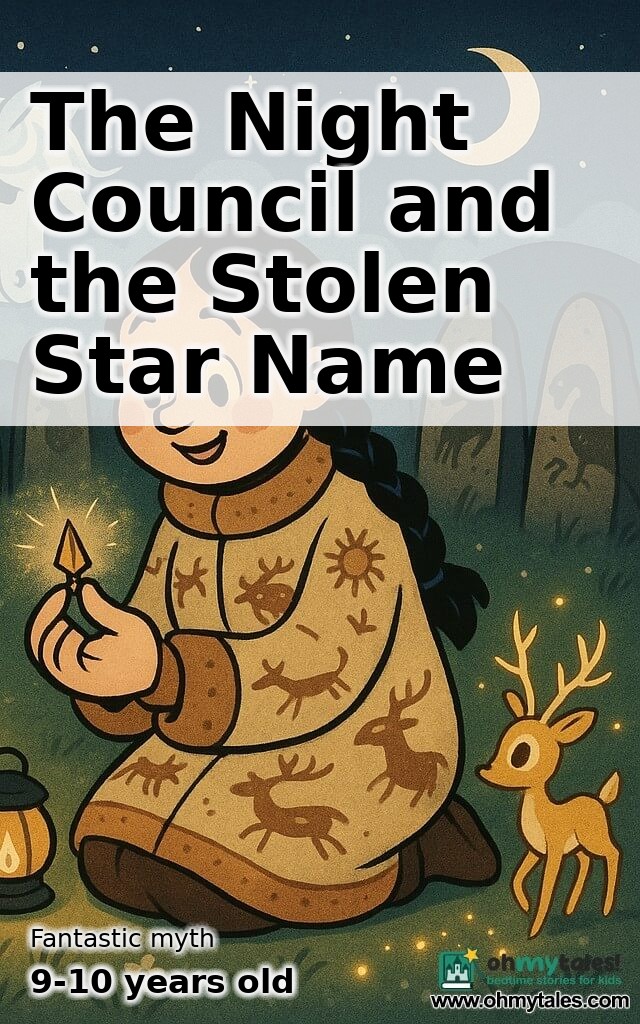
She was an adult, with sharp eyes and a quick mind, and she lived near the Black River in a round felt yurt painted with swirling deer and sun-wheels. People came to her when they lost a goat, or a good idea, or their courage. Alya never promised magic. She simply watched, waited, and asked the kind of questions that made answers appear.
Tonight, her brazier crackled with sweet-smelling wood. Above it, a kettle sang softly.
Alya set three cups on the low table. Then she set a fourth.
Her niece, little Saira, popped her head through the yurt flap. “Four cups? Are we having guests?”
“We are,” Alya said.
Saira grinned. “Is it the wolf again? The one that steals our sausages?”
“That wolf is a poet,” Alya said. “He steals only the best.”
Saira giggled and sat on a cushion. “Then who's the fourth cup for?”
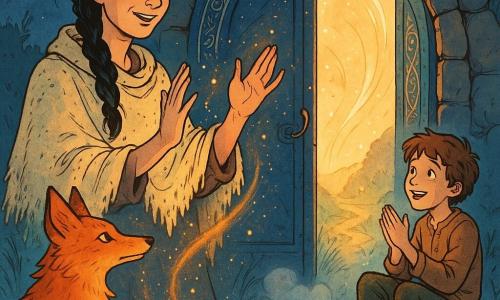
Alya looked toward the open doorway, where night waited like a patient animal. “For the ones who only come when the sky is dark,” she said. “For a Night Council.”
Saira's eyes widened. “A council? Like chiefs and heroes?”
“Like voices,” Alya replied. “Like wisdom. Like help.”
Outside, a thin crescent moon hung low, as if it had slipped and was trying not to fall. Alya felt a tug inside her chest, the same tug she'd felt for many nights: a wish, not for gold or glory, but for gathering—bringing together the right minds at the right hour.
Because something was wrong.
The Black River had been too quiet. The deer moved in strange circles. Even the fire seemed to hesitate before it flared. In the old stories of the Scythian lands, when the world held its breath, the spirits were listening.
Alya stood and lifted a small object from a wooden box: a bronze arrowhead, green with age. It had belonged to her mother, and before that, to a grandmother whose name was a wind-sound no one could quite pronounce. The arrowhead was said to point toward truth—if you dared to follow.
Saira leaned closer. “Are we going to hunt?”
“We are going to call,” Alya said.
She stepped outside. The steppe stretched away, wide and watchful. Alya raised the arrowhead to the sky and spoke softly, as if the stars were sleepy children.
“Horse of the North Wind,” she called, “bring your swift ears.”
“Deer of the Golden Antlers,” she called, “bring your quiet feet.”
“River Mother,” she called, “bring your deep memory.”
“And you,” she added, and her voice turned gentle, “Sky Father, send a sign that we are not alone.”
The grass shivered.
Somewhere far off, a single owl said, “Hoo,” as if clearing its throat before a speech.
Saira whispered, “Does that mean they heard?”
Alya smiled, but her smile was a lantern, not a shield. “It means the night has opened its door,” she said. “Now we must be brave enough to walk in.”
Chapter 2: The Arrowhead That Chose a Path
At dawn, the world looked innocent again. The steppe sparkled with dew. The river glittered, pretending it had never been strange. Even the goats acted as if they'd always behaved perfectly—though one of them had a suspiciously shiny mouth.
Alya packed a small bag: flat bread, dried berries, and a strip of smoked meat that Saira insisted was “emergency joy.” She also packed the bronze arrowhead in a cloth pouch and tied it to her belt.
Saira trotted beside her as they walked away from the yurt. “So,” she said, “when do the spirits arrive? Do they knock? Do they shout? Do they bring snacks?”
“Spirits never bring snacks,” Alya said. “That's how you know they're serious.”
They followed the Black River upstream where the reeds grew thick and whispered secrets to one another. Alya felt the arrowhead tugging, like a tiny finger pulling her left, then right, then straight ahead.
Soon they reached a hill shaped like a sleeping lion. At its top stood an ancient stone, taller than Alya, carved with swirling lines and a single symbol: a deer leaping toward the moon.
Saira put her hand on the cold rock. “It feels… awake,” she said.
“It is,” Alya answered. “This is a marker from before our grandfathers had grandfathers.”
Alya took the arrowhead from her pouch and held it near the stone. The bronze warmed in her palm. Then, like a compass deciding its mind, it turned—pointing not north, not south, but toward the shadowed valley behind the hill.
Alya's throat went dry. “That way,” she murmured.
Saira hopped once, then twice, as if she could jump her fear into a smaller shape. “What's in the valley?”
“Old things,” Alya said. “And perhaps the place where the Night Council can meet.”
They descended. The air changed as soon as their boots touched the valley floor. It smelled like rain that hadn't happened yet. The light felt softer, as if the sun was using a quiet voice.
There, half-hidden by tall grass, lay a circle of stones—twelve of them, each carved with a different creature: wolf, eagle, fish, bear, snake, and more. The carvings were worn, but the eyes of the creatures still seemed to watch.
In the center of the circle, the ground dipped. A shallow hollow, like a bowl waiting to be filled.
Saira whispered, “This is a council table for giants.”
Alya knelt and brushed away grass from the hollow. At the bottom was a patch of dark soil, almost black.
She placed the arrowhead in the center.
The air hummed.
Alya didn't run. Alya didn't shout. She simply breathed, slow and steady, the way her mother had taught her: In, like gathering courage. Out, like sharing it.
She said, “Tonight. When the moon rises. Here.”
The wind answered by circling the stones once, as if agreeing.
Saira swallowed. “Aunt Alya?”
“Yes?”
“What if they don't come?”
Alya looked at her. “Then we will still have done something important,” she said. “We will have trusted the night enough to ask.”
Saira nodded slowly, as if storing that sentence in her pocket for later.
Chapter 3: The Guests Who Wore the Dark Like Clothing
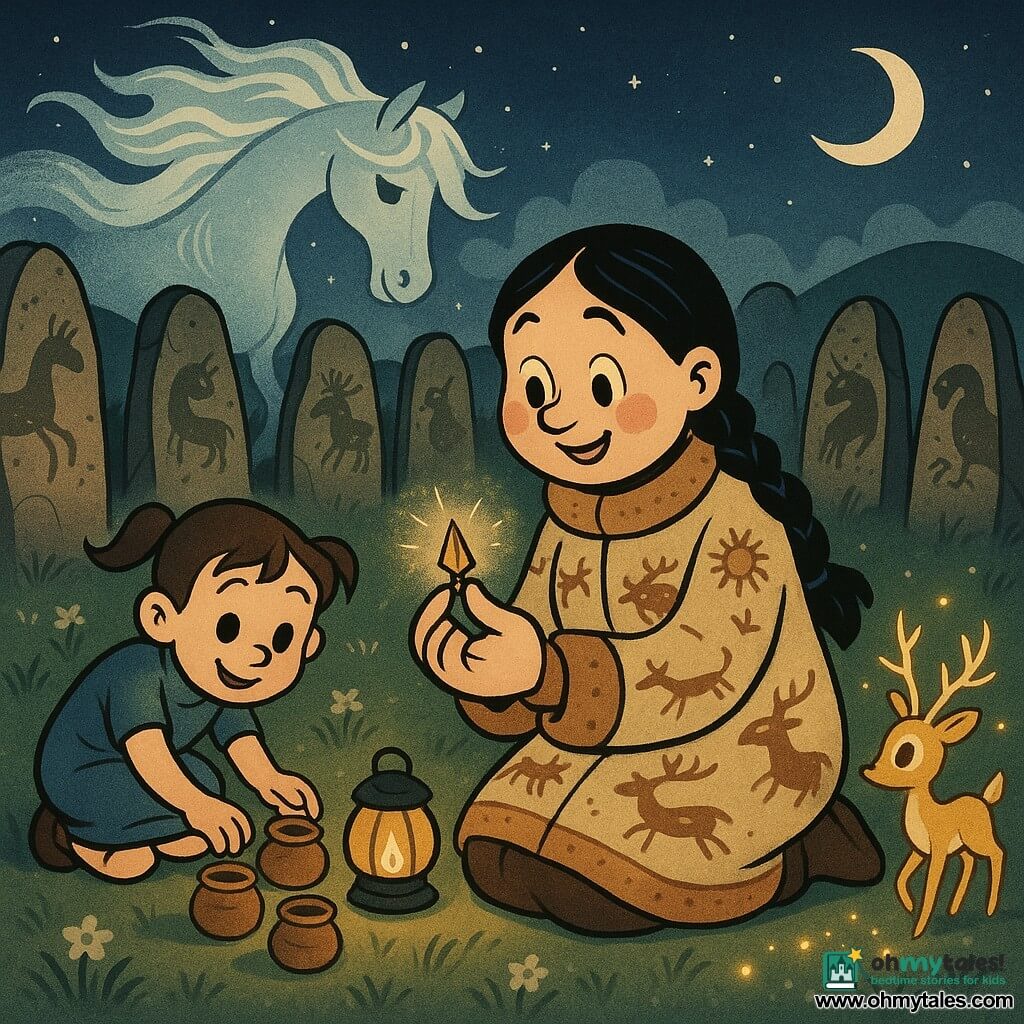
Night came again, warm and deep. Alya and Saira returned to the stone circle with a lantern and four cups. Alya set them carefully at the edge of the hollow. The lantern's light made the carvings look as if they were moving.
Saira whispered, “I feel like the stones are holding their breath.”
“So are we,” Alya whispered back. “But we can breathe anyway.”
The moon climbed. It was not shy now; it was a bright, round shield in the sky.
Alya stood in the center of the circle. She didn't wave her arms. She didn't demand. She simply spoke, clear and calm.
“Horse of the North Wind,” she called, “swift one, come.”
“Deer of the Golden Antlers,” she called, “gentle one, come.”
“River Mother,” she called, “wise one, come.”
For a moment there was only cricket-song and the faint pop of the lantern wick.
Then the wind arrived.
It did not arrive like a storm. It arrived like a traveler stepping politely into a room. The grass bent in a smooth line, and the air smelled suddenly of cold snow and far mountains.
A shape formed near the wolf-stone: a horse, tall and pale, made of moving mist. Its mane flowed like streamers. Its eyes shone like frost.
The horse dipped its head. A voice spoke, but it wasn't from a mouth. It was from the wind itself.
“You called,” said the North Wind Horse. “Why?”
Saira's jaw dropped. “It talks without talking!”
Alya kept her hands still. “Because our land feels worried,” she said. “Because the river has forgotten how to laugh. Because my people need counsel.”
The mist-horse snorted softly, as if amused. “A human asking for counsel. Brave. Or foolish.”
“Sometimes those are the same,” Alya said.
A soft glow appeared near the deer-stone. Out stepped a deer with antlers like branches dipped in gold. Wherever its hooves touched, tiny lights rose, like fireflies waking up.
The deer's voice was gentle and clear. “She is brave,” it said. “I can taste it in her words.”
Then the Black River itself made a sound—far away at first, then closer. Water slid over stones with purpose. In the hollow at the center of the circle, the dark soil shimmered and became a small pool.
A face appeared in the water, made of ripples and moonlight. A woman's face, old as rivers and calm as deep places.
“I remember you,” said the River Mother. “Your mother once asked for courage. You ask for council. The need is growing.”
Alya bowed her head. “Will you help me gather a Night Council?” she asked. “Not just for me—for everyone. For the steppe. For the children who will inherit our stories.”
The North Wind Horse's misty tail flicked. “A council is not a party,” it said. “It needs a reason.”
The Deer of Golden Antlers lowered its head toward Alya. “What is the reason?” it asked kindly.
Alya took a breath. In, like gathering courage. Out, like sharing it.
“Because trust is thinning,” she said. “People whisper instead of speak. They hide instead of help. They fear the dark, and the dark feels that fear. I want a council that meets at night to remind us: the night is not our enemy. The night is a listening place.”
Saira whispered, “Tell them about the circling deer!”
Alya nodded. “The animals are confused. The river is quiet. Something sacred is out of balance.”
The River Mother's rippled eyes narrowed. “A sacred mystery has been disturbed,” she said. “A star-name has been stolen from the sky's memory.”
Saira's mouth formed a perfect O. “You can steal a star-name?”
The North Wind Horse stamped once, and the grass flattened in a neat circle. “Yes,” it said. “And without its name, a star cannot guide.”
Alya's mind clicked like beads on a string. “That's why travelers have been getting lost,” she said. “That's why the steppe feels wrong.”
The Deer's golden antlers shone brighter. “The stolen name is kept in the Tomb of Echoes,” it said, “where old words bounce around until they forget who they belong to.”
Saira shivered. “That sounds like my classroom when everyone talks at once.”
Alya almost laughed, and the spirits' eyes seemed to soften.
The River Mother spoke again. “If you want a Night Council, Alya, you must first bring back what was stolen. Restore the star's name. Then the sky will trust the earth again.”
Alya looked at the three cups she had set out. “I only have one pair of hands,” she said. “How do I do this?”
The North Wind Horse leaned closer, mist curling around Alya's shoulders like a scarf. “With trust,” it said simply. “Trust in yourself. Trust in your allies. Trust that the night can hold you.”
The Deer added, “And with a promise: when you succeed, you will not keep the council for yourself. You will share its light.”
Alya straightened. “I promise,” she said.
Saira raised her hand politely, as if asking permission at the world's strangest meeting. “Um… can I come too?”
Alya looked at her niece. Then she looked at the spirits.
The River Mother's face smiled in the water. “A council needs young ears,” she said.
The North Wind Horse snorted. “And someone to bring snacks,” it added.
Saira beamed. “I knew snacks were important!”
Alya felt something warm in her chest. Not fear—fire. Not worry—will.
“Then we go at first light,” she said. “To the Tomb of Echoes.”
Above them, the moon watched like a white eye that did not blink.
Chapter 4: The Tomb of Echoes and the Trick of Voices
The Tomb of Echoes was not a tomb like a stone box. It was a crack in a hillside, a dark mouth in the earth, hidden behind hanging vines. The elders warned children not to shout near it, because the echoes might shout back with your own secrets.
Alya and Saira arrived just as the sun leaned toward afternoon. Shadows stretched long, and the wind seemed to hold its breath again.
Saira clutched her bag of “emergency joy.” “I don't like holes in hills,” she muttered.
“I don't either,” Alya admitted. “But we don't have to like something to do it.”
They stepped inside.
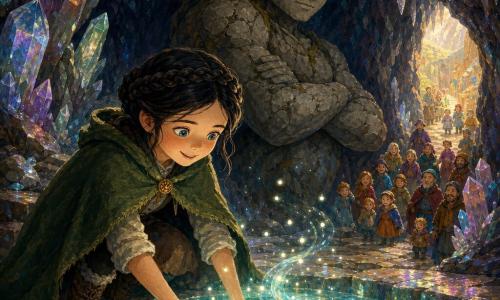
The air was cool. The walls glittered with tiny stones like trapped starlight. Every sound returned to them a heartbeat later: their footsteps, their breathing, even Saira's quiet “eek.”
“Hello,” Saira whispered.
“Hello,” the tomb whispered back. Then, a little louder, “Hellooo.”
Saira glared at the darkness. “Stop copying me!”
“Stop copying me,” the darkness replied, cheerfully.
Alya held up the lantern. The light threw giant shadows that wobbled like dancing giants. Farther in, the passage split into three tunnels. Above each tunnel, symbols were carved: a sun, a moon, and a star.
Saira pointed at the star. “That one! We need the star-name.”
Alya didn't move. She listened. The tomb was full of voices—not just echoes, but words that had been dropped long ago, rolling around like marbles.
A soft voice said, “Alya, you're not brave enough.”
Another voice said, “Turn back. You'll fail.”
Another voice said, “Trust no one.”
Saira's face tightened. “Those voices are mean.”
“They're not mean,” Alya said gently. “They're afraid.”
The voices grew louder as if hearing her. “Afraid! Afraid! Afraid!”
Alya crouched to Saira's level. “Listen to me,” she said. “This tomb tries to confuse us with borrowed thoughts. But thoughts are not truth unless we choose them.”
Saira swallowed. “How do we choose the right tunnel?”
Alya touched the bronze arrowhead at her belt. It was warm again, as if it had been waiting. She took it out and held it in front of the three tunnels.
The arrowhead turned, slowly, toward the moon tunnel.
Saira frowned. “But the symbol is the moon, not the star.”
“The moon borrows light,” Alya said. “And echoes borrow voices. The tomb likes borrowed things. So the stolen star-name is probably hidden where borrowing feels normal.”
Saira blinked, then smiled. “That is… actually smart.”
Alya winked. “I practice.”
They entered the moon tunnel.
The passage curved and dipped. The echoes multiplied. Soon Alya heard her own voice—perfectly copied—saying, “You should be alone. Councils are trouble.”
It was so accurate that Alya's stomach flipped. For a second, she almost believed it.
Then she remembered the wind-horse's words: Trust that the night can hold you.
Alya spoke out loud, steady and clear. “I do not have to be alone to be strong,” she said.
The echo tried to repeat her, but it came out thinner, weaker, like a bad copy of a good drawing.
Saira chimed in, loud enough to make the walls ring. “And I'm here! And I have snacks!”
Alya laughed, and the laughter seemed to push the darkness back.
At the end of the tunnel they found a chamber. In the center stood a stone pedestal. On it lay something that looked like a thread of light, coiled like a sleeping worm. It flickered, trying to remember how to shine.
Above it hovered a whisper, circling like a moth: a word that would not settle.
Alya knew, without knowing how, that this was the star-name.
But as she reached for it, the tomb's voices rose in a storm.
“Mine,” hissed the walls.
“Mine,” echoed the ceiling.
“Mine,” chanted the floor.
A shadow pulled itself together near the pedestal, shaped like a person made of smoke. It had no eyes, but it leaned toward Alya as if staring.
“You cannot take it,” said the shadow. “You are only one woman.”
Alya's hand trembled. The old fear tried to climb into her throat.
Saira stepped forward. “She's not only one woman,” she said. “She's Alya.”
The shadow hissed. “Names are power.”
Alya nodded. “Yes,” she said. “That's why you stole one.”
She took a slow breath. In, like gathering courage. Out, like sharing it.
“I am Alya,” she said clearly. “And I trust my steps. I trust my heart. I trust the ones who stand with me—seen and unseen.”
The bronze arrowhead in her palm flashed, a green-gold spark.
The shadow flinched.
Alya reached and gently wrapped the thread of light around the arrowhead, as if winding yarn. The whispering word dropped into place, settling at last.
The chamber brightened. The echoes fell quiet, as if embarrassed.
Saira exhaled loudly. “So… we just stole it back?”
“We returned it,” Alya corrected, smiling. “Big difference.”
As they left, the tomb tried one last trick. In Alya's own voice it whispered, “You can't really start a council. No one will come.”
Alya paused, turned her lantern toward the darkness, and said warmly, “Then I will keep inviting them until they do.”
The tomb had no answer for that.
Chapter 5: The Night Council and the Sign of the Sky
They returned to the stone circle under a sky that looked cleaner, as if someone had washed it with cold water. The air smelled like new beginnings.
That night, Alya placed the bronze arrowhead—now wrapped with its thread of light—into the hollow at the center. The small pool formed again, reflecting the moon. The twelve carved stones seemed to lean inward, eager.
Saira set down the four cups and whispered, “Everyone's invited, right?”
“Everyone who listens,” Alya said.
Alya spoke the calling words again. Not louder. Not fancier. Just truer, as if each syllable were a candle being lit.
The North Wind Horse arrived first, mist streaming behind it. The Deer of Golden Antlers stepped softly into the circle, leaving tiny lights. The River Mother's face rose in the pool, calm and bright.
But they were not alone this time.
From the eagle-stone came a shadow of wings, and an eagle made of starlight perched atop the rock, its gaze sharp and kind.
From the bear-stone came a low rumble, and a bear spirit padded in, smelling of pine and honey.
Even the poet-wolf appeared, sitting with its tail wrapped neatly around its paws, looking far too proud of itself.
Saira whispered, “That's… a lot of guests.”
“That,” Alya whispered back, “is a council.”
The River Mother spoke, her voice like water over smooth stones. “You brought back the stolen star-name.”
Alya nodded. “It tried to hide,” she said. “But it wanted to be found.”
The starlit eagle tilted its head. “Speak the name,” it said.
Alya lifted the arrowhead. The thread of light around it rose like a tiny ribbon, stretching upward. The word—bright, clear, and ringing—left Alya's lips. It was a simple sound, like a bell made of ice and joy.
As soon as she spoke it, the sky responded.
High above them, a star that had been dim blinked awake. It flared, not harshly, but warmly—like a lantern lit on a distant hill to guide travelers home.
Saira gasped. “It's saying hello!”
The North Wind Horse bowed its head. “The sky remembers,” it said.
The Deer of Golden Antlers stepped closer to Alya. “Now,” it said, “you may ask for your Night Council.”
Alya looked around at the gathered spirits. Then she looked beyond the circle, imagining her people: the herders, the storytellers, the children who were still learning how to be brave.
“I don't want a council that belongs to me,” Alya said. “I want a council that belongs to the night itself. A place where worries can be spoken and not laughed at. A place where plans can be made with honest hearts. A place where trust can grow back, like grass after winter.”
The bear spirit rumbled approvingly. The poet-wolf gave a small howl that sounded suspiciously like applause.
The River Mother's eyes shone. “Then let it be so,” she said. “But remember: a council is not made only by spirits. It is made by people choosing to show up.”
Alya nodded. “I will show up,” she said. “Again and again. And I will invite others to do the same.”
Saira stood very straight. “Me too,” she said. “I can be… the snack keeper.”
The starlit eagle let out a crisp, pleased cry. “A noble role,” it said.
Alya laughed, and her laughter warmed the circle. She felt the old fear loosen its grip. She felt the steppe listening—not hungrily, but kindly.
Above them, the newly awakened star shimmered and, for a moment, drew a bright line across the sky—like an arrow of light pointing forward.
Alya lifted her face to it. The sign in the heavens felt like a promise.
And in that gentle, mysterious night, with cups set out and voices gathered, the first true Night Council began—under a sky that now remembered its own name.