Chapter One: The River That Remembered
The river outside Arinna's clay walls remembered names. It remembered when oxen pulled bronze plows and when the sky wore the color of baked wheat. Every morning the river offered small gifts—smooth pebbles the color of moonlight, a drift of willow that smelled like old stories—because it loved to be useful and it loved to keep promises. On the far bank stood a house of flat stone and reed, where Tammur lived. He was a man of careful hands and loud ideas, a maker of things that hummed when the wind passed through them: flutes that sang like rain, wind-harps woven from broken chariot strings, and at times, a kettle that laughed.
Tammur's hair had the gray of winter barley and a speckled scar that ran along his wrist from a time he had tried to mend a comet. He had an ancestor's name carved under the lintel of his door—a name that smelled of cedar and salt—and a promise etched in his chest like a steady drumbeat. Years ago, when he was younger and reckless with his heart, he had promised his grandmother before the hearth, “I will bring peace to the hollow of our valley. I will stitch the old song back to the stones.” His grandmother had smiled with tired teeth and wrapped a blue ribbon around his wrist. “Keep to the river,” she had said. “Keep to the quiet things. The ancestors will listen.”
So Tammur kept things. He kept the ribbon knotted. He kept the flutes safe. He kept the promise like a small, shining coin in a pocket. Yet the valley hummed uneasily under a sky heavy with slow omens. Herds grazed with one eye on the hills. Children no longer raced the dogs to the fig trees. At night, shadows moved like lost travelers, and strangers told tales of a seam in the world where voices slipped through.
One autumn morning the river spoke differently. It did not only remember; it offered a path of floating bark—an invitation. Tammur took it, because he had learned to listen. He loaded his pack with a reed flute, a coil of copper wire, bread wrapped in fig leaves, and the ribbon tied above his wrist. He pushed off and let the river carry him toward the mountains where the ancients had once hung wreaths for sky-gods and where the land still kept fragments of those ceremonies like scattered shells.
Chapter Two: The Stone That Listened
The river wound like an argument and finally emptied into a basin hemmed by standing stones. The stones were ringed with lichen, each stone taller than a house, each carved with spirals and eyes that had known storms. Tammur stepped ashore and touched the nearest monolith. It was warm and tasted faintly of honey and iron. He felt the pulse of a memory there, slow and deep, as if the stone kept a ledger of what had been promised and what had been broken.
In the circle's center lay a slab, and on that slab the ancestors had once placed offerings—bones, painted wheat, and a cup of milk. Now spiders had made curtains across the offerings, and wind had rearranged petals into small, accidental poems. Tammur knelt. He unwrapped his bread and set a piece on the stone, laying beside it a whisper of copper wire like an offering of the present. He spoke softly, "For those who came before, who called this valley home, I bring the song and the peace I promised."
The stone answered not with a voice but with a slow rolling of dust, as if giving Tammur a name. And then the ground sighed and a slit appeared between two stones—a fissure thin as a reed. From there, a light breathed upward like a slow flame, and a presence stepped out, neither wholly shadow nor wholly light. It carried the shape of the ancestors: a braided crown of wheat, a cloak threaded with stars, hands that smelled of hearth-smoke. It looked at Tammur with eyes like still pools.
"You are the maker who kept a promise," it said, and its voice was the sound of fire on the last log. Tammur bowed. The ancestor told him of an old veil that had once wrapped the valley like a soft blanket, a veil woven from moon-wool and starlit reed. It had been taken, long ago, by a storm of hunger and fear, and with it went the hush that kept neighbours from quarreling and the patient listening that let roots grow deep. The ancestor spoke of a place where the veil had been carried—into the hollow of a mountain guarded by a beast whose hunger was for names. Only if names were given up in anger would the beast be satisfied; if names were offered gently, it would let the veil be taken back into its woven hands.
"You promised peace," the ancestor said. "You must go and ask the mountain for what was lost. But know this: the mountain keeps what it is given. Tend your words like seeds."
Tammur felt the drumbeat in his chest answer with a hopeful note. He tied a small knot in the ribbon and rose. Before he left, the ancestor leaned close and pressed a tiny, warm stone into his palm—the size of a lentil, bright as a corn kernel. "When words fail, drop this into the dark. It will hum the truth," it said.
Chapter Three: The Mountain That Ate Names
The path to the mountain was a story in itself. It climbed through olive groves that whispered with past conversations, threaded past a dried spring where a child's laughter was said to be trapped in an old clay jar, and wound into a range of basalt ribs that stuck up like the teeth of a sleeping giant. As Tammur climbed, the wind told him riddles, and sometimes the moon followed like a patient stitch in the air. He kept to his promise by walking slowly, by greeting every shepherd and asking after their mothers, by planting a tine of copper under a thornbush where someone had once lost a coin. Little acts became a trail of soft light behind him.
On the second night, the sky was a bowl of silver. Tammur camped where the air smelled of crushed fennel. He played his flute, and the melody that rose trembled like a small bird learning to fly. In the distance, the mountain breathed, a sound like wool being pulled through a loom. At the mountain's mouth hung a curtain of dark ivy, and inside the mouth a shape stirred—a great form folded over itself, layered like carpets of night. People called it the Name-Devourer. It was not ugly in the harsh way of storms; it was solemn, old, and very, very patient.
"Who walks in the valley of my teeth?" it asked. Its voice made Tammur's breath shrink and his ribbon flutter.
"I am a maker," Tammur answered. "I carry the words of those who came before. I have a promise to keep."
The beast lifted a lid of rock and peered. Its eyes were like lanterns full of ink. "Promises are heavy," it said, "and names are weightier. Bring me what you have, and I will weigh it."
Tammur stepped forward. He thought of the ancestors' braided crowns, of the river that remembered, of the ribbon at his wrist. He gave not a single name in anger but placed the tiny warm stone into the beast's palm. The stone hummed like a bee. The beast inhaled it and exhaled a sigh that shook loose dust from the ceiling. Then it opened its maw in a manner more curious than cruel and said, "Speak, then. Speak the truth you guard."
Tammur told the beast about the valley's quarrels, about how small spites had grown like weeds and how neighbors had begun to distrust one another's shadows. He spoke of his grandmother's hands and the ribbon. He spoke about the song they used to sing at harvest, a song of folding hands and shared bread. His words were neither loud nor faint; they were steady, like a line of smoke. When he finished, the beast was quiet for so long that Tammur feared he had failed.
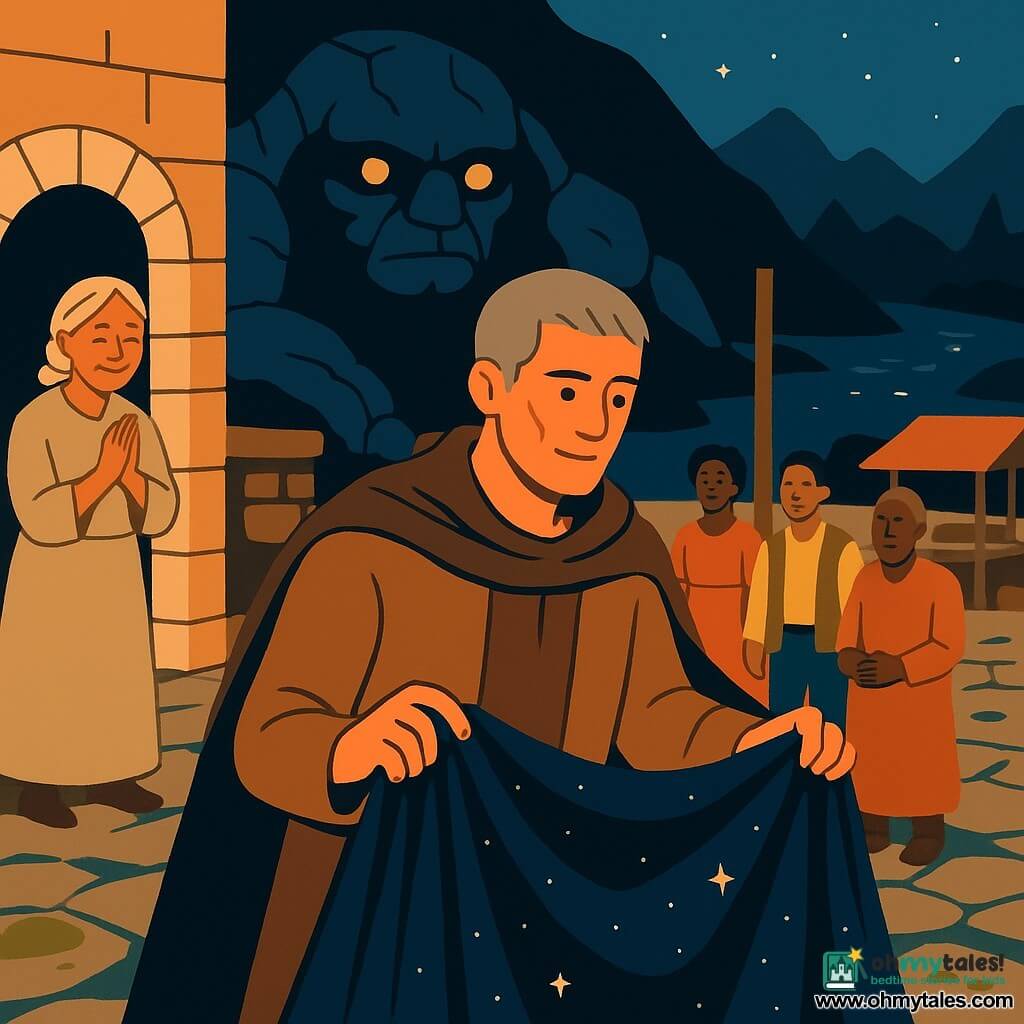
At last the beast lowered its head. From its throat unwound a ribbon of soft, dark cloth—woven from its own patience. It carried the cloth to Tammur and said, "I take names when they are shoved like knives. I return cloth when names are given like gifts. Use this veil well."
Tammur wrapped the cloth around his shoulders. It shimmered faintly, catching the moon. He felt the ancestors' eyes upon him, and the drum in his chest became a steady, bright pulse. He thanked the beast, and for the first time, the creature smiled in a way that was almost human, as if pleased by the return of an old bargain.
Chapter Four: The Stitching of the Valley
With the veil across his shoulders, Tammur descended like a slow wind. Along the road, he met people carrying their troubles like bundles. He did not lecture or scold; he listened. He told the farmers who argued over water a story about two brothers who learned to measure the river by sharing a single cup. He helped the potter who feared their kiln had cursed them by mending a shard with a thin braid of copper wire—an act that turned a broken thing into a new vessel, one that sang a sweeter note when touched. Each encounter was a small stitch.
When Tammur reached the valley, the sky leaned in like a curious guest. He walked the lanes and lay the veil over thresholds, over the stone of the market, over the communal oven where bread rose like small moons. Where the veil touched, voices softened. The veil did not command; it coaxed. It hummed with the echo of lullabies sung under oil lamps, and neighbors who had been strangers at the well began to trade seeds and stories again. Children returned to racing, leaving lines of dust like stitched white thread.
One evening, at the center of the market, Tammur tied the veil to the standing post where the town once fastened wreaths for the gods. He did not spread it like a curtain but hung it like a story to be read by all. The veil shimmered, and the air carried a taste of boiled figs and sage. People gathered: elders with hands knotted like roots; youths with scarlet headbands; mothers with infants asleep against their chests. Tammur did not make a speech. He simply unrolled the ribbon from his wrist and placed it on the table where offerings were shared. "For those who remembered me," he said softly. "For those who will remember us."
A woman who had not spoken in months stood and took the ribbon. "Our ancestors are patient," she said, voice rough but steady. "We are patient also." She raised the ribbon and wrapped it around the post, tying it in a careful knot. The crowd hummed like bees in a hive. They began a song—no one could say whose words they were—and the melody stitched the valley tighter, line by line.
Chapter Five: The Veil That Closed
Time, in that valley, is like a slow river: it carries small things without hurry. The veil settled into the life of the people. It did not lock them into silence or force peace like armor. It taught them to listen—to the river naming the dawn, to children who are loud with joy, to neighbors who need help with a roof. Little disagreements still came, as wind brings insects to fruit, but they were handled with cups of tea and careful apologies. The beast in the mountain rested, not hungry but contented with the gentle naming of things.
At the year's turning, Tammur walked back to the stone circle where his journey had begun. He left the veil at the post but carried no more need to hang it like a banner. He placed his flute upon the standing slab and sat. The ancestors stepped from their slit in the stone and surrounded him as if they had never left. They took the ribbon he had wrapped around the post and wound it into their braid. They accepted the story of the valley with a soft, satisfied silence, the sort that comes when quilts are complete and the children are asleep.
Tammur offered the tiny warm stone back into the hands of the eldest ancestor. "It hummed truth," he said.
"It hummed because you did," the ancestor replied. "Because you listened. Because you gave names with care."
They spoke of the veil as one speaks of a child who has learned to walk: with quiet joy and a small, proud sadness. Then, in a gesture as gentle as a closing book, they drew a curtain of mist around the standing stones. The mist folded over like a palm, and when it settled, the slit in the rock was no more. The circle was whole again. The ancestors smiled—no more visible than the warmth behind a hearth—and their presence eased into the memory of the land like a last, treasured ember.
Tammur left the circle lighter than he had come. He walked home along the river that remembered, and the river hummed his name with a gentle ripple. Children ran to meet him, certain that stories do not vanish but merely go to sleep until they are needed again. Neighbors greeted one another with softer eyes. The veil was still there at the market post, and it shimmered only when someone looked with an open ear and a quiet hand.
That night, Tammur stood in his doorway. He untied the ribbon from his wrist and placed it on the sill. The moon watched as if it had done no other thing all its nights but witness such small, steady endings. Tammur closed the door softly. The valley settled, as all good valleys do, into peace. The ancestors had their hush, and the veil had its rest. The promise was kept not like a trophy but like a warm hearth handed down.
As sleep moved across the fields like a slow blanket, Tammur dreamed of rivers that remembered names and mountains that listened. He dreamed of a world where vows are simple stitches, where listening is the bravest craft of all, and where the last breath of a story is a curtain folded closed. When morning came, the world was the same and different—same earth, different heart. The veil had found its place and the drum in his chest had quieted into a tender, steady beat.
Outside, the river kept offering little gifts to anyone who would take them: a smooth pebble, a willow drift, the echo of a song. And sometimes, just sometimes, people would pass by the market post and feel the veil's soft presence, like the memory of a good dream. They would nod and then go on with their day, carrying peace like a small coin in their pockets, passing it on in the warmest way they knew.
The veil closed. The valley kept its promise. The ancestors slept, and the world, for a while longer, was at ease.