Chapter 1: The Totem That Forgot Its Song
On the island of Vaerua, the ocean never stayed quiet. It hummed against black rocks, sighed through palm leaves, and whispered secrets into shells. Kairo liked to listen.
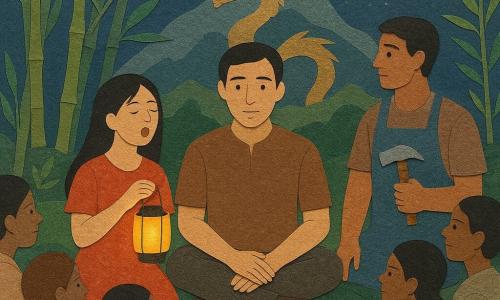
He was a grown man with calm eyes and a patient way of moving, as if he had all the time the tide could ever bring. While others hurried to fish or weave nets, Kairo often sat on the warm sand beside the village meeting place and watched the horizon. He watched the clouds stack like sleeping whales. He watched the sea change its color—silver, then jade, then deep blue like a story told at night.
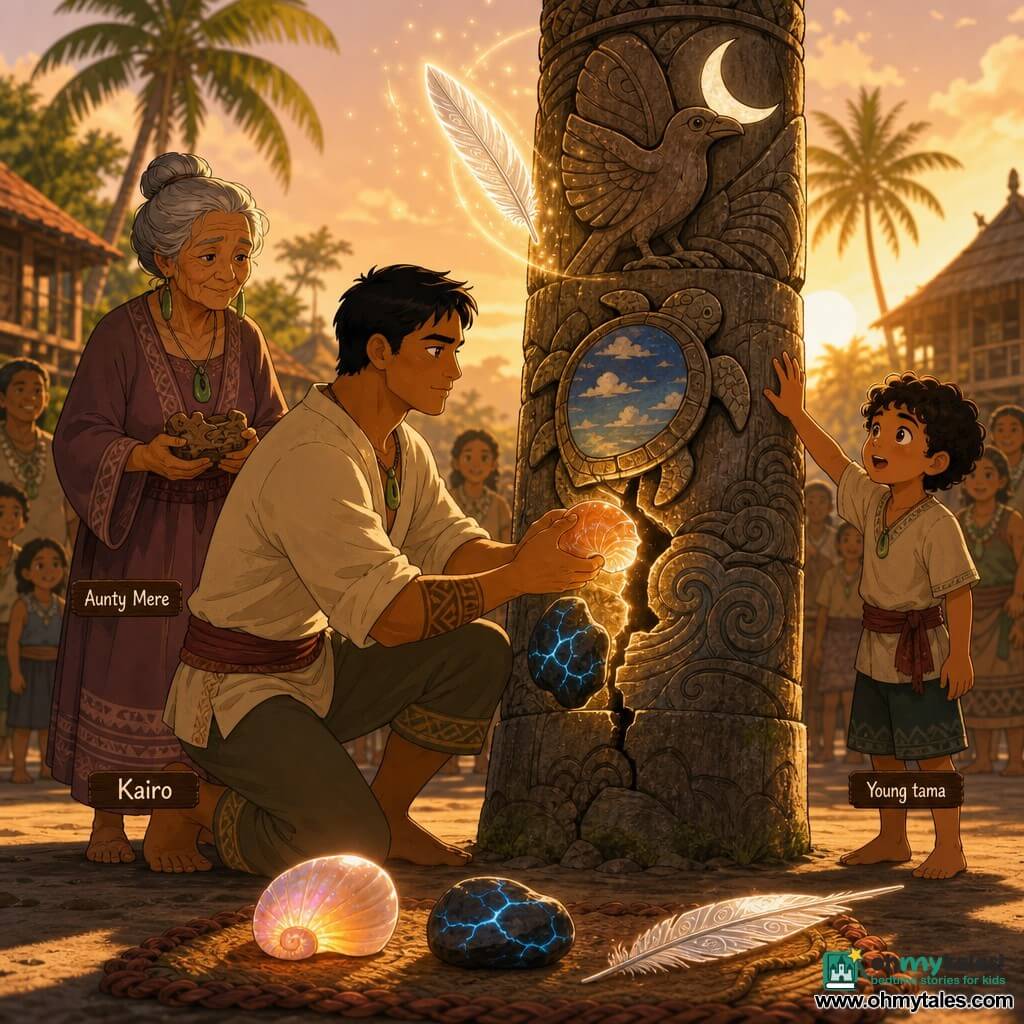
In the middle of the village stood a totem carved from driftwood and stone. It showed many things: a turtle with a sky on its shell, a bird with a moon in its beak, and a wave curling around them like a protective arm. Old legends said the totem was a promise—between gods above the clouds and mortals below the palms. As long as it stood whole, harmony would hold.
But this morning, Kairo saw it clearly: a crack ran down the totem's side, thin as a hair, yet sharp as worry. A small piece near the wave carving had fallen away. Where there should have been a smooth curve, there was an empty bite.
The village elder, Aunty Mere, tapped the totem gently with her knuckles. “It used to feel warm,” she murmured. “Now it feels… lonely.”
The air itself seemed to agree. The breeze kept changing direction. The chickens argued louder than usual. Even the ocean's hum sounded out of tune.
Kairo rested his palm on the cracked wood. In his mind, he heard an old teaching: When a promise breaks, it does not shout. It whispers.
“I will mend it,” Kairo said.
Aunty Mere lifted her eyebrows. “With what? With glue and rope?”
“With what the totem remembers,” Kairo answered. He didn't fully know what he meant, but the words came like a small canoe finding the current.
That night, as the village slept, Kairo lay under the stars. The sky was so full it looked like someone had spilled glowing sand across it. He listened. Again and again, he listened.
And then—soft as a feather landing—he heard a voice in the sea breeze.
Not scary. Not loud.
Just certain.
“Find the three echoes,” it said. “Find the shell that holds dawn, the stone that holds thunder, and the feather that holds the way home. Bring them to the totem, and the song will return.”
Kairo sat up, heart thumping like a drum played gently. “Who are you?” he whispered.
The breeze answered with a smell of salt and flowers. “A friend of balance.”
Kairo looked at the dark outline of the totem against the stars. The crack seemed deeper at night, as if the shadows had moved in.
He stood, quietly, and gathered what a traveler needed: a small woven bag, a gourd of water, dried fruit, and a short spear—not for fighting, but for feeling brave.
Before dawn, he touched the totem once more. “I'm coming back,” he promised.
The ocean, as if it understood, breathed in and out. In and out. Like a sleeping giant dreaming of peace.
Chapter 2: The Lagoon of Listening Fish
Kairo followed a path along the shore where the sand was pale and the rocks were dark as old stories. The sun rose slowly, painting the sea with ribbons of gold. He walked as if he had walked in this world before—because he had. But now, everything felt slightly tilted, like a song played in the wrong key.
By midday he reached a lagoon hidden behind a ring of tall ferns. The water there was still, so still it looked like a piece of sky that had fallen and decided to rest.
In the center of the lagoon, on a flat stone, sat a shell the size of Kairo's hand. It shimmered with pink and orange, like it had caught sunrise and refused to let go.
“The shell that holds dawn,” Kairo murmured.
He stepped into the lagoon. The water was cool and clear. Small fish circled his ankles, not biting, not fleeing—just watching.
Then something odd happened.
Every time Kairo took a step, the fish made tiny sounds. Not splashes. Not bubbles.
Words.
“Mmm,” said one fish, as if tasting a thought.
“Careful,” said another, like a grandparent.
“Why now?” asked a third, sounding almost bored.
Kairo froze. “You can talk?”
The fish swam in a circle, like a group deciding who would answer. Finally, a silver fish with a dark stripe glided close.
“We can always talk,” it said. “Most people are too loud inside to hear us.”
Kairo smiled a little. “Then I should be quiet inside.”
“That helps,” the silver fish agreed, as if this was obvious.
Kairo waded toward the stone. The dawn-shell seemed to glow brighter the closer he came. He reached for it, but the lagoon suddenly rippled, even though there was no wind. The water lifted in a smooth ring, like a gentle wall.
A face formed in the ripples—made of water, light, and patience. It looked neither young nor old. It looked like the lagoon itself had decided to think.
“This shell is not taken,” said the watery face. “It is given.”
Kairo lowered his hand. “Then… may I be given it?”
The watery face tilted, almost amused. “Why do you seek it?”
“To mend the totem,” Kairo said. “To bring harmony back between gods and mortals.”
The fish whispered among themselves: “Harmony… mortals… gods…” as if the words were tasty and strange.
The watery face watched Kairo for a long moment. The air felt bright and heavy at the same time.
“Many wish to fix the world,” it said. “Few will first fix their own listening.”
Kairo nodded. “Tell me what to do.”
“Answer this,” said the lagoon. “What is stronger: a shout or a whisper?”
Kairo thought of the crack in the totem. Of the way the promise had not screamed. Of the voice in the breeze.
“A whisper,” he said. “Because you have to lean in to hear it. And when you lean in, you are closer.”
The lagoon's face softened, like water relaxing. The wall of ripples sank back into calm.
“Well answered,” it said. “Take the dawn-shell. But remember: when you want peace, do not try to win. Try to understand.”
Kairo lifted the shell. It felt warm, as if a tiny sunrise lived inside it. As he placed it in his woven bag, the fish swam around him in a happy swirl.
“Good luck,” said the silver fish.
“Be quiet inside,” said another.
“Bring snacks next time,” added a bold little fish, and Kairo laughed, the sound bright as the morning.
He left the lagoon with the first echo in his bag and a new steadiness in his steps. The ocean beyond the ferns glittered, watching him like an old guardian.
Chapter 3: The Mountain Where Thunder Sleeps
The path turned inland and climbed. The air changed from salty and soft to cool and sharp. Birds called from high branches, and the leaves shivered like they were telling secrets.
By late afternoon, Kairo reached the foot of Mount Raukani. Its peak wore a crown of cloud, and from far away you could hear a low rumble, like a giant snoring.
“The stone that holds thunder,” Kairo said, looking up.
He began to climb. The ground was rough, and roots tried to trip him like playful hands. Every now and then he paused, not because he was tired—though he was—but because he needed to listen.
On the mountain, listening felt different. The silence was not empty. It was full. Full of waiting.
As Kairo neared a narrow ridge, the rumbling grew louder. The wind pushed at his shoulders. Pebbles skittered away as if they were late for something.
Then, from behind a boulder, a creature stepped out.
It was tall and broad, made of stone and moss, with eyes like wet river rocks. A guardian. Not a monster, but not a pet either. It held a wooden club, and its footsteps shook the ground just enough to make Kairo's knees wobble.
“Halt,” the guardian said. Its voice sounded like two rocks bumping together.
Kairo stopped. “I don't want to fight.”
“Then why do you carry a spear?” the guardian asked.
Kairo lifted the spear and planted it in the soil like a walking stick. “So I remember courage. Not so I steal it.”
The guardian stared. A beetle crawled across its arm and it didn't even blink.
“You seek thunder-stone,” it said.
“Yes,” Kairo replied. “To mend a broken promise.”
The guardian's eyes narrowed. “Promises break when mortals forget respect.”
Kairo swallowed. He could have argued. He could have blamed storms or time or bad luck. But something in him—quiet and firm—chose a different path.
“Sometimes we forget,” Kairo said. “Sometimes we get busy. Sometimes we think the gods will always wait. That is not wise.”
The guardian's shoulders eased slightly, like a mountain settling.
“Wisdom is heavy,” it said.
“I can carry some,” Kairo answered.
The guardian turned and walked toward a cave mouth hidden behind hanging vines. Inside, the darkness flickered with pale blue light, like trapped lightning.
Kairo followed. The air smelled of rain, even though the sky outside was clear.
In the center of the cave sat a stone the size of a coconut. It pulsed softly, and with each pulse, the distant rumble answered—boom… boom… like thunder remembering its own name.
Kairo reached out, then stopped. “May I?”
The guardian nodded once. “Only if you wake it gently.”
“How do I do that?”
The guardian pointed at Kairo's chest. “With truth.”
Kairo held the dawn-shell in one hand and placed the other hand over his heart. He spoke into the cave, not loud, not dramatic—just honest.
“I am Kairo of Vaerua. I have listened too little and assumed too much. I ask for thunder not to threaten, but to protect balance. If you come with me, I will remember respect. I will teach it, too.”
For a moment, nothing happened.
Then the thunder-stone's light brightened, and the rumble softened into a steady purr, like a storm choosing to be calm.
Kairo lifted the stone. It was surprisingly light, but it made his arms feel strong, as if it carried courage in a quiet way.
The guardian stepped aside. “Go,” it said. “And when you speak to gods, do not speak as a beggar or a boss. Speak as a neighbor.”
Kairo bowed. “Thank you.”
As he left the mountain, clouds gathered around the peak like a blanket. The rumble faded, not angry—resting.
In his bag, the dawn-shell warmed his fingers. The thunder-stone pulsed, steady as a drumbeat. Two echoes found.
One remained.
Chapter 4: The Sky-Canoe and the Feather of Return
Kairo traveled back toward the coast where cliffs rose above the sea like the backs of great sleeping beasts. At the highest cliff stood an ancient platform of flat stones, said to be the place where the first navigators asked the stars for directions.
He arrived at sunset. The sky blazed orange and purple, and the ocean below reflected it all, making the world look twice as magical.
In the center of the platform was a carved bowl filled with smooth pebbles. Kairo remembered a line from an old chant: When you are lost, offer your worry to the wind.
He took one pebble, held it, and thought of the village. The crack. The lonely feel of the totem. He placed the pebble back with care.
The air stirred. The sunset colors deepened. And then, as if stepping out from behind the sky, a canoe appeared.
Not on water.
In the air.
It was woven from light and shadow, with a sail made of thin cloud. It hovered just above the stones, rocking gently as if on invisible waves.
Kairo's mouth fell open. Then he remembered to breathe.
A figure stood in the canoe—tall, with hair like night and eyes like bright stars. A god, or something close to it. Not terrifying, but so real it made Kairo's thoughts feel small.
“You have two echoes,” the figure said, voice soft as starlight. “Why do you seek the third?”
“So the totem can be repaired,” Kairo answered. “So gods and mortals can be in harmony again.”
The figure stepped closer. “Harmony is not a rope that ties. It is a dance that listens.”
Kairo nodded, even though his knees wanted to argue with gravity. “Then teach me the step I'm missing.”
The figure held out a single feather. It was long and pale, and along its edges shimmered faint patterns, like tiny maps drawn by moonlight.
“The feather that holds the way home,” the figure said. “It does not point north or south. It points to what you truly mean.”
Kairo reached for it, but the feather drifted away from his fingers like it was teasing him.
The figure's eyes gleamed. “A question, Kairo of Vaerua. If harmony returns, what will you do differently?”
Kairo looked out at the ocean. He thought of the fish who spoke only to those quiet inside. He thought of the guardian who respected truth more than strength. He thought of the totem standing in the village, not as decoration, but as a promise.
“I will make time,” he said slowly. “Time to listen. Time to give thanks. Time to remember the stories, not just when something breaks. And when people argue, I will remind them: a whisper can be stronger than a shout.”
The figure smiled, and the air itself seemed to brighten.
“This is the way home,” it said.
The feather floated into Kairo's hand and settled there, light as breath. At once, he felt a pull—not dragging, but guiding—like a gentle hand on his shoulder pointing him toward the village.
Kairo climbed into the sky-canoe. It lifted smoothly, sailing through the air as if the wind were a river.
Below, the ocean rolled in shining folds. Above, the first stars winked awake. Kairo held the feather and watched it glow faintly whenever he thought of kindness, patience, and respect.
The canoe drifted down near Vaerua as night wrapped the island in cool blue. Before stepping out, Kairo looked at the star-eyed figure.
“Will the gods forgive us?” he asked.
The figure gazed toward the village, where small lights twinkled from sleeping homes. “Forgiveness is easy,” it said. “Remembering is the work.”
Then the canoe dissolved into the wind, as if it had always been part of the sky.
Kairo stood on the path with three echoes in his bag and a heart full of steady courage.
Chapter 5: The Mending of the Promise
At dawn, the village gathered around the totem. The crack looked worse in the early light, like a sad smile pulled too far.
Aunty Mere stepped forward. “You returned,” she said, relief softening her voice.
“I brought what the promise asked for,” Kairo replied.
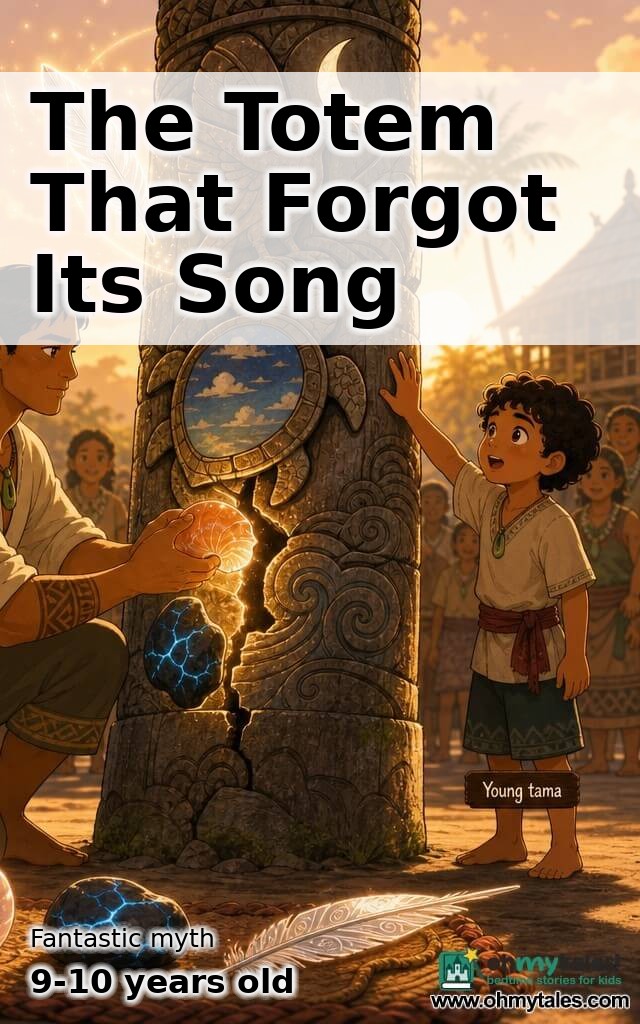
He knelt by the totem and laid the three echoes on a woven mat: the dawn-shell glowing warm, the thunder-stone pulsing calm, and the feather shimmering with moon-map patterns.
The villagers leaned in. Even the youngest children grew quiet, their eyes wide. Somewhere, a rooster started to crow, then seemed to think better of it and stopped.
Kairo placed the feather against the cracked wood first. It slid along the split like a brush of light, showing the true shape of the break—not just wood separated, but respect thinned, attention lost, gratitude delayed.
Again and again, Kairo breathed in and out. In and out. He remembered the lagoon's lesson: lean in. He remembered the guardian's lesson: speak as a neighbor. He remembered the sky-canoe's lesson: harmony is a dance that listens.
Then he held the dawn-shell to the empty bite where the wave carving was missing. The shell warmed until it felt like a sunrise in his palm. Light spilled out, not blinding, but gentle, like morning entering a room.
The wood softened slightly, as if it were willing to be shaped.
Kairo pressed the thunder-stone against the crack. The stone's pulse grew stronger—boom… boom…—and the sound traveled through the totem like a drumbeat calling scattered pieces to return.
A breeze rose. Not wild. Not scary. Just steady.
The fallen piece of carving, which had been kept safely by Aunty Mere, trembled on the mat. It lifted, slowly, as if remembering where it belonged. It floated toward the totem and clicked into place with a sound like a bead sliding onto a string.
The crack sealed, line by line, until the totem stood whole.
For a heartbeat, everything was silent.
Then the totem began to sing.
Not with a mouth, of course. With the air around it. With the ocean beyond the village. With the palms overhead. A low, beautiful hum flowed through the morning, and the world seemed to settle into itself.
The chickens stopped arguing. The dogs stopped barking. Even the waves sounded smoother, like they had found the right rhythm again.
Aunty Mere wiped her eyes. “It's warm,” she whispered, pressing her hand to the wood.
Kairo stood, feeling lighter than when he had left. “The promise is mended,” he said. “But we must keep it mended.”
A boy raised his hand, serious as a tiny chief. “How?”
Kairo smiled. “By remembering. By listening. By giving thanks before we need to ask.”
The villagers nodded. Someone began a simple chant, and others joined in. It was not fancy. It did not need to be. It was a song of neighborly hearts—mortals under the palms, gods in the wind, all sharing the same sunrise.
Kairo looked at the totem's carvings: turtle, bird, wave. They seemed brighter now, as if lit from inside.
He thought of whispers and shouts, of thunder and dawn, of feathers and home.
And again and again, he made the same quiet promise in his chest:
To listen. To respect. To keep balance.
The totem hummed warmly in answer, and the island of Vaerua breathed—peaceful, whole, and singing.