Chapter 1: The Snow That Would Not Stop
The Kingdom of Alderwynd lay under a roof of ice.
Snow fell every day, not in playful flurries, but in steady, stubborn sheets, as if the sky had forgotten how to do anything else. Rivers were locked like silver chains. Trees wore heavy white coats that never melted. Even the church bell sounded tired, as though its bronze throat had caught a chill.
Tristan watched it all from the edge of the village square, his breath turning to mist. He was nearly grown—tall, broad-shouldered, with hair as dark as wet pine bark and eyes the color of storm clouds. People said he had an old soul, like a candle that had been burning a long time.
“Winter again,” grumbled old Master Brune, tugging his scarf up to his nose. “It's always again.”
A child kicked at a drift. “Will spring ever come?”
Tristan opened his mouth to answer, but words felt useless in a world where seasons had become a fairy tale.
Then the wind changed.
It did not grow colder. It grew… quieter. The snowflakes slowed, hanging in the air like tiny feathers caught in invisible hands. A hush rolled over the square, and the villagers turned as one body, as if a single giant had nudged their shoulders.
From the white fog of falling snow stepped a creature that did not belong to common days.
A unicorn.
Its coat was moonlight made solid, its mane a river of pale gold. A single horn rose from its brow like a slender candle flame carved from crystal. When it moved, the snow beneath its hooves did not crunch; it sighed, soft as flour.
The villagers backed away. Someone crossed themselves. Someone else dropped a basket, and apples rolled like red marbles across the ice.
The unicorn's eyes—clear, deep, and steady—rested on Tristan.
“You,” it said, and its voice sounded like a harp heard from far away.
Tristan's heart lurched. “Me?”
“You have been listening to the winter,” the unicorn replied. “Not just enduring it. That matters.”
Master Brune found his voice. “A… a speaking beast! What do you want with the boy?”
The unicorn did not look at him. “Alderwynd is bound by a curse. The winter is a padlock. The key still exists.”
Tristan swallowed. His tongue felt too large for his mouth. “What key?”
“A heart that will not freeze,” said the unicorn. “And a hand willing to open what it fears.”
It stepped closer, and Tristan saw that tiny frost-flowers clung to its eyelashes. They glittered, but they did not seem cold. They seemed like stars that had lost their way and landed gently.
“My name is Lumen,” the unicorn said. “Will you come, Tristan?”
Tristan thought of his mother, who warmed their home with laughter that now came less often. He thought of the fields that never saw green. He thought of the children whose games had become slow and quiet, because cold makes even joy stiff.
He also thought of the stories he'd been told: those who walked into enchanted forests did not always return. Magic, like fire, could cook your supper or burn your house down.
Tristan tightened his gloves. “If there's a way to end this winter,” he said, “then yes.”
The unicorn lowered its head, horn shining. “Then hold on to hope. It is lighter than snow, but stronger than iron.”
And with that, Tristan stepped out of the square, leaving behind the familiar gray world, and followed a creature made of wonder into the white unknown.
Chapter 2: The Forest of Whispering Pines
Beyond the village, the road vanished under drifts, so Lumen led Tristan between the trees. The forest was a cathedral of pine and silence. Snow piled on branches like heavy frosting on dark cakes. The air smelled sharp and clean, as if it had been scrubbed.
Tristan's boots sank, and his legs began to ache. After an hour, his eyelashes were laced with frost, and his fingers felt like wooden spoons.
Lumen walked without struggle, leaving a faint glow where it stepped—small circles of gentle light that faded slowly, like memories.
“Are you warm?” Tristan asked, trying to sound casual, though he felt ridiculous speaking to a creature of legend.
“I am as warm as purpose,” Lumen replied.
“That's not an answer.”
“It is the only one I have.”
As they passed between two ancient pines, a whisper slid through the branches.
Tristan stopped. “Did you hear that?”
“I hear many things,” said Lumen. “Some belong to the world. Some belong to fear.”
The whisper came again, clearer now, like many thin voices braided together.
Turn back, it hissed. Turn back. No spring is coming. No hero is needed.
Tristan's stomach clenched. He glanced behind him. The forest already looked different, as if it had rearranged its corridors while he wasn't watching.
Lumen's horn brightened, and the whispering faltered.
“The pines have learned the sorceress's language,” Lumen said. “She taught them to doubt.”
Tristan pulled his scarf higher. “So she's real.”
“She is called Morwenna,” Lumen answered. “Once she was clever, and her cleverness curdled into cruelty. She wanted the kingdom to admire her. When it didn't, she decided to make it kneel.”
Tristan pictured a woman wrapped in black, smiling as the first snow fell. His jaw tightened. “How do we stop her?”
“We must reach the Lake of Looking-Glass,” Lumen said. “There lies a shard of truth. Morwenna hid her weakness there, as people hide letters they cannot bear to read.”
“Her weakness is a… letter?”
“A secret,” said Lumen. “A secret can be a chain. Or a key.”
The whispering rose again, louder, and the trees seemed to lean inward. Snow tumbled down, puffing in Tristan's face.
He pushed forward, but the forest played tricks. Paths looped, and fallen logs looked like sleeping beasts. Once, Tristan thought he saw his own home between the trunks, warm and lit, and he nearly stepped toward it.
Lumen blocked him. “That is a lie dressed in a familiar coat.”
Tristan's cheeks burned with embarrassment. “I'm not scared.”
Lumen's gaze was steady. “You are. And that is not shameful. Courage is not a stone. It is a muscle. It hurts when it grows.”
A laugh—small and sly—skittered across the snow. From a hollow stump popped a creature no taller than Tristan's knee. It wore a hat made of dried leaves and had a beard like moss.
“A muscle, is it?” it chirped. “Well! I've got muscles too, and I still hate the cold!”
Tristan blinked. “A gnome?”
“Name's Brindle,” the gnome said, puffing out his chest. “Forest guide, professional complainer, part-time hero—when snacks are provided.”
Lumen inclined its head. “Brindle. We have need of your knowledge.”
Brindle eyed Tristan. “And you have need of my excellent sense of direction. This forest loves to turn brave feet into lost feet.”
Tristan crossed his arms. “Can you help us reach the Lake of Looking-Glass?”
Brindle scratched his beard. “Can I? Yes. Will I? That depends.”
“On what?” Tristan asked.
Brindle grinned. “On whether you can answer a riddle without freezing your brain.”
Tristan sighed. “Fine.”
Brindle hopped atop the stump like a tiny judge. “Here it is: What can be carried without hands, can be broken without touch, and can warm a kingdom without fire?”
Tristan thought of torches and blankets and spells. Then he remembered Lumen's words in the square.
“Hope,” he said softly.
Brindle's grin widened. “Correct! Not bad, Tall Boy. Not bad at all.”
Lumen's horn dimmed to a calm glow. “Then guide us.”
Brindle leapt down. “Follow me, and step where I step. The snow listens, and the pines repeat gossip.”
As they moved deeper, the whispering trees seemed less bold, as if hope had stuffed their mouths with cotton. Tristan walked on, his legs still aching, but his heart steadier—like a lantern protected by both hands.
Chapter 3: The Lake of Looking-Glass
The Lake of Looking-Glass lay in a hollow where the forest opened its arms. The water was frozen smooth, so clear it seemed the earth had grown a second sky. Above, clouds drifted. Below, those same clouds drifted again—perfect copies, trapped under ice.
“It's like staring into a dream,” Tristan murmured.
Brindle shivered. “Or a nightmare. Mirrors show you what you have, not what you want.”
At the lake's center stood a small island, reachable by a narrow strip of ice that looked thinner than honesty. On the island, a stone pedestal rose, and on it sat a little box made of dark wood. It did not have a lock, but it did have a seam, as if it could be opened only by a certain kind of decision.
“That is Morwenna's hidden truth,” Lumen said. “But the lake does not give gifts freely.”
Tristan peered across the ice. “So what's the trial?”
The answer came from the ice itself.
A crack crawled like a black spiderweb, then another. The lake groaned, deep and ancient, and a figure rose from beneath the frozen surface as though the ice were a curtain.
It was a woman made of water and winter—her hair a tangle of lakeweed and frost, her eyes pale and shining. Her voice was the sound of a cup breaking.
“I am the Mirror-Warden,” she said. “Those who walk upon my face must show what they hide.”
Tristan's throat went dry. “We just need the box.”
“Then step forward,” the Mirror-Warden whispered. “And do not flinch from your own reflection.”
Tristan took one step onto the narrow ice path. It held.
The second step held too, though cold seeped through his boots like a nosy thief.
Halfway across, the ice beneath him brightened—then changed. The clear surface became a moving picture, and Tristan saw himself, younger, standing beside his father's empty chair. His father had been taken by illness the year the winter began, and Tristan had tried to be “strong,” which mostly meant swallowing his grief like a stone.
In the reflection, his mother spoke, tired and gentle. “Tristan, talk to me.”
But reflection-Tristan turned away. “I'm fine.”
The real Tristan's chest tightened. The lie tasted familiar.
The Mirror-Warden's voice floated up. “Is that the face you wear?”
Tristan's feet trembled. He wanted to shout, to deny it, to stomp the memory away. But the ice did not care about stomping. It only cared about truth.
He forced air into his lungs. “I didn't want to worry her,” he said, voice breaking like thin ice. “I thought being silent was being brave.”
The reflection shifted. His mother's face softened, not with anger, but with sadness.
Brindle called from the shore, unexpectedly quiet. “Tall Boy… keep going.”
Tristan took another step. The next reflection came.
He saw himself in the village square, watching others work, telling himself he was too tired, too busy, too small to change anything. He had complained about the cold, like everyone else, but he had not once offered to lead, or to try, or to risk looking foolish.
The Mirror-Warden's smile was sharp. “And now you pretend you are different?”
Tristan's cheeks burned. “I'm not pretending,” he said, then stopped. The reflection showed his mouth saying brave words while his hands hid behind his back.
He swallowed. “I'm afraid,” he admitted. “I'm afraid I'll fail and everyone will see.”
The lake seemed to exhale. The crackling quieted. The ice beneath him steadied.
Lumen's voice drifted over the lake, gentle as snowfall. “Honesty is not weakness. It is the door that only opens inward.”
Tristan reached the island.
He approached the pedestal and placed both hands on the dark wooden box. The seam glowed faintly, as if it had been waiting for a truthful touch. The lid lifted without a sound.
Inside lay a shard of glass, thin as a tear and bright as morning. When Tristan picked it up, it pulsed with warmth—not hot, but alive.
“What is it?” he asked.
“A piece of the first mirror Morwenna ever owned,” Lumen said, stepping onto the island as if the ice were solid ground. “She looked into it as a child and decided she could not bear being ordinary. She chased greatness like a hungry wolf. This shard remembers her beginning.”
Brindle hopped across behind them, nearly slipping. “So we've got a sliver of childhood vanity. Wonderful. Will it stop a blizzard?”
“It will,” Lumen said, “if Tristan learns what it means.”
The Mirror-Warden sank slowly back beneath the ice. “You have spoken truth,” she said, voice fading. “So you may carry truth. But beware—truth cuts both ways.”
Tristan slipped the shard into his coat pocket. It felt like carrying a star fragment. He looked back at the lake's glassy face and saw his reflection again—still scared, still imperfect, but standing.
For the first time in a long time, he felt something unfamiliar: not confidence, but readiness.
Chapter 4: The Wolf of Silver Hunger
They left the lake behind and climbed into higher ground where the wind sharpened. Snow swirled around them like white bees, stinging and busy. The forest thinned, and rocks rose like dark teeth through the drifts.
Brindle lagged, muttering. “If I'd known heroism involved so much climbing, I'd have become a poet instead.”
Tristan snorted. “Poets suffer too.”
“Yes, but indoors,” Brindle replied.
Near dusk, they found a narrow pass between two cliffs. The space was tight enough that Tristan had to turn his shoulders sideways. Lumen's glow painted the rock walls in pale gold, making them look like sleeping giants.
Halfway through the pass, a low growl rolled toward them, thick as thunder under a blanket.
From the shadows padded a wolf—huge, lean, and silver-gray, its fur glittering with frost as if it had rolled in broken mirrors. Its eyes were amber coins, bright with hunger.
Brindle squeaked and ducked behind Tristan's leg. “That is not a normal wolf.”
“It is Morwenna's hound,” Lumen said softly. “A creature fed on fear.”
The wolf's lips lifted, showing teeth like small knives. It blocked the pass completely.
Tristan's hand went to the hunting knife at his belt. His fingers curled around the handle, but the metal felt childish against a beast like this.
“Run?” Brindle suggested, voice high.
“There is nowhere to run,” Lumen replied.
The wolf stepped closer. Its breath smoked. “Give me your hope,” it rumbled, and the words sounded wrong in an animal's mouth, like someone playing music on a saw.
Tristan's skin prickled. “Hope isn't something you can hand over.”
The wolf's ears twitched. “Everything can be taken. Even warmth.”
It lunged.
Tristan jumped back, nearly slipping. He yanked out his knife, but the wolf snapped at the air inches from his arm. The blade looked as useful as a toothpick.
Lumen's horn flared, casting light into the wolf's eyes. The beast recoiled for a heartbeat, and Tristan saw something inside it—something cramped and shivering, like a frightened dog trapped in a wolf's body.
“Tristan,” Lumen said urgently. “Do not fight only with steel.”
Tristan's mind raced. The shard in his pocket throbbed faintly, as if reminding him it existed.
The wolf circled, tail low, preparing to spring again.
Tristan lifted his free hand, palm open. “Wait.”
Brindle whimpered. “That's your plan? A polite hand?”
Tristan didn't answer. He stared at the wolf's eyes, not at its teeth.
“You're hungry,” Tristan said, voice steadying. “But you're not hungry for meat. You're hungry for fear. Someone trained you to eat it.”
The wolf's head tilted. It took a step closer, sniffing the air, as if Tristan's words had a scent.
Tristan slowly reached into his coat and pulled out the glass shard. In the dim light, it shimmered with a softer glow than Lumen's horn—like candlelight behind paper.
“This is a memory,” Tristan said. “A beginning. You had one too.”
The wolf growled, but the sound wavered.
Tristan held the shard between them. In its surface, a reflection flickered—brief, unclear, but there: a smaller creature, not silver and terrible, but gray and young, curled beside a fire. A hand stroked its head. A voice—Morwenna's, perhaps—whispered praise.
The wolf's eyes widened. Its body stiffened, caught between attack and recognition.
Tristan's arm trembled, but he kept it raised. “You don't have to be her weapon,” he said. “You can choose what you are.”
The wolf's lips quivered. Then, slowly, it sat back on its haunches, as if the very idea of sitting had been forgotten.
Brindle's mouth fell open. “He… he talked the monster into manners.”
Lumen stepped forward, calm as dawn. Its horn lowered to touch the wolf's brow. Light flowed, not blinding, but warm, and the frost-glitter on the wolf's fur dulled into ordinary snow.
The beast exhaled a long breath. When it looked at Tristan again, its eyes were still amber, but less like coins and more like lanterns.
“Go,” Tristan whispered. “Find your own path.”
The wolf stood, shook itself, and trotted past them through the narrow pass, disappearing into the darkening hills without another sound.
Brindle let out a shaky laugh. “Remind me never to argue with you. You'll make me face my feelings.”
Tristan's hands were still cold, but inside his chest something glowed—small, stubborn, and bright. He had not defeated the wolf by breaking it. He had freed it by seeing it.
And that, he realized, was a different kind of strength.
Chapter 5: Morwenna's Castle of Ice
On the third day, the land rose into a jagged range of mountains. At their center stood Morwenna's castle, carved from ice and black stone. It clung to the cliff like a frozen crown, sharp and glittering. Spires pierced the clouds. Windows stared like blind eyes.
A bridge of ice stretched over a chasm. Far below, the wind wailed, and the darkness seemed bottomless.
Brindle stopped at the bridge's edge. “I hate this place already. It feels like the world's holding its breath.”
“It is,” Lumen said. “Morwenna's magic tightens around it.”
Tristan's stomach fluttered. His fear returned, but now it felt familiar, like an old opponent. He could nod to it without surrendering.
They stepped onto the bridge. The ice was slick, and beneath it, trapped air bubbles looked like tiny ghosts. Halfway across, the air shimmered.
Morwenna appeared at the far end, as if she had been painted into the cold. She was tall and elegant, with hair as black as ink spilled on snow. Her cloak seemed made of midnight, and frost clung to her lashes like cruel lace.
“Well,” she purred, voice smooth as polished stone. “A unicorn and a village boy. How charming. How predictable.”
Tristan's fingers curled into fists. “End the curse.”
Morwenna laughed lightly. “End it? Why? Winter is honest. It does not pretend to be kind. Your spring is a liar—flowers that smile and then rot.”
Lumen stepped forward. “You froze the kingdom because you could not bear being unseen.”
Morwenna's eyes flashed. “Unseen?” she hissed. “I was ignored. They praised farmers and bakers and fools with clean hands, while I—who understood true power—was called strange.”
Tristan took a breath. The shard in his pocket warmed, as if urging him to speak.
“You wanted to be admired,” Tristan said, “but you chose to be feared.”
Morwenna's smile sharpened. “Fear lasts longer.”
She lifted a hand, and the bridge groaned. Ice surged up like a wave, forming a wall between them and the castle gate. Then, with a flick of her fingers, the wall split into three archways, each leading into darkness.
“Let's play,” Morwenna said sweetly. “Three doors. One path forward. Two paths to… inconvenience.”
Brindle muttered, “That's one word for it.”
Morwenna's gaze pinned Tristan. “Choose, brave boy. And choose quickly. I grow bored when hope takes too long to die.”
The three archways were different: one rimmed with sharp icicles like teeth, one draped in frost that sparkled like jewels, and one plain, almost kind-looking, its edges smooth.
Brindle leaned in. “Pick the pretty one. Pretty things are usually safe.”
“Pretty things are often traps,” Lumen said.
Tristan stared, listening—not to the wind, but to himself. The whispering pines had tried to fill his head with doubt. The lake had shown him the lies he wore. The wolf had taught him that monsters can be made, not born.
Morwenna wanted him to choose out of panic.
He closed his eyes for a heartbeat. In his mind, he pictured his mother's face when he had finally admitted his grief. Not disappointment—relief. A door opened inward.
Tristan opened his eyes and pointed to the plain archway.
Morwenna arched a brow. “Boring choice.”
“Honest choice,” Tristan replied.
He stepped through.
Cold wrapped around him, and darkness swallowed the bridge. For a moment, he felt weightless, like a thought unmoored.
Then he landed on stone.
He stood in a corridor inside the castle, lit by pale blue flames that gave no warmth. Lumen and Brindle appeared beside him, unharmed.
Brindle exhaled loudly. “Ha! Your boring instincts saved us.”
From behind them came a distant cracking sound—like laughter made of ice. The other two archways, visible now through a slit window, had collapsed into the chasm, spitting glittering shards into the void.
Tristan's knees went weak. He swallowed it down.
“Forward,” Lumen said. “Morwenna's heart of winter lies in the highest chamber. The curse is tied to it like a knot.”
They climbed spiraling stairs that seemed to twist the wrong way, as if the castle had been built by someone who disliked straight answers. Along the walls hung mirrors—hundreds of them—each reflecting Tristan at odd angles: Tristan frowning, Tristan sneering, Tristan triumphant, Tristan broken.
Brindle scowled at a mirror showing him as tall and handsome. “Now that's just insulting.”
Tristan paused at one mirror that showed him holding the shard, but his hand was empty. In that reflection, his eyes were dull. Behind him, the kingdom remained frozen forever.
He looked away quickly.
“Mirrors are Morwenna's favorite pets,” Lumen murmured. “Do not feed them your attention.”
At last, they reached a great door of ice etched with swirling patterns—snowflakes tangled with thorny vines. It was beautiful in the way a blade is beautiful: clean, shining, and made to cut.
Lumen's horn touched the door. It sighed open.
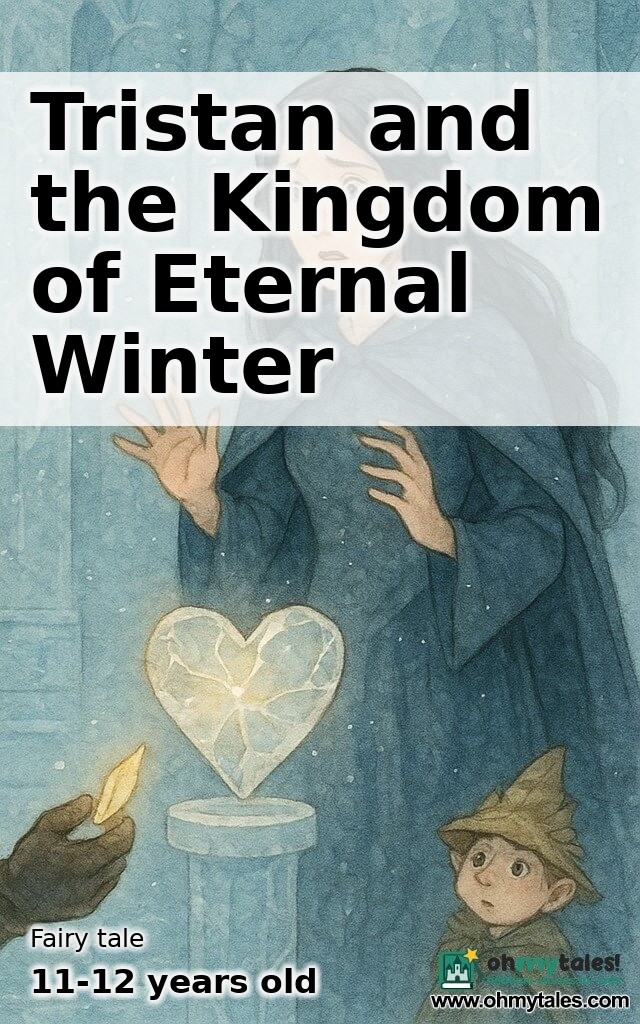
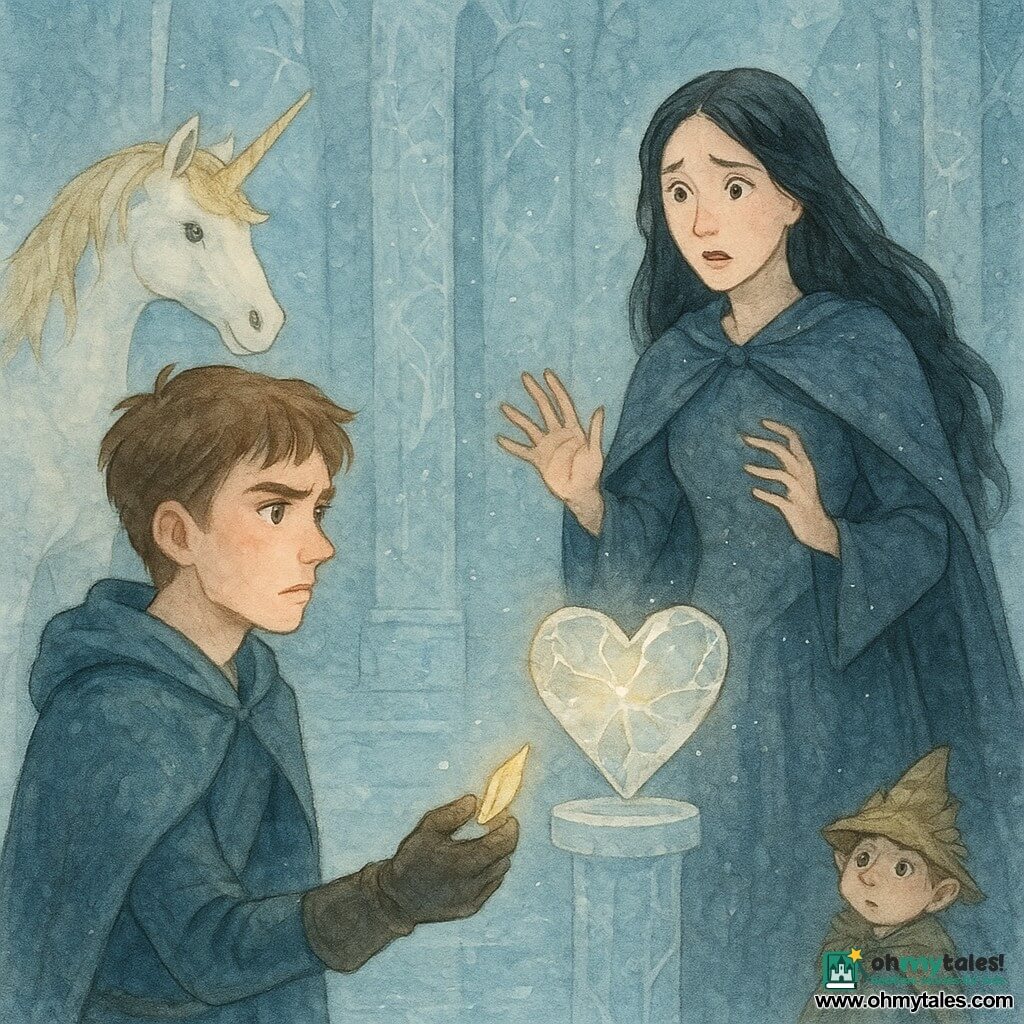
Inside, the highest chamber stretched wide, ceiling lost in shadow. In the center stood a pedestal of black stone, and upon it rested a crystal heart—large as a melon, beating with slow pulses of cold light. Each pulse sent a breath of frost across the room.
Morwenna stood beside it, smiling as if she'd been waiting for guests.
“Welcome,” she said. “You've climbed so far. I hope it was worth your little adventure.”
Tristan stepped forward. “It ends now.”
Morwenna's gaze flicked to his coat pocket. “Ah. You stole my secret.”
“I found it,” Tristan corrected. “There's a difference.”
Her smile faltered, just slightly. “Give me the shard.”
“No,” Tristan said.
Morwenna's face hardened. “Then freeze.”
She spread her arms. The air thickened. Frost raced along the floor toward Tristan's boots like living lace. Brindle yelped and jumped onto Lumen's back.
Tristan's legs began to numb. His breath came out in panicked bursts.
Lumen's voice cut through. “Tristan! The heart of winter is not only magic. It is her decision, made solid. Break the decision.”
“How?” Tristan gasped.
“With compassion,” Lumen replied. “Not for her cruelty. For the wound beneath it.”
Tristan's mind reeled. Compassion for Morwenna? The woman who had stolen spring?
Morwenna watched him struggle, delight flickering in her eyes like cruel candlelight.
Tristan forced his hand into his pocket and gripped the shard. Its warmth pushed back against the cold, small but stubborn. He pulled it out and held it up.
Morwenna's eyes widened, and for the first time, her voice shook. “Don't.”
Tristan took a step closer to the crystal heart. Frost crawled higher up his legs, but he moved anyway.
In the shard's surface, the faint reflection sharpened—Morwenna as a child, small and pale, standing alone in a hall while others danced and laughed without her. She held the mirror close, as if it were the only friend that would look back.
Tristan's anger faltered. Not vanished, but softened around the edges.
“You were lonely,” he said, voice rough. “You wanted someone to see you.”
Morwenna's mouth twisted. “Pity me, then. Go on. Pity is just another way of looking down.”
“I'm not looking down,” Tristan said. “I'm looking through.”
He held the shard toward her, not like a weapon, but like an offered hand.
“Being unseen hurts,” Tristan continued. “I know. When my father died, I hid my grief and pretended I was fine. I made myself invisible, even to the people who loved me. It didn't make me strong. It made me colder.”
The frost paused, trembling.
Morwenna's eyes flickered toward the crystal heart. For a moment, she looked tired—so tired.
“You think you understand?” she whispered.
“I understand that winter is easier than trust,” Tristan said. “Because winter doesn't ask anything from you. But it takes everything from everyone else.”
Morwenna's hand rose, as if to snatch the shard—then stopped, hovering, uncertain.
Lumen stepped forward, horn glowing like sunrise behind fog. “Morwenna,” it said, voice gentle and grave. “You cannot be admired if all hearts are frozen. You cannot be seen if you make the world blind with snow.”
Morwenna's throat worked. Her gaze darted to Tristan's face. Something there—his fear, his honesty, his stubborn refusal to hate her into a corner—seemed to crack a line through her composure.
“I… I wanted them to remember me,” she said, the words thin as threads. “I wanted to matter.”
“You do matter,” Tristan replied. “But not the way you think. Matter like a hearth matters—warming others. Not like a storm.”
The crystal heart pulsed faster, as if listening.
Tristan lifted the shard. “This is your beginning,” he said. “Not your prison.”
Morwenna's eyes filled with something that looked dangerously like tears, though they did not fall. If they had, they might have shattered on the floor.
Her fingers finally touched the shard.
The moment she held it, the shard flared bright, and the crystal heart on the pedestal trembled. A ringing sound filled the chamber, like a bell struck deep inside the ice.
Morwenna gasped. “No—!”
Tristan's boots freed themselves as the frost retreated. The air warmed—not by much, but enough that his fingers stopped aching.
The crystal heart cracked.
A thin line appeared across it, then another, branching like lightning. Cold light leaked out, and with it came something else: a whisper, not of doubt, but of longing.
Morwenna staggered back. “If it breaks, what will I be?” she breathed, terrified.
“Human,” Tristan said simply. “And that's not an insult.”
The crystal heart split apart with a soft, sad sound. A gust of cold burst outward—then collapsed inward, as if the winter were folding itself up like a cloak.
For a heartbeat, the chamber was silent.
Then warmth, gentle as a hand on a shoulder, drifted through the cracks in the walls.
Morwenna sank to her knees, her cloak pooling around her like spilled ink. She looked smaller now, as if the storm had been borrowing her shape and had finally let it go.
Lumen lowered its head. “The curse loosens,” it said.
Tristan stood, trembling, holding the shard between his hands. It had dimmed, but it was still warm.
Outside the castle windows, the sky—still gray—seemed less heavy, as if it had remembered there were other colors it could be.
Chapter 6: The Thawing of Hearts
They left the castle at dawn.
Morwenna did not try to stop them. She remained in the chamber, staring at the broken crystal heart as if it were a puzzle she had finally grown tired of solving. When Tristan looked back once, he saw her lift one of the cracked pieces, not with pride, but with a quiet, careful sadness.
On the bridge, the air felt different. The wind no longer bit. It simply blew.
Below, in the chasm, water trickled—a sound so small and brave that Tristan nearly laughed. It was the sound of the world clearing its throat after a long silence.
As they traveled back through the mountains, icicles fell from ledges with sharp clinks. In the forest, snow slid from branches in heavy sighs, revealing green needles beneath. The whispering pines were quieter, as if they had run out of cruel stories.
Brindle walked with a spring in his step. “I can feel it,” he declared. “My toes are returning to their natural state: not frozen.”
Tristan smiled, exhausted. “You're welcome.”
Lumen glanced at him. “Do not thank yourself too quickly. The kingdom will thaw because many small things changed—not only Morwenna's heart of winter, but yours as well.”
Tristan touched his chest. It did feel different—tender in places he hadn't noticed were numb.
When they reached the Lake of Looking-Glass again, a thin crack ran across its surface, and water shimmered beneath like a waking eye. The Mirror-Warden did not rise, but a ripple moved under the ice, as if she nodded from below.
At the edge of the village, people were already gathering, faces tilted upward. The snow was still falling—but now it fell in lazy, drifting flakes, like feathers shaken from a pillow. Between the clouds, a patch of pale blue showed, shy and new.
Master Brune spotted Tristan and nearly dropped his cane. “By my beard—Tristan! You're alive!”
Children ran forward, their boots splashing in a puddle that hadn't existed the day before.
Tristan's mother pushed through the crowd. For a moment, she just stared at him as if she couldn't trust her eyes. Then she grabbed him in a fierce hug.
“You're freezing,” she scolded, voice shaking.
“I'm thawing,” Tristan murmured into her hair.
She pulled back, eyes bright. “Did you—? Is it—?”
Tristan nodded. “The curse is breaking.”
A cheer rose, wobbly at first, then stronger. Someone laughed. Someone cried. A baker lifted his tray of rolls as if offering them to the sky.
Lumen stepped into the square, and a hush fell again—but this time it was a hush of wonder, not fear.
“The winter will fade,” Lumen said, voice carrying like music. “But remember: the cold did not only live in the air. It lived in silence, in pride, in hearts that hid.”
Tristan looked at the people—neighbors who had grown sharp with each other during the endless storm. He saw old grudges and tired faces. He also saw hands reaching out now, helping each other up from muddy slush.
He cleared his throat. “I thought being strong meant never showing pain,” he said. “But the lake showed me my own lies. And the wolf—” He paused, and Brindle coughed dramatically as if to say, Yes, yes, tell the wolf part. “The wolf showed me that even something scary can be changed if you see what's underneath.”
Master Brune blinked. “You talked to a wolf?”
Brindle threw his arms wide. “He practically gave it life advice!”
Laughter bubbled through the crowd, warm as soup.
Tristan continued, quieter now. “If we want spring to stay, we can't just wait for it. We have to make room for it—in how we treat each other. Say what's true. Ask for help. Forgive when we can. That's how you keep a kingdom from freezing again.”
His mother squeezed his hand. “You sound older,” she whispered.
“I feel… clearer,” Tristan replied.
Over the next days, the thaw came like a slow, careful visitor. Snow melted into streams that sang over stones. Roofs dripped steadily. In the fields, patches of brown earth appeared, and soon after, the first stubborn shoots of green—tiny flags of victory.
One afternoon, Tristan walked to the forest edge where he had first met Lumen. The unicorn stood beneath a pine, its coat glowing softly in the slanted light.
“Are you leaving?” Tristan asked.
Lumen's ears flicked. “My work is done for now.”
Tristan hesitated. “Morwenna… what will happen to her?”
Lumen's gaze was distant. “She will face herself without winter to hide behind. That is a hard journey. Harder than yours.”
Tristan nodded slowly. “I don't forgive what she did,” he said. “But… I'm glad she isn't only a monster.”
“That is wisdom,” Lumen replied. “And it is rare.”
Brindle appeared from behind a tree, dragging a tiny sled loaded with stolen—he would say “liberated”—pastries. “Are we having a heartfelt farewell? Because I brought snacks for the occasion.”
Tristan laughed. “Of course you did.”
Lumen stepped closer to Tristan. “Keep the shard,” it said. “Not as a trophy. As a reminder: when you look into a mirror, do not ask only, ‘Am I enough?' Ask, ‘Whom can I warm?'”
Tristan slipped the shard into his pocket. It no longer pulsed like a star. It felt like plain glass now—ordinary, and that, somehow, was comforting. Magic didn't always need to sparkle. Sometimes it simply needed to be true.
The unicorn bowed its head, horn catching the light like a final sunrise. Then it turned and walked into the trees, and the forest seemed to brighten as it passed, as if it carried a piece of morning with it.
Tristan stood watching until the last glow vanished.
Behind him, the village rang with sounds he hadn't heard in years: hammering, singing, children shouting in games that required running rather than huddling. The air still held a bite, but it was the honest bite of late winter, not the cruel grip of a curse.
Tristan turned toward home.
The road was muddy, the sky uncertain, and spring was still a promise rather than a fact. But promises, he had learned, were not made of air.
They were made of choices.
And his heart—once quiet, once hidden—walked forward like a lantern, lighting the path not only for himself, but for anyone who dared to follow.