Chapter 1: The City That Learned to Float
The city was called Lumenrest, and it did not sit on the ground like ordinary places. It rested on clouds the way a swan rests on water—lightly, trustingly, as if the sky were a patient pair of hands.
Its streets were ribbons of pearly mist. Its towers were carved from condensed moonlight. At night, the windows glowed like jars of honey, and in the daytime, the roofs shimmered as though someone had sprinkled them with crushed seashells.
In Lumenrest, people spoke softly, because echoes were sensitive. They laughed gently, because laughter drifted away and became weather. They lived between dreams and light; even their shadows seemed half-asleep.
Among them lived a man named Erian. He was generous by habit and cautious by choice. He carried spare scarves for cold strangers, and he checked the cloud-bridges twice before crossing. When children ran too close to an edge, he would call, “Careful—clouds are kind, but they are not fences!”
Erian's job was unusual, even in a place where unusual things were common. He was a Star-Keeper.
Not a keeper of all stars—only one.
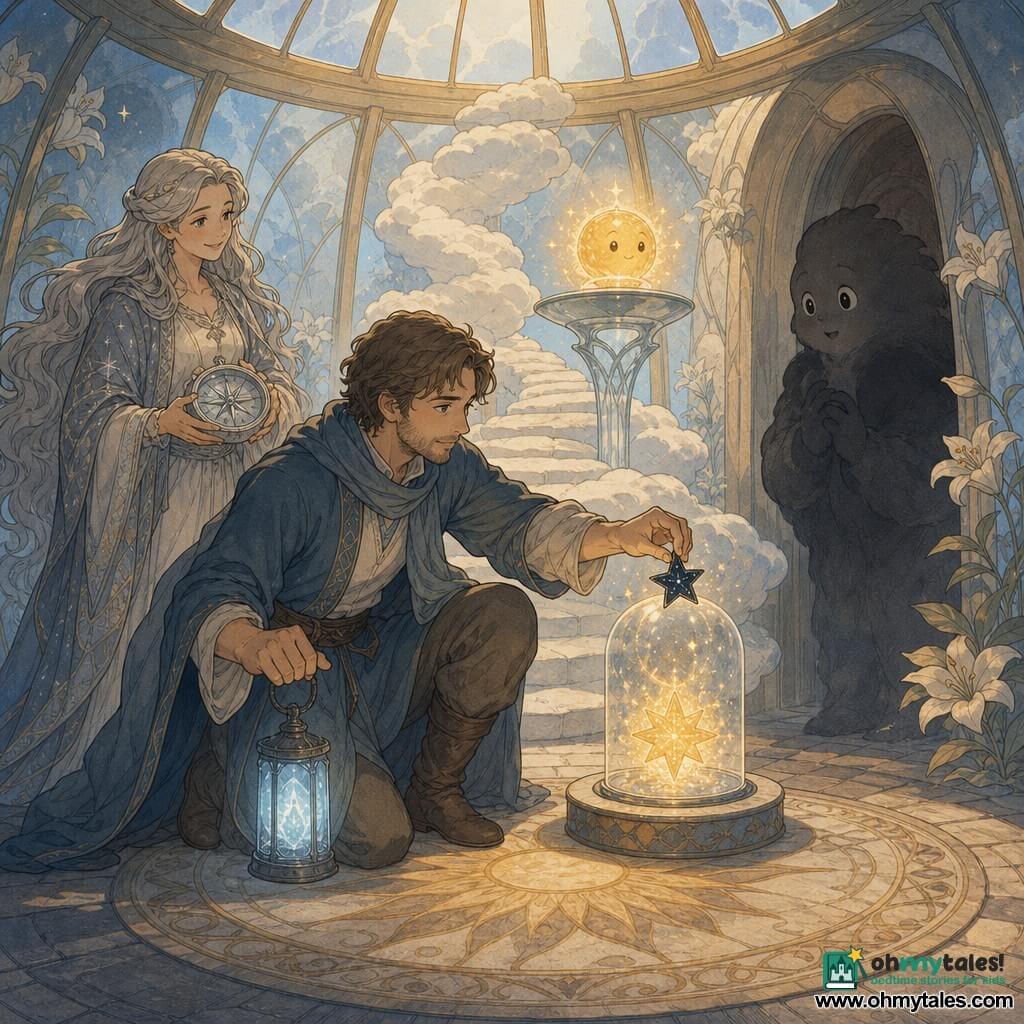
In the center of the city, in a small tower shaped like a teardrop turned upside down, there was a star no bigger than an apple. It was called Saffron, because its light had a warm, golden taste, the kind you could almost smell—like toast and sunlight and brave beginnings.
Saffron did not belong to the sky anymore. Long ago, during a storm that argued with itself for three days, Saffron had fallen. The people of Lumenrest had found it tucked inside a cradle of cloud, blinking in confusion.
They brought it home.
A star in the wrong place is a delicate thing. It can dim from loneliness. It can crack from fear. It can forget the song it was born singing.
So Erian watched over Saffron. He polished the glass dome above it with a cloth woven from dawn. He kept the tower warm with lanterns fed by kind words. He listened to the star's faint humming each evening, as if it were a secret told in a whisper.
One night, as the city drifted over a sea of sleeping mountains, Saffron flickered—once, twice—like an eyelid twitching in a dream.
Erian leaned close.
A voice as thin as thread came from the star. “Keeper?”
Erian smiled, careful not to startle it. “I'm here.”
“I saw… a shadow,” Saffron whispered. “Not a cloud-shadow. Something hungry.”
Erian's hand paused on the cloth. Beyond the dome, the sky was calm. The moon looked like a silver coin forgotten on velvet. Everything seemed peaceful.
But Erian had learned that danger often arrives wearing a quiet face.
“Rest,” he told the star. “I will be the lock on your door.”
Saffron's light steadied, but only a little. “Don't let it take my name,” it said, and then it fell silent again, as if it had used up all its courage in one sentence.
Erian stood very still. In Lumenrest, names were not just labels. Names were lanterns. To lose your name was to wander in yourself and never find the way out.
He whispered to the dome, to the tower, to the city itself, “Not while I can breathe.”
Outside, far below the cloud streets, something shifted in the darker layers of sky—like ink stirred in water.
Chapter 2: The Market of Moon-Feather
The next morning, Lumenrest woke to the smell of sweet steam buns and the sound of bells that rang without being touched. Market day always felt like a festival, even when nobody said the word.
Erian walked through the floating square with a woven basket on his arm. The clouds underfoot puffed softly, as if the city was breathing. Merchants called out their magical wares:
“Combs that untangle worries!”
“Bottles of yesterday's rain—excellent for remembering!”
“Pocket mirrors that show your best idea!”
Erian purchased a coil of silver thread from an old woman with eyebrows like feathery commas.
“For mending,” she said, squinting at him. “Or for binding?”
“For protecting,” Erian answered.
The old woman nodded as if she had been expecting that. “Then you'll want advice more than thread. Shadows don't fear rope. They fear truth.”
Truth, Erian thought, can be sharper than any hook.
He moved on. A boy offered him a cinnamon cloud-on-a-stick. Erian bought two and handed one back.
“You're paying me to eat?” the boy laughed.
“I'm paying you to keep smiling,” Erian said. “It's important work.”
The boy saluted with his sticky treat. “Yes, sir! I'll smile responsibly!”
Erian's steps slowed near the fountain in the center of the square. It didn't pour water. It poured light—thin streams of it, like liquid sunrise, collecting in a basin of pale stone.
Beside the fountain stood Mirra, the city's Dreamwright. She was not old, but she had the calm look of someone who had listened to many sleepless hearts. Strands of her hair floated as if remembering they once belonged to a cloud.
“Erian,” she said, and her voice sounded like pages turning. “You look as if your thoughts have stones in their pockets.”
He offered her the extra cloud-on-a-stick. “A star told me it saw a hungry shadow.”
Mirra's eyes narrowed, and for a moment her gaze seemed to pierce through the bright day and into the layers beneath. “Not all shadows are made by the sun,” she murmured.
“That's what worries me.”
Mirra took a small vial from her belt. Inside was a drop of darkness, perfectly round, like a bead. It did not shine, but it seemed to swallow nearby brightness.
“A sample,” she said. “Collected near the lower drift last week. The clouds there have been… thinning. As if something has been nibbling the edges of the city.”
Erian felt cold in his ribs. “Can it climb?”
“Anything can climb if it is hungry enough,” Mirra replied. Then she softened. “But hunger is also a kind of pain. And pain can be spoken to—sometimes.”
Erian did not like that word: sometimes. Sometimes was an umbrella with holes.
“I need to strengthen the tower,” he said.
Mirra touched the vial. “You must also strengthen the star. A protected thing can still grow frightened. And fear is a door left ajar.”
Erian thought of Saffron's whisper: Don't let it take my name.
“Tell me,” he said. “If something takes a star's name… what does it do with it?”
Mirra's smile was small and sad. “Names can be worn like masks. Or swallowed like medicine. Or used like keys.”
Erian looked back toward the teardrop tower, where the star waited behind its dome.
Then, on the far edge of the market, a flock of sky-gulls suddenly swerved in panic, as if avoiding an invisible wall. Their wings beat wildly. Their cries turned sharp.
For half a breath, the bright air dimmed.
Erian felt it—a tug, like a cold finger pulling at the hem of the day.
Mirra's hand closed around his wrist. “It's testing,” she whispered. “It has smelled your star.”
Erian's voice stayed steady, but his heart moved quickly. “Then it will find me standing in its way.”
Mirra let go. “Be careful, Star-Keeper. Courage without wisdom is just a candle in a storm.”
Erian nodded. “Then I'll be a lantern with glass around it.”
He hurried home, the silver thread heavy in his basket, and the sweetness of cinnamon suddenly tasting like a farewell.
Chapter 3: The Whisper at the Dome
The teardrop tower stood slightly apart from other buildings, as if giving the star a little space to breathe. A ring of pale lilies grew around it, their petals edged with light.
Inside, the air smelled of clean glass and warm wax. The dome above Saffron was smooth and clear, but Erian could see faint lines—tiny scratches, like hairline worries.
He knelt beside the star. In daylight, Saffron's glow was gentler, like a candle lit in a sunny room. Still, it was unmistakably alive. Its light pressed against the glass as if longing to touch the world.
“Good morning,” Erian said.
Saffron hummed, a sound like a lullaby remembered.
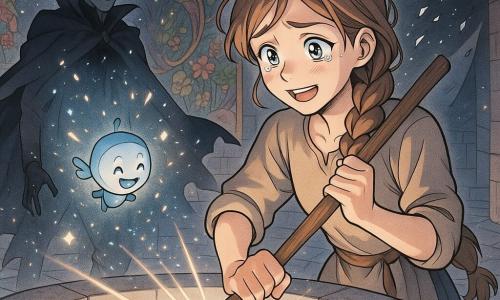
Erian took out the silver thread and began to weave it around the base of the dome, not as a net but as a pattern—loops and knots shaped like old blessings. He had learned the craft from his father, who had once been a Bridge-Braider, tying cloud paths together so no one would fall.
As Erian worked, the dome's scratches seemed to soften, as if the tower itself relaxed.
Saffron brightened. “That tickles,” it said, and its voice sounded more awake.
Erian chuckled. “That's the idea. Laughter is a good lock, too.”
The star pulsed once, like a contented heartbeat. Then its glow trembled. “Keeper… I dreamt again.”
“Was the dream kind?”
“It was… warning-shaped,” Saffron admitted. “In it, I was back in the sky, but the sky didn't remember me. And below, there was a mouth made of shadow. It was calling my name the wrong way.”
Erian stopped weaving. “The wrong way?”
“Yes,” Saffron whispered. “Like it was chewing it.”
Erian's stomach tightened. A name, chewed and changed, would not fit back in its rightful owner. It would become a crooked key.
He forced his voice to be calm. “Listen to me, Saffron. Your name is yours. It was given to you by the light that made you. Nobody else can truly own it.”
“But they can steal it,” Saffron said, and for the first time its light looked afraid—thin and sharp, like a needle.
Erian reached out and placed his palm against the dome. The glass was warm. “Then we won't give them the chance.”
From outside came the faint sound of wind. Not the soft, giggling wind that played in the upper clouds, but a lower, heavier wind, like someone dragging a cloak across stone.
The lilies around the tower bowed, though no breeze touched the city streets.
Saffron dimmed. “It's near.”
Erian stood. He moved to the tower door and opened it a crack. The sky beyond was bright, but along the underside of the nearest cloud-bridge, something clung—a bruise-colored smear, almost invisible unless you looked with the corner of your eye.
It reminded Erian of mold on bread.
Or a thought you tried not to think.
The smear wavered. It did not move like an animal. It moved like a question.
Erian shut the door gently, slid the bolt, and whispered, “No.”
He turned back to the star. “Saffron, I need you to do something difficult.”
The star's light quivered. “What?”
“I need you to remember a happy thing—something strong. Something that makes your light thicker.”
“I… I remember the day the city found me,” Saffron said. “Hands like clouds. Voices like blankets.”
“Good,” Erian said. “Hold that. Hold it as if it's a rope and you are climbing out of a deep well.”
Saffron's glow steadied, spreading warmer, like butter melting on bread.
Erian pulled out a small bell from his pocket, the kind used to call cloud-ferries. He rang it once. The note was high and clear, like a drop of water striking ice.
A moment later, Mirra entered, her eyes already searching.
“I felt it,” she said.
“It's right under the bridge,” Erian replied. “It's not attacking. It's… waiting.”
Mirra approached the dome and studied Saffron. “Your star is brave.”
“I don't feel brave,” Saffron confessed.
Mirra smiled gently. “Bravery is not loud. It is simply the decision to stay kind while you are afraid.”
Erian breathed out slowly. “What do we do?”
Mirra looked up at the dome, then at the tower walls. “We must discover what the shadow wants. A creature that only eats light will never be full. But a creature that eats names… is searching for something else.”
Erian's mind worked like a lantern being turned. “A name is a belonging.”
Mirra nodded. “And perhaps it has none.”
Outside, the bruise-smear thickened, and the tower's lilies bowed lower, as if listening to a sad song beneath the world.
Chapter 4: The Descent to the Lower Drift
That evening, when Lumenrest's lamps blinked on one by one like fireflies taking attendance, Erian and Mirra prepared to go down.
Down was not a direction most cloud-citizens liked. Down was where the air grew heavy and the colors lost their courage. Down was where discarded dreams drifted like torn paper. Down was where shadows learned to stretch.
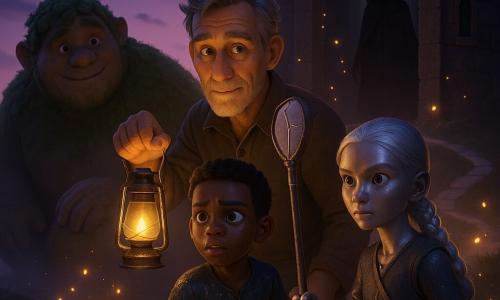
They did not leave Saffron alone. Erian asked two trusted neighbors—Toma, a baker with flour on his elbows, and Nessa, a glassworker whose hands never shook—to stand watch by the tower door.
“If you hear scratching,” Erian told them, “ring the bell and don't open anything. Not even if it begs politely.”
Toma swallowed. “Do shadows beg?”
“Some do,” Mirra said. “That's why you must be careful.”
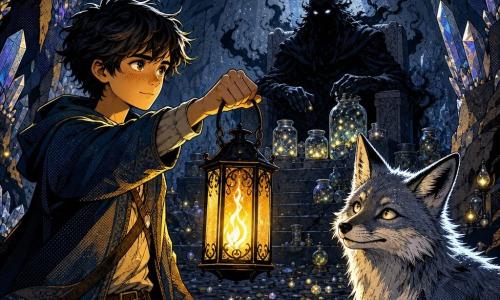
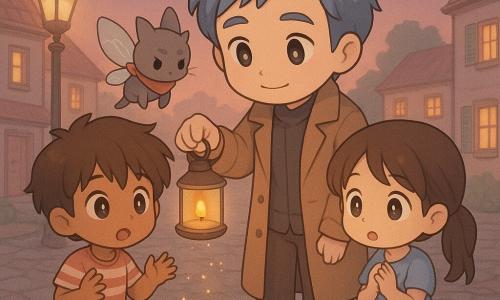
Erian slipped a small lantern into his coat. Its flame was pale blue, fed by a wick dipped in honest promises. Mirra carried a Dream-Compass: a silver disc that pointed not north, but toward whatever you most needed to understand.
They stepped onto the lowest cloud-bridge and began their descent along a spiral stair made of thick mist. Each step felt like walking down through layers of forgotten lullabies.
The air changed. It smelled of damp stone and old thunder. Below, the clouds were not white but gray, as if someone had washed them too many times.
Mirra's compass needle twitched. “It's close,” she said.
Erian kept his lantern held high. Its light made a small, brave circle, like a campfire in a wide wilderness.
Then they saw it.
At first it looked like a puddle of darkness stuck to the underside of a cloud. But as they approached, it lifted itself, gathering shape the way a cloak gathers around shoulders.
It was not a monster with teeth. It was worse and sadder: it was emptiness pretending to be a person.
Where its face should have been, there was only a soft blur, like smoke trying to remember a portrait.
Mirra spoke first, her voice steady. “Who are you?”
The shadow's edges rippled. When it answered, the sound was not a voice but a cold draft through a keyhole. “I am… not.”
Erian's lantern flame wavered, but he held it firm. “You are here. That means you are something.”
The shadow tilted, as if the idea puzzled it. “Something takes. Something fills. Something belongs. I do not.”
Mirra's compass spun once, then pointed directly at the shadow. She swallowed. “You have been feeding on the city's light.”
The shadow's edges tightened. “Light leaks. I drink. I grow. Still I am hollow.”
Erian felt a surprising sting behind his eyes. A creature that could not feel full was a creature trapped in its own hunger.
“What do you want with Saffron?” he asked.
At the name, the shadow shivered as if someone had struck a bell inside it. “That name,” it breathed. “That bright word. If I wear it, I will be real.”
Mirra stepped forward, careful. “A stolen name will not make you real. It will only make you a thief.”
The shadow's blur-face seemed to deepen. “Then give me another.”
Erian's heart knocked. The request was strange—almost childlike. It was as if the shadow had been hungry so long it forgot how to ask for anything else.
Mirra's eyes met Erian's. In that glance, he read the same thought: a battle could be won with force, but healing was a rarer victory.
Erian lowered his lantern a little, so the light did not glare like judgment. “Names must be given,” he said. “Not taken. If you want one, you must stop reaching with your hunger.”
The shadow trembled. “If I stop, I vanish.”
Mirra lifted her compass. “Not if you learn another way to exist.”
The shadow leaned closer, and the air around it grew colder. “Teach.”
Erian's caution spoke up like an old friend. “We can't trust it,” it warned.
But his generosity answered, quieter and stronger: “We can't ignore it.”
Erian said, “Come with us.”
The shadow recoiled. “Up? Into light?”
“Yes,” Mirra said. “Not as a thief. As a guest—under watch.”
Erian added, “If you try to touch the star, I will bind you with this lantern's promise and drop you into the sea of storms. I don't want to. But I will.”
The shadow's edges fluttered, like a frightened bird deciding whether to land. Then it whispered, “Agreed.”
Mirra's compass needle steadied, pointing upward now.
As they climbed, the shadow followed at a distance, keeping to the dimmer side of the stairs. Erian could not tell if it was planning betrayal or simply afraid.
Perhaps, he thought, those two things sometimes look the same.
Chapter 5: The Tower of Warm Glass
When they returned to the upper clouds, Lumenrest looked like a necklace of lights laid across the night. The stars above blinked politely, as if pretending not to notice the city that had stolen one of their own.
At the tower, Toma and Nessa stood stiff as statues.
Toma exhaled in relief when he saw Erian. Then he saw the shadow hovering behind Mirra and made a noise like a frightened teapot.
“It's… following you,” Nessa said, her voice controlled but thin.
“Only for now,” Erian replied. “Stay calm.”
They ushered the shadow inside the tower's entry room. Erian kept the door open a crack, so the city's lamplight could spill in like a gentle guard.
Saffron sensed the presence immediately. The star's light flared against the dome—bright, alarmed.
“Keeper!” it cried. “The hungry thing is here!”
“I know,” Erian said, moving quickly to the dome. “You are safe. Look at me.”
Saffron's glow flickered. “It wants my name.”
Erian put both hands on the glass and spoke softly, as if soothing a skittish horse. “Listen, Saffron. You are not a prize. You are a person of light. And we do not trade people.”
Mirra stepped between the shadow and the dome. “Do you remember our agreement?”
The shadow hovered like smoke unsure which way the wind would take it. “I remember. But the name… it sings. It hurts.”
Erian's voice stayed firm. “That hurt is your hunger talking. Hunger lies. It tells you stealing will cure you. It won't.”
Saffron's light trembled, then steadied slightly, like a child gripping a blanket. “Why does it have no name?” the star asked, quieter now.
Mirra glanced at Erian. “Some things are born in the cracks between lights,” she said. “In places where no one looks. If no one names you, you may start to believe you are nothing.”
The shadow's edges shrank, as if embarrassment were a kind of rain.
Erian swallowed. He had always thought shadows were only enemies. Now he saw one as a lonely absence, shaped like a mistake the world forgot to correct.
He took a step toward it, lantern in hand. “You said you wanted a name,” he said. “But names are earned, too. A name should match what you choose to become.”
The shadow trembled. “I don't know how to choose.”
“Then start small,” Erian said. “Choose not to harm.”
The shadow's blur-face turned toward the dome. Saffron glowed brighter, ready to defend itself with light if it had to.
For a moment, everything held its breath.
Then the shadow drifted backward—away from the star.
“I… choose,” it whispered, as if the word were heavy. “No harm.”
Saffron's light softened, astonished. “It moved away,” it said, almost to itself.
Mirra nodded. “Good. Now, the next step.”
She opened a drawer and took out a blank strip of cloud-paper and a pen dipped in starlit ink. “A true name is spoken,” she said, “but it can be written first, like planting a seed.”
Erian looked at the shadow. “Tell me,” he asked, “what do you feel—beneath the hunger?”
The shadow shuddered. “Cold. Empty. Like a room with no furniture.”
Erian thought of all the times he had given scarves away. Warmth was not only a temperature. It was a message: You are not alone.
He spoke gently. “What would you like to be, if you could?”
The shadow's edges flickered with something almost like longing. “A shelter,” it whispered. “A quiet place. A corner where light can rest without being chased.”
Mirra's eyes softened. “That is not a thief's wish.”
Erian nodded slowly. “Then perhaps your name should be the thing you want to offer.”
He turned to Saffron. “Star,” he said, “you have been afraid. But you are also wise. Would you help name it—if it promises never to touch your light again?”
Saffron's glow hesitated. The star's humming rose and fell like a careful breath.
Finally Saffron said, “If it keeps its distance… yes. Because… because being nameless sounds worse than being scared.”
The shadow trembled, as if the kindness struck it like sunlight.
Mirra handed the pen to Erian.
Erian looked at the blank cloud-paper. Words mattered. They could be bridges or knives.
He wrote slowly: “Hearth.”
The ink shimmered.
The shadow leaned closer to read. “Hearth,” it repeated, and the sound this time was less like a draft and more like a voice trying to learn warmth.
Saffron pulsed. “A hearth is where stories are told,” it said, and its light warmed. “Where people gather.”
Erian held up the paper. “If you accept this name,” he said, “you must live by it. A hearth does not swallow light. It shares it.”
The shadow—Hearth—seemed to gather itself differently now. Its edges became less jagged, more rounded. It was still dark, but not cruelly so. Like soft soot instead of sharp ink.
“I accept,” Hearth whispered. “Teach me how.”
Erian felt something in his chest loosen. “We will,” he said. “But there is one more thing.”
He turned to Mirra. “The scratches on the dome,” he said. “They weren't there before. Something has been testing it longer than we thought.”
Mirra's face grew solemn. “Yes. And there are older secrets in this tower than your weaving can cover.”
Saffron's humming changed—lower, as if the star had heard that sentence before, long ago.
Chapter 6: The Secret Under the Lily Ring
Near midnight, when the city was quiet enough to hear the clouds sigh, Mirra led Erian and Saffron—yes, Saffron too, in its own way—into the tower's lowest room.
It was a circular chamber beneath the star's pedestal, hidden under a rug woven with sun-motes. Erian had been Star-Keeper for years, yet he had never been shown this place. It made his skin prickle with the feeling of unopened letters.
Hearth waited by the stairs, keeping its promised distance, as if afraid one wrong move would erase its new name.
Mirra placed her palm on the floor. “Lumenrest was built on clouds,” she said, “but it was anchored by a vow.”
The stone—yes, stone, in a city of cloud—shivered, and a seam appeared. A small door opened with a sigh.
Erian peered inside. There lay a second star.
Not bright like Saffron.
This one was dark, like a pearl that had lost its shine. Yet it was not empty. It was full—full of quiet, full of rest, full of night the way a blanket is full of warmth.
Saffron's light flared. “That is… my other half,” it whispered, voice trembling with recognition. “My shadow-star.”
Erian stared, mind reeling. “Stars have… halves?”
Mirra nodded, her eyes reflecting both lights and darkness. “Every light casts a shadow. But in the sky, a true star is balanced. When Saffron fell, its night-half fell too—separately. The people of Lumenrest found Saffron, and they rejoiced. But they feared the other half. They locked it away and never spoke of it.”
Saffron's glow wavered with sorrow. “They hid it… because it was dark.”
“Because they did not understand,” Mirra said softly. “They thought protecting the light meant imprisoning the night.”
Erian felt a slow anger—not the hot kind, but the steady kind that comes when you see an old wrong. “And the hungry shadow?”
Mirra looked at Hearth. “It was drawn to what was locked away. A nameless thing recognizes other forgotten things.”
Hearth drifted closer, trembling. “I heard… a sleeping call,” it said. “Like a lullaby with its last note missing. I followed it. I tried to fill the missing note with stolen light.”
Saffron pulsed, and for the first time its voice held no fear—only a gentle ache. “You were hungry because something was incomplete.”
Erian knelt near the hidden star. It was cool, but not cruel. He felt the urge to speak to it as one speaks to someone asleep.
“What is its name?” he asked Mirra.
Mirra's smile was wistful. “It has been called many things in old records. But its true name was always paired with Saffron's.”
Saffron whispered, “My name is only half a sentence.”
Erian looked from the bright star above to the dark star below. Two halves of the same story, separated because people had been afraid of one page.
“How do we mend it?” he asked.
Mirra lifted the Dream-Compass. Its needle pointed not at Hearth, not at Saffron, but at Erian.
Erian blinked. “Me?”
Mirra said, “The vow that anchors Lumenrest was made by the first Star-Keeper. It required a keeper to choose wisdom over fear—to accept that darkness can be gentle, and light can be reckless. The secret has waited for someone to understand.”
Erian's throat tightened. All his caution, all his careful locks and bolts—had he been guarding only half the truth?
He turned to Hearth. “You wanted a place where light can rest,” he said. “Can you be that place?”
Hearth's edges trembled. “If I am allowed.”
Erian looked at Saffron. “And you,” he asked softly, “can you share your name without losing it?”
Saffron hummed, and the sound was stronger now, like a choir finding its missing voice. “Yes,” it said. “Because love doesn't get smaller when it is shared.”
Erian took a deep breath. He lifted the hidden door wider, and Mirra carefully raised the dark star from its cradle. It did not resist. It seemed relieved, like someone waking from a long, uncomfortable sleep.
Saffron's light poured down the stairwell in a warm stream. Hearth drifted between them, not to steal, but to soften the meeting—like a curtain drawn to stop a room from being too bright at once.
In that gentle middle place, the bright star and the dark star began to hum together.
Their sounds braided—gold and midnight, courage and calm.
Mirra whispered, “Now, the secret.”
Erian listened, and he heard it: Saffron's true name was not Saffron at all.
That was only what the city had called the light-half.
The real name was a pair of words, spoken together like clasped hands: “Saffron-Hush.”
Light and night. Flame and rest. A star complete.
As the name was spoken, the two halves slid toward each other, drawn by their own belonging. When they touched, there was no explosion, no drama—only a soft bloom of radiance, like a flower opening in slow motion.
The star became whole.
Its light was not blinding. It was balanced, comforting. It made room for shadows without feeding them fear.
Hearth shivered, not with hunger now, but with wonder. “I… I can feel,” it whispered. “Not empty. Not full of stealing. Just… here.”
Erian's eyes stung. “That's real,” he said. “Being here, without taking.”
Above, Lumenrest's cloud-streets brightened. The city's lamps seemed to glow steadier, as if they had been waiting for this harmony.
Saffron-Hush hovered within the dome again, but the dome's scratches vanished like worries forgiven.
Mirra closed the hidden door gently and laid the rug back. “The city did not need a single star,” she said. “It needed a whole one.”
Erian looked at Hearth. “And you,” he said, “do you know what you are now?”
Hearth's voice was warmer. “A hearth,” it said, almost shy. “A place where light can rest.”
Erian smiled. “Then you may stay—beneath the bridges, in the lower drift. Not as a hungry mouth, but as a shelter for lost dreams. You will guard the city's underside, where fear likes to hide.”
Hearth bowed—an awkward motion, like a child learning manners. “I will.”
Saffron-Hush pulsed gently. “Keeper,” it said, “thank you.”
Erian shook his head. “No,” he said softly. “Thank you for teaching me the secret I didn't know I needed.”
In the quiet after, Erian understood the moral that would guide him like a lantern: protecting something precious is not only about building walls. Sometimes it is about mending what was split by fear, and offering a name to what the world forgot.
Outside, the night held the city tenderly. And Lumenrest floated on—lighter now—not because it had no shadows, but because it had learned how to live kindly with them.