Chapter 1: The Girl Who Swept Starlight
In the kingdom of Lumenvale, the streets were not made of stone but of dream-dust pressed firm, sparkling faintly under every footstep. Above, the sky was a quilt of stars stitched close together, as if night itself feared to leave any holes where sadness could slip through.
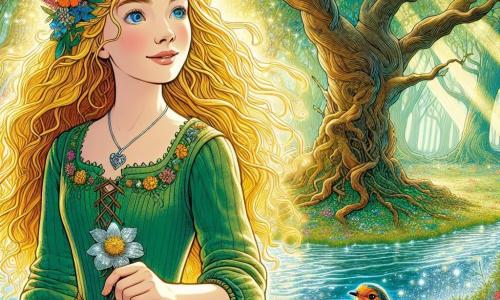
Mira lived in a small cottage tucked between two moon-white willows. She was not a princess, nor a wizard, nor a famous hero whose name was sung by trumpets. She was simply Mira—young, generous, and steady as a candle that refuses to flicker out.
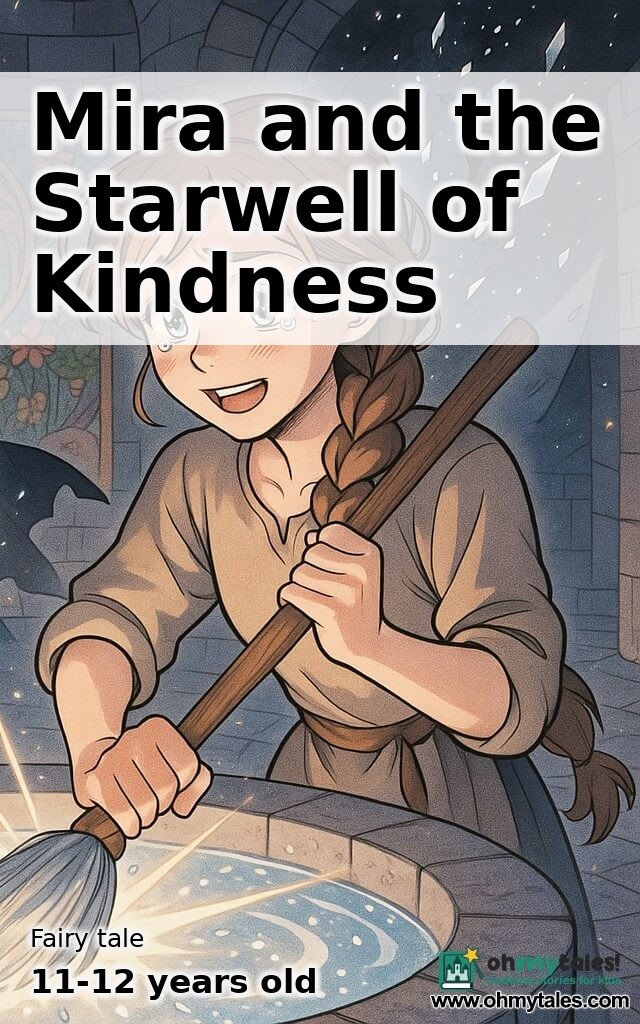
Each morning, she swept the village paths with a broom woven from comet-straw. The broom did not just gather leaves; it gathered worries, too—little grey crumbs of them—so that the road looked brighter when people walked it.
Old Master Pell, the baker, would call from his window, “Mira! If you keep polishing the paths, I'll have to start baking mirrors.”
Mira would grin. “Then I'll buy one and check if my nose is still on straight.”
That morning, however, the dream-dust seemed dull. The air tasted like rain that had forgotten how to fall. In the marketplace, neighbors spoke in whispers that scraped like dry twigs.
At the fountain—where water usually rose in shining ribbons and sang to itself—only a thin trickle moved, as if the fountain had grown shy.
Mira knelt and touched the stone. It felt cold in a way that wasn't just cold. It felt lonely.
A voice behind her murmured, “The stars have begun to argue.”
Mira turned. A small figure stood there, no taller than her knee, wearing a cloak the color of twilight. Its eyes were bright as dew on a spiderweb.
“A star is arguing with another star?” Mira asked, half-smiling, because the idea sounded silly.
The figure shook its head solemnly. “Not the stars in the sky. The stars in the hearts. When hearts quarrel, the sky listens. And when the sky listens too long…” It pointed upward.
Mira followed its finger. For the first time in her life, she noticed it: a thin shadow, like a scratch across glass, stretching from the eastern hills toward the center of the heavens.
“What is it?” she whispered.
“The Rift of Muffled Light,” said the figure. “Peace is slipping. Soon the kingdom will forget how to be kind without trying.”
Mira stood up, and in her chest something tightened—not fear, exactly, but the feeling you get when you see a bird with a broken wing and you can't pretend not to notice.
“Who are you?” she asked.
“I'm Glint,” the creature said, with a small bow. “A lantern-sprite. And you, Mira, have been chosen.”
“Chosen by whom?” Mira asked, because she had always suspected “chosen” was a fancy word for “volunteered without being asked.”
Glint's smile was quick and sad. “By your own heart. It's one of the bravest rulers in Lumenvale.”
Mira looked at the dim fountain, the greyish paths, the scratch of shadow in the sky. She imagined the kingdom growing colder and more suspicious, like soup forgotten on the stove.
“I don't know spells,” she said softly. “I only know how to help.”
Glint nodded. “That is the oldest magic.”
Chapter 2: The Map That Was a Lullaby
Glint led Mira beyond the village, past fields where wheat shimmered like sleeping gold. The road curled toward the Hills of Soft Echoes, where every shout returned as a gentle sigh.
On the way, Mira met travelers who usually greeted strangers with warm jokes. Today, their smiles were thin as paper.
A boy bumped into Mira and snapped, “Watch it!”
Mira could have snapped back. Her mouth even prepared the words. But she saw the boy's clenched hands, the way his shoulders sat up like frightened cats.
“I'm sorry,” she said instead. “Are you all right?”
The boy blinked, startled, as if kindness had spoken in a language he'd almost forgotten. His anger wilted. “I… I don't know. Everything feels… scratchy.”
Mira offered him a small roll from Master Pell's basket she carried for the journey. “Food helps. Sometimes it doesn't fix things, but it makes fixing possible.”
He took it and mumbled, “Thanks,” then ran off, chewing like someone trying to swallow a storm.
Glint watched her. “The shadow wants quick flames,” it said. “Anger burns fast.”
“And kindness?” Mira asked.
Glint's eyes shone. “Kindness is a lantern. It doesn't hurry, but it lasts.”
At dusk they reached a sleeping lake called Mirrorpond. The surface reflected the stars so perfectly it looked like you could fall upward into it.
On the shore stood an old willow with branches like long, careful fingers. Glint tugged at a knot in the bark, and a folded map slid out—though “map” was hardly the word. It looked like sheet music, with lines and dots that hummed softly when Mira held it.
“It's singing,” Mira whispered.
“It's a Lullaby Map,” Glint said. “It shows the road to the Starwell—where the kingdom's peace is poured out each year like bright water. Someone has been covering the Starwell with gloom. If the Starwell is cleared, the Rift will heal.”
Mira traced the humming notes. The melody painted pictures in her mind: a bridge of moonbones, a forest where lanterns grew like fruit, a tower made of quiet.
“And if I fail?” she asked.
Glint didn't pretend. “Then the shadow becomes a habit. People won't notice it's there, because it will feel normal.”
Mira swallowed. “I hate habits like that.”
Glint chuckled. “So do I. I once had a habit of hiding in teapots. Very embarrassing.”
Mira laughed, and the laugh sounded like a bell shaken gently. For a moment, the scratch in the sky seemed less sharp.
They camped beside Mirrorpond. Mira lay awake, watching the reflected constellations ripple.
She thought of Lumenvale's people—how they had always been like a choir, different voices but one song. Now the song was cracking.
She pressed her palm to her chest. “All right,” she whispered to her heart, “let's be brave rulers together.”
The map hummed louder, as if agreeing.
Chapter 3: The Forest of Borrowed Lanterns
The next day, the Lullaby Map guided them into the Forest of Borrowed Lanterns. Trees rose tall and dark, their leaves shaped like small hands, catching and holding bits of light. Lanterns dangled from branches like glowing pears—each one labeled with a name.
Mira reached toward a lantern that read: “Sela—First Laugh.” Another read: “Garron—Courage.” Another: “Nina—Trust.”
“What are these?” she asked, her voice hushed as if she were in a library.
Glint's cloak fluttered. “When people feel too tired to shine, they borrow light from the forest. They hang it here for safekeeping. But lately…”
A gust of wind moved through the branches, and several lanterns flickered weakly, as if someone had pinched their flames.
Mira's stomach tightened. “The shadow is stealing what people stored.”
They walked deeper, until they found a clearing where the lanterns hung low, heavy with dimness. In the center sat a creature shaped like a heap of wet ash. It had no clear face, only a mouth that opened and closed like a forgotten purse.
It spoke in a voice like soot falling. “Why polish peace? Let it crack. Cracks are entertaining.”
Glint hissed, tiny but fierce. “Gloommote.”
Mira stepped forward, her hands open. “Why are you doing this?”
The Gloommote's mouth stretched. “Because people are easier to push when they're tired. Because kindness is hard work. Because…” It paused, and its ash-body shuddered. “…because I am hungry.”
“Hm,” Mira said, surprising herself with how calm she sounded. “What do you eat?”
“Light,” it breathed. “Especially the light that comes from choosing goodness when it would be simpler not to.”
Mira looked at the lanterns. She imagined each one as a promise someone had made: I will trust again. I will laugh again. I will be brave again.
She turned to the nearest tree and gently unhooked a lantern labeled “Mira—Patience.” Its glow was small, but steady.
Glint gasped. “That's yours! You left it here when you were nine and your neighbor's goat ate your favorite ribbons.”
Mira shrugged. “I was very dramatic about those ribbons.”
She held the lantern up. “Gloommote,” she said, “you can't have this.”
The ash-heap surged forward, greedy as a hand snatching candy. Mira did not run. Instead, she spoke, not like someone casting a spell, but like someone telling the truth out loud.
“I will not fight you with hate,” she said. “Hate would feed you. I will fight you with what you cannot digest.”
“And what is that?” it wheezed.
“Understanding,” Mira said. “You are hungry. But stealing lanterns won't fill you. It just makes more hunger.”
The Gloommote hesitated, as if it had never been described so plainly. It wavered like smoke unsure of its direction.
Mira lifted her lantern and, one by one, began returning other lanterns to the trees, fastening them higher, safer. With each lantern she placed, she spoke a small sentence:
“Trust is worth the risk.”
“Courage doesn't need applause.”
“Laughter is not a waste.”
The forest brightened. The lanterns glowed stronger, and their light braided together like golden thread.
The Gloommote shrank, coughing. “Stop. It hurts.”
Mira's voice softened. “It doesn't hurt you. It hurts what you're pretending to be. You are not all-powerful. You are only uninvited.”
Glint fluttered up and whispered, “You're doing it, Mira. You're starving the shadow.”
With a final hiss like a candle blown out in reverse, the Gloommote dissolved into a harmless puff of grey dust that settled on the ground like old regret.
The lanterns shone so brightly that even the scratch in the sky above the treetops looked thinner.
Mira let out a breath she didn't realize she'd been holding. “That was… weirdly exhausting.”
Glint snorted. “Try being a lantern-sprite. We're basically professional brightness.”
They left the forest, carrying the steadier glow with them like a pocketful of dawn.
Chapter 4: The Bridge of Moonbones
The Lullaby Map led them to a ravine where mist coiled like sleepy dragons. Across it stretched a bridge made of pale arcs—smooth, curved stones that looked like the ribs of some ancient, gentle moon-whale.
At the bridge's entrance stood a guardian: a tall figure wearing armor that shimmered softly, as if made from pearl. Its helmet had no opening for eyes, yet Mira felt watched.
A voice rang out, musical and cold. “To cross, you must carry nothing false. Speak one truth you have been hiding.”
Mira glanced at Glint. “Does it mean like… secret secrets?”
Glint whispered, “It means the truth you keep from yourself.”
Mira stepped onto the first moonbone. It was warm under her boot, like it remembered sunlight.
“I'll go,” she said.
The guardian's voice echoed. “Speak.”
Mira's mouth went dry. She wanted to say something easy, something that sounded noble. But the bridge didn't ask for fancy words. It asked for a real one.
She stared into the mist. “Sometimes,” she admitted, “I help people because I'm afraid that if I stop being useful, they won't want me around.”
The words dropped between them like a stone into water—heavy, honest, rippling.
The bridge hummed, and a faint light ran along the moonbones. The guardian stepped aside.
“You may cross,” it said.
Mira blinked, surprised by the relief that followed. It felt like loosening a tight braid.
Halfway across, the mist below rose and formed shapes—faces of villagers she knew, looking disappointed.
Master Pell's face frowned. “You should have done more.”
The boy from the road scowled. “You don't really care.”
Even Mira's own reflection appeared, lips curled in doubt. “You're not brave. You're just stubborn.”
Mira's knees wobbled. The bridge beneath her felt suddenly narrow.
Glint darted to her shoulder. “Illusions,” it said, but its voice shook a little too. “The shadow uses doubt like a hook.”
Mira closed her eyes and took a breath. She pictured the lanterns in the forest, each one belonging to someone who had once been afraid. She remembered the boy's blink of surprise when she apologized.
“I do care,” she said aloud, voice steadying. “Not to be needed. To be kind. Even when no one claps.”
The illusion-faces cracked like thin ice and drifted away.
They reached the far side, where the land rose into a hill crowned by a tower. The tower looked as if it had been built from silence: smooth grey stone that swallowed echoes, so that even footsteps sounded like thoughts.
Glint pointed. “The Tower of Hushed Hours. Inside is the Starwell.”
Mira looked up. Above the tower, the scratch in the sky widened into a faint bruise.
“We're close,” she whispered.
“And the shadow knows it,” Glint said.
Chapter 5: The Tower Where Time Held Its Breath
Inside the tower, the air was cool and still. No wind wandered here. No dust dared dance. It felt as if time itself had pressed a finger to its lips.
They climbed a spiral staircase. On the walls hung tapestries that showed Lumenvale's history: people sharing bread, strangers becoming friends, quarrels ending in hugs that looked awkward but sincere.
But as Mira walked, the scenes in the tapestries began to change. Bread turned into crumbs thrown in anger. Hugs turned into pushing. Smiles twisted into smirks.
Mira stopped before a tapestry where two sisters once stood back-to-back, united. Now the thread showed them glaring across a widening gap.
“That's not true,” Mira whispered.
A new voice answered from above, smooth as spilled ink. “Truth is flexible when hearts are tired.”
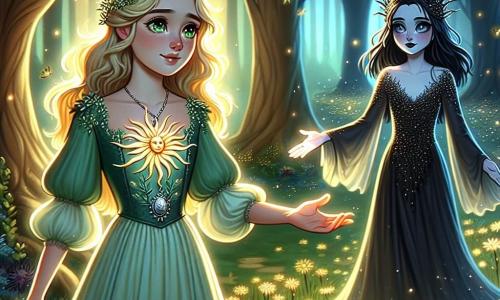
At the top of the stairs stood a figure in a cloak darker than midnight. Its face was handsome in a careful, empty way, like a mask polished too much. A crown of thin black glass rested on its head.
Glint trembled. “The Night Regent.”
The Night Regent inclined its head. “Mira of the Swept Paths. I wondered when you would arrive, carrying your little lantern-sprite like a pet firefly.”
Glint puffed up. “I am not a pet. I am a professional.”
Mira stepped forward. “Why are you doing this? Lumenvale was peaceful.”
The Night Regent spread its hands. “Peace is boring. Peace asks people to be patient, to forgive, to listen. I offer something easier: the thrill of being right. The comfort of blaming. The speed of anger.”
Mira thought of the boy's “scratchy” feeling. She thought of the dull fountain. “Easier isn't better,” she said.
The Night Regent's smile sharpened. “You are young. You will learn. People choose what feels good now, not what is good forever.”
Mira glanced past the Regent, through an archway, and saw it: the Starwell. A round pool filled with pale light—only the light was covered by a film of shadow, like oil on water.
The Starwell's glow was muffled, struggling, like a song sung under a blanket.
Mira's chest hurt. “You're suffocating it.”
“I am teaching it realism,” the Regent said. “Light is fragile. Shadow is honest.”
Mira shook her head. “Shadow is not honesty. It's only what happens when something blocks the light.”
For the first time, the Regent's eyes flickered—annoyance, perhaps, or fear.
“Take her lantern,” the Regent snapped, and the shadows at its feet sprang up like black dogs.
They lunged. Glint zipped away, shouting, “Not my face!”
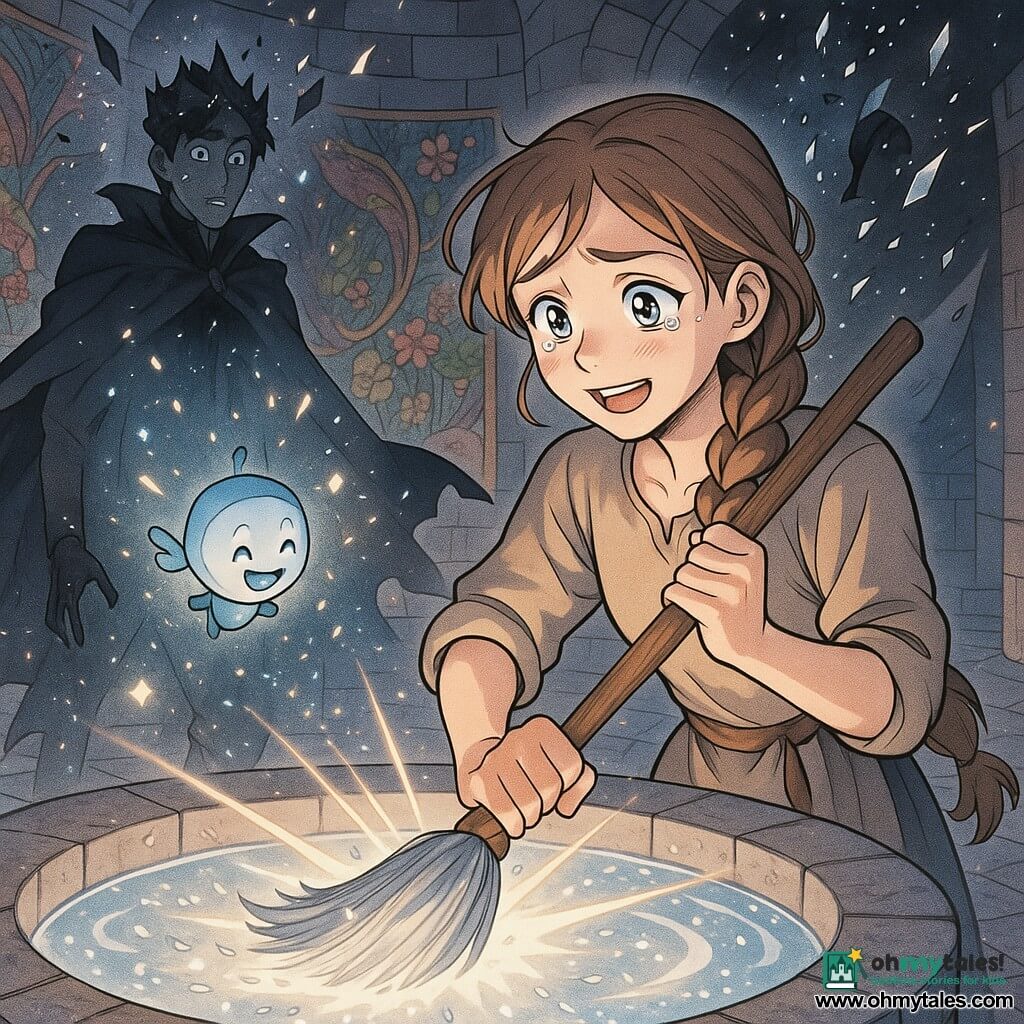
Mira raised her broom—the comet-straw bristles glimmered faintly. It was a simple tool, not a sword, not a wand. But Mira had swept paths for years. She knew how to clear what didn't belong.
She swung the broom in a wide arc. The bristles caught the shadows like cobwebs, pulling them into swirling strands.
The Night Regent laughed. “Cleaning? How adorable.”
Mira's arms shook, but she kept sweeping, gathering the darkness into a tight bundle. The shadows fought, writhing, whispering insults that poked at her soft spots.
“You'll be alone.”
“You'll fail.”
“No one asked you to come.”
Mira gritted her teeth. Then she spoke, not to the shadows, but to herself.
“I came because peace matters. Even if nobody asked. Even if I'm scared.”
The bundle of darkness tightened, as if the truth had tied it into a knot.
Glint darted back and landed by the Starwell. “Mira! The film is like… like burnt sugar on a pudding! How do we crack it?”
Mira looked at the Starwell, then at the tapestry of the sisters, then at the Regent's crown of black glass. She understood suddenly: the shadow wasn't just a creature. It was a choice people had been tempted to make—again and again—until it felt like a throne.
She stepped toward the Starwell. The Night Regent blocked her path.
“You cannot remove what people secretly want,” it hissed.
Mira met its gaze. “Then I won't remove it by force.”
She held out her hand, palm up, as if offering something fragile. “I'll offer something stronger.”
The Night Regent hesitated, confused.
Mira spoke clearly, letting each word ring like a small bell in the tower's hush. “I forgive you.”
Glint gasped. “Mira—”
The Regent recoiled as if struck. “You… you do not even know me.”
“I know what you do,” Mira said softly. “And I know you're made of hunger and loneliness wearing a crown. I forgive you for trying to fill yourself the wrong way.”
The black glass crown trembled. Hairline cracks appeared, thin as spider silk.
The Regent's voice faltered. “Stop.”
Mira continued, eyes wet but steady. “You can stop. You can let the light breathe. You don't have to be a ruler. You can be… nothing, if you want. Or something better.”
For a moment, the Night Regent looked very young—like a child caught stealing because they were starving. The shadows around it thinned, uncertain.
Then, with a sound like ice breaking on a spring river, the crown shattered. Shards dissolved before they hit the floor, turning into harmless sparks.
The Night Regent staggered. Its cloak faded to grey, then to mist.
“I didn't know,” it whispered, voice small now, “that anyone would speak to me like that.”
Mira's throat tightened. “Light speaks that way. It doesn't just shine. It welcomes.”
The Regent—no longer a regent, just a fading gloom—bowed its head. “Then… welcome me out of the way.”
And it vanished like a bad dream at morning.
Chapter 6: The Starwell Sings Again
The film of shadow on the Starwell shivered, as if it had lost its grip. Mira knelt and dipped her broom's comet-straw into the pool.
The bristles drank the pale light, and the light drank the bristles back. It was not a battle; it was a washing.
Mira swept gently across the surface. The shadow-film broke apart into little flakes that melted like snow on warm skin.
At once, the Starwell brightened. A clear, ringing sound rose from it—a song like water laughing. The light spilled up the tower walls and rushed out the windows in shining ribbons.
Outside, the bruise in the sky began to heal, the scratch smoothing as if an unseen hand were mending the seam of night.
Glint danced in the air, glowing so hard it nearly looked solid. “Yes! Oh, yes! I feel like a thousand tiny birthdays!”
Mira laughed through tears. “That is… an excellent way to describe it.”
The tapestries on the walls rewove themselves. The sisters stood together again, not because they had never argued, but because they had chosen to return.
Mira leaned over the Starwell. In its light she saw her own face—not perfect, not heroic in a shiny-story way, but earnest. And behind her eyes, she saw something else: a steady flame that didn't depend on applause.
Glint hovered near her cheek. “You did it. You brought peace back.”
Mira shook her head gently. “The kingdom did. I just reminded it how.”
They descended the tower. At the door, the guardian of moonbones waited. This time its voice was warmer.
“What truth will you carry home?” it asked.
Mira smiled. “That being useful is nice, but being loving is better. And love doesn't need permission.”
The guardian stepped aside, and the road home seemed to glow by itself.
In the village, Master Pell rushed out of his bakery waving a floury hand. “Mira! The fountain's singing again! It nearly splashed me—rude, but cheerful.”
The boy from the road appeared, holding a roll in one hand and looking embarrassed. “I… I was mean yesterday,” he said. “Everything felt wrong.”
Mira nodded. “It did. But you're here now.”
He offered her the roll as if it were a peace treaty. “Friends?”
Mira took it and broke it in half. “Friends.”
As evening fell, Lumenvale lit its lanterns. The stars above seemed closer, not because they moved, but because the hearts below had opened like windows.
Mira walked the paths with her broom, but she did not sweep alone. Neighbors joined her—laughing, talking, sharing stories, gathering old worries like fallen leaves.
Glint perched on Mira's shoulder, proud as a tiny lighthouse.
And so the kingdom returned to peace, not the fragile peace that pretends shadows don't exist, but the brave peace that shines anyway—pure at the center, like the Starwell's song, and warm enough to guide anyone home.