The Lantern on the Edge of Clouds
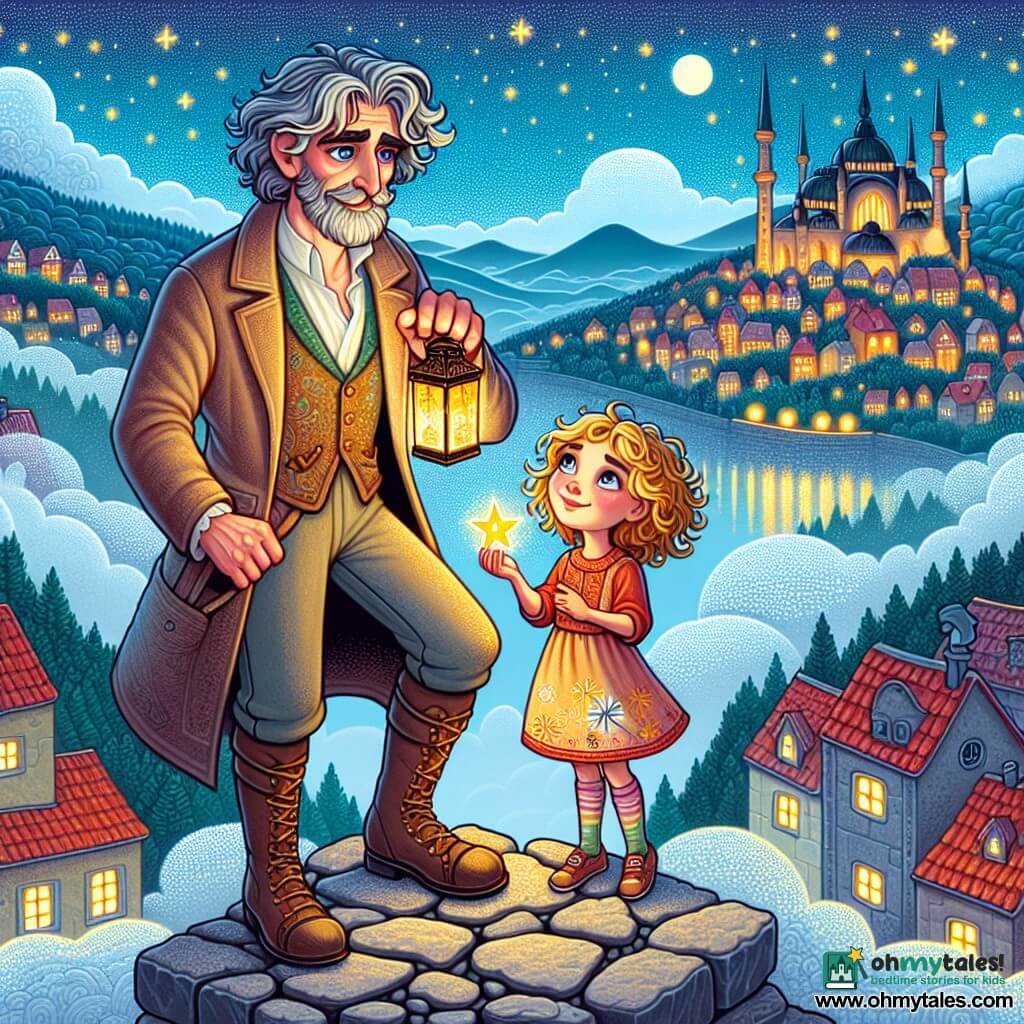
Elias lived where the world leaned toward its dreams. His house sat on a narrow ledge of rock that jutted out from a village of small chimneys and willow bells. Below him the land dissolved into a sea of soft silver fog; above him the sky kept its pale pockets of wandering stars. People said his house was balanced between sleep and waking, and sometimes, when he whistled in the early morning, starlight replied.
He was a tall, steady man with a pocket of quiet in his chest. Those who knew Elias called him faithful because he never missed the hour when the Lantern of Lumen needed tending. The lantern hung from a crooked iron stand outside his door; it was not the kind of lantern that warmed a room or chased away cold—its light did something else. The Lantern of Lumen kept the path of small hopes lit. Travelers who had lost their songs and children who had misplaced dreams often found their way home by its glow. Birds of sadness found a place to roost in its beam until they learned to sing again.
Every evening, when fog came like a soft blanket, Elias would fill the lantern with oil he distilled from the tiny sunflowers he cultivated on his roof. The oil did not burn with flame alone; it burned with memory and care. To tend the lantern was a solemn, gentle work. It required patience, which Elias had like rings hidden beneath his clothes.
Yet beneath his steady hands, a quiet fear lived like a moth—afraid to flutter in daylight. He feared the deep dark places beyond the fog, places where lights went out and did not return. He feared that, one day, his lantern would gutter and leave the paths of dreaming unmarked. This fear followed him like the second shadow that appears on winter evenings.
"Why do you worry, Elias?" his neighbor Marta asked one warm dusk, as they shared a copper pot of tea. "You keep the lantern, and it keeps many things from getting lost."
Elias smiled and stirred his tea with a spoon of moonlight. "Because responsibility is a long path," he said, "and sometimes a long path stumbles in its own footsteps."
Marta tapped his hand. "Then remember: you are not the lantern alone. You are part of its light."
That night, Elias climbed the creaking stairs to wind the lantern's wick, feeling the weight of his promise like a locket against his heart. Outside, the fog drew near, and somewhere beyond the village a low bell tolled the hour when courage and fear meet at the edge of sleep. He blew softly on the flame and watched the light breathe. The world was balanced; for now, the roads of hope glowed faintly where travelers walked.
Deep inside him, though, the moth of worry stirred. He could not yet see the shape of what lay in the deeper night. But he knew, as people who live between two worlds know, that to be faithful is to face what you dread. He closed his shutters with hands that had steadied many things, and he listened to the soft, bright whisper of the lantern as if it were telling him a story of its own.
The Whispering Fog
The fog that winter wore many voices. On some nights it hummed like an old tuba; on others it sighed like a distant sea. It could speak in the voices of those who had once been brave and of those who had once been small, and sometimes it repeated questions that children left unanswered. When the fog rolled over the village like a silk blanket, it carried a hundred forgotten thoughts.
One evening, the fog came with a hush thinner than a secret. It curled its fingers around Elias's doorstep and peered at the lantern with green eyes. "Why do you hold us back from the world?" it whispered—not unkindly, just curious and a little cold. "Why keep light where darkness might learn to be itself?"
Elias opened his door and looked out. The lantern's light made a small pond of gold in the fog. There, in the sheen, shapes swam—kites without strings, a child's lost shoe, a song with only two verses left. The fog made them all appear and disappear like silver fish. Elias took a breath, the air tasting faintly of lilies.
—"Because," he said, "some things need steady footprints. Without them, wanderers fall into places they cannot climb out of."
The fog drifted closer. It was not cruel. It simply wanted to understand. "But if you keep them safe," it said, "how will they learn to walk by themselves? How will darkness ever learn to be less frightening if it is never met?"
Elias thought of his lantern and of the people who had found their way by its light. He thought of the boy who had once returned to his parents after finding the path again, the woman who had relearned to paint, the old clockmaker who woke from his long ache. He had never thought of light as a teacher until the fog gave the word to it.
—"Responsibility is not only shelter," Elias answered softly. "Sometimes it is the hand that lets go at the right moment. I keep the path, but I do not hold on forever."
The fog let out a sound like distant rain and changed shape, growing thinner and more curious. "Then show me," it breathed. "Prove that you can let go."
It was a dangerous thing to be asked, and Elias felt the moth in his chest beat harder than before. The fog drifted away like a curious cat and left a trail of cool white flowers in the footprints it passed. They smelled faintly of lost lullabies.
That night, Elias lay awake and listened to the village breathing. He thought about the lantern again, about how much of his life had been spent tending it. The idea of letting go scared him, but the fog's question became a small brilliant ember in his mind: prove that you can let go. To prove meant to try. To try meant to face fear. His heartbeat, like a small drum in the dark, answered for him.
The Mirror Lake
There was a lake not far from the ledge where Elias lived, though it was not always visible. In autumn it hid beneath a shawl of reeds and soot-colored lilies. In winter it crowned itself with thin ice and the sky's reflection. Locals called it the Mirror Lake because on still days it showed you the person you were holding inside, and sometimes people found truths there like coins along the bottom.
One sharp morning, when the fog had taken off its shoes and left behind a smell of cinnamon, Elias walked to the lake. He carried the Lantern of Lumen upright. The lake's surface lay like polished glass. When he leaned over, his reflection met him: a man with a lantern, hair flecked with silver, eyes like two warm stones.
"Who are you looking for?" a voice asked. The voice belonged to a woman who sat on a fallen log nearby, wrapped in a shawl of paper stars. She was old and young at once, as if she had kept the same smile through every age.
Elias paused. "Sometimes I look for the part of me that is not afraid to let go," he said.
The woman pointed to the lake. "Look deeper," she said. "The lake keeps the names of things. It will tell you your fear if you ask without hiding."
Elias set the lantern on the ground and crouched by the water. His reflection shimmered. For a moment he only saw the surface—his features, the lantern's small halo—but then the lake opened like a book and showed him a flicker of another life: a young Elias, holding tight to a small kite on a stormy afternoon, clamping his jaw to keep his hands from letting go. The kite had torn and flown away, and the young Elias had sworn never to trust wind again.
The image stung with the salt of old regret. Elias remembered the sound of the string slipping and the taste of his failure. He had kept that memory folded like a letter and let it dictate how he held everything he loved. The lantern, the village, even relationships—he had gripped them to keep them near, fearful of loss.
—"You have been planting roots in a pot," the old woman said, her voice like paper rustling. "Roots need soil. They grow when they're given room to search for water."
"But what if the kite leaves and I never see it again?" Elias whispered. The lantern's light made his shadow long and steady on the reeds.
—"Then you will know it once lived," she answered. "Sometimes being responsible is remembering what you love and trusting it to grow alone."
Elias watched the reflection until the kite scene softened into the memory of his parents' hands, of the nursery where his sister had learned to hum. Responsibility, he realized, was both hold and release. The lake showed him what fear had been: a string wrapped too tight around his heart.
He picked up the lantern. Its beam seemed gentler, like a hand stroking a child's hair. The old woman rose and smiled, leaving a coin of moonlight on the log. "Find your courage in the small moments," she said. "A patient heart mends itself by degrees."
Elias walked home with his steps measured, each one an act of careful courage. The moth in his chest had not been banished, but it had grown calm enough to let him breathe. He had looked into the lake and recognized his fear. That was the first work of facing it: to see it clearly.
The Cavern of Echoes
Beyond the village and beyond the lake, in a hollow where the earth kept its secrets, there was a cavern. People rarely spoke of it because it was not a place for passing conversation. The cavern was called by those few who visited it the Cavern of Echoes. Sounds that entered there would come back altered: a child's laughter might return as an old story, a promise might return as a quiet question. Some said the cavern echoed what you feared, so you had to be careful of your step.
Elias felt the pull to go there like a tug at a loose thread. The lantern swung at his side, marking the path like a patient heart. He remembered the fog's question and the lake's mirror—let go and learn; meet your fear and show it mercy. He needed to know what the cavern would echo back from his chest.
Inside, the cavern was cool and smelled of wet paper. Elias's steps made small, deliberate sounds. He called out softly, "I have kept a light for others. What comes back to me?"
For a while, nothing replied but the slow drip of mineral tears. Then the cavern answered with his own voice, but older, frayed at the edges.
"You are only a keeper," it said. "What makes you think you are enough to be brave? You have held before and you have lost. You will be empty."
The words carved themselves into Elias like tiny rivers. He knelt on a stone bench worn by the knees of those who had waited. The lantern warmed his face. "I do not feel enough," he admitted aloud, to the cavern and to himself. "I am small in the great dark."
From the depths came another reply, softer and more particular. It was the voice of the village baker, calling him by name. "Elias," the echo said, and from somewhere beyond the walls came the baker's laughter, the neighbor's cough, the child's prayer. The cavern stitched those borrowed sounds into a cloak of remembrance.
Elias closed his eyes and let them wrap around him. He heard the old clockmaker say, "Some nights I walk to your light and pretend I am whole again." He heard a teenage girl practicing a violin who had once been too shy to play in public, and he heard the distant murmur of a hundred small acts that had bloomed because they had a path to follow.
The cavern answered its own question: bravery need not be a single bright sword. It could be a long, patient weaving of small threads. Responsibility was not weight alone; it was also the pattern that those threads made, and that pattern kept people warm.
—"So you are enough," Elias whispered to himself.
Then the cavern did what it had to do. It echoed back his fear, but softened it with the sound of all he'd saved. "You are afraid of empty hands," it said, "but you are full of many small returns."
Elias left the cavern with his shoulders lightened as if someone had taken a pack from his back. He understood that the echoes were not the judge; they were the ledger. What he carried might one day be returned to the world, altered and changed. That was part of the design. Responsibility asked for patience, not perfection.
The Night of Falling Stars
Autumn collected its leaves like coins, and one evening the sky decided to be generous. Stars began to fall—one after another—soft as moths, glittering like sugar flakes. The village rose in wonder, because when stars fell they sometimes became things: slippers that fit only truthful feet, seeds that bloomed into laughter, notes of music that taught courage.
The Lantern of Lumen's beam brightened as if in greeting. Elias stood on his ledge and watched the stars fall, his lantern humming like a bird. But among the silver shower one star behaved differently. It faltered, turning gray, then sputtering like a candle with its wick snapped. It drifted toward the sea of fog, and Elias saw, with a secret hollowness, that it would be gone unless someone reached it.
"Let it be," said a voice in his head—the moth of fear, old and familiar. "You cannot catch every falling thing."
But there were people below. A child had wide eyes clenched around a question. A fisherman had his boat ready to leave, and the old clockmaker had come out with a cane, trailing a little hope like string. Responsibility braided itself into action.
Elias took the lantern and climbed down the rope ladder that led from his ledge to the lower boardwalks. The fog hugged the rails and smelled like wet wool. The faint gray star bobbed in the fog like a wounded bird. There was no time for carefulness now, only for the steady way of hands that had learned to perform small tasks endlessly.
He guided the fishermen's boat with the lantern's gentle light. The boat moved like a soft thought. Together they reached the star and, leaning over the side, Elias cupped it in his palms. It felt like cold glass and warm earth at once—fragile and full of promise.
—"We can patch it," the fisherman said, his voice a dry net. "We can make it a little brighter."
Elias thought of all the little returns he'd collected in the cavern, the lake, the lantern's light. He thought of the fog's question and the old woman's coin. He put his hand against the star and whispered, "I will be gentle. I will not keep you in my fist. I will hold you while you heal."
He did not seal the star into a box. He mended it with threads borrowed from his own patience—small acts of tending, nights of warming and watching. The fishermen and children sang old songs while Elias worked. The star's light grew steady again, and then the moment came when it wanted to fly. He could have tucked it under his coat, promised never to let such beauty go again, but he had learned at the lake that love keeps itself by letting things grow.
He lifted his hands and set the star free. It shot upward with a damp blue wink and joined the pinned sky. As it vanished, those who had watched felt something loosen in their chests, as if weight had been lifted from a great, invisible table. Elias's hands smelled like salt and trust.
One of the fishermen clapped him on the shoulder. "You did well," he said. "You held without keeping."
Elias smiled, the first full smile he had given in a long time. His fear had not disappeared; it now trembled in the wings of possibility. But each small act had patched its edges. The hairline cracks were still there, yet they did not make the lantern fragile. They made it honest.
Dawn and the Quiet Heart
When the dawn came, it moved like a slow harp, plucking light across the village. The fog withdrew, trailing ribbons of silver, and birds with tiny bellies of song returned to their rooftops. The Lantern of Lumen still glowed faintly, as if it too were waking up after a long dream.
People came to the ledge with pies and bread and shoes mended by the village cobbler. They did not come to congratulate Elias with fanfare; none of this had been a feat to show off. They came because they had a habit of sharing the small, necessary things with one who had given so often of himself. Gratitude is a plain thing, the kind that sandwiches warm bread between two slices of life.
Elias stood at his window and watched the village wake, feeling the weight in his chest—no longer a stone, but a seed that needed tending. He remembered the fog's question, the lake's mirror, the cavern's echoes, and the night when a star nearly slipped from the sky. He had faced his fear in pieces: he had named it, listened to it, cared for what faltered, and then let it fly.
—"You lost something," the old woman had told him once, "and you gained the practice of tending."
He understood now that responsibility had never meant keeping everything wholly. It meant choosing what to guard and when to let the world learn its own steps. It meant being patient until patience ripened into courage.
A child approached the ledge—one who had once found her song again near the lantern. She handed Elias a folded paper boat painted with tiny suns. "For you," she said. "So you remember the hugs your light gave."
Elias accepted the boat and felt warmth in his fingers. He set it on the windowsill beside the lantern. It seemed foolish and perfect, a small monument to simple things.
—"Are you still afraid?" the child asked, curious as children are when they see grown-up things.
Elias looked at the sky where the stars were thinning. He let his hands rest on the iron stand. For the first time in many years, he could speak without the moth quivering his voice. "I am still careful," he said. "But I am no longer afraid that every letting go will end in loss. Some things return in other shapes."
He thought of the clockmaker with his honest hands, the violin girl practicing courage in the attic, the fisherman who had helped him hold a star. The world had folded itself back together with tiny stitches, and he had been one of many threads.
As the morning spread like bread buttered with light, Elias wound the lantern's wick and filled it with oil. The oil had the flavor of memory, of patience, and of care shared rather than hoarded. He set the flame and watched it catch—this time not to conquer darkness but to send a greeting to the day.
Deep inside him, the moth grew quiet. It did not vanish; fears do not disappear in stories that respect truth. But it took up a place beside the ember of courage, both small and warm. Responsibility remained, no longer a burden but a calling answered in a thousand small ways.
People passed by and smiled, and some laid their hands on the iron stand as if to say thank you without words. The village began to bustle in its ordinary way, with laughter and errands and the soft humming of daily life. Elias paused, feeling a gentle peace settle like a shawl over his shoulders.
He had faced the dark, the echo, the mirror, and the storm of falling lights, and he had learned to hold without clinging. The Lantern of Lumen continued its quiet work, tending the paths of small hopes. Elias had kept faith with his promise and discovered that courage can be patient and that responsibility is love wearing a careful face.
At noon, when the sun hung like a coin in the sky, Elias sat on his ledge and listened to the village breathe. His heart felt like an instrument finally tuned. It thudded its steady, patient beat and knew itself to be at home. He had done what he set out to do: he had faced his fears, and in doing so, he had found a quieter heart.
Outside, someone sang a melody that had been lost for years, and a child answered with a laugh. In that small music, Elias heard the whole of the world he had chosen to care for—imperfect, brave, and gentle. He placed his palm on the lantern's iron stand, feeling its warmth, and let a calmness, like morning light, spread through him until it filled him entirely.