Chapter 1: The Castle That Drifted Like a Thought
The floating castle moved as quietly as a white swan gliding across a lake—except its lake was the sky.
Some mornings it sailed through clouds as soft as torn cotton. Other mornings it floated above storms, watching lightning stitch silver seams into the dark. From the ground, people said the castle was only a rumor, a bedtime sparkle. But Elias knew its hallways, its cold stair stones, and the way the towers hummed when the wind brushed them.
Elias was an adult man with calm eyes that missed very little. He did not speak much. He listened, the way a lighthouse listens to waves: steady, patient, always facing the sea.
He was the castle's keeper, and he guarded an ancient promise.
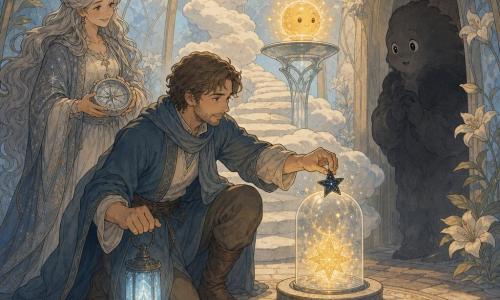
In the highest chamber—where windows curved like the edges of bubbles—there stood a clear glass bell taller than Elias. Inside it lay something that looked like a tiny sleeping star: a pale flame, no bigger than a walnut, with a heart-beat flicker.
Elias called it the Hearthlight.
It had been left here long ago with a vow: When love grows thin in the world, like soup watered down, the keeper must carry the Hearthlight to those who have forgotten how to feel it. Not to force them. Not to scold them. Only to remind them.
He ran his fingers over the bell's smooth surface. The glass felt cool, like morning air before sunrise.
“Not yet,” he whispered, as if the flame could hear. “But soon.”
Down below, beyond the clouds, the world had begun to bruise.
Elias saw it in the small signs. Letters arriving in the castle's mailbox—yes, it had one, enchanted and stubborn—were shorter than before. People wrote fewer kind words. The birds that sometimes followed the castle's shadow had stopped singing, and even the wind seemed to clear its throat more often, as if unsure of the tune.
Then, on an afternoon when the clouds looked like old gray wool, a paper plane sailed up from nowhere and tapped Elias on the shoulder.
It was made from a torn page of a storybook. The ink was smudged by tears.
Elias unfolded it.
There was only one sentence:
LOVE HAS GONE QUIET. PLEASE, SOMEONE—REMEMBER IT FOR US.
Elias closed his eyes. The promise inside him stirred like a waking lion, not roaring, but stretching.
He turned toward the glass bell. The Hearthlight flickered, as if it had been holding its breath.
“All right,” Elias said, softly but firmly. “We will go.”
Chapter 2: The Key That Could Not Open Doors
To travel from a castle among clouds to the ground below, Elias did not need stairs or wings. The castle owned an old elevator made from braided moonbeams and polished wood, and it could drift down like a dandelion seed.
But first, Elias needed the key.
It was not kept in a drawer or hung on a hook. It rested, strangely, in a bowl of water in the kitchen, as if it were a silver fish waiting to be caught.
Elias dipped his hand in. The water was warm, like someone else's hand holding yours in a crowd.
The key lay in his palm: long, bright, and shaped like a question mark.
He carried it to the Hearthlight's chamber. The glass bell had no lock. Instead, a thin line of darkness ran around its base, like a shadow trying to pretend it was a crack.
Elias fitted the key into that line.
The key did not click. It sighed.
The bell lifted as if a gentle giant had raised it. The Hearthlight rose into the air, floating toward Elias as obediently as a firefly that trusts your fingers.
He held out a lantern made of cloudglass, with holes cut in it like tiny stars. The flame slipped inside without burning. Immediately, the lantern warmed, and a faint honey-colored glow spilled onto Elias's sleeves.
The castle responded. Somewhere far below, ropes creaked. Wind chimes sang a shy note.
Elias walked through corridors where paintings watched him go. In one, a smiling queen held a baby and a bouquet of roses. In another, a knight bowed to a dragon who wore spectacles. These were not just decorations; they were reminders: love had taken many shapes here.
At the elevator, a small figure waited.
It was a creature the size of a cat, with moth wings, a scarf made of ribbon, and eyebrows that looked permanently offended. It perched on the railing like it owned the place.
“You're leaving,” it announced, as if Elias had tried to sneak away with the furniture.
Elias nodded. “I have to.”
The creature sniffed. “Of course. When humans forget their hearts, everyone else has to do the tidying.”
“You could come,” Elias offered.
The creature's eyebrows jumped. “Me? On a mission of feelings? I'm allergic.”
Elias's mouth curved, almost a smile. “Then you can be allergic loudly. It might help.”
The creature hesitated, wings trembling like paper in a breeze.
“What's your name again?” Elias asked.
“Huff,” it said, as if the name had been forced upon it by an impatient universe. “Huff the Mothling. And I am not helpful.”
“We'll see,” Elias replied, stepping into the elevator. “Come, Huff. The world is quieter than it should be.”
Huff fluttered in after him, grumbling, “If I get sentimental, I will deny it.”
The elevator began to descend. Clouds slid past, brushing the wooden walls like soft ghosts. The air changed, growing thicker with the smell of wet earth and chimney smoke.
Below, the world waited—its colors a little dim, like a painting left too long in the sun.
Chapter 3: The Town of Closed Windows
Elias and Huff arrived on a hill outside a town where the houses leaned toward each other as if whispering, but the streets were oddly silent.
The windows were closed. Not simply shut—closed like eyes refusing to wake.
A fountain stood in the square, but it did not sing. Its water was still, as if it had forgotten how to fall.
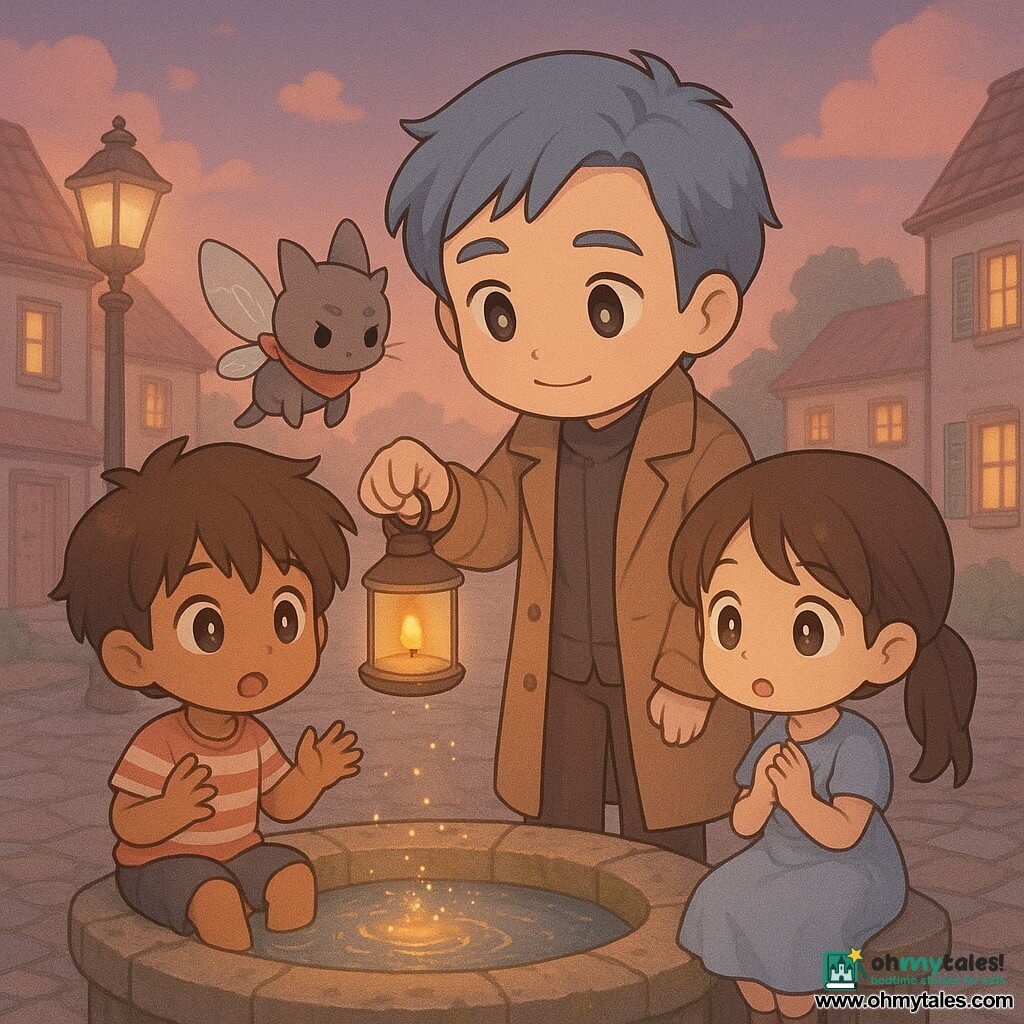
Elias walked slowly, lantern in hand. The Hearthlight inside glowed gently, like a candle trying not to disturb anyone.
Huff hovered near his ear. “See? Everyone's busy being miserable. Efficient, really.”
In the middle of the square, a boy and a girl sat back-to-back on the edge of the silent fountain. They looked about eleven or twelve, old enough to pretend they didn't care and young enough to care fiercely anyway.
The boy kicked a pebble. The girl stared at her shoes as if they had personally betrayed her.
Elias approached with care, like someone nearing a skittish animal.
“Good afternoon,” he said.
The boy glanced up, suspicious. “Are you selling something?”
“Only a question,” Elias replied. “Why is the fountain quiet?”
The girl snorted. “Because nobody makes wishes anymore. What's the point?”
Elias sat on the fountain's edge at a respectful distance. “What happened?”
The boy's shoulders rose and fell. “People used to… you know… be nice. My dad used to laugh. Now he just looks at the floor like it owes him money.”
“And my sister,” the girl said, voice sharp with a sadness she didn't want to show, “stopped hugging me. She says hugs are ‘childish.' Like love has an age limit.”
Huff rolled in the air, dramatic. “Disgusting. I mean—tragic.”
Elias opened his lantern slightly, just enough for the Hearthlight's glow to spill out like warm tea.
The children's eyes widened, not with giddy excitement but with a careful hope, like someone touching a bandaged bruise.
“What is that?” the boy whispered.
“A reminder,” Elias said. “May I show you something?”
He held the lantern toward the fountain. The light fell across the still water. At first nothing changed. Then, slowly, the surface shivered, like a sleeping cat's whiskers twitching.
A single drop rose from the fountain, floating up as if it had changed its mind about gravity.
Then another. Then a stream.
The fountain began to flow, not loudly, but with a soft chuckle, as if it remembered an old joke.
The children stared.
The girl swallowed. “So… people can change back?”
“They can remember,” Elias said. “But the light does not do the remembering for them. It only shows the way, like a lantern in a hallway.”
The boy frowned. “How do we help?”
Elias pointed at their backs—at how they sat turned away from each other.
“Start small,” he said. “Turn around.”
They hesitated. Pride is a heavy coat, and preteens wear it even in summer.
Huff whispered, “This is the part where you do something embarrassing, I bet.”
The girl spoke first, very quietly. “I'm sorry I said your drawings were babyish.”
The boy blinked hard. “I'm sorry I called you bossy.”
They turned and looked at each other. Their faces softened. Not perfect, not sudden, but real.
The fountain's water brightened, catching the lantern's glow. A few nearby windows creaked open, as if the town was peeking.
Elias stood. “Good,” he said. “Now spread it. Not like a rumor. Like bread.”
The boy laughed once—an uncertain sound that quickly became freer. “We can do that.”
As Elias walked away, the square seemed less gray. The Hearthlight flickered happily.
Huff fluttered close. “Don't get smug,” it warned. “One fountain does not make a summer.”
Elias nodded, eyes on the road. “No,” he agreed. “But it makes a beginning.”
Chapter 4: The Mirror Market
Beyond the town, Elias followed a path that curled through fields where the grass lay flat, as if pressed down by invisible hands. The air carried a tired feeling, like a song sung too many times without meaning.
They reached a market set in a valley. Stalls stood like crooked teeth, and above them hung hundreds of mirrors—round, square, tall as doors, small as plates—swaying gently.
A sign read: SEE YOURSELF CLEARLY.
People wandered between the stalls, staring into mirrors with tight mouths. Some frowned. Some preened. Some looked away as if frightened by their own faces.
Huff made a gagging noise. “Ah. The Mirror Market. Where everyone falls in love with themselves or breaks up with themselves. Both are exhausting.”
A vendor with a glittering hat stepped forward. His smile was sharp enough to slice cheese.
“Welcome!” he sang. “Here you can find the truest mirror. It will show you what you deserve.”
Elias lifted his lantern. The warm light touched the mirrors—and the mirrors, strangely, began to darken.
The vendor's smile twitched. “No lights,” he said quickly. “They interfere with accuracy.”
Elias's voice stayed gentle. “Accuracy without kindness is a knife.”
A woman nearby stared at her mirror and whispered, “I'm not enough.” Her reflection nodded eagerly, as if pleased.
A man hissed at his own face, “You should have been braver.” The mirror seemed to lean closer, hungry for his shame.
Elias stepped between them and their mirrors. The Hearthlight glowed, and in its glow the reflections changed. Not into lies, not into flattery—but into fuller truths.
The woman's reflection showed her hands helping a child tie a shoe. The man's reflection showed him standing by a friend in hard weather.
They blinked, startled, as if they had discovered secret rooms inside themselves.
The vendor snapped, “Stop that! They won't buy my mirrors if they feel… decent!”
Huff gasped dramatically. “You mean you're selling misery? I knew it! I smelled it. It smells like old socks and jealousy.”
The vendor reached into his sleeve and pulled out a mirror framed in black iron. It drank the light around it, making the air colder.
“This one shows the world as it truly is,” he said. “Hard. Lonely. Fair.”
Elias looked into the black mirror. At first he saw himself as a lone keeper in a floating castle, holding a small flame against a huge night. The image tried to press on his chest, to make him feel foolish.
Then Elias breathed, slow and steady, like a tree refusing to be rushed by wind.
“I am not alone,” he said.
The Hearthlight flared—not angrily, but bravely. Its glow poured into the black mirror. The iron frame began to sweat, as if it were afraid.
In the mirror, Elias now saw the children by the fountain, turning toward each other. He saw open windows. He saw hands passing bread. He saw a hundred small choices, bright as scattered coins.
The vendor stepped back, blinking. “That's not—”
“That's also true,” Elias said.
He turned the black mirror so the crowd could see. People gathered, cautious at first, then closer. They did not gasp and cheer. They simply exhaled, like someone loosening a tight belt.
A girl in the crowd touched the mirror's edge. “I forgot,” she murmured, “that I've been kind before.”
A boy nudged his friend. “Remember when you stayed up helping me study? That was… actually awesome.”
Huff's wings buzzed, almost like a purr. “Ugh,” it muttered. “Feelings are contagious.”
The vendor, seeing his business crumble, fled into the stalls, vanishing between hanging mirrors like a guilty thought.
Elias did not chase him. Shadows liked to run; love liked to stay.
As Elias and Huff left the valley, the mirrors above the market began to swing more gently, reflecting not just faces but sky and sunlight too. The valley brightened, not because it became perfect, but because it became honest.
Huff floated beside Elias. “So the problem is… people staring too hard at themselves?”
Elias nodded. “And forgetting to look at each other.”
Chapter 5: The Thorn Library
Their road led them to a forest where trees wore thorny vines like angry necklaces. In the center stood a library made of pale stone, its doors wrapped in brambles.
A sign, half-covered by thorns, read: STORIES ARE DANGEROUS.
Huff squinted. “That sign has the energy of a grown-up who hates fun.”
Elias reached toward the door. The thorns trembled, as if recognizing a visitor.
Inside, the library smelled of dust and rain. Bookshelves rose like cliffs. Candles burned with blue flames, giving the room a dreamlike chill.
A librarian sat behind a desk. She wore spectacles and a cloak stitched from old pages. Her hair was white as snowfall on branches.
She looked up. “The keeper from the cloud-castle,” she said, as if she had been expecting him for years.
Elias bowed slightly. “I came because the world's love has grown quiet.”
The librarian tapped a finger on the desk. “Yes. People have begun to fear their own hearts. They prefer simpler things: winning, proving, being right.”
Huff whispered, “I like being right.”
The librarian's eyes flicked to Huff. “Even mothlings.”
Huff choked. “Rude.”
Elias lifted the lantern. “How do we reach those who lock their feelings away?”
The librarian stood and walked to a shelf where the books were bound in thorny covers. She removed one carefully and placed it on the table between them.
“This is the Book of Old Promises,” she said. “It remembers vows people have forgotten.”
Elias opened it. The pages were blank at first—then words appeared, as if written by invisible ink warming under the lantern's glow.
A promise shimmered into view:
I WILL LOVE YOU EVEN WHEN IT IS INCONVENIENT.
Elias felt the sentence land in him like a stone dropped into water—heavy, and full of ripples.
Another promise appeared:
I WILL LISTEN BEFORE I JUDGE.
Then:
I WILL APOLOGIZE WITHOUT MAKING EXCUSES.
Elias looked up. “These are simple.”
The librarian smiled, and the smile was both kind and sad. “Simple is not easy.”
A gust of wind pushed against the windows. The blue candle flames leaned.
The librarian lowered her voice. “There is a place where love is being strangled. The valley of Sighs. People go there to trade their tenderness for safety. They come back protected, yes—protected from joy, too.”
Huff hugged its ribbon scarf tighter. “Sounds like my kind of nightmare.”
Elias closed the book gently. “Then that is where we go.”
The librarian reached under the desk and pulled out a small silver bell, no bigger than a walnut. “Take this,” she said. “If you ring it, the wind will pay attention.”
Elias accepted the bell. “Thank you.”
As they left, the brambles on the library doors loosened slightly, as if they had been listening to the promises and felt ashamed of their own sharpness.
Huff glanced back. “Do you think the thorns will ever go away?”
“Maybe,” Elias said. “Or maybe they'll learn to guard something better.”
Chapter 6: The Valley of Sighs
The Valley of Sighs lay under a sky the color of dull metal. Mist crawled along the ground, curling around ankles like needy cats.
In the center of the valley stood a figure made of shadow, tall as a tower and thin as hunger. Its face was smooth, without eyes or mouth, but it seemed to watch anyway.
Around it, people stood in a line, holding small glowing objects in their hands: tiny flames, sparks, warm little lights.
Their own heartlights.
The shadow figure held out long hands, and as each person stepped forward, it took the light and placed in exchange a gray stone.
People tucked the stone into their pockets and walked away with straighter backs and emptier eyes.
Huff's voice shook, just a little. “That's… not a good trade.”
Elias's calm tightened into something sharper, like a bowstring drawn.
He stepped forward, lantern held high. The Hearthlight inside glowed brighter, as if recognizing a cousin in danger.
A woman in line whispered to Elias, “Don't interfere. It hurts less this way.”
Elias spoke softly. “It hurts less today. And more tomorrow.”
The shadow turned toward him. The mist around it swirled faster.
Elias could not fight it with fists or swords. Love was not that kind of hero.
Instead, he did what he always did: he observed. He listened.
The valley was filled with a sound so quiet most people missed it—a constant, trembling sigh, like the world exhaling through a crack.
The shadow fed on that sound. On giving up.
Elias lifted the small silver bell the librarian had given him.
Huff fluttered close. “What if ringing it makes the shadow angry?”
Elias's eyes stayed steady. “Then at least the wind will know where to come.”
He rang the bell.
The sound was clear and bright, like a drop of water falling into a silent well. The mist paused, as if startled.
Then the wind arrived—not as a storm, but as a swift, purposeful breath. It moved through the valley, pushing the mist aside and stirring hair, sleeves, and the hem of the shadow's darkness.
The shadow stretched taller, trying to swallow the sound. But the wind was stubborn. It threaded between people, touching their faces, their hands, their pockets where the gray stones lay.
Elias opened his lantern fully.
The Hearthlight rose into the air, hovering between Elias and the shadow like a brave little sun refusing to be bullied.
Its glow was not blinding. It was inviting.
The shadow reached for it. The Hearthlight dodged, and as it did, its light spilled across the line of people. Their forgotten heartlights trembled in their palms, answering like birds hearing their own names.
A boy in line stared at the gray stone in his pocket. “This isn't safety,” he whispered. “This is just… numb.”
A man clenched his fists. “I traded away my laugh,” he said, voice cracking. “I thought it made me strong.”
The woman who had warned Elias began to cry, not loudly, but as if tears were finally allowed to exist again. “I miss my daughter,” she breathed. “I miss saying it.”
The shadow shuddered. It grew thinner, as if the wind had found loose threads and pulled.
Elias spoke to the crowd, not shouting, but carrying his words like lanterns held up along a path.
“Your hearts will hurt sometimes,” he said. “That is not failure. Pain is proof you are alive. Love is not a shield that makes life easy. It is a compass that keeps you human.”
Huff, surprising itself, added, “And if you're scared, do it anyway—but do it with someone.”
Several people laughed—small, shaky laughs that sounded like doors unlocking.
The shadow recoiled. Without all the sighing, without the willing surrender, it had little to eat. It tried to gather the mist again, but the wind kept scattering it, playing with it like a kitten with a ribbon.
Elias held out his hand to the people. “Take your lights back.”
One by one, they did. The tiny flames returned to their owners, slipping into their chests as naturally as breath. Color returned to cheeks. Eyes lifted.
The shadow figure shrank, collapsing into a dark puddle that the wind swept toward the edge of the valley, where it seeped into the soil like ink diluted by rain.
The sky above the valley softened from metal-gray to pearl.
Huff landed on Elias's shoulder, trembling a little. “I… may have felt a feeling,” it muttered. “Don't tell anyone.”
Elias's almost-smile returned. “Your secret is safe.”
Chapter 7: The Wind's Song at the Cloud-Castle
When the work was done, Elias did not stay to be praised. Love, he believed, was not a medal; it was a habit.
He and Huff returned to the hill where the elevator waited like a patient rope. As they rose, the world below looked different. Not perfect. Not finished. But brighter in the way a room brightens when someone opens the curtains.
Back in the floating castle, Elias carried the lantern to the highest chamber. The Hearthlight, having traveled and given and warmed, seemed even steadier now.
He placed it once more under the glass bell. The bell lowered with a soft hush, like a blanket settling over a sleeping child.
Huff hovered near the window, staring down at the clouds. “So that's it?” it asked. “We fixed love?”
Elias shook his head. “No one fixes love forever. People forget. People remember. The promise isn't about finishing. It's about returning.”
Outside, the wind circled the towers, brushing them like fingers across harp strings. The castle hummed. The whole sky seemed to lean closer to listen.
Elias opened the window. Cool air poured in, smelling of rain and faraway firesides.
He rang the small silver bell once more, not as a warning this time, but as thanks.
The wind answered by singing.
It sang through the arches and along the stairwells, around the chandeliers and across the sleeping banners. It sang like a story that refused to end in sadness. It sang like a friend knocking on your door at the exact right moment.
And if you listened carefully, the wind's song carried words—simple enough for any heart, old or young, to understand:
“Be gentle when you are strong,
Be patient when you are sure.
For love is not a sudden spark,
But a lantern you learn to carry.
Share your warmth, and it will grow.
Hide it, and the night will feel longer.
Remember: the heart is brave—
Not because it never breaks,
But because it keeps on mending.”
Elias stood very still, letting the song wrap around him.
Below, somewhere on earth, a child turned toward a sister and tried a hug again. A father laughed at a small joke and did not swallow it. A friend listened instead of interrupting. A window opened.
In the cloud-castle, the keeper watched, calm and observant, guarding his promise as the wind continued to sing—softly, endlessly—down all the brightening roads of the world.