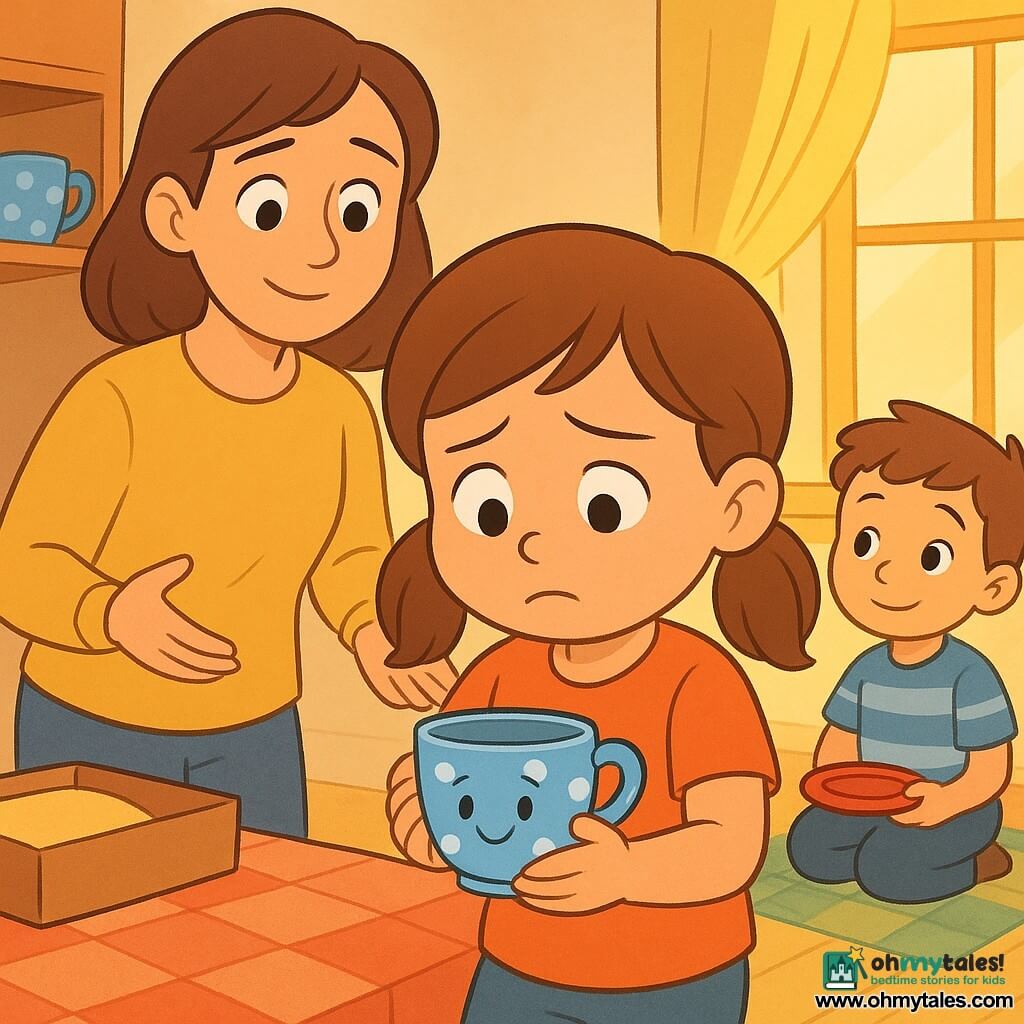
Tilly the little teacup lived on a sunny kitchen shelf. She was blue with tiny white dots. Every morning she watched the window light move across the table. She loved the warm spot where she sat and the quiet clink of spoons.
Tilly had one small habit. When asked if she had any chips or cracks, she would say, "No, I am fine." It sounded quick and easy. Saying it felt safe. Tilly was small and gentle. She did not want anyone to worry.
Mornings were soft at the house. A child named Emma came for breakfast. Emma loved Tilly. She would lift Tilly carefully, wipe her rim, and say, "Good morning, little cup." Tilly liked that. She liked how Emma smelled of orange juice and warm pancakes.
One morning, Emma's friend Sam visited. They planned to make a pretend tea party on the floor. They set a little mat and placed toy cakes on it. Emma chose Tilly for the real tea. Sam watched closely.
"Is she okay?" Sam asked. He pointed to a tiny hairline on Tilly's handle. It was small. It looked like a fine line of light. Tilly felt the question like a soft tickle.
"Yes," Emma said, without looking. She wanted to hurry and pour. Tilly felt the same wish. She did not want to ruin the fun. So she whispered, "I am fine," even though the line made her feel a little wobbly inside.
They poured pretend tea into Tilly. They pretended to sip. They pretended to dunk cookies. Laughter filled the room. Tilly felt warm with play. But inside her glaze a small worry stayed. The line at her handle seemed to watch every move.
Later that afternoon, Emma's mother cleaned the table. She picked Tilly up to wash her. The tiny line felt cooler in the soapy water. Emma's mother looked closely. "Oh," she said, gently. She set Tilly on the counter and spoke to Emma with calm voice. "There is a hairline crack. We should be careful."
Emma felt a tug in her chest. She had said Tilly was fine. She remembered the quick words. Sam had looked worried. Emma had not wanted to worry anyone. She had not meant to upset anyone. She did not know what to do now.
At dinner, Emma sat with her chin in her hands. Tilly watched the quiet. The house hummed and gave soft sounds. Emma's mother sat beside her and asked, "Are you all right?"
Emma took a deep breath. "I said Tilly was fine," she whispered. "But I was scared she might break."
Her mother smiled and nodded. "It is okay to be scared," she said. "Sometimes we say things to make worry go away. We can fix it by telling the truth. People can help."
Emma hugged Tilly carefully that night. "I am sorry," she said, very softly. Tilly felt the apology like a warm blanket. It made her glaze glow a little brighter.
The next morning, Emma and her mother made a plan. They would keep Tilly safe and learn how to care for her. Emma learned to hold Tilly with both hands. She learned to set her down on soft napkins. She learned to tell others when she was unsure.
At the park, Emma saw Sam. She chose to tell him first. "Yesterday I said Tilly was fine," she said. "I was scared and I lied. I am sorry." Sam looked at her. His face changed from small surprise to kind calm.
"Thank you for telling me," Sam said. "I like when you tell the truth. We can help."
They played more. They told each other when they bumped knees or when a toy broke. They practiced saying, "I am sorry," and, "Can you help me?" Saying these words felt soft and right. It made the friendship steady like a quiet song.
At home, Emma's mother found a tiny box with soft cotton. She placed Tilly inside when not in use. "We can keep Tilly safe," she said. "We can also be honest when we feel worried." Emma nodded and hugged the box.
One rainy afternoon, Emma sat with Tilly on her lap and told a story. "I was scared," she said. "I did not know what to say. Now I know I can say, ‘I was scared' or ‘I need help.'" Tilly seemed to nod as if she understood. The tiny hairline stayed, but it was no longer a frightened line. It was a mark of a small lesson learned.
Days passed. Emma practiced being honest in small moments. She said when she had spilled juice. She said when she felt tired. She still sometimes felt the tug to say, "No, I am fine," because it was easier. But when she did, she remembered the warm way she had fixed things with Tilly. She remembered how good it felt when someone helped.
One evening, as the sun set soft and gold, Emma placed Tilly on the shelf. She whispered, "Good night." Tilly looked at the window. She felt safe. She felt trusted.
In the quiet, Emma's mother kissed her forehead. "You did well today," she said. "You told the truth. You asked for help. That makes you strong."
Emma smiled in her sleep. Tilly held the memory of the small crack and the bigger mending. The truth had made a bridge between worry and help. It had brought soft words, warm hands, and care.
And so the little blue cup rested on the shelf by the window. The house was calm. The light moved across the table. Trust grew like a small, steady plant, gentle and sure. Everyone learned that saying the truth could be brave, and that asking for help could make the heart feel at home.