Chapter 1: The Ruins and the Red-Heart Forge
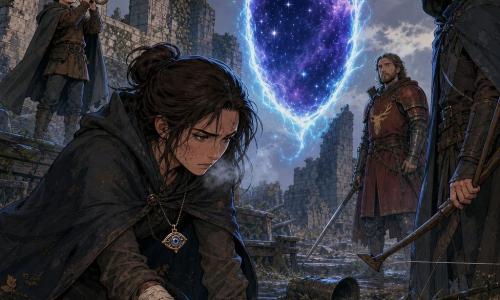
In the province of Greyfallen, the wind never ran out of stories. It rushed through broken towers and roofless halls, through ivy-choked courtyards where old banners had turned to threads. Every ruin looked like it had once been proud—and every ruin looked like it was still listening.
Edrin Voss listened too, but not to the wind. He listened to metal.
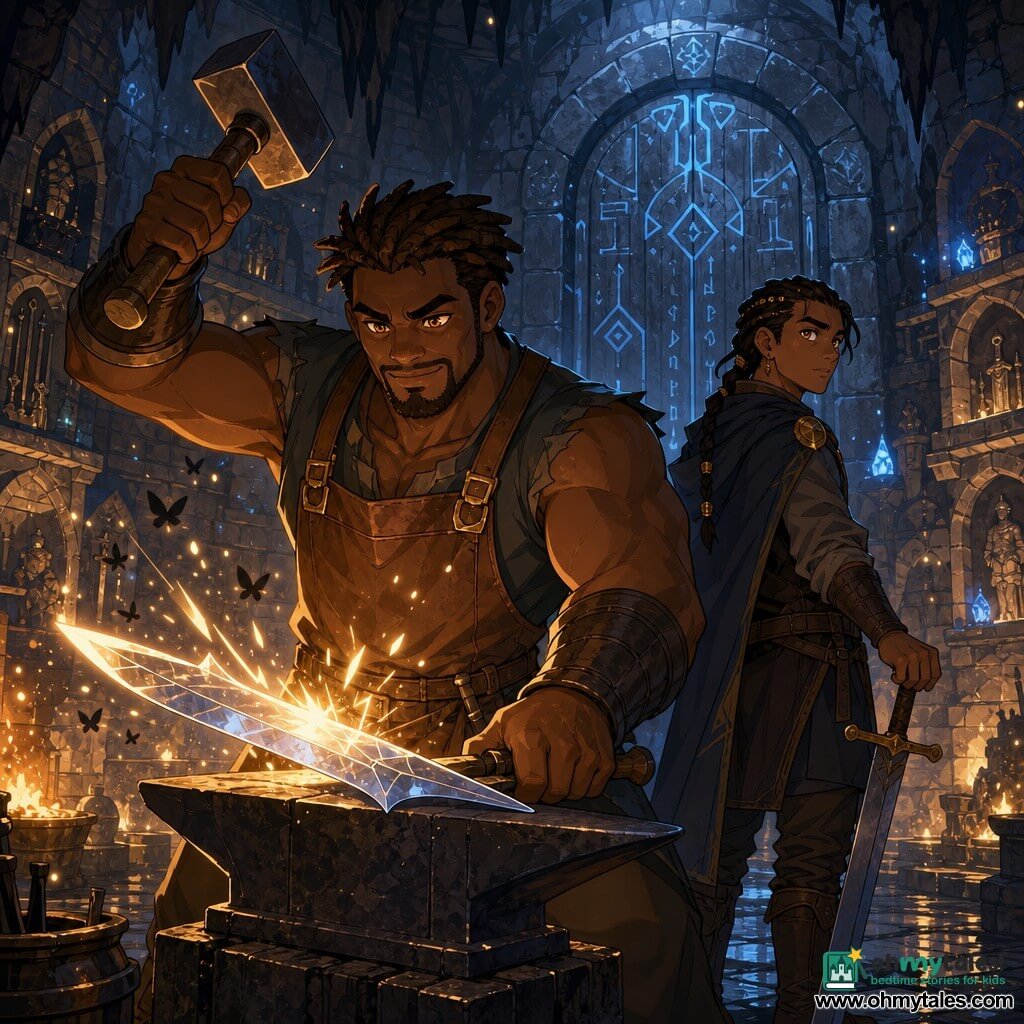
His forge sat in the shadow of Castle Wyrmholt's fallen gatehouse. The castle had been a giant once; now it was a skeleton, and Edrin's workshop was a warm, stubborn heart beating in its ribs. By dawn, his hammer was already talking to the anvil, sharp and steady—clang, ring, hush—like a disciplined drummer calling a march.
Edrin was a careful man. He lined his tongs by size. He counted his nails. He swept ash into a neat crescent before it could scatter. When he spoke, he chose his words like he chose his steel: tested, straight, and true.
Old Mira, who sold onions and gossip at the market, liked to say, “That boy could measure a thunderstorm with a ruler.”
Edrin didn't mind. A forge needed rules. Fire, especially, needed respect.
That morning, the coal in his brazier flared in an odd way—too bright, too clean, as if the flame had been scrubbed. The air smelled not of smoke, but of rain on hot stone. Edrin frowned, wiped his hands on his apron, and leaned closer.
The flames folded inward, forming a small, pulsing hollow. At the center, a spark the color of sunrise hovered like a living bead.
Edrin's breath caught. “That's… not normal.”
The spark drifted upward and pressed itself against his chest. It didn't burn. It sank through cloth and skin as gently as a warm coin slipping into a pocket.
For a moment, the whole forge seemed to inhale. The iron tools on the wall trembled. The anvil gave a low, humming note.
Then the world steadied again—except Edrin's heartbeat, which thudded like a war drum.
He staggered back. “Sacred fire,” he whispered, because every child in Greyfallen had heard the old prayer: When the ember chooses, the chosen must answer.
Outside, the wind shoved at the broken stones of Wyrmholt, making them groan like giants rolling in sleep.
Edrin did the most sensible thing he could think of. He sat down on a crate and stared at his hands as if they might start glowing.
They didn't.
But his palms felt different—alert, as if they knew a secret.
A shadow crossed the open door. Tamsin, the apprentice from the next street, peered in, cheeks red from the cold and from running.
“Edrin! You're needed at the market. A fight—no, not a fight—something worse. Words. There's a man with a chest and a lock he can't open, and he's offering silver.”
Edrin blinked. “Words?”
Tamsin nodded fast. “He says it's a treasure of a word. Like… a word that holds treasure. Everyone's laughing, and he's furious.”
A treasure of a word.
Edrin's careful mind clicked like gears. The province's ruins were full of hidden vaults and sealed doors, but a word? That sounded like the kind of old magic Greyfallen used to have—before its castles fell and its kings went missing.
Edrin stood, feeling the new heat in his chest. “Show me.”
At the market square, people circled a traveler with a battered chest. The chest was iron-banded, the wood dark as river stones. A lock sat on its lid like an eye. No keyhole showed—only a thin slit and a ring of carved letters.
The traveler's beard was braided with copper wire. His cloak was patched and dusty, but his voice was sharp. “I've tried knives, picks, and prayers. The lock takes none of it. It wants the right word. And I don't know it.”
A baker snorted. “Then it's empty.”
“It is not!” the traveler snapped. “Inside is a word that can open more than this box. A word that can unlock what should not be lost.”
Edrin stepped forward. The crowd shifted, making space the way people do for someone who looks like he belongs near dangerous heat.
He studied the ring of letters. They weren't in any language he knew, and yet they tugged at his thoughts like a familiar song heard through a wall.
The traveler saw his gaze and pointed. “You. Smith. You've got a look about you.”
Edrin didn't like being guessed at. Still, his chest was warm, and the warmth seemed to lean toward the chest as if it recognized it.
“What's your name?” Edrin asked.
“Rook of Westrill,” the traveler said. “And before you ask, yes, I've been chased. No, I won't tell you by whom—not in a crowd.”
Edrin nodded once. “I'm Edrin Voss. Bring it to my forge. If there's a word inside, it will have to meet fire.”
Rook's eyes narrowed, then softened—like a blade sliding back into its sheath. “Good. Fire understands secrets.”
As they lifted the chest, the lock's carved letters shimmered faintly, as if waking.
Edrin felt the ember in his chest answer with a quiet, fierce beat.
Somewhere in the ruins above, a stone dove clattered loose and fell, breaking in two—a small warning from a crumbling world.
Chapter 2: The Lock That Listened
Back in the forge, Edrin placed the chest on his worktable and circled it the way a hunter circles a sleeping bear. Rook stood close to the door, one hand near a short sword hidden under his cloak.
“Do you always look like you're about to leave?” Edrin asked without turning.
Rook shrugged. “Do you always look like you're about to argue with the air?”
Edrin almost smiled. Almost.
He heated an iron rod until it glowed orange, then held it near the lock. The metal hissed. The lock didn't.
Edrin tried cold water, then oil, then soot. He tapped the lid, listening. The chest answered with a dull, stubborn thump.
“No keyhole,” he muttered. “No tumblers. It's not built to be forced.”
Rook leaned in. “The letters. They move when you breathe near them.”
Edrin exhaled slowly over the ring. The carved symbols gleamed and shifted, rearranging themselves like a flock of birds wheeling in the sky.
Edrin's eyes widened. “It's listening.”
“To what?” Rook asked.
Edrin's throat felt tight. “To names. Maybe. Or to truth.”
Rook gave a dry laugh. “Then we're both doomed.”
Edrin set his hands on either side of the lock. The ember in his chest pulsed, and warmth flowed down his arms like invisible molten metal. The symbols stilled, waiting.
Edrin spoke, carefully. “Open.”
The letters swam. A harsh sound came from the lock—like a cough.
Edrin tried again. “Unlock.”
The lock clicked once, but not the way a lock should. It sounded… annoyed.
Rook tilted his head. “Maybe it wants a particular word. The word inside?”
“A word can't open itself,” Edrin said automatically.
Rook raised an eyebrow. “In my experience, impossible things do whatever they like.”
Edrin closed his eyes. He imagined the sacred ember as a tiny forge-fire inside his ribs. He imagined it speaking to the lock the way heat speaks to iron: not by shouting, but by changing what something is.
He opened his eyes and leaned closer. “Who made you?” he asked the lock, feeling foolish.
The letters rearranged. Not into a sentence—into a single symbol repeated three times, like a stamp.
Rook sucked in a breath. “That mark. I've seen it in Westrill—on the stones of a collapsed library. They called it the Sigil of Moth-Kings.”
“Moth-Kings,” Edrin echoed, tasting the strange words.
Rook nodded. “Old rulers. Hoarders of knowledge. They believed words were treasures and treasures were words.”
Edrin's hands tightened. “And what did they hoard in this chest?”
Rook's gaze flicked away. “I was hired to carry it. The man who hired me didn't come back from the ruins he sent me into. But before he—before he fell, he said the chest held a word that could open the ‘Vault of Echoes.'”
Edrin's breath fogged in the cool air. “Vault of Echoes is a myth.”
“It's a ruin with a name,” Rook corrected. “Like all myths.”
Edrin looked past the forge door toward the broken castle above. Greyfallen's ruins were scattered like bones. If there was a vault that held something worth sealing with living letters, it would be here.
“What do you want?” Edrin asked.
Rook's mouth twitched, half-grin, half-wince. “To not die poor. Also, to not die.”
Edrin's own desire rose like a steady flame: to open the treasure of a word. Not for greedy glitter. For the certainty of it. For the clean click of rightness. For the feeling that something broken in Greyfallen could be mended.
He nodded once. “We go together. But first, I need to know what the lock wants.”
He lifted a hammer—not to smash, but to tap. He struck the ring of letters lightly, once.
The sound rang clear. The lock answered with a ripple of light.
A voice—thin as smoke, old as soot—whispered from the slit. “Forge-born… flame-chosen…”
Rook stepped back so fast he nearly tripped. “Did it—?”
Edrin swallowed. “Yes.”
The voice returned, stronger. “Bring the word to its door. Speak it where stone remembers.”
Edrin's skin prickled. “Where is its door?”
The lock's letters shifted, forming a map-like pattern—three jagged lines like ruined towers, and a single circle at their base.
Edrin recognized it at once. “The Three Broken Sisters.” Three ruined keeps on the ridge road. At their feet lay a sinkhole cave everyone avoided, because voices there came back wrong.
Rook's face went pale. “The Echo Hollow.”
Edrin's ember burned warmer, as if pleased by danger.
He took a deep breath and did what he always did when a task grew too large: he made a list.
“Food,” he said. “Rope. Lantern oil. A blade. And I'll bring my tongs.”
Rook blinked. “Tongs?”
“If the sacred fire chose me,” Edrin said, “it didn't do it so I could stand around looking surprised.”
Rook stared at him for a heartbeat, then let out a short laugh. “Fine, Forge-lord. Let's go steal a word from a box and argue with a cave.”
Chapter 3: The Road of Fallen Banners
They left at first light. Greyfallen's sky was the color of hammered pewter, but the horizon held a thin promise of gold. Edrin carried the chest wrapped in canvas and strapped to a pack frame. It was heavier than it looked, as if the word inside had weight.
Rook walked ahead, nimble as a cat, scanning the road and the ruins that watched it. Every mile, a broken watchtower leaned toward them like an eavesdropper.
“You really think a word can open a vault?” Rook asked as they crossed a mossy bridge.
Edrin adjusted the straps. “Words open people. Why not stone?”
Rook gave him a sideways look. “That's the most sensible magical thing I've heard.”
They climbed into the ridge road where the wind grew sharper. Old battlefields lay on either side, their grasses flattened in long, pale waves, as if remembering the rush of soldiers.
Near noon, they reached a valley where torn banners still hung from dead trees. Someone had tied them there recently—black cloth marked with a white moth.
Rook froze. “That symbol again.”
Edrin's hand slid to the knife at his belt. “Who uses it now?”
Rook's jaw tightened. “The Moth Court. Thieves dressed as scholars. Scholars dressed as thieves. Either way, they want old words.”
As if summoned by his sentence, figures rose from the tall grass. Not many—five, maybe six—but they moved with calm confidence. Their cloaks were grey and their masks were pale, painted with moth wings. Each carried a short bow.
The leader stepped forward and spoke in a voice that sounded like parchment tearing. “Hand over the chest.”
Rook's hand hovered near his sword. “No.”
The leader tilted his head. “Then you will be unmade by your own curiosity.”
Edrin felt the ember flare, hot and steady. He stepped beside Rook, planted his feet, and lifted his hammer from his pack—a blacksmith's hammer, scarred and honest.
“I don't like threats,” Edrin said. “They're inefficient.”
The leader's bow rose. “Last chance.”
Rook muttered, “I was hoping for a quiet walk.”
Edrin glanced at the fallen banners, at the ruined land that had already swallowed so many brave people. He thought of Greyfallen's broken castles, waiting. He thought of the chest's whisper: Speak it where stone remembers.
He made his choice like he made a blade: with a clean strike.
“Now,” he said.
Rook hurled a small pouch to the ground. It burst in a cloud of pepper-dust. The Moth Court coughed, blinking. Edrin charged.
An arrow hissed past his ear. Another struck his pack frame and stuck there, quivering.
Edrin swung his hammer—not wildly, but with the controlled force of a man who knew exactly where metal would yield. He slammed the leader's bow aside, then struck the ground. The impact sent a jolt through the stone, and for a blink the sacred ember's heat spilled outward.
The air shimmered. The grass nearest his hammer browned as if kissed by summer. The Moth Court staggered, surprised by invisible force.
Rook darted in, quick as a shadow, knocking bows from hands, cutting straps, tripping knees. He didn't fight like a knight. He fought like someone who had learned to survive.
Edrin took a hit on the shoulder—a glancing arrow that tore cloth and bit skin. Pain flared, bright and sharp. He grunted but didn't slow. His world narrowed to movement, breath, and the steady roar of fire inside him.
“Fall back!” the leader rasped, and the masked figures retreated, melting into the grass like smoke.
Silence rushed in, loud after the struggle.
Rook panted, pushing hair out of his eyes. “You—did you just… cook the ground?”
Edrin pressed a hand to his shoulder wound. It bled, but not badly. “I struck stone,” he said, as if that explained everything.
Rook stared. “The sacred fire likes you.”
Edrin's voice softened. “Or it's using me.”
They moved on, faster now. The banners flapped behind them like warnings.
By evening, the Three Broken Sisters rose on the ridge—three ruined keeps, jagged against the sky, their stones blackened by old lightning strikes. At their feet, the earth fell away into a dark sinkhole surrounded by pale rocks. Cold air breathed out of it, smelling of damp and distant thunder.
Rook stood at the edge and swallowed. “Echo Hollow.”
Edrin shifted the chest on his back. The lock hummed faintly, as if excited.
Edrin looked down into the darkness and felt Greyfallen looking back.
Chapter 4: The Echo Hollow
They lit lanterns and descended by a narrow path that spiraled into the sinkhole. The walls were slick stone veined with quartz that caught the lantern light and threw it back in sharp, silver flashes. Water dripped steadily, like a patient clock.
At the bottom, a tunnel opened into a wide cavern. The ceiling vanished into shadow. Stalagmites rose like frozen teeth. Their footsteps echoed, but not quite right—each sound returned with an extra syllable, like the cave was adding its own opinions.
Rook whispered, “Hello,” and the echo came back: “Hello… hollow… follow…”
He scowled. “I hate that.”
Edrin set the chest down on a flat stone. The lock's letters glimmered, crawling around the ring like tiny, bright insects.
“Stone remembers,” Edrin murmured. “So where is the door?”
The cave answered first. A low, rolling sound traveled through the ground.
Rook stiffened. “That wasn't us.”
From the darkness ahead, something moved—slow, heavy, scraping. A shape emerged into lantern light: a creature like a bear made of stone, its back jagged with shards, its eyes two dull crystals. It sniffed the air as if smelling fear.
Rook's hand went to his sword. “Please tell me that's friendly.”
Edrin lifted his hammer. “Nothing made of stone in a cave is friendly.”
The stone-bear lumbered forward. Each step shook grit from the ceiling. It opened its mouth, and the sound that came out wasn't a roar—it was a grinding chorus of echoes.
Edrin's mind raced. Hammer, heat, shape. Fire could crack stone, but in a cave, a collapse could kill them both. He needed precision.
“Rook!” he called. “Draw it to the left. I need a clear strike on its leg.”
Rook didn't argue. He darted sideways, shouting, “Hey! Overgrown pebble!”
The stone-bear turned, annoyed, and swiped. Rook rolled under the swing and popped up behind a stalagmite, breathing hard.
Edrin ran in. The ember in his chest blazed, and his arms felt strong and light at the same time. He swung his hammer into the creature's front leg—once, twice—aiming for the same spot, the way you tap a chisel until a clean line appears.
On the third hit, the stone fractured with a sound like a bell splitting. The bear stumbled.
Edrin pivoted, struck again, and the leg snapped. The creature crashed to the ground, shaking the cavern.
But it wasn't dead. Its crystal eyes flared, and the cave's echoes gathered, layering and stacking until Edrin's own breathing came back to him as a chant: breathe… seethe… leave…
The stone-bear's broken limb began to knit, stones crawling toward each other like insects.
“It heals!” Rook shouted.
Edrin's thoughts grabbed a single idea: stone can heal, but glass shatters. Heat turns sand to glass. Heat could change it.
He thrust his hammer head into the lantern flame and held it there until it darkened, then lifted his other hand toward the creature. The ember surged, and heat poured out—not a wild blast, but a focused stream like bellows feeding a forge.
The air wavered. The bear's cracked leg glowed faintly, the stone reddening. The healing slowed, confused.
Edrin struck once more. The heated stone shattered into glittering fragments, half-glass, half-rock.
The stone-bear let out a grinding wail and collapsed, its body slumping into a pile of rubble. The crystal eyes dimmed to ordinary stones.
Rook stared at Edrin. “You just tempered a monster.”
Edrin's chest hurt, not from the fight, but from the effort of channeling that heat. He swallowed the metallic taste in his mouth. “It's still stone,” he said. “Stone follows rules.”
The echoes returned, softer now, like the cave was disappointed the entertainment was over.
They moved deeper. At the far end of the cavern, the floor rose into a natural archway. Beyond it stood something that did not belong to nature: a door carved into the rock face, tall as a giant, covered in the same shifting letters as the chest's lock. No handle. No hinge. Just words etched so densely they looked like scales.
Rook breathed, “That's it.”
Edrin set the chest before the door. The lock's letters spun faster, bright as fireflies. The slit widened slightly, and the whispering voice returned.
“Forge-born… flame-chosen… bring forth the treasure.”
Edrin's hands trembled. Not from fear—though fear was there—but from the weight of the moment. He had wanted to open the treasure of a word for so long it had become a quiet ache. Now the ache stood in front of him, shaped like a door and a promise.
“How?” he asked.
The lock's letters aligned into a single, clear shape. The slit opened.
Inside the chest, something stirred. Not gold, not jewels—light, folded tight. It seeped out like a ribbon made of dawn.
A word rose into the air, not written, not spoken yet—waiting to be claimed.
Rook whispered, awed, “It's… beautiful.”
Edrin reached out. The word settled onto his tongue like a snowflake that didn't melt.
He knew it at once, the way you know the right note in a song.
The door waited.
Rook leaned close. “What is it?”
Edrin's voice came out low and steady. “I can't tell you yet. If I speak it wrong… if I waste it…”
The cave echoed: waste it… taste it… face it…
Edrin took a breath. “Stand back.”
He faced the door. He felt the ember in his chest, the sacred fire that had chosen him—not to destroy, but to shape. The word was a blade and a key and a promise all at once.
He spoke it.
The sound was clear as hammered silver: “Unbar.”
For a heartbeat, nothing happened.
Then every carved letter on the door lit up, bright as a sunrise trapped in stone. The cavern filled with a deep, ringing note, and the door slid open without a whisper, as if it had been waiting for centuries just to move.
Beyond it, darkness waited—thick, velvet-dark—and within that darkness, something breathed, slow and immense.
Rook's hand found Edrin's sleeve. “Do we go in?”
Edrin's answer was the steady beat of his heart.
“Yes.”
Chapter 5: The Vault of Echoes
Inside the vault, the air was warmer, dry as old paper. Their lantern light fell on walls lined with shelves carved directly from stone. Thousands of objects rested there—not treasures that glittered, but treasures that mattered: scrolls in clay tubes, metal plates etched with maps, small wooden boxes sealed with wax, and stones with single runes carved into them like names.
“The Moth-Kings weren't joking,” Rook murmured. “They collected meaning.”
Edrin stepped carefully, as if afraid to crack the silence. The echoes here were different. Softer. Respectful. Their footsteps returned as gentle reminders.
On a pedestal in the center stood a single item: a sword blade, unfinished. No hilt, no guard—just a length of pale metal that seemed to drink the lantern light. It looked like moonlight made solid.
Edrin's throat tightened. He knew metal, and he had never seen metal like this.
Rook circled the pedestal. “Is that… for you?”
Edrin didn't answer. His hands moved on their own, hovering over the blade without touching. The sacred ember in his chest burned with a steady, approving heat, like a master smith watching a student finally find the right steel.
A voice drifted from the shadows. Not the lock's whisper—this was deeper, layered with many tones.
“Flame-chosen,” it said. “Why do you seek the treasure of a word?”
Rook spun, sword half-drawn. “Who's there?”
From behind a shelf, a figure emerged, tall and wrapped in robes patterned with moth wings. Unlike the bandits outside, this one wore no mask. His face was pale and sharp, his eyes dark and shining like wet ink.
“The Moth Court,” Rook hissed.
The man inclined his head. “Archivist Sable. I have been following my property.”
Edrin stepped between Sable and the pedestal. “This vault belongs to Greyfallen.”
Sable smiled, thin as a paper cut. “Greyfallen lost the right to its secrets when it let its castles crumble.”
Rook's voice went tight. “We were attacked on the road. That was you.”
Sable shrugged. “They are impatient. I am not.”
Edrin felt anger spark—hot, quick—but he forced it into order. “You can't take what's sealed by sacred fire.”
Sable's gaze slid to Edrin's chest, as if he could see the ember through bone. “Sacred fire chooses tools. Tools can be… borrowed.”
The vault's echoes stirred, uneasy.
Sable lifted one hand. Behind him, more figures stepped out—three, then four—bows ready, blades drawn. They had found another entrance, or they had hidden in the dark like stains.
Rook muttered, “So much for quiet.”
Edrin's eyes flicked to the unfinished blade on the pedestal. It called to him with a silent pull. He didn't know why—only that it belonged in a forge, under a hammer, made complete.
Sable followed his glance. “Ah. The Echo Blade. Forged once, unfinished by a king who died mid-sentence. It can cut through lies, they say. A fine prize.”
Edrin's mind snapped into clarity. “This is why you wanted the word. ‘Unbar' opens the vault. But the treasure isn't the word itself—it's what the word can reach.”
Sable's smile widened. “Clever. Now step aside.”
Rook raised his sword fully. “No.”
Sable sighed, almost bored. “Then we do this the ugly way.”
The Moth Court advanced.
Edrin planted his feet and lifted his hammer. The ember surged, and the metal head grew warm in his grip. He didn't want to bring fire into a vault of ancient knowledge. But he wouldn't let Sable take it either.
Rook moved like a flicker, slashing at a bowstring, kicking a knee. An arrow grazed his sleeve. He swore—quick and quiet.
Edrin met the first attacker with a hammer strike to the forearm. The man yelped, dropping his blade. Edrin didn't chase. He guarded the pedestal.
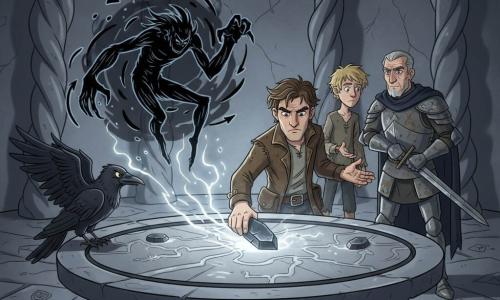
Sable watched, then spoke a single word in a language that tasted like dust. The shadows near the shelves thickened, gathered, and rose into shapes—moths, enormous and made of darkness, their wings beating without sound.
They swooped at Edrin and Rook, blotting lantern light. Cold brushed Edrin's face, a chill that tried to smother the ember in his chest.
Edrin gritted his teeth. “No,” he growled, and fed the ember with breath the way he fed a fire with bellows. Heat flared from him in a ring, not scorching the shelves, but pushing back the shadow-moths like sunlight pushing through fog.
The moths shrank, fluttered, and vanished.
Sable's eyes narrowed. “Impressive.”
Edrin's shoulder wound throbbed. His arms ached. He could not fight forever.
His gaze snapped to the Echo Blade again.
A plan formed—bold, risky, and very unlike him.
He grabbed the unfinished blade with both hands.
It was cold, but not dead-cold. It felt like holding a promise.
The vault's echoes swelled, as if holding their breath.
Sable's voice sharpened. “Put it down.”
Edrin didn't.
He lifted the blade like a bar of raw steel. He raised his hammer in his other hand.
Rook stared. “Edrin, what are you doing?”
“Finishing it,” Edrin said, and struck.
The sound rang through the vault like a cathedral bell. Sparks burst—not orange sparks, but pale ones, like tiny stars.
He struck again. And again.
With each blow, the blade changed. Lines appeared along it like writing, then faded, then reappeared in new patterns. The metal seemed to drink the sound and shape itself from it.
The echoes themselves were feeding the forge-work.
Sable stepped forward, furious now. “Stop!”
Edrin struck one last time, and the blade sang—a clear note that cut straight through the air.
The unfinished sword was unfinished no longer. A hilt formed from light, coiling around Edrin's grip like a vine of silver. A guard blossomed like a tiny crescent moon.
Rook let out a breath. “Wow.”
Edrin didn't have time to admire it. Sable lunged, reaching for the sword.
Edrin swung.
The blade didn't cut flesh. It cut something else.
Sable's shout turned into a stutter. The words he tried to speak fell apart, unraveling into meaningless sounds. His shadow-magic snapped like a thread pulled too hard.
He clapped a hand to his throat, eyes wide with shock.
Edrin pointed the sword at him. “Leave,” he said, voice steady as iron. “And take your moths with you.”
Sable backed away, rage trembling in his jaw. He gestured, and his followers retreated with him, dragging the injured man. Before he vanished into the darkness, Sable hissed, brokenly, “You… don't… understand… what you've opened.”
When they were gone, the vault fell silent again.
Rook leaned on a shelf, panting. “Please tell me you understand.”
Edrin stared at the sword in his hands, its pale light washing his fingers. He felt the sacred ember steady, like a fire settling after a storm.
“I understand one thing,” Edrin said quietly. “Greyfallen's ruins were not meant to stay empty.”
He looked at the shelves, at the collected meaning of a lost age.
And he knew their work was only half done.
Chapter 6: The Word That Stayed
They didn't take everything. Edrin refused.
“We are not thieves,” he said when Rook eyed a tube sealed with gold wax. “We're… caretakers.”
Rook snorted. “That's a fancy way to say ‘poor.'”
Edrin gave him a look.
Rook lifted both hands. “All right, all right. Caretakers.”
They chose only what they could carry without greed: a map plate etched with the province's hidden wells and safe roads, a small book of herbal cures for winter fevers, and a bundle of blank vellum—because Edrin had a sudden, fierce belief that Greyfallen would need to write new stories, not just read old ones.
And the Echo Blade, of course, which Edrin wrapped in cloth like a newborn.
Before leaving, Edrin turned back to the chest. It sat open now, its lock quiet.
Rook touched the rim. “So the word is gone?”
Edrin shook his head. “No.”
He closed his eyes and listened inward. The word “Unbar” was still there—not as sound, but as understanding. It had become part of him, like a tool you carry so long your hand remembers it even when it's set down.
“The treasure of a word,” he murmured, “is that it can be used… and still remain.”
The vault's echoes returned his sentence as a blessing: remain… remain… remain…
They climbed out of Echo Hollow under a sky scattered with stars. The night air tasted of pine and cold stone. The Three Broken Sisters stood above them like guardians with missing faces.
On the ridge road, Rook walked beside Edrin instead of ahead.
“I've been thinking,” Rook said, voice quieter than usual. “About what Sable said. That we don't understand what we opened.”
Edrin adjusted the pack. “He wanted to scare us.”
“Maybe,” Rook admitted. “But… opening old vaults wakes old problems.”
Edrin looked toward the distant silhouette of Wyrmholt's ruined gatehouse. His forge would be dark now, waiting. Greyfallen would be sleeping—children curled under blankets, adults worrying in silence, the province holding its breath for spring.
“Then we will be awake,” Edrin said.
Rook glanced at him. “You always talk like you're carving stone.”
Edrin's mouth twitched. “And you always talk like you're throwing stones.”
They walked, and the road felt less lonely.
By dawn, they reached Wyrmholt. The broken castle looked different after the vault—not less ruined, but less hopeless, as if its stones had heard a rumor of purpose.
Edrin returned to his forge and set down the map plate and the book and the vellum with careful hands. Then he unwrapped the Echo Blade and laid it on his anvil.
The sacred ember in his chest pulsed, warm and steady.
Rook lingered in the doorway. “So what now, Forge-lord?”
Edrin stared at the sword's pale sheen. Outside, the wind threaded through the ruins, whispering, always whispering.
“Now,” Edrin said, “we rebuild what can be rebuilt. We guard what should be guarded. And we teach Greyfallen to speak again.”
Rook scratched his chin. “That sounds like a lot of work.”
“It is,” Edrin agreed.
Rook grinned, and it was a real grin this time—bright, a little crooked, full of stubborn life. “Good. I get bored easily.”
Edrin picked up his hammer. Not as a weapon, but as himself.
He struck the anvil once, a clean ringing note that filled the forge and spilled out into the ruined stones beyond—an announcement to the province, to the wind, to the sleeping castles.
The sound seemed to say: We are here.
And somewhere deep under Greyfallen, behind doors made of words, the old echoes answered—no longer mocking, no longer lonely.
Only listening. Only waiting for what the living would dare to shape next.