Chapter 1: The Road of Split Banners
The duchy of Larkspur looked peaceful from far away—rolling wheat, neat villages, rivers that shone like ribbons. Up close, it was stitched together with arguments.
Every hill carried a different banner. The Red Stag claimed the south roads. The Silver Pike guarded the bridges. The Black Thorn watched the forests and pretended not to watch the people who lived there. When the wind changed, the flags snapped at one another like angry tongues.
Mara Vell had learned to read those tongues the way other folk read clouds.
She rode a sturdy chestnut mare named Bramble, her mail shirt hidden under a dark riding coat, her satchel packed with wax seals, ink, and a small wooden box of letters tied in twine. Across her back lay a long leather case that held her postmaster's horn—and, tucked beside it where no one would notice unless they were looking, a short sword with a nicked edge.
It wasn't a knight's blade. It was a blade that had been used, and used again.
Mara's job was simple on paper: carry messages between scattered stations, keep routes open, keep the duchy speaking even when it wanted to shout. She was an itinerant postmaster, the sort of person who arrived at a gate and made even the proudest guards remember they had a mother who once waited for news.
Still, today the road felt wrong.
The air had the sharp taste of lightning without a storm. Bramble's ears kept flicking toward the treeline. And the shadows between the oaks seemed deeper than the daylight should allow.
At the last bend before the village of Harth, Mara saw a boy sitting on a milestone, knees hugged to his chest. He looked about twelve, hair like a messy crow's nest, cheeks smudged with soot. A small parchment tube dangled from his belt on a string.
He jumped up when she approached. “Are you Mara Vell? The road-post?”
“I'm Mara,” she said, slowing Bramble. “And you're trying to decide whether to run.”
“I'm trying to decide if you'll listen,” he blurted.
Mara dismounted, because people listened better when you met them on the ground. “Talk.”
The boy's eyes were bright with fear and excitement, like someone who'd stolen a pie and found a dragon in the pantry. “The sky tore last night. Near the old chapel by Foxbarrow. I saw it. It was like… like someone ripped a curtain.”
Mara kept her face calm. “You didn't see a tear in the sky.”
“I did!” He grabbed the parchment tube and thrust it toward her. “And the station-master in Harth wrote to you. He said you'd know what to do.”
Mara took the tube. The seal was stamped with the winged boot of the postal riders. Official. She broke it with her thumb.
Inside was one tight page of ink.
Mara—
Not a riot, not a raid. Something worse. A breach at Foxbarrow Chapel. Lights like cold fire. A voice in the wind calling names that aren't ours. I've sent the boy, Jory, because no one else will run that road. The banners are already blaming each other. If you have ever believed the old warnings, believe them now.
—Tamsin, Harth Station
Mara folded the letter, slow and careful. She could feel Jory watching her like a dog watching a hand for crumbs.
“How big?” Mara asked.
Jory swallowed. “Big enough that I could see stars inside it. But they weren't our stars.”
That settled it. Mara's pragmatism was not the sort that denied trouble. It was the sort that packed rope before the flood arrived.
“Do you know the path to Foxbarrow?” she asked.
Jory nodded quickly. “Yes. I— I can show you.”
“You will,” Mara said. “But first you'll eat.”
He blinked. “Eat?”
Mara pulled a heel of bread from her saddlebag and a strip of dried apple. “Heroic deeds are hungry work. And if you faint on me, I'll be very cross.”
Jory grinned, half relieved, half amazed. He ate as they walked Bramble down the narrow trail that cut toward the chapel ruins.
Above them, banners fluttered on distant hills. The wind tugged them all in different directions.
Mara looked at the boy and said quietly, “If this is what I think it is, the duchy's squabbles will seem like children arguing over a pebble while the river rises.”
Jory chewed and whispered, “Can you… fix the sky?”
Mara's mouth tightened into something like a smile. “I can try. And I can promise this: I won't leave you alone with it.”
Chapter 2: Foxbarrow Chapel and the Cold Fire
Foxbarrow Chapel had once been a small stone building where shepherds lit candles for safe lambing and kind weather. Now it was a broken tooth on the hill: half its roof gone, ivy crawling over the walls, the bell tower leaning as if it had grown tired of standing.
The path up was steep. Bramble snorted, hooves sliding a little on the loose gravel. As they climbed, Mara heard a sound that didn't belong: a faint humming, like a song remembered wrong.
At the top, the air changed. It was colder, but not with winter's honest chill. It was the kind of cold that made your thoughts feel brittle.
Jory's voice shrank. “There. In the doorway.”
The chapel door was gone. Inside, sunlight should have poured through the ruined roof. Instead, the light bent strangely, as if the world inside the chapel were underwater.
And in the middle of the cracked stone floor, between toppled pews, hung the tear.
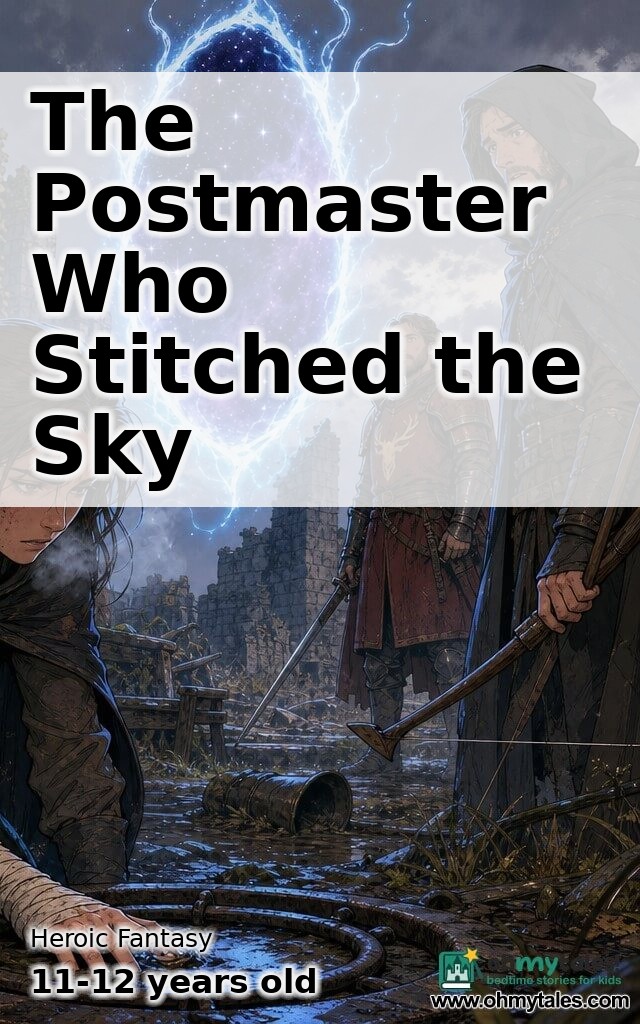
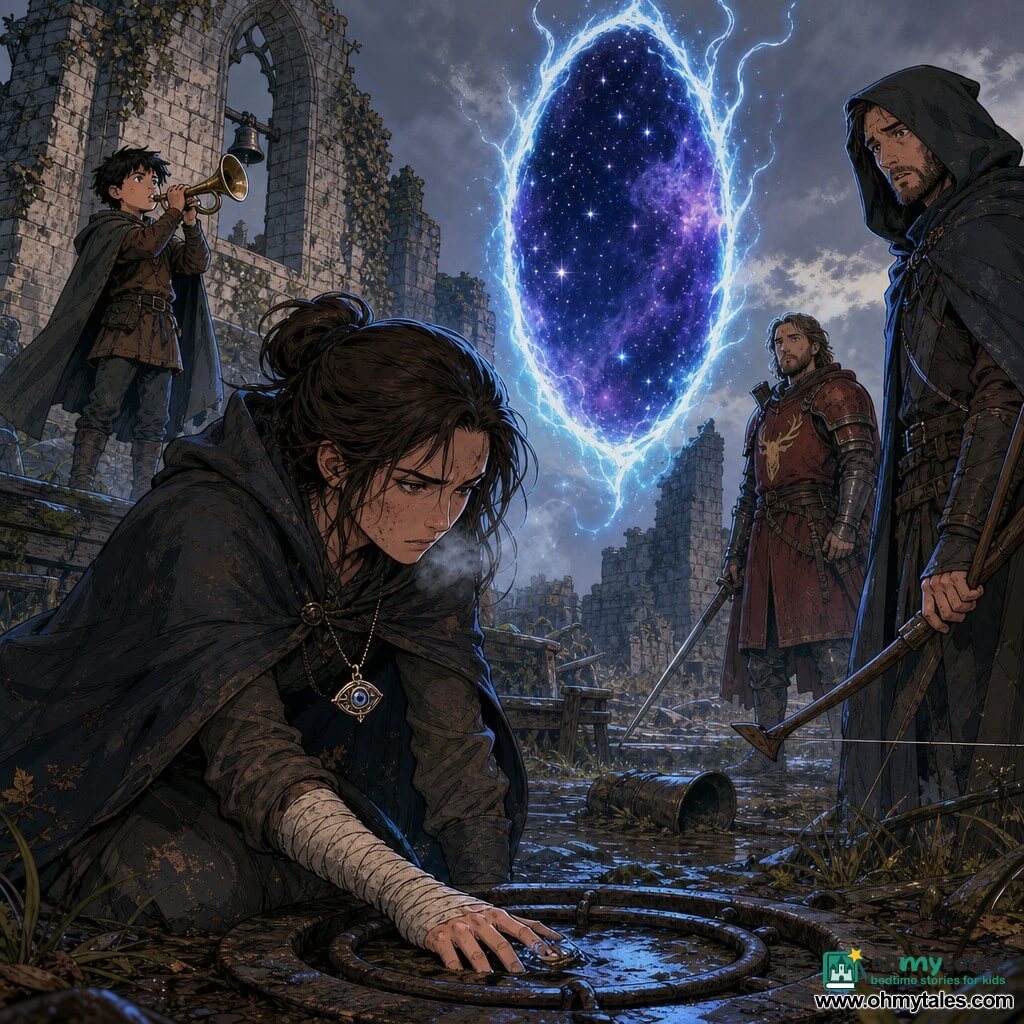
It was an oval gap, taller than Mara and narrow as a doorway, floating a handspan above the ground. The edges flickered with pale blue fire that made no smoke. Within it was not darkness, but depth—stars, swirling clouds of color, shapes that slid away when she tried to focus.
Mara's skin prickled.
“Bramble,” she murmured, and the mare backed away at once, wise enough to obey fear. Mara tied her to a thorn bush outside and ran a calming hand down her neck. “Stay. You're a good girl.”
Jory hovered behind Mara like a shadow trying to be brave. “It spoke last night.”
“Did it?” Mara asked, stepping toward the chapel entrance.
“Yes. Like— like someone calling across a field. But the field was the whole sky.”
Mara drew a small iron charm from her pocket, shaped like a closed eye. She had inherited it from her predecessor, an old postmaster who had died with boots on and secrets in her teeth.
The charm warmed in Mara's palm. That, more than anything, told her the truth.
She took one step into the chapel.
The humming sharpened into words.
Not words she knew—yet they scratched at her mind, trying to become meaning. For a heartbeat she smelled strange scents: metal and flowers and a rain that fell upward. She saw, or thought she saw, a city made of glass bridges, and a river flowing through the air.
Then the tear flared, and a shape moved within it.
Jory gasped. “Mara!”
Mara's hand went to her sword.
A creature slid out as if squeezing through cloth. It looked like a wolf made of moonlight and ash, its fur drifting like smoke. Its eyes were too bright, like coins left in snow. Around its neck hung something that did not belong on a monster: a broken red ribbon, the kind tied to a child's wrist at fairs.
The creature sniffed the air, then turned its head toward Mara.
It spoke, and this time the sound was clear enough to understand, though it made her teeth ache.
“Post… master.”
Jory squeaked, “It knows you!”
Mara didn't lower her blade. “Who sent you?”
The wolf-thing's ears twitched, as if listening to voices far away. “The seam is open. The quarrel makes it thin. Many will come.”
Mara's stomach dropped. “Many?”
The creature took a step forward, paws silent on stone. Its body shimmered, as if it were only half convinced it belonged here. “Close it. Or the banners will drown.”
Mara's mind raced through every rumor she'd ever carried along the roads: old tales of rifts where grief or greed tore the world; warnings carved under station benches; the secret line in the postal oath that no one recited aloud.
Keep the roads. Keep the words. Keep the worlds apart.
She tightened her grip on the sword. “How do I close it?”
The wolf-thing's eyes fixed on the iron charm in Mara's hand. “With the Eye that Sleeps. With a vow spoken true. With blood willingly given.”
Jory made a small choking sound. “Blood?”
Mara glanced at him. The boy's face had gone pale, but his feet stayed planted. That mattered.
Mara turned back to the creature. “Is there another way?”
The wolf-thing shook its head slowly. “Not in time.”
Mara hated vague answers. She hated prophecy even more. But she could see the edge of the tear pulsing, like a wound that couldn't stop bleeding.
Outside the chapel, somewhere beyond the hill, horns sounded—distant, angry. The banners had noticed.
Mara said to Jory, “Go. Run to Harth. Tell Tamsin to bar the station doors and keep people indoors.”
Jory's voice trembled. “I'm not leaving you.”
“You are,” Mara said, gentle but firm. “Because if knights come charging up here, they'll try to stab the sky and blame each other for the blood. You're quicker than any banner-lord. Go.”
He hesitated, then nodded, jaw clenched. “Don't die,” he whispered, as if it were a simple request like “don't spill the milk.”
Mara gave him a quick, fierce smile. “I'm too busy.”
Jory sprinted down the hill.
Mara faced the tear again. “All right,” she said, mostly to herself. “Show me what you mean by a vow.”
The wolf-thing's smoky tail flicked. “Speak the oath of roads. The one you do not write.”
Mara's mouth went dry. She knew that oath. Every postmaster learned it in a locked room with a candle and a witness who never said their name.
She lifted the iron charm. It was hot now, almost painful.
From the distance, closer than before, came the thunder of hooves.
Chapter 3: The Banner Knights Arrive
They came in a blur of color and clanking steel.
First the Red Stag—three riders with crimson cloaks, spears held like accusations. Then the Silver Pike with polished helms and a banner that flashed like fish scales. And behind them, on the ridge, the Black Thorn's soldiers appeared in dark leather, bows already strung.
All of them stopped when they saw the tear.
For a moment, even hatred went quiet.
Then a Red Stag knight spat on the stones. “Witchcraft. Pike trickery.”
A Pike captain snapped back, “Your Stag priests have been poking curses into every shrine!”
From the treeline, a Black Thorn archer called, “Both of you are fools. That thing is forest-rot. We warned you.”
Mara stepped out of the chapel doorway and raised her empty hand. Her sword stayed low but ready.
“I am Mara Vell, itinerant postmaster of the duchy,” she said, her voice carrying. “By the Road Charter—”
The Red Stag knight cut her off. “Postmaster? This is no time for letters.”
“This is exactly the time for them,” Mara said, sharper. “Because your bickering has thinned the world. That tear is a breach between realms.”
The Silver Pike captain frowned. “A breach. That's an old scare-tale.”
The tear answered with a pulse of cold light that made everyone's horses rear.
A thin laugh drifted out of it—too many voices at once, delighted and hungry.
The Black Thorn archers took an involuntary step back.
Mara pointed at the tear. “You can argue later. Right now, you have two choices. Help me close it, or stand aside and watch your duchy become a doorway.”
The Red Stag knight lowered his spear a fraction. “And why should we take orders from a messenger?”
Mara met his gaze without flinching. “Because I am the only one here who is trained for this. And because if you charge, you will make it worse. You cannot stab a seam shut. You stitch it.”
The Silver Pike captain's mouth tightened. “What do you need?”
Mara glanced at the chapel floor. Old stones. Old faith. Thin places liked old things.
“I need a circle of iron,” she said. “Nails, horseshoes, anything. And I need silence.”
“Silence?” scoffed the Red Stag knight. “From us?”
“Yes,” Mara said. “From you. From your grudges. Your banners are loud. They echo in that gap like drums.”
The Black Thorn archer—older than the others, with a scar across his cheek—called, “We have iron arrowheads. Plenty.”
The Pike captain signaled his men. “We have nails in our saddlebags. For repairs.”
The Red Stag knight hesitated, then jerked his head. “Fine. But if this is a trick—”
Mara's patience snapped like a whip. “If this is a trick, I am the one standing closest to it. Now move.”
Perhaps it was the way her voice left no space for pride to sit down. Perhaps it was the cold light licking the chapel stones. But they obeyed.
Horseshoes, bent nails, broken buckles—iron gathered in Mara's hands, heavy and familiar. She laid them in a ring around the tear, spacing them like stitches.
The wolf-thing watched from inside the chapel, half-shadowed, as if it didn't fully trust the knights.
Mara stood at the ring's edge and lifted the iron charm.
“Everyone back,” she ordered.
They retreated, warily, forming a ragged half-circle. Red Stag beside Pike beside Thorn, looking as uncomfortable as cats in the same basket.
Mara drew her small knife—not the sword, but a thin blade meant for cutting twine. Practical. Honest.
Her heart hammered. She thought of the roads she'd traveled: the old woman who pressed a letter into her hands like a prayer; the soldier who cried quietly when news came; the little girl who waved at every postal rider as if they were heroes from a song.
No one wrote songs about postmasters. But they all depended on them.
The tear's cold light painted Mara's fingers blue.
She began the hidden oath in a steady voice.
“I keep the roads when roads break,” she said. “I carry words when words burn. I bind what must be bound, and I shut what must be shut.”
The tear trembled.
Mara continued, louder now, letting the rhythm of the oath gather like wind in a sail.
“I do not serve a banner. I serve the living between banners. I am a hinge, not a blade. A bridge, not a wall.”
Something inside the tear shifted. The stars within it spun faster, like startled birds.
The knights stared, their arguments caught in their throats.
Mara looked down at her knife. The last part of the oath waited like a cliff edge.
“With my will,” she said, voice softening, “and with my blood, freely given—”
She cut her palm.
Pain flashed. Warmth ran over her skin. The sight of it made the tear flare bright, eager.
Mara clenched her fist and let a few drops fall onto the iron ring.
The iron hissed, but did not melt. Instead it glowed dull red, like embers waking.
The wolf-thing stepped forward. “Now,” it whispered.
Mara pressed her bleeding palm to the iron charm shaped like a sleeping eye.
“I close the seam,” she said. “I name it closed. I hold it closed.”
The tear screamed.
Not like a person. Like a door that didn't want to be shut because it had forgotten how to be a door at all.
Wind slammed through the chapel, ripping ivy from stone. Dust rose in spirals. The knights shouted and grabbed their horses. One Red Stag rider was knocked to his knees.
Mara planted her boots. Blood slicked her fingers. The charm burned as if it had been in a forge.
Through the roar, she heard a different sound: hoofbeats again, but lighter.
A voice, small and fierce, cut through the storm. “Mara!”
Jory, breathless, stood at the chapel threshold. He held something above his head: the postal horn, Mara's own, which he must have snatched from her saddle case before running.
“I brought this!” he yelled. “You always say the roads answer the horn!”
Mara's eyes widened. The horn was more than a signal; it was an old promise, older than banners. It was how postmasters claimed right of passage. How they reminded the world to listen.
“Blow it!” Mara shouted.
Jory put it to his lips and blew.
The note was deep and steady, like a ship calling through fog. It didn't fight the wind; it rode it.
The tear faltered.
For the first time, the cold light dimmed, as if confused by a sound that belonged to this world too strongly to ignore.
Mara seized the moment, voice ringing with the horn's note.
“By road and oath,” she cried, “by iron and breath—shut!”
The iron ring flared.
The tear began to fold inward, edges curling like paper held to flame, but instead of burning, it stitched itself closed. The stars vanished, swallowed by stone and air and the stubborn sound of the horn.
The wolf-thing looked at Mara one last time. Its eyes, for a heartbeat, seemed almost sad.
Then it dissolved into a drift of moonlit ash.
The chapel went silent.
Mara swayed, the charm cooling in her hand. Her palm throbbed.
Outside, banners fluttered, still divided—but the sky above them was whole.
Chapter 4: The Price of the Stitch
The knights did not cheer. They simply stared at the spot where the tear had been, as if expecting it to pop back open like a rude mouth.
A Silver Pike soldier whispered, “It's… gone.”
The Red Stag knight looked as if he'd bitten into a lemon. “What did you do?”
Mara wrapped her bleeding hand in a strip torn from her own sleeve. “I closed it,” she said, voice hoarse. “Before it could invite worse things through.”
The Black Thorn archer stepped forward, cautious. He prodded the chapel floor with the tip of his boot. “Feels solid.”
“It is solid for now,” Mara replied. “But seams remember. And this duchy is full of strain.”
The Pike captain's expression changed—less proud, more thoughtful. “You said our quarrels made it thin.”
“They did,” Mara said. She nodded toward their banners, now hanging limp in the sudden stillness. “Every raid, every burned granary, every lie carried from hill to hill—it's not just people who tear. The land tears with them.”
The Red Stag knight's jaw worked. “So what? We all just… stop fighting because the postmaster says so?”
Mara looked him straight in the eyes. “No,” she said. “You stop fighting because you saw the other side of the world looking back. And because next time, I might not be here.”
That landed harder than any insult.
Jory lowered the horn slowly. His cheeks were flushed from blowing, his eyes wide with amazement and a little terror. He held the horn as if it had suddenly become a famous sword.
Mara walked to him and took it gently. “Good work,” she said.
He swallowed. “I thought you were going to get pulled in.”
“So did I,” Mara admitted.
Behind them, the wind returned in a normal way—messy and ordinary, tugging at hair and cloaks. Clouds drifted. Birds, late to their confidence, chirped again in the trees.
Mara picked up the iron pieces from the ring one by one. Each was warm. She placed them in her satchel, because if you stitched something once, you kept the needle.
The Pike captain cleared his throat. “Postmaster… what do we tell our lords?”
Mara looked at the three groups of soldiers, at their wary faces and hands hovering near weapons. These were not villains from a story. They were people wearing pride like armor because fear sat underneath it.
“Tell them the sky doesn't care about their colors,” Mara said. “Tell them there are enemies that don't march under any banner. And tell them this: if they want messages carried, roads kept, and harvests unburned—then they will meet at Harth Station by sundown. All of them. Not to argue. To listen.”
The Red Stag knight snorted. “And if they refuse?”
Mara lifted her bandaged hand. A small stain of red seeped through. “Then they can deliver their own letters through whatever comes next.”
The Black Thorn archer gave a rough laugh, surprising everyone. “That,” he said, “is the first sensible threat I've heard in years.”
The Red Stag knight glared at him, but his spear lowered. “Fine. Harth by sundown.”
They departed in separate clumps, still suspicious, but quieter than before. Even their horses seemed relieved to leave the chapel hill.
When they were gone, Jory let out a breath that sounded like he'd been holding it since last night. “Do you always do that? Close… holes?”
Mara began walking down the hill toward Bramble. “No. Usually I argue with innkeepers about stable fees.”
Jory trotted beside her. “But you knew what to do.”
“I knew enough,” Mara said. “And I had help.”
Jory's face brightened. “Me?”
“You,” Mara said, “and a brave mare, and a horn, and perhaps a bit of luck that decided to behave for once.”
They reached Bramble. The mare huffed and nudged Mara's shoulder, as if checking she was still made of the right pieces.
Mara stroked her neck. “We need to get to Harth,” she told Jory. “Fast.”
Jory's grin returned, stubborn as sunlight. “I can run ahead and tell Tamsin you're coming.”
Mara shook her head. “Not this time. You're riding.”
His mouth fell open. “I— I've never—”
“You'll learn,” Mara said. “Heroic deeds are also learning work.”
She boosted him up onto Bramble's back and swung up behind him, keeping one arm ready to steady him. Bramble walked carefully, as if she understood she was carrying something precious and unpredictable.
As they rode, Mara watched the hills where the banners flew. She felt the ache in her palm and the deeper ache behind it—the knowledge that closing one breach did not mend a duchy.
But it was a start.
And starts mattered.
Chapter 5: The Station Where Lords Must Listen
Harth Station sat where three roads met, like a stubborn stone in a stream. Its walls were thick, its courtyard busy with carts, and above its gate hung the winged boot symbol that meant, to most sensible folk: do not cause trouble here, or you will regret it later.
By late afternoon, the sky had turned the color of hammered pewter. The air smelled of rain.
Mara rode into the yard with Jory still perched in front of her, gripping the saddle horn as if it might bite.
Tamsin, the station-master, burst out of the doorway. She was a broad woman with gray-streaked hair and ink stains on her fingers. Her eyes flicked to Mara's bandage, then to Jory, then to Mara again.
“You're alive,” she said, and it sounded like an accusation.
“Barely,” Mara replied. “Where can we talk?”
Tamsin ushered them inside to the station's main room, where maps covered the walls and hooks held satchels ready for riders. The hearth was lit, and the smell of stew made Mara realize she was starving.
“Eat,” Tamsin ordered, shoving a bowl into Mara's hands. “Then tell me everything.”
Mara ate two spoonfuls before speaking. “Foxbarrow was a breach. I closed it with the Eye charm and an iron ring. But it opened because the duchy is splitting.”
Tamsin's face darkened. “The lords will blame each other.”
“They already did,” Mara said. “I told them to meet here by sundown.”
Tamsin's eyebrows shot up. “You told them—”
“I threatened their mail,” Mara said. “It worked.”
Jory puffed up a little, proud to be part of something that made adults look surprised.
Outside, horns sounded—different horns than the postal one. Formal, proud. The first lord arrived.
Then the second.
Then the third.
Within the hour, Harth Station's yard was crowded with armed men and restless horses. The station, meant for letters and travelers, suddenly felt like the center of a storm.
Mara stood at the main table with Tamsin beside her. Jory hovered near the hearth, eyes darting between helmets and banners like he was watching a dangerous game.
The lords entered with their escorts.
Duke's cousins, banner-lords, captains—men with sharp beards and sharper pride. They looked around as if expecting an ambush of paperwork.
The Red Stag lord spoke first, voice booming. “Why have we been summoned to a post station like squabbling children?”
Mara didn't bow. She didn't curtsey. She didn't soften her words.
“Because you are squabbling children,” she said, and the room snapped into silence. “And your tantrum opened a wound in the sky.”
Outrage flashed across faces. Hands moved toward sword hilts.
Tamsin slammed a heavy ledger onto the table. The sound was like a gavel. “No fighting in a station,” she warned. “Not unless you want every message in the duchy to ‘get lost' for a month.”
The lords hesitated. Even proud men respected hunger, and hunger followed silence between towns.
Mara took a breath. She described Foxbarrow: the cold fire, the voices, the wolf-thing that spoke of drowning banners. She kept the details clear, not dramatic, because truth didn't need extra paint.
When she finished, the room had changed. Fear had crept in, quiet and unwelcome.
The Silver Pike lord cleared his throat. “If such a breach opens again… what then?”
Mara looked at each of them in turn. “Then creatures will come through that do not care about your titles,” she said. “And while you argue about whose border it is, your people will die.”
The Black Thorn lord's eyes narrowed. “So what do you propose, messenger?”
“I propose a truce,” Mara said. “A practical one. Not friendship. Not forgiveness. A truce long enough to stop tearing the duchy like old cloth.”
A Red Stag cousin scoffed. “And why would we trust them?”
Mara gestured to the station walls. “Because this place exists. Because the roads connect you whether you like it or not. Because I have carried your words and watched them grow into knives.”
She placed the iron charm—the sleeping eye—on the table. It looked small compared to their rings and seals, but the air around it felt heavier.
“This charm closed the breach today,” Mara said. “It will not endure endless strain. If you keep pulling, the seam will split somewhere else, and next time you may not have a postmaster standing ready with iron and an oath.”
The lords stared at the charm as if it might blink.
Rain began tapping on the shutters. Soft, steady. Like fingers asking for calm.
Finally, the Silver Pike lord spoke, voice lower. “What are the terms?”
Mara exhaled slowly. “No raids across the three main roads. No burning of messenger stations. No threats to riders. And—most important—if any strange lights, voices, or cold fire appears, you send word to Harth Station at once.”
The Black Thorn lord muttered, “And if we catch someone breaking this?”
Mara's eyes sharpened. “Then you punish them,” she said. “Not the village next to them. Not the farm that happens to fly the wrong cloth. You punish the person who broke the truce. That is what being a lord is for.”
A heavy silence followed. Then the Red Stag lord's shoulders sagged a fraction, as if he'd been carrying anger like a sack of stones.
“Three months,” he said grudgingly. “We can manage three months.”
“Four,” said the Pike lord, surprising everyone.
The Black Thorn lord clicked his tongue, then nodded. “Four.”
Mara didn't smile. She simply picked up a quill from Tamsin's inkpot. “Then we write it,” she said. “And you all seal it. So the duchy can breathe.”
As they leaned over the table, seals stamping wax one by one, Mara felt something loosen inside her chest. Not victory—not yet. But possibility.
Jory edged closer and whispered, “You made them agree.”
“I reminded them the world is bigger than their pride,” Mara whispered back.
“And you did it with a ledger,” he said, awed.
Mara's mouth twitched. “Never underestimate stationery.”
Chapter 6: The Road Holds, the Sky Heals
The truce did not turn enemies into friends overnight. Men still glared across the yard. Old grudges still prowled at the edges of conversation like stray dogs.
But when the lords rode away, they did so without drawing steel. Their escorts kept their weapons sheathed. And the banners, though still separate, moved in the same wind.
That night, after the station quieted and the last rider brought in his mud-splattered satchel, Mara sat on the step outside the door. The rain had stopped. The air smelled freshly washed, like the world had taken a careful breath.
Jory sat beside her, wrapped in a spare cloak that made him look like a determined lump. He stared up at the sky as if expecting it to rip again.
Mara flexed her hand. The cut had stopped bleeding, but it still stung. She didn't mind. Pain was information. It said: you are alive, and you did something that mattered.
Tamsin came out with two cups of warm cider and handed one to Mara. “You always were a stubborn one,” she said.
Mara sipped. “It's a job requirement.”
Tamsin nodded toward the charm hanging now on a cord around Mara's neck. “Do you think it's truly over?”
Mara watched a cloud drift across the moon. “Breaches happen where the world is weak,” she said. “We patched one. Now we have to stop making new weak places.”
Tamsin snorted. “Tell that to lords.”
“I did,” Mara said. “And I'll do it again.”
Jory hugged his knees and said quietly, “The creature… the wolf… it warned you. Was it evil?”
Mara thought of the broken red ribbon around its neck, the way it had looked at her at the end. “I think it was lost,” she said. “Not every frightening thing is cruel. Some things are just on the wrong side of a door.”
Jory was silent for a moment. Then he said, “Will you teach me the horn call?”
Mara glanced at him. “Why?”
“Because,” he said, cheeks coloring, “if the sky tears again, someone should know how to help.”
Mara's throat tightened in a way she didn't show. “All right,” she said. “But you'll practice away from the horses. Unless you want to be thrown into a trough.”
Jory laughed, the sound bright in the damp night.
Mara looked out across the dark roads. Somewhere beyond Harth, villages slept. Somewhere beyond them, banners watched each other with tired eyes. Somewhere beyond even that, other worlds pressed against the seam, curious as fingers.
She could not fix everything. She was not a queen, not a mage in a tower, not a hero with a shining sword.
She was a woman on a road with a satchel of letters, a horn, and a vow.
And sometimes, that was enough to keep the sky stitched to its proper place.
Mara stood, feeling the steady weight of the charm at her chest.
“Come on,” she told Jory. “Tomorrow we ride. The duchy will want news, and the roads don't keep themselves.”
Jory sprang up. “Where to?”
Mara looked into the night as if it were a map. “Wherever the world is fraying,” she said. “And wherever someone is waiting for a message.”
Together they stepped back into the warm light of the station, while outside the sky held—whole, quiet, and watching.