Chapter 1: Ink, Oats, and Restless Hooves
At the crossing of four old roads, where merchants argued over bolts of cloth and bakers shouted about warm pies, stood the market town of Brackenford. Its roofs were brown as chestnuts, its chimneys smoked like patient dragons, and its stones were worn smooth by a thousand boots.
In a small room above the map-seller's shop lived Aldren Pike, cartographer of forgotten lands.
Most people thought cartographers drew lines.
Aldren knew better. He listened for them.
He listened to the way travelers described a hill that “leaned like a tired shoulder,” or a river that “sang at night.” He listened to rumors, too—the sort that clung to tavern walls like spilled ale.
On this particular afternoon, Aldren was not listening to travelers at all.
He was listening to hooves.
A trembling thunder came from the square. Sheep bleated, goats complained, and someone—probably a pig—made a noise like a kettle falling down stairs.
Aldren leaned out his window. Below, Old Marn's drovers were struggling with a woolly herd penned beside the fountain. The animals pressed together as if the stones themselves had grown teeth.
Marn himself, red-faced and sweating, yanked at a gate rope. “Easy, you fluffy villains! It's just water!”
“It's not the water,” called a girl with a basket of turnips. “They've been like that since dawn.”
Aldren's chest tightened. He had always been fond of animals, especially the ones that couldn't explain what frightened them. And he had made a promise to Brackenford: he would help whenever the town's roads brought trouble to its doorstep.
He grabbed his satchel—ink, quills, compass, a strip of charcoal, and his leather-bound mapbook—and hurried down the stairs. As he pushed into the square, the smell of wet wool and fear hit him like a gust.
The herd's eyes rolled white. A few sheep stamped so hard the pen shook.
Aldren approached slowly, palms open. “Hello,” he said softly, as if greeting a skittish child. “No one's going to eat you. Not today.”
Marn snorted. “Talk to 'em all you like. They won't settle.”
Aldren knelt, careful not to startle them. He watched the herd the way he watched a landscape. Not just what it was, but what it wanted to become. His gaze found small clues: ears angled toward the eastern road, noses lifting as if tasting a scent that humans couldn't.
“What's that way?” Aldren asked.
Marn wiped his brow. “Old pasture trail. Leads to the Briar Downs. Been empty for years. Wolves, mostly.”
Aldren frowned. Wolves didn't make sheep panic in broad daylight like this. Wolves were sharp fear—fast, obvious. This was a deep dread, like thunder before the storm.
A sheep at the edge of the pen trembled so hard its bell jingled. Aldren heard something beneath that sound, faint but steady.
Not a bell.
A hum.
It seemed to come from the ground, from the stones themselves, and it pulled at his thoughts the way a strong current tugs a boat.
Aldren rose. “Marn,” he said, voice low, “these animals are hearing something. Something down the eastern road.”
Marn gave him a look that meant he was deciding whether Aldren was wise or simply odd. “And you think… what? You'll sketch it into behaving?”
“No,” Aldren replied. He adjusted his satchel strap. “I think I'll find what's disturbing them. And then I'll make it stop.”
The girl with the turnips stared. “Alone?”
Aldren smiled, quick and reassuring. “I won't be alone. A road is never truly empty.”
He stepped toward the eastern gate, where the road slipped out of town like a ribbon into green distance. Behind him, the herd bleated—a chorus of anxious prayers.
Aldren whispered, as if the sheep could hear him through stone and air, “Hold on. I'm coming.”
Chapter 2: The Road That Remembered
Beyond Brackenford, the eastern road narrowed. Market chatter faded behind him. The world opened into fields, then into scrubby hills that wore thorny shrubs like bristling armor.
Aldren walked with the steady pace of someone used to measuring miles by footsteps. He had mapped marshes that tried to swallow his boots and cliffs that made his knees shake. Yet today, a different unease paced beside him.
Every few minutes, he felt that hum again—a vibration in the bones. He paused, took out his compass, and held it level.
The needle quivered.
Not north. Not south.
It jittered in tiny circles, like a nervous eye.
“Magic,” Aldren muttered. He wasn't the sort to shout about spells and curses. Magic was a tool, like fire: useful, dangerous, and rarely polite.
A raven landed on a fencepost ahead, glossy as spilled ink. It tilted its head, watching him with bright, clever eyes.
“You're staring,” Aldren told it.
The raven croaked. Then, to Aldren's surprise, it said—roughly, like someone speaking through gravel, “Map-man.”
Aldren froze. “I beg your pardon?”
“Map-man,” the raven repeated. “Lines and lies. You go where roads forget.”
Aldren's mouth went dry. Talking animals were rare. Talking ravens were usually worse, because ravens remembered everything and forgave nothing.
“I'm Aldren,” he said cautiously. “And I'm not here to lie.”
The raven fluttered closer, hopping along the fence. “Herd screams. Ground sings wrong. Old stone wakes.”
Aldren's fingers tightened around his compass. “Do you know why?”
The raven's beak opened in something that might have been a laugh. “Why? Because someone poked a sleeping thing. Because someone stole a name.”
Aldren felt a chill despite the sun. Names mattered in the old stories. A stolen name could make a king into a beggar, a river into a trickle.
“Who stole it?” Aldren asked.
The raven flicked its wings, as if brushing off the question. “Briar Downs. Hollow hill. Door with no handle. Map-man goes, yes? Map-man always goes.”
Aldren exhaled slowly. He could turn back. He could tell Marn to keep the herd penned and pray the fear passed.
But the hum in the earth grew stronger, and his mind filled with the image of the sheep's rolling eyes, their trembling legs. If the herd ran, they could stampede through town, crush stalls, break bones. Fear was a fire; it spread.
“I'm going,” Aldren said. “If you know the way, you're welcome to guide me.”
The raven blinked, offended at being called helpful. “I guide myself,” it said. Then it hopped off the post and flew low, beating the air in a steady rhythm, leading him along the road.
The hills rose into the Briar Downs, where wind combed the grass and thorn bushes clutched at passing cloaks. Aldren's boots crunched on pale stones scattered like old teeth.
He stopped when he saw the first sign: a standing stone by the trail, half-buried and cracked. Carved into it was a symbol—an eye inside a circle—filled with a dark resin that looked too fresh.
Aldren touched it. Warm.
The hum surged. His compass needle spun wildly, then stopped, pointing not forward, but down—straight into the earth.
“Door with no handle,” Aldren whispered.
The raven circled overhead. “Hollow hill,” it rasped.
Ahead, a mound rose from the downs, rounded and grassy, as ordinary as any hill… except for the thin seam in its side, like a mouth held tightly shut.
Aldren approached. The seam widened as he drew near. Stone slid against stone without a sound, revealing a narrow opening that breathed out air cold enough to taste like metal.
Aldren's throat tightened. He could almost hear, beneath the hum, a whispering chorus—fragments of old words, broken like shells.
He lit a small lantern, its flame shivering in the draft.
“To calm a herd,” he murmured, mostly to himself, “I suppose I have to calm whatever's waking under their feet.”
The raven landed on his shoulder, heavier than it looked. “Careful, map-man,” it said. “Some halls don't like being measured.”
Aldren stepped into the hollow hill.
Chapter 3: The Hall of Unwritten Paths
Inside, the air smelled of stone and ancient rain. The passage sloped downward, walls rough at first, then suddenly smooth—polished so well Aldren could see his own face waver in them like a reflection in water.
The hum became a steady pulse, as if a giant heart beat behind the rock.
Aldren walked slowly, lantern held out. His other hand rested on his mapbook, not for comfort, but because it was his anchor. Words and lines. Evidence that the world could be understood.
The passage opened into a chamber that stole his breath.
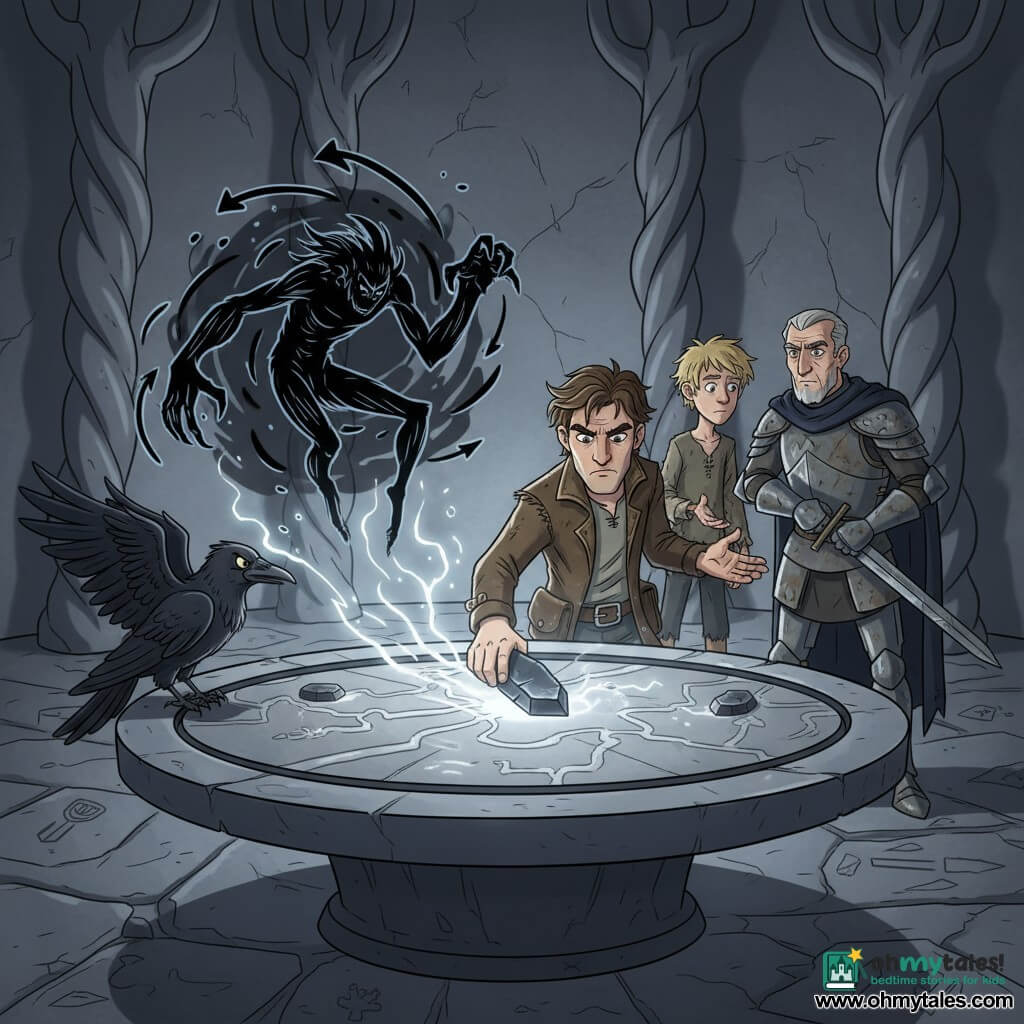
The ceiling arched high, held by pillars carved like twisted trees. In the center stood a stone table with a map etched into it—rivers, mountains, forests—yet the lines shifted when Aldren stared too long. A road he saw one moment would curl away the next, like a shy snake.
On the far side of the chamber sat a figure in armor.
At first Aldren thought it was a statue. Then the helm turned. A pair of eyes shone from the dark slit—pale, steady, and tired.
The armored figure rose with a creak of metal. A sword slid from its sheath, not raised to strike, but held ready, like a question waiting for an answer.
“Who enters the Hall of Unwritten Paths?” the figure asked. Its voice was deep, echoing off stone. It sounded like the last note of a bell.
Aldren swallowed. “Aldren Pike. Cartographer of Brackenford.”
The sword's tip dipped slightly. “Cartographer,” the figure repeated, as if tasting the word. “One who dares to name what should remain unnamed.”
“I don't want to name it,” Aldren said quickly. “I want to soothe it. A herd in my town is panicking. Something here is disturbing the land.”
The figure's eyes narrowed. “The herd hears the Tremor-Song.”
Aldren nodded. “Yes. That hum. What is it?”
The armored figure stepped closer. The lantern light revealed dents in its breastplate, scratches across the helm—signs of old battles. Yet the metal was strangely clean, as if the dust refused to cling to it.
“I am Sir Caldus,” it said. “Once a knight of the Border Marches. Now a guardian of what was sealed.”
Aldren glanced at the shifting map on the table. “Sealed from what?”
Sir Caldus's gaze moved to the table, and for a moment something like sorrow softened his eyes. “From a path that should not be walked. From a name that should not be spoken. From the Hunger of Directions.”
Aldren almost laughed, but the sound died in his throat. “That can't be real.”
Sir Caldus's sword lifted just enough to make the air tense. “It is real. And someone has disturbed the seal. The Tremor-Song is the lock complaining.”
Aldren set his lantern on the table's edge. The lines on the stone map trembled under its light. “Who disturbed it?”
“A boy,” Sir Caldus said, voice grim. “A thief with quick hands and no sense. He came with a crowbar and a greedy grin. He stole the Keystone—an old shard carved with the True North. Without it, the seal loosens.”
Aldren's mind flashed to the market—trinket sellers, curious children, the way people picked up odd stones and called them lucky.
“Where is the Keystone now?” Aldren asked.
Sir Caldus's jaw tightened under the helm. “The thief fled deeper, into the corridors where paths rewrite themselves. I cannot leave this hall. My oath is a chain.”
Aldren looked past him into a darker tunnel, where the hum pulsed stronger. The air there seemed thick, as if it didn't like being breathed.
“I'll go,” Aldren said before he could talk himself out of it.
Sir Caldus's eyes sharpened. “You would walk the Unwritten Paths? They twist. They trick. They will try to make you forget your own name.”
Aldren opened his mapbook and tore out a small strip of parchment. With charcoal, he wrote in bold letters: ALDREN PIKE. Then he tucked it inside his glove against his skin.
“If I forget,” he said quietly, “I'll feel it.”
Sir Caldus stared for a long moment. Then he reached to his belt and unhooked a small object: a compass, older than Aldren's, its casing etched with tiny runes.
“This is not for finding north,” Sir Caldus said. “It finds what you truly seek. Hold it when the paths lie.”
Aldren accepted it. The metal was cold and heavy, like a promise.
The raven swooped down to perch on the table, eyeing the knight. “Shiny tin man,” it croaked.
Sir Caldus ignored it. “Bring back the Keystone,” he said to Aldren. “Restore the seal. Quiet the Tremor-Song. Or your herd will be the least of your worries.”
Aldren's mouth went tight. He pictured Brackenford's square cracking open, roads buckling, animals screaming. He pictured fear spilling down the streets like oil.
He lifted his lantern and faced the dark corridor.
“Then I'd better not get lost,” he murmured.
The raven fluttered onto his shoulder again. “Lost is a place,” it said. “Some live there.”
“Not today,” Aldren replied, and stepped into the Unwritten Paths.
Chapter 4: The Maze That Wanted a Story
The corridor swallowed lantern light greedily. The walls were carved with shallow grooves that looked like rivers on a map—except the grooves moved when Aldren wasn't staring straight at them.
He walked, counting steps under his breath. One hundred. Two hundred. The hum in the stone matched his heartbeat until he couldn't tell which was which.
At the first fork, his own compass spun. Sir Caldus's compass, however, trembled and then pointed left, steady as a finger.
Aldren followed.
The corridor widened into a room full of doors.
Not wooden doors with handles—stone doors, each smooth and plain, each marked with a single carved symbol: a mountain, a fish, a crown, a candle, a closed eye. Dozens of them.
Aldren's lantern flickered. The air smelled faintly of smoke and apples and sea-salt all at once, like a kitchen trying to cook every meal in the world.
“Pick a story,” the raven croaked. “Doors like stories.”
Aldren took a slow breath. “I'm looking for the Keystone. A shard carved with the True North.”
The doors did not answer. But the hum grew louder, impatient.
Aldren held Sir Caldus's compass. Its needle swung not to a door, but to the floor between them.
He frowned. “Down?”
The stone beneath his boots felt strangely warm. He stepped back and knelt, running his fingers along the seam between tiles. There—an outline, almost invisible: a trapdoor of stone.
“No handle,” he muttered. “Of course.”
He pressed the edge. It didn't move. He tried again. Nothing.
The raven pecked his ear. “Maybe you ask.”
Aldren sighed, annoyed that a bird had better manners than he did. He placed his palm on the stone and said, feeling ridiculous, “Please.”
The trapdoor clicked.
Aldren stared. “You're kidding.”
The trapdoor swung open on silent hinges. Cold air rose, smelling of wet earth and old coin.
The raven made a sound that was definitely laughter. “Polite map-man,” it said.
Aldren climbed down a narrow stair. The stone was slick, and the hum became so strong it buzzed his teeth. At the bottom, he entered a low chamber where the ceiling pressed close like a heavy thought.
In the center, on a pedestal, lay a shard of black stone veined with silver. It looked like a broken piece of night sky. Even from a distance, Aldren felt it tug at his sense of direction, as if his mind were a needle trying to align.
“The Keystone,” he whispered.
But he wasn't alone.
A boy crouched beside the pedestal, perhaps thirteen, with hair like straw and eyes bright with fear and excitement. He held a crowbar in one hand and a sack in the other. His clothes were torn, and his knees were muddy.
When he saw Aldren, he jumped as if stung. “Don't—don't come closer!”
“I'm not here to hurt you,” Aldren said, keeping his voice calm. “What's your name?”
The boy hesitated. “Tovin.”
Aldren nodded. “Tovin, the stone you took is waking something. The ground is singing, and it's scaring animals all the way to town.”
Tovin's chin lifted stubbornly. “I didn't steal it from a person. It was just… here. And I—” He glanced at the sack. “I needed coin.”
Aldren's gaze softened. Hunger made thieves, just as storms made floods. “I understand needing things,” he said. “But some things aren't meant to be sold.”
Tovin's fingers tightened on the crowbar. “It's mine now.”
The hum spiked, and the chamber shuddered. Dust sifted from the ceiling. The pedestal's silver veins flared, glowing like moonlight.
A voice—thin, eager, and wrong—whispered from the walls.
“Give… direction…”
Tovin's eyes widened. “What was that?”
Aldren took a step closer despite the boy's threat. “That's why. Something down here wants the Keystone. It wants to know where to go. And if it learns—”
The whisper grew louder. The grooves in the walls writhed like drawn lines coming alive. Shadows stretched, pointing toward the boy's sack like hands.
Tovin's bravado cracked. “I didn't mean— I thought it was just a rock!”
Aldren's lantern flame bent sideways as if pulled. He felt a pressure in his skull, like an invisible finger pushing his thoughts.
The parchment in his glove scratched his skin: ALDREN PIKE.
He clung to his name.
“Aldren,” the raven croaked sharply, voice suddenly serious. “Hunger of Directions wakes. It will choose a road. Any road.”
Aldren reached his free hand toward Tovin, palm up. “Give it to me. Now. We can fix this.”
Tovin looked at the glowing shard, then at the writhing shadows. His lip trembled. He yanked the Keystone from the pedestal and thrust it toward Aldren.
At that exact moment, the shadows lunged.
Aldren grabbed the Keystone. Cold shot up his arm like winter water. The hum roared.
The chamber cracked with a sound like a giant snapping a bone. A slit opened in the air—a tear of darkness edged with silver light.
From it poured a shape that wasn't quite a creature, not quite a cloud: a twisting mass of lines and arrows, as if someone had ripped directions out of a thousand maps and stuffed them into a hungry sack.
It had no face, yet Aldren felt it looking at him.
“North,” it whispered, voice like scraping quills. “Show… north…”
Aldren backed toward the stairs, clutching the Keystone. “Move!” he shouted to Tovin.
The boy scrambled, dropping the crowbar. The raven flapped into the air, cawing harshly.
The thing surged forward, and for a heartbeat Aldren saw the world the way it did: every path as prey, every choice as a meal.
He gritted his teeth. “Not my town,” he growled. “Not my herd.”
He ran.
Chapter 5: A Knight's Oath and a Cartographer's Stand
They burst into the room of doors, gasping. Behind them, the tear in the air followed like a wound that refused to close. The Hunger of Directions seeped through corridors as if stone were smoke.
Tovin stumbled. Aldren caught his elbow and hauled him upright. “Keep moving,” Aldren ordered.
“I'm sorry!” Tovin blurted. “I didn't know!”
“Apologize later,” Aldren said, though his voice wasn't cruel. “Run now.”
Sir Caldus's compass in Aldren's hand trembled violently, then steadied, pointing back the way they had come—to the Hall of Unwritten Paths.
Aldren sprinted, lantern swinging. The raven swooped ahead, screaming warnings into the dark.
The maze fought them.
At a bend, the corridor split into three when Aldren could have sworn it was one. At another, the floor tilted, trying to spill them into a side passage. Aldren clutched the Keystone and felt its cold certainty, its pull toward a single, true line.
“Don't think,” he muttered. “Feel.”
He held Sir Caldus's compass close to the Keystone. The two seemed to argue, needles twitching, then align, pointing the same direction.
Aldren followed that agreement like a lifeline.
Behind them, the Hunger hissed. Arrows and lines peeled off its body and stuck to the walls, forming new corridors, new lies.
“You can't outrun a map that's angry,” Tovin panted.
Aldren's jaw clenched. “Then we don't outrun it. We finish the job.”
They burst into the Hall of Unwritten Paths. Sir Caldus stood ready, sword raised now, stance wide.
His eyes widened when he saw the Keystone. “You have it!”
“Where does it go?” Aldren shouted.
Sir Caldus pointed to the shifting stone table. At its center was a hollow shaped exactly like the shard. “There. Quickly!”
The Hunger flowed into the hall like a storm cloud given hunger and purpose. The lantern's flame flattened. Aldren felt his thoughts tug, as if the creature were trying to rearrange his memories into convenient roads.
The parchment in his glove scratched him again.
ALDREN PIKE.
He ran to the table, Tovin close behind. Sir Caldus stepped forward, sword slicing through the air. When the blade struck the Hunger, it didn't cut flesh—it cut lines. The creature shuddered, pieces of direction falling away like broken arrows.
“Back!” Sir Caldus roared. “To the pillar!”
Aldren slammed the Keystone into the hollow.
For a moment, nothing happened.
Then the hall went silent—so silent Aldren could hear Tovin's breath and the raven's claws tapping stone.
A silver light spread from the Keystone across the map table, racing along etched rivers and roads. The shifting lines froze, snapping into place like soldiers standing at attention.
The hum in the stone changed.
It softened.
It became a steady, low note—calm, like a sleeping animal.
The Hunger shrieked, a sound like paper being torn in a storm. It surged toward the table, desperate.
Sir Caldus planted himself in its path. “By my oath,” he thundered, “you will not pass!”
The creature slammed into him. Lines wrapped around his armor, trying to pull him apart into directions. Sir Caldus's knees buckled, metal groaning.
Aldren's instincts screamed to run.
Instead, he stepped forward.
He pulled out his charcoal, tore a blank page from his mapbook, and drew—fast and bold—a circle around the symbol of the eye he had seen outside. In the center, he marked a single point and wrote one word beneath it:
STILL.
He didn't know if it would work. But he knew maps were not just drawings. They were agreements between mind and world.
He thrust the page toward the Hunger like a shield. “Here!” he shouted. “A place with no roads. A point with no hunger!”
The creature hesitated, as if confused by the offered meaning. It leaned toward the paper, its lines quivering.
Sir Caldus, straining, forced his sword upward and drove it into the air where the tear had been following them—a thin seam of wrongness in the hall's far wall.
The blade struck with a clang like a bell struck by lightning.
The tear snapped shut.
The Hunger recoiled, suddenly without a doorway, without an escape route. It writhed, furious, and the silver light from the Keystone surged brighter, washing over it.
The creature's lines began to unravel. Arrows fell away, losing purpose, fluttering to the floor like dead leaves. The last thing it whispered, small and bewildered, was, “Where…?”
Then it collapsed into dust.
The hall's silence broke with a long, trembling sigh from the stone itself, like a giant settling back into sleep.
Sir Caldus staggered and lowered his sword. He looked at Aldren with something like respect. “You offered it stillness,” he said. “A roadless truth. Clever.”
Aldren's hands shook. He let out a breath he hadn't realized he'd been holding. “I just… wanted it to stop.”
Tovin sank to the floor, face pale. “Is it over?”
The hum was now a gentle pulse. Aldren listened, and for the first time since leaving Brackenford, he heard something else beneath it: quiet. The kind that let animals chew their cud and traders haggle and children laugh.
“It's over,” Aldren said. Then he looked at Tovin. “But we're not done.”
Tovin flinched.
Aldren's voice softened. “You're going to help me make it right.”
The raven hopped onto the table, peering at the frozen map lines. “Map-man wins,” it croaked. “Tiny thief lives. Shiny tin man still shiny.”
Sir Caldus made a noise that might have been a sigh. “Take the boy back to the surface,” he said. “And tell your town the seal holds—for now.”
Aldren nodded. “Thank you, Sir Caldus.”
The knight's gaze lingered on the Keystone. “Thank you,” he replied, quieter. “For remembering that maps are meant to guide, not to consume.”
Aldren placed his torn page—STILL—inside his mapbook. Then he turned toward the passage up, with a boy to redeem and a herd to calm.
Chapter 6: The Herd and the Quiet Song
The door in the hill opened for them as if the earth itself had learned manners. Sunlight spilled in, warm and golden, and the wind of the downs tasted of thyme and freedom.
Tovin squinted. “I thought I'd never see the sky again.”
Aldren kept walking, not unkind but firm. “The sky is generous. Don't make it regret you.”
They returned to Brackenford by late afternoon. The town's sounds rose to meet them—wagon wheels, shouting merchants, clinking coins. Yet the square was still tense. The herd remained penned, but the animals' bleats were hoarse, worn out by fear.
As Aldren approached, something changed.
The nearest sheep lifted its head. Its ears relaxed. It exhaled, a long breath, and began to nibble at a tuft of hay as if it had remembered how to be ordinary.
A goat sneezed and butted its neighbor in the ribs. The neighbor bleated indignantly, but it was the kind of complaint that meant life was normal again.
Old Marn spotted Aldren and marched over. “Well?” he demanded. “Did you find a wolf? A demon? A wandering ghost with a grudge?”
Aldren glanced at Tovin, who stood with his hands clenched, eyes fixed on the ground.
“I found a broken seal,” Aldren said. “And I fixed it.”
Marn opened his mouth, then closed it, apparently deciding he didn't want the details after all. “The herd's settling,” he said grudgingly. “So… whatever you did, it worked.”
Aldren stepped closer to the pen. He moved slowly, letting the animals smell him. He spoke in a low, steady tone, the way he might speak to a frightened traveler.
“You're safe,” he told them. “The ground is quiet now. The road beneath you isn't hungry.”
A sheep blinked at him, then pressed its nose briefly against his sleeve. Warm breath. Damp wool. A small, trusting touch that made Aldren's throat tighten.
He turned to Tovin. “Now,” he said, “you'll tell Marn what you did.”
Tovin's face went red. He swallowed. “I… I took something from a hill. I didn't know it would hurt anyone. But it did. And Aldren—he stopped it.”
Marn's eyes narrowed. “You stole?”
Tovin flinched. “Yes, sir.”
Marn crossed his arms. “Why?”
Tovin's voice was small. “My mum's sick. Medicine costs coin.”
The anger in Marn's face shifted into something complicated. He scratched his beard, grumbling. “Fool boy. There are easier ways to earn coin than poking sleeping hills.”
Aldren spoke gently. “He'll work it off. In my shop. Copying maps. Carrying water. Sweeping floors. Honest work.”
Tovin looked up, startled. “You'd… take me?”
Aldren nodded once. “You have quick hands. Learn to use them for making, not taking.”
The raven landed on the fountain, glaring at everyone like a judge. “Humans,” it croaked. “Always stealing names and stones. Always sorry after.”
Marn huffed. “And what about you, Aldren? You're always wandering off after whispers and trouble. One day you'll get yourself eaten by something with too many teeth.”
Aldren smiled faintly. “Then draw me a nice memorial in the square.”
Marn barked a laugh despite himself. The tension eased, like a rope slackening.
That evening, as the sun slid behind Brackenford's roofs, Aldren stood in his shop and unrolled a fresh sheet of parchment. He drew the eastern road, the Briar Downs, the hollow hill—careful to mark it with a small symbol only he would understand: a closed eye, finally resting.
Tovin sat at the table nearby, tongue sticking out in concentration as he copied a simple map of Brackenford's lanes. His lines were shaky, but honest.
Outside, the herd was led away at last, calm and munching. Their bells jingled softly, a music that belonged to safe things.
Aldren paused, listening. The Tremor-Song was gone. In its place was the normal song of the world: distant laughter, creaking wood, the clop of a horse, the rustle of paper.
He touched the parchment strip in his glove and felt the raised charcoal letters.
ALDREN PIKE.
He smiled, not triumphant, but grateful.
Because in a world of hungry magic and shifting paths, one man had held to a simple desire: to soothe a frightened herd—and in doing so, he had steadied the ground beneath an entire town.
The raven watched from the windowsill, head tilted.
“Map-man,” it said softly, almost kindly. “You drew stillness.”
Aldren dipped his quill in ink. “Someone had to,” he replied. Then, with steady hands, he began to draw the next road—one that led forward, not into fear, but into whatever brave work tomorrow would ask of him.