Chapter 1: Stones That Listen
In the Valley of Standing Stones, even the wind seemed to speak in old syllables. It slipped between dolmens like a careful thief, tugged at the grass around the cromlech circles, and hummed over the lichened slabs as if reading them aloud.
Mara moved through that hush with a healer's basket on her arm and a quick, steady step. She was sixteen—old enough to carry salves and secrets, young enough that elders still tried to pat her head as if she were a child. They stopped doing that after she snapped her teeth at Old Bram's fingers once. Not hard. Just enough.
She stopped beside the largest dolmen, the one everyone called the Table of Kings. A flat stone lay balanced on two uprights, and beneath it shadows pooled like ink.
“Are you sulking in there again?” Mara asked the dark.
No one answered, of course. Stones did not talk. Not to most people.
Mara crouched and slid a small bundle of thyme and honeycomb into the shade. It was habit, half joke and half promise. In her mind, the valley was alive with watching.
Behind her, boots thudded on turf.
“Mara!” came a voice, sharp as a goose's beak. “Mara of the Stones!”
Mara straightened. Sir Calder's page was trotting toward her, red-faced and sweating, his tunic too big and his confidence too small.
“What now?” she asked.
The boy gulped. “A message. From Lord Avelin at Highridge. He says—he says you must come at once. There's… trouble.”
“Trouble is always in a hurry,” Mara muttered, but she took the sealed strip of parchment.
The wax stamp bore Highridge's crest: a tower and a hawk. Mara broke it with her thumbnail.
Mara of the Valley, it read.
You are known as frank, and your hands have eased many fevers. Now we need not your herbs, but your courage.
Two armies gather at Greyford. The River Clan blames Highridge for a raid we did not order. Blood is one spark from fire.
You will carry a truce banner to Greyford and speak for peace.
Come before the moon turns.
Mara read it twice. Then her mouth went dry.
“A truce banner?” she repeated.
The page nodded so hard his cap nearly flew off. “Lord Avelin says no knight can go. They'd be taken as spies. A healer is… safer.”
Safer. Mara almost laughed. Healers were safer the way candle flames were safer than torches. Smaller, yes. Still capable of burning.
She looked back at the stones. The Table of Kings seemed to lean closer, listening.
“Fine,” she said. “Tell Lord Avelin I'm coming.”
The page let out a noisy breath. “Oh, thank the saints. Also—Sir Calder says you're to bring your best bandages.”
Mara's fingers tightened around the parchment. Her secret sat like a hidden blade under her ribs.
Because it wasn't only bandages she carried.
“Pack light,” she told the boy. “And run faster than you did coming here.”
When he was gone, Mara walked to her cottage, a low roof tucked between two ancient stones like a bird hiding beneath a boulder. Inside, her grandmother Nessa was grinding dried leaves with the patience of a mountain.
Nessa didn't look up. “The valley told me you'd be called.”
“The valley doesn't—” Mara began.
Nessa's eyes flicked up, bright and knowing. “Doesn't what? Doesn't whisper? Doesn't warn? Keep arguing and you'll miss your own heartbeat.”
Mara swallowed. “They want me to carry a truce banner to Greyford.”
Nessa set the grinder down gently, as if it might shatter from bad news. “That river crossing has tasted too much war.”
“I'm not a diplomat,” Mara said. “I'm a healer.”
“A healer is a diplomat with different tools.” Nessa rose and went to the chest beneath Mara's bed. She drew out a long roll of cloth, wrapped in oilskin.
Mara's stomach tightened. “No.”
Nessa's hands did not shake. “Yes.”
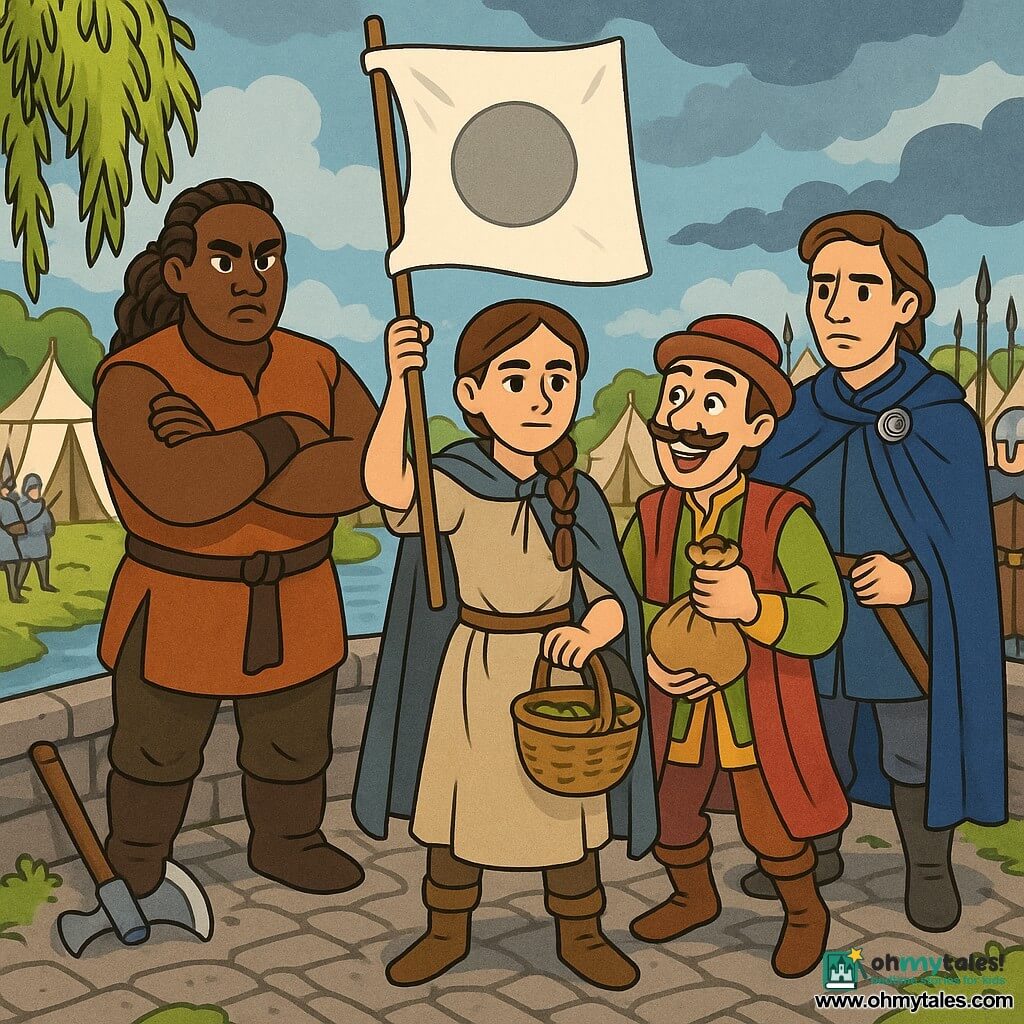
She unrolled it. Inside lay a banner pole, pale wood carved with spirals. The cloth was not Highridge's hawk, nor River Clan's fish. It was white—white as milk, white as bone—with a single stitched circle of grey thread like a stone ring.
“The old truce sign,” Mara whispered.
“The sign of the stones,” Nessa said. “Older than your lords.”
Mara stared at it. “If I take that, they'll ask why I have it.”
Nessa met her gaze. “Let them ask.”
Mara's secret pressed harder. Beneath her collarbone, hidden by skin and fear, was a birthmark shaped like a tiny ring of stones. Nessa had called it a blessing. Other people would call it a claim.
Mara shoved the banner back into the roll. “I'll take it,” she said, voice rough. “But if this ends with my head on a pike, I'm haunting you.”
Nessa's smile was soft and fierce. “Then haunt me with pride.”
Chapter 2: The White Banner and the Black Road
By dawn Mara was on the road, her basket at her hip and the truce banner strapped across her back like a quiet promise. The Valley of Standing Stones faded behind her, its dolmens shrinking into grey teeth on the horizon.
She walked the old king's road, which was not really a road but a stubborn memory of one: broken stones, muddy ruts, and weeds waving like impatient hands. Ravens hopped along the verge, watching her as if taking notes.
At midday she met a peddler cart stuck in a ditch. The cart was loaded with pots and ribbons and two goats that looked offended by everything.
A man with a cheerful face and a tragic mustache waved at her. “Ho! Traveler! Would you help a poor merchant who is being cruelly attacked by gravity?”
Mara eyed the cart. “Gravity attacks everyone. It's fair.”
“Fair, yes, but inconvenient.” He wiped his brow. “Name's Jory. Jory Tallow, seller of fine things and questionable sausages.”
“I'm Mara.”
Jory's gaze snagged on the banner roll on her back. His smile slid into something more careful. “That's not a fishing pole.”
“No,” Mara said. “It's not.”
Jory leaned closer, lowering his voice as if the grass might gossip. “Greyford way?”
Mara nodded.
He whistled. “Bold. Or foolish.”
“Both,” Mara said. “Move your goats, Jory Tallow. I'll help.”
Together they heaved the cart while the goats complained in offended bleats. With a final shove, the wheel bumped free.
Jory bowed with ridiculous flourish. “My savior! Please accept—”
“No,” Mara said quickly.
“—my company,” he finished, grinning. “On the road. I hear arrows fly straighter when you're alone.”
Mara wanted to refuse. She traveled best without chatter. But the road ahead felt heavy, as if the air itself expected trouble.
“Fine,” she said. “But if you try to sell me sausages, I'll feed them to your goats.”
“Agreed,” Jory said solemnly. “My goats have standards.”
They walked together under a sky that grew bruised with clouds. As the afternoon cooled, they passed a circle of standing stones, smaller than Mara's home valley but still old enough to make her skin prickle.
Jory slowed. “These always make me feel like I'm being measured.”
Mara touched one stone with her fingertips. It was cold, even in summer. “They remember,” she murmured without thinking.
Jory raised an eyebrow. “Do they?”
Mara snatched her hand back. “Never mind.”
That night they camped beside a brook. Jory made a fire, and Mara brewed willowbark tea for his blistered heel. The flames painted his face gold and made his mustache look even more tragic.
“You're really carrying peace into a war,” he said quietly.
“I'm carrying a chance,” Mara replied.
“Why you?” Jory asked. “Why not a priest? Or a knight with shiny manners?”
Mara stared into the fire. The secret in her chest stirred like a sleeping cat. “Because I'm… not important,” she lied.
Jory snorted. “That's the worst lie I've heard all week, and I sell questionable sausages.”
Mara flicked a pebble at him. He dodged with a yelp.
Silence returned, full of crackles and distant owl calls. Above them, the moon rose—thin, sharp, turning like a blade.
Mara lay awake long after Jory's snores started. She listened to the brook and the wind and the faint, impossible feeling that stones were waiting for her to do something brave.
Chapter 3: Greyford's Teeth
On the third day the smell of smoke reached them before they saw the river. It was the kind of smoke that didn't belong to campfires. It tasted of burned thatch and anger.
Greyford lay in a shallow bend where the river widened and slowed. A stone bridge crossed it—three arches, each one dark beneath like an open mouth. On the Highridge side, tents flapped in neat lines, banners snapping: the hawk on blue. On the River Clan side, across the water, their camp sprawled rougher, with poles topped by fish bones and strips of cloth like streamers of warning.
Between them, on the bridge itself, stood a no-man's-land of splintered wood and old bloodstains.
Jory stopped. “Well,” he said faintly, “that looks friendly.”
Mara's heart thumped hard enough to hurt. She unslung the banner roll. Her fingers were steady, though her knees would have preferred to become pudding.
She unfurled it.
The white cloth snapped open in the wind, bright as a shout. The grey circle at its center seemed to hover, simple and stubborn.
From Highridge's camp, guards shouted. A horn brayed—one long note, then two shorter, like a question.
A line of soldiers formed, spearpoints glinting. Not charging. Watching.
Across the river, River Clan warriors gathered like a flock of crows. They wore leather and river-green scarves. Some carried axes. One lifted a bow, then lowered it when he saw the white banner.
Mara stepped onto the bridge.
The first plank creaked. The second. Each step felt louder than it should, as if the bridge wanted to announce her to the world.
Halfway across, a voice boomed from the Highridge side. “Halt! Name and purpose!”
Mara raised her chin. “Mara of the Valley of Standing Stones. Healer. I carry a truce banner.”
Another voice—rougher, from the River Clan side—answered. “Truce? We'll see how long it lasts.”
Mara stopped in the very center of the bridge, where the river slid beneath her like cold silk. She planted the banner pole, gripping it with both hands so it wouldn't tremble.
“I'm here to speak with whoever leads you,” she called. “Both sides. Not separately. Together.”
A murmur rolled through both camps. People disliked together. Together made it harder to throw blame like stones.
From Highridge's side, Lord Avelin himself emerged, tall and narrow as a spear, wearing a cloak pinned with silver. His eyes landed on Mara and did a quick, uneasy dance over the banner's grey circle.
From the River Clan side came their chief—Chief Rovan—broad-shouldered, scarred, with hair braided tight. He looked like someone carved from river rock and then dared to complain.
They approached the bridge from opposite ends, stopping several paces from Mara, leaving a tense triangle between them.
Lord Avelin's voice was smooth. “Healer Mara. We are grateful. You have courage.”
Chief Rovan snorted. “Or she's been sent as a shield.”
Mara kept her voice clear. “I was sent because I'm frank. Because I'll say what others won't.”
“Then speak,” Rovan said. “Tell the hawk-lord to admit his men raided my village.”
Avelin's jaw tightened. “We did not. That raid was not ordered by Highridge.”
Rovan's hand went to the haft of his axe. “My people buried three children.”
The word children hit Mara like a fist. She thought of fevers and small hands and the way grief made even tough men look lost.
“Stop,” Mara said sharply.
Both leaders blinked, surprised. A healer didn't usually command.
Mara continued, voice carrying. “You're both staring at each other like the other is a monster. But monsters don't leave footprints that make sense. Monsters leave chaos. This raid—who gained from it?”
Avelin's eyes narrowed. “You suggest a third hand.”
Rovan's gaze flicked to the trees on the far bank. “Bandits?”
“Or someone who wants war,” Mara said.
Jory had stayed back, near the Highridge camp, but now he edged closer, eyes wide. “I heard talk on the road,” he blurted, then seemed to regret having a mouth. “About a company of sellswords. Black cloaks. They've been taking coin from… well, from whoever pays.”
Both leaders looked at him as if he'd thrown a live eel onto the bridge.
Avelin's voice cooled. “And how do you know this?”
Jory gulped. “I sell pots. People talk. Also I listen. It's a skill.”
Rovan spat into the river. “Sellswords. The kind who burn a village and blame someone else.”
Avelin's eyes went back to Mara. “If you have proof, show it.”
Mara's secret rose like a tide. Proof. She had something, but it was dangerous.
She took a breath and made her choice. “I can find the truth,” she said. “But you must give me time. Three days. Hold your men. No arrows. No raids.”
Rovan barked a laugh. “And why would we trust you?”
Mara's fingers tightened on the banner pole until her knuckles paled. “Because this banner is older than your feud. And because if you break truce under it, the stones will remember your names.”
Avelin's expression flickered—fear? Respect? Something like both.
Rovan's eyes narrowed, then slid to the grey circle on the white cloth. For a heartbeat, he looked less like rock and more like a man remembering a story his grandmother told.
“Three days,” Rovan said slowly. “If blood spills, it won't be ours.”
Avelin nodded once. “Three days.”
Mara let out a breath she hadn't realized she'd been holding. The river beneath the bridge kept moving, as if unimpressed by human promises.
Chapter 4: The Secret Under the Skin
They gave Mara a small tent on the bridge's Highridge side, close enough that both camps could watch her like a hawk watches a rabbit. Which was comforting in the way a cage might be comforting: you know where the bars are.
That night, Mara sat with Jory near the tent flap, listening to soldiers mutter and sharpen blades. The air tasted of iron and impatience.
“You just told two angry leaders the stones will remember their names,” Jory whispered. “Is that true?”
Mara stared at her hands. “I don't know. But they believe it enough to pause.”
Jory's voice softened. “So what now, Banner-Bearer?”
Mara reached into her basket and pulled out a small pouch of dried herbs, more for something to do than because she needed them. “Now I find out who raided the River Clan.”
“How?” Jory asked.
Mara hesitated. The secret pressed, asking to be spoken. She had carried it like a coin in her mouth, afraid to swallow, afraid to spit it out.
She glanced around. Guards were nearby, but the shadows were thick, and Jory's face held only curiosity, not hunger.
She tugged down the collar of her tunic, just enough to reveal the ring-shaped mark near her collarbone.
Jory blinked. “That looks like—”
“A cromlech,” Mara finished. “My grandmother says it means the stones claimed me when I was born.”
Jory leaned back, as if the mark were a hot pan. “Claimed you to do what?”
Mara's laugh came out thin. “If I knew, I'd sleep better.”
She rolled her collar back up. “But sometimes,” she admitted, “I can… feel things. Echoes. Like listening to a song from another room.”
Jory scratched his mustache, which seemed to help him think. “You're telling me you can do magic?”
“I'm telling you I'm a healer with a problem,” Mara said. “And if either camp decides my mark makes me dangerous, they'll hang me first and argue later.”
Jory's eyes widened. Then, unexpectedly, he smiled. “All right,” he said. “Then we won't tell them. We'll use your… echo-listening to find those black-cloaked sellswords.”
Mara studied him. “Why help me?”
Jory shrugged. “Because I like living. And peace seems cheaper than war. Also because you saved my heel.”
Mara rolled her eyes, but warmth stirred in her chest like a small lamp. “Fine,” she said. “We start at first light.”
Before dawn, Mara walked alone onto the bridge, banner in hand, and listened—not with her ears, but with that strange inner sense Nessa called stone-speech.
She focused on the grey circle stitched on the cloth. She thought of the Valley. Of dolmens that watched. Of stones that remembered footsteps and screams.
The world seemed to tilt slightly, like a door opening a crack.
Then she felt it: a tug, faint but clear, pulling her attention downstream, toward the marshy bend where willows grew thick.
Mara's breath caught. “There,” she whispered.
When the sun finally rose, she found Jory. “We go to the willows,” she said.
Jory rubbed sleep from his eyes. “How do you know?”
Mara lifted her chin. “Because the stones told me.”
Jory stared for a beat, then nodded as if that were the most normal plan in the world. “Right,” he said. “Willows it is.”
Chapter 5: Black Cloaks in the Marsh
The marsh smelled like secrets: wet earth, sour reeds, and rot hidden under green. Mara and Jory moved carefully, stepping from root to root to avoid sinking into mud that looked harmless until it tried to eat your boot.
Ahead, willows drooped over the water like long-haired giants. Beneath their curtains, something gleamed—metal, half-buried.
Jory crouched and brushed away leaves. A helm stared up at them, dented and stained. Not River Clan leather. Not Highridge steel.
“This is sellsword gear,” Jory whispered.
Mara's stomach twisted. She pushed on, following the tug she'd felt, until they reached a patch of higher ground where a fire had been built recently. Ash lay grey and cold, but hoofprints and bootmarks crisscrossed the mud like frantic handwriting.
Mara knelt, touching the ground. The echo came again—sharper now. A flash of movement in her mind: black cloaks, laughing, a torch thrown onto a roof. Screams. Then a voice, greedy and smooth: “Make it look like the hawk did it.”
Mara jerked her hand back, breathing hard.
Jory grabbed her elbow. “Mara?”
“Sellswords,” she panted. “And someone paid them.”
Jory looked around nervously. “Let's take proof. Something we can show.”
They searched the abandoned campsite. Under a rock, Mara found a small leather purse with a broken seal. Inside were coins—gold, stamped with a tower and hawk.
Highridge coin.
Mara's throat tightened. “No.”
Jory's face went pale. “That's… that's bad.”
“It could be stolen,” Mara said quickly. “It must be.”
But doubt crept in like cold water. What if a Highridge lordling had hired them? What if Avelin himself—
A twig snapped.
Mara froze. Jory's eyes darted.
From behind the willows, three men stepped out, cloaked in black. Their faces were hard, their smiles easy. One carried a crossbow. Another twirled a knife as if it were a toy.
“Well, well,” said the one with the crossbow. “Little birds picking at our leftovers.”
Mara stood, forcing her voice steady. “We're leaving.”
The sellsword laughed. “You're leaving with questions. And questions are heavy. Hard to carry when you're dead.”
Jory raised his hands. “Now, friends, perhaps we can discuss—”
“Shut up,” the knife-man snapped.
Mara's mind raced. She was a healer, not a warrior. She had no sword. Only herbs, bandages, and a truce banner that wasn't here.
But she did have one thing.
In her basket was a small jar of crushed nettle and pepper—meant to wake up a fainting patient. In the eyes, it would wake up anything.
Mara flung the jar.
It shattered against the crossbowman's face. He screamed, dropping his weapon and clawing at his eyes.
Jory didn't waste the moment. He grabbed a fallen branch and swung it at the knife-man's wrist. The knife flew, landing with a soft plop in the mud.
The third sellsword lunged toward Mara. She ducked, but his hand caught her collar, yanking her close. His breath stank of onions and cruelty.
“Pretty mark,” he hissed, seeing the edge of it at her neckline. “Maybe we'll sell you to someone who likes strange girls.”
Mara's fear turned hot. The echo inside her surged—stone-deep and ancient. She didn't cast a spell with words. She simply wanted him away.
The ground under his feet shifted.
Not like an earthquake—more like a stubborn stone deciding it had had enough of being stepped on. The sellsword stumbled, slipped in the mud, and fell backward with a yelp.
Mara tore free.
Jory stared at her, then at the mud, then back at her. “Did you—”
“No time,” Mara snapped.
They ran, weaving between willows as shouts rose behind them. The sellswords pursued, but the marsh was a cruel friend to anyone who didn't know where to step. Mara's feet seemed to find the solid roots without thinking. Jory followed, panting and swearing creatively.
At last they burst out of the reeds onto firmer ground, hearts hammering.
Jory bent over, hands on his knees. “All right,” he gasped. “Next time you say ‘the stones told me,' I'm not arguing.”
Mara clutched the purse of Highridge coins. “We have proof,” she said. “And we have trouble.”
Chapter 6: The Bridge of Promises
By the time they returned to Greyford, the camps were already tightening like fists. Rumors moved faster than horses. Someone had seen smoke in the marsh. Someone else had heard shouting. Fingers pointed across the river like spears.
Mara marched straight onto the bridge with the white banner raised high, Jory at her side, the coin purse in her other hand.
“Call your leaders!” she shouted. “Now!”
A Highridge captain hesitated, then signaled. On the far bank, River Clan warriors gathered, suspicious and restless.
Lord Avelin arrived first, cloak snapping. Chief Rovan came from the opposite end, axe in hand. Both looked ready to blame.
Mara didn't let them speak.
“We found the raiders' camp,” she said, voice ringing across the stones. “Sellswords in black cloaks. They admitted they burned the River Clan village to make it look like Highridge.”
Rovan's eyes flared. “Lies—”
Mara held up the purse and spilled the coins into her palm. Gold flashed in the sun. The hawk-and-tower stamp was clear.
Avelin's face drained of color. “Those are Highridge coins.”
Rovan's grip tightened on his axe. “So you did pay them.”
“No,” Avelin snapped. Then his voice lowered, strained. “Not I.”
Mara stepped closer, banner pole planted between them like a line drawn in chalk. “Someone used your coin,” she said to Avelin. “Stolen, or gifted by a traitor. But if you and Rovan start a war over this, the sellswords win. Whoever hired them wins.”
Rovan's nostrils flared. His gaze flicked from the coins to Avelin's face, searching for truth like a fisherman watching ripples.
Avelin swallowed. “There is… Lord Merek,” he admitted. “My cousin. He argued for war. He would gain land if the River Clan were driven back.”
Rovan's voice was low as thunder. “Where is this cousin?”
Avelin's eyes darted to a knot of officers behind him. One of them—broad, with a silver clasp—turned and started to walk away too quickly.
Jory pointed. “That one's doing a guilty stroll.”
The officer broke into a run.
Avelin shouted orders. Soldiers surged. River Clan archers raised bows, unsure if they were being attacked. The bridge filled with shouting, boots, and the sharp smell of panic.
Mara lifted the banner higher. “Hold!” she cried. “Truce!”
But fear is deaf.
An arrow snapped from somewhere—loosed by a hand too eager or too scared. It flew toward the bridge's center.
Mara saw it coming like a black line drawn through the air.
She turned without thinking, throwing the banner cloth wide. The arrow punched into the white fabric and stuck, quivering. The grey circle shuddered around it, as if swallowing violence.
For a heartbeat, everything paused.
Chief Rovan stared at the arrow in the truce banner. His mouth tightened. He raised his voice, booming across his warriors. “Lower your bows! Any man who shoots under truce answers to me!”
Lord Avelin spun on his soldiers. “Stand down! By my authority—stand down!”
The tide of bodies slowed. Breath returned to the world.
Mara's hands trembled now that it was over. She pulled the arrow free and let it drop into the river. It vanished with a soft plink.
Jory leaned in. “You just caught an arrow with a banner,” he whispered, awed. “That's… extremely heroic.”
Mara shot him a look. “It was extremely lucky.”
Avelin's gaze fixed on Mara's collar, where in the scuffle her neckline had slipped. The ring-shaped mark showed clearly.
His eyes widened. “You are… Stone-marked.”
Mara's throat tightened. This was the moment her secret became a weapon in someone else's hands.
Rovan noticed too. He stared, then slowly, carefully, set his axe down on the bridge stones.
“My grandmother spoke of the Stone-marked,” he said, voice roughened by memory. “Those who carry the old truce.”
Mara forced herself to stand tall, though her heart battered her ribs. “I'm still just Mara,” she said. “I bleed, I get blisters, and I make terrible decisions. But I won't let you bury more children because a greedy man jingled coins.”
Avelin's shoulders sagged. “Then help us finish this,” he said quietly.
They did.
Avelin's men, joined by a handful of River Clan scouts, hunted Lord Merek's trail. The traitor was caught before nightfall trying to flee with a chest of gold and a letter sealed in black wax—payment promised by the sellsword captain. Proof upon proof, ugly as it was necessary.
When Merek was dragged onto the bridge, he spat at Mara. “You meddling hedge-witch.”
Mara wiped the spit from her sleeve with calm disgust. “I prefer ‘healer.' And you're welcome.”
Chief Rovan stepped close to Merek, eyes like river ice. “You burned my people for land?”
Merek sneered. “War was coming anyway.”
Rovan's fist moved faster than speech. Merek crumpled, and the bridge seemed to exhale.
Chapter 7: The Circle Holds
On the fourth morning, the camps looked different. Not friendly—war doesn't wash off that quickly—but less like clenched teeth. Men crossed the bridge carrying water, not weapons. A River Clan child, thin as a reed, offered a Highridge soldier a carved wooden fish. The soldier looked startled, then accepted it as if it were fragile treasure.
Mara stood at the bridge's center with the white banner billowing above her. The arrow hole had been stitched, clumsily but proudly, by a River Clan seamstress who muttered that if a banner had to be brave, it might as well be patched too.
Lord Avelin and Chief Rovan met again, this time without shouting.
Avelin spoke first, voice steady. “Highridge will pay for the River Clan's losses. Grain, timber, medicine.”
Rovan nodded once. “And we will return the prisoners taken in anger. We will keep the ford open to traders. Even… questionable sausage sellers.”
Jory put a hand on his heart. “An honor, Chief.”
Rovan's mouth twitched, almost a smile. Almost.
When the terms were spoken, Mara felt something ease inside her, like a knot untying. The secret mark beneath her collarbone warmed—not burning, not aching, just… present. As if the stones, wherever they were, had leaned back in their ancient seats.
Later, when the leaders had gone, Jory walked with Mara to the river's edge.
“So,” he said, skipping a pebble. “What happens to a Stone-marked healer now?”
Mara watched the pebble hop, hop, sink. “I go home,” she said. “Back to the dolmens. Back to my grandmother. Back to people with fevers and stupid injuries.”
“And the next time lords want peace?” Jory asked.
Mara smiled, tired and real. “Then I suppose they'll come looking for me again. The valley has a way of lending me out.”
Jory glanced at her. “Are you afraid?”
Mara thought of the arrow, the marsh, the black cloaks, the two armies balanced on the edge of disaster. She thought of the banner in her hands, white as a clean bandage.
“Yes,” she admitted. “But I did it anyway.”
Jory nodded, as if that was the proper answer in a world full of sharp things.
When Mara set off for the Valley of Standing Stones, the white truce banner was strapped across her back again. It flapped behind her like a wing.
As she walked, the wind rose, carrying the scent of rain and far-off heather. In the distance, the first silhouettes of dolmens appeared against the sky—patient, quiet, unmovable.
Mara lifted her chin and walked toward them, healer's basket at her hip, secret at her heart, and peace—hard-won, stitched, and stubborn—following in her wake.