Chapter 1: The Walk to the Sorghum
In the morning when the sun yawned and stretched its gold fingers, Amina walked to the edge of the great sorghum field. The stalks stood like a small forest of green spears, heads bowing like old grandmothers listening. Amina was a diplomat — a woman who healed words and mended hearts. Today she carried a small cloth bundle and a calm like river water.
The village watched her go. Children whispered, “She walks like a drumbeat — steady, steady.” The elders nodded, for Amina had a gift for soft answers. She believed time was a patient weaver. “We can tie knots quickly,” she would say, “but the best cloth takes time.”
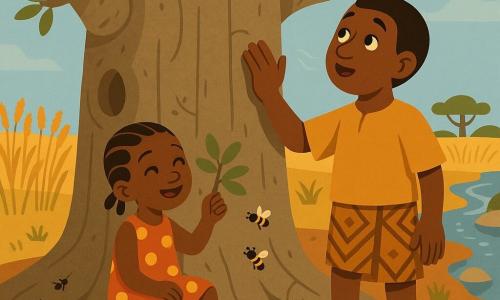
At the border of the field, a boy pointed. “There!” he cried. “Two men argue by the baobab. Their voices are hot like the noon.” Amina sighed. She folded her cloth tight and went toward the baobab, its trunk a drum of memory. The two men stood with arms like rivers against one another, each pushing. One wore a red wrap; the other wore blue. Their words were thorns.
“Stop,” Amina said, and the field seemed to hold its breath. The men jumped, blinking as if someone had gently slapped the sun. “Why shout?” she asked. Her voice was a soft bell.
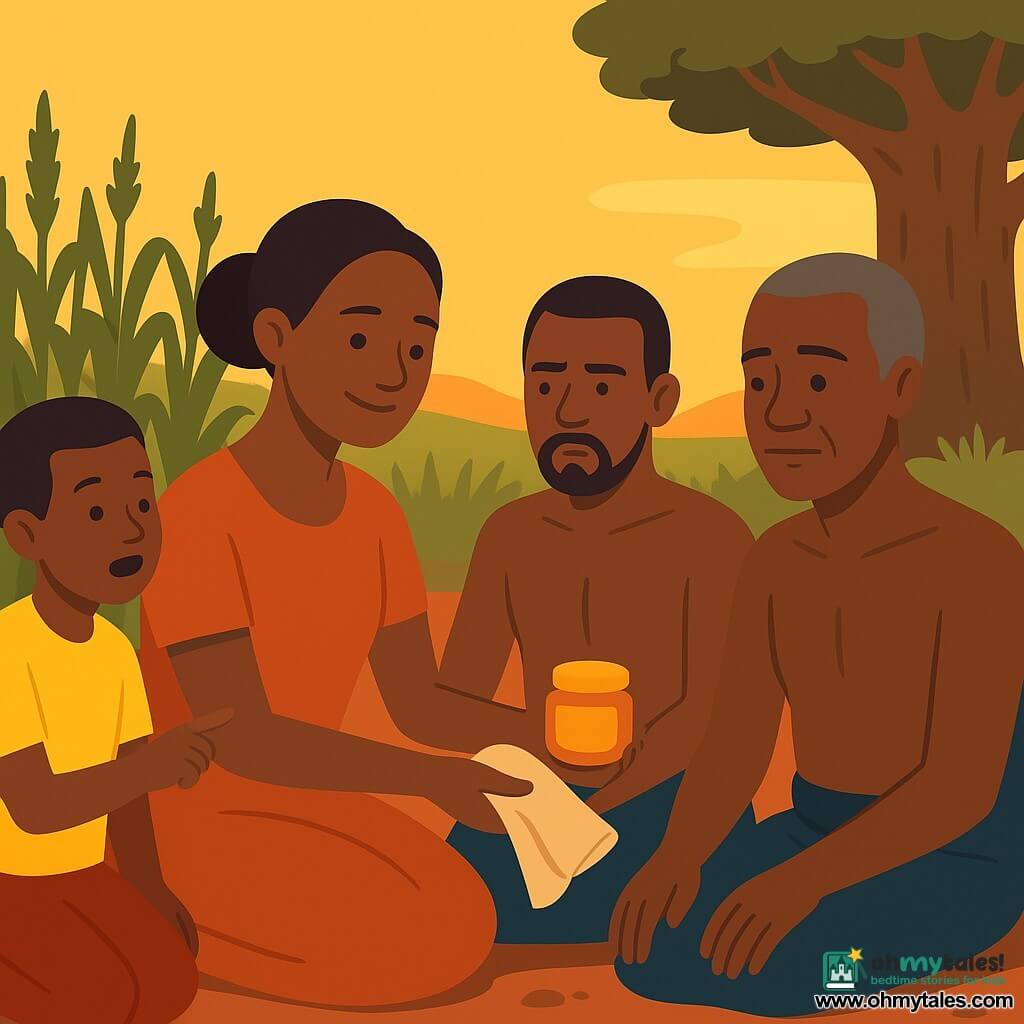
“It is my hurt!” the man in blue cried. “He took my goat!” the man in red said. The village had come, and their faces were bright with curiosity. Amina's eyes were like two calm birds. She opened her cloth and showed a small jar of balm made of shea and ginger. “I do not fix goats,” she said, smiling. “I heal wounds.”
The men looked at their hands as if they could see the hurt inside. “There is a different kind of wound,” Amina said. “Words can cut like sickles. I am a diplomat. I stitch with words. May I sit?”
So they sat on the warm earth at the edge of the sorghum, and the field whispered around them like a chorus of soft feet.
Chapter 2: Time Like a Basket
Amina told a story, because she knew stories were rugs on which people could sit together. “Once,” she began, “there was a river who thought it could rush faster than the rain. It rushed and made errors. The river forgot that stones teach patience.” She tapped the jar twice. “A wound can be like that river.”
The men listened. The village children gathered, legs crossed like little mirrors. Amina spoke slowly, like a woman counting beads on a rosary. Her words moved in patterns: repeat, return, and rest. “Tell me what happened,” she asked. The man in red sighed. “He borrowed my goat for one day. Two days, then three. When I asked for the goat, he said the goat was heavy with work.”
“And yet,” said the man in blue, “the goat ate my sorghum. I said nothing. I thought it was one day. Time slipped.”
The sorghum rustled, as if saying, Time slips if you do not hold it. Amina smiled. “Time is like a basket,” she said. “We put things inside. If we do not tie the top, things fall out.”
They told their sides, and Amina held each word like a bright coin. She did not hurry. Sometimes she sang a line, and the words came back like friendly frogs. “Yes,” she said to one. “Yes,” she said to the other. Each yes was a stitch.
When the sun moved, the shadows leaned. “Why did you not tell me?” the man in red asked the man in blue. “I was ashamed,” the man in blue said. “I thought I would be laughed at.” The man in red folded his hands and looked at the sorghum. “I should have kept my goats closer,” he said softly.
Amina patted the ground. “We must tend time like a garden,” she said. “Pull out weeds of shame. Plant seeds of truth. Water them.” She mixed the balm and opened the jar. “Listen. I will show you how to heal more than skins.”
Chapter 3: Healing with Words and Leaves
Amina took a leaf from the sorghum, slender and green. She pressed it between her fingers like a tiny drum. “First,” she said, “say the hurt. Let it sit in the air like smoke, then let it go.” The man in blue breathed and said, “I am sorry I kept the goat.” The words were small, but the sorghum bent to hear.
“And I am sorry my sorghum was eaten,” said the man in red. The apology landed like a seed. Amina blew softly, and the seeds of their words stuck in the ground.
“Second,” she sang, “make a promise that is like a rope — not thin, not broken.” They promised to watch each other's animals and to speak within three sunrises if a goat wandered. They nodded, and laughter, like small bells, unknotted their faces.
“Third,” Amina said, “let us use time.” She wrapped the balm around the promise and tied the cloth. “You must wait a little while. Respect time.” The men frowned. “How long?” asked the man in blue. Amina pointed to the baobab's shadow. “Wait until the shadow reaches the old stone. Time will teach you how to trust again.”
So they waited. The children chased one another through the sorghum, and the songs of the village rose and fell. The men sat together and told old tales until the shadow moved. Slowly, like dough rising, their anger softened.
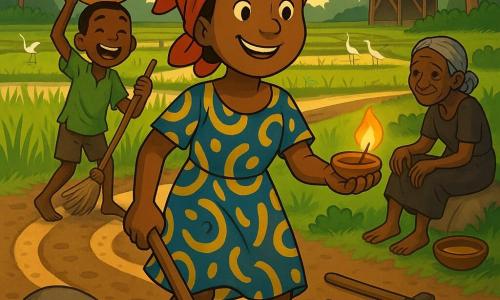
When the shadow reached the stone, Amina took the cloth and showed them the knot. “This knot is not tight like anger,” she said. “It is loose enough so you can breathe, and strong enough to hold a promise.” They unwrapped the cloth together and shared the balm on each other's palms, not for cuts on the skin, but for cuts in the heart. The balm smelled of earth and sunlight.
Chapter 4: The Feast and the Quiet
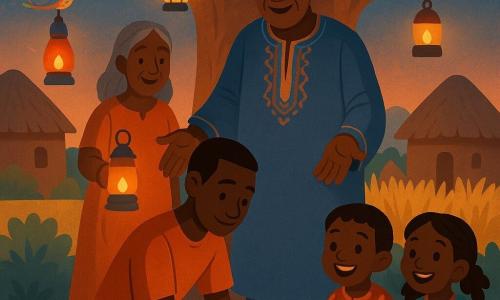
At dusk, the village made a small feast. A pot steamed with jollof rice, and the goats bleated softly, counted and safe. The men laughed about the goat who had eaten more sorghum than a little boy. “He must have been hungry for a story,” joked the man in blue, and everyone laughed like a rain drum.
Amina rose. Her task was done. “Remember,” she told them, voice like a ribbon, “time heals when we respect it. Words can sew. Promises are rivers. Tend them.” The men shook hands, and the quarrel that had been hot like noon was now a cool ember. The field bowed. The baobab hummed a small tune.
That night the village slept with faces soft as ripe mangoes. The sorghum slept too, heads tucked under stars. Amina walked back, the cloth bundle empty of balm but full of quiet. She thought of the river and the stones, of baskets and knots. She hummed a little song the children taught her.
In the morning, the goat wandered back to the man in red by itself, tail high like a flag. The men met by the baobab and shared a cup of tea. They spoke of time and of watching, and when it was needed, of saying sorry. The quarrel was not a fire anymore; it was ash that warmed their hands, a lesson they would not forget.
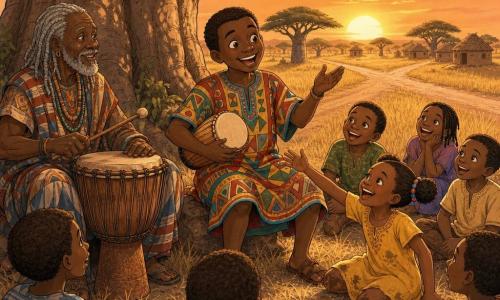
And the village told the tale the way a griot tells a tale — slow, sweet, and sure. They said, “A wound can be mended with words, with promises, and with time.” The story passed from mouth to ear like a warm loaf, and Amina's name was whistled by children as they ran through the sorghum, learning to respect the time that stitches life together.