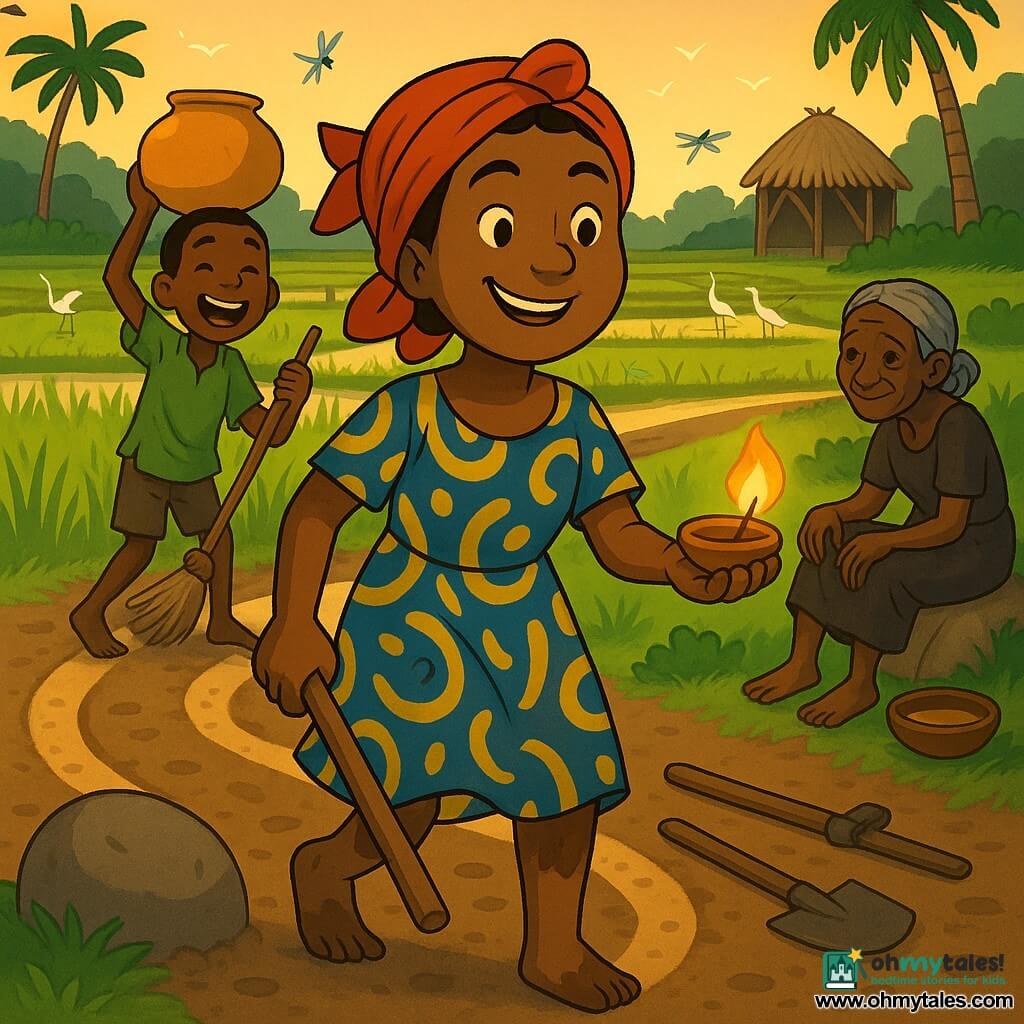
Chapter 1: The Village of Green Mirrors
Listen, listen, little ones, and I will tell you a story the way a griot tells it—like a drum that never forgets its beat.
In a village hugged by rice fields, the water lay shiny and calm. The paddies were green mirrors, reflecting clouds like slow white sheep. When the wind walked through the blades, the rice whispered, “Hush-hush, grow-grow,” as if it knew a secret.
In that village lived a woman named Adia. Adia was small, but her spirit was a bright coal. People said, “Adia's heart is a hot pepper—careful, it can make you dance!” And it was true: she laughed quickly, moved quickly, and dreamed quickly.
Her dream was simple, but strong: she wanted to trace a new footpath from the village to the farthest rice fields, where the water birds liked to stand like little old men in white coats. The old path was twisty and muddy. In the rainy season, it grabbed ankles like sticky hands. Adia wanted a path that was smooth, clear, and kind to tired feet.
One morning, she stood at the edge of the village with a long stick in her hand. She dragged its tip through the dust and said, “Here. I will start here. A straight path like a singing line!”
Kofi the potter, who always had clay on his fingers, teased her. “Adia, you want to draw on the earth like a child draws on a slate?”
Adia grinned. “Yes! The earth is my slate. And my chalk is courage.”
Nana Sira, the eldest woman in the village, sat under a neem tree nearby. Her back was bent like a question mark, but her eyes were bright like morning. Nana Sira held a small gourd cup and sipped slowly, as if sipping time itself.
She called out, “Adia, daughter of the quick feet, come and greet your elders before you greet the road.”
Adia paused. She had been so excited that her hello almost ran away from her mouth. She walked over and knelt, touching the ground with her fingertips, then touching her forehead.
“Good morning, Nana Sira,” Adia said softly. “May your day be long and sweet.”
Nana Sira smiled. “And may your day be wise. A path is not only made by feet. A path is made by listening.”
Adia's cheeks warmed. She respected Nana Sira, everyone did. Nana Sira had stories tucked into her wrinkles like seeds in a pod. Still, Adia's dream bounced inside her like a young goat.
“I will listen,” Adia promised. “But first I must begin. My dream is tapping me on the shoulder!”
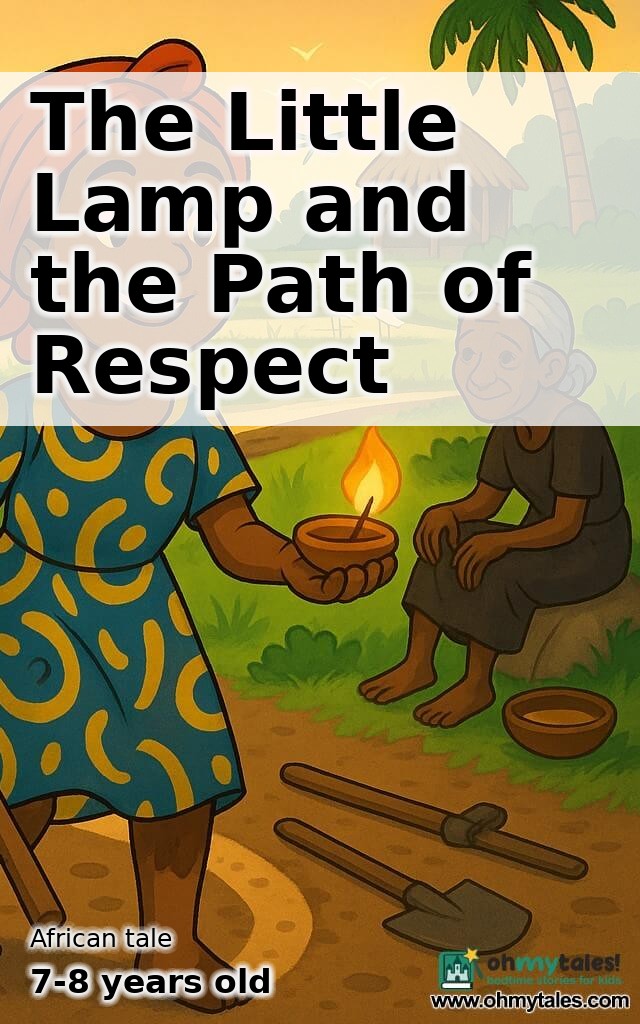
Nana Sira laughed, a gentle sound like dry leaves dancing. “Go then. But take this with you.” She lifted her hand. In her palm lay a tiny clay lamp, no bigger than a mango pit, with a little wick curled inside.
“A lamp?” Adia blinked.
“A flame is a symbol,” Nana Sira said. “It is patience. It is care. It is the kind of light that does not push—it invites. Carry it when you walk. Not for fear. For remembering.”
Adia took the lamp carefully, as if it were a sleeping bird. “Thank you, Nana.”
“Remember,” Nana Sira added, “the land has elders too. Trees are elders. Stones are elders. Even water is an elder. Greet them with your steps.”
Adia nodded, though she did not fully understand. She tucked the little lamp into her cloth bag, tied her headscarf tighter, and marched toward the rice fields.
The sun climbed, the air smelled of wet earth and green life, and Adia's dream walked beside her like a friend.
Chapter 2: Where the Grass Has Opinions
Adia reached the first paddy. The rice plants stood in rows like schoolchildren, their leaves thin and sharp, their heads swaying.
“Good morning, rice,” Adia said, half-joking, half-serious, because Nana Sira's words were still humming in her ears.
The wind answered by bending the rice, and the rice replied with a soft shush. Adia laughed. “You are polite! Good.”
She took her stick and began to trace. She pressed the tip into the ground and dragged it forward, making a pale line in the brown soil. The line looked like a ribbon laid on the earth.
But the earth was not empty. A clump of tall grass stood in the way, thick and proud.
Adia planted her hands on her hips. “Move aside, grass. I am making a path.”
The grass, of course, did not move. It simply rustled, as if whispering to itself, “We were here first.”
Adia could have rushed. Her heart was a drum, boom-boom, faster, faster. Yet she remembered Nana Sira's face, calm as a pond.
So Adia tried again, kinder. “Hello, grass. I am Adia. I want to make a path so people can walk without slipping.”
The grass waved in the breeze. A bright green lizard popped its head out and stared at her like a tiny judge.
From behind, someone called, “Adia! You are talking to grass now?”
It was Amadu, the village boy who carried water and carried jokes. He balanced a calabash on his head like a crown.
Adia puffed out her chest. “Yes, I am talking to grass. Nana Sira says the land has elders.”
Amadu chuckled. “Then greet the mud too. It loves to hold feet.”
Adia stuck out her tongue at him, and Amadu laughed louder. “Don't worry, Adia. I will help you. My arms are strong.”
They worked together. Adia did not yank the grass out angrily. Instead, she dug carefully around it, lifting some clumps to the side, leaving other clumps where birds liked to hide. She spoke as she worked, as if the grass could hear.
“Excuse me,” she said. “I am not here to fight you. I am here to guide feet.”
Soon the line became clearer. It ran beside the paddies where the water shimmered, where frogs made plop sounds like tiny stones, and where dragonflies stitched blue threads through the air.
At midday, Adia and Amadu sat under a palm and ate roasted groundnuts. The shells cracked like small applause.
Amadu wiped his mouth. “Your path is already better than the old one.”
Adia's eyes shone. “It will reach the far fields. It will be a path that sings.”
Amadu pointed to her bag. “What is that little bump?”
Adia opened the bag and showed him the tiny clay lamp.
Amadu tilted his head. “A baby lamp?”
Adia smiled. “Nana Sira gave it to me. She said it is for remembering.”
“Remembering what?”
Adia looked out over the rice, over the water that held the sky. “Maybe… remembering to listen.”
Amadu shrugged. “I listen to my stomach. It says I need more groundnuts.”
Adia laughed so hard she nearly dropped the lamp, then hugged it close. “Careful! This is not food.”
They finished their snack. The sun began to lean, and Adia's dream pulled on her sleeve again. They stood up, dusted off their hands, and continued.
As they walked, Adia saw a big stone sitting right where her path wanted to go. It was round and smooth, like the back of a hippo.
“There!” Adia declared. “That stone is blocking my straight line.”
Amadu squinted. “That stone has been here longer than my grandmother's grandmother.”
Adia tapped it with her stick. “Stone, please move.”
The stone did not answer. Stones are quiet elders.
Adia frowned. Her dream wanted to jump over the stone, but her feet wanted to respect Nana Sira's words.
She sat down beside it and whispered, “Hello, elder stone. Tell me your story.”
Amadu stared. “Now you are listening to rocks.”
Adia grinned. “Yes. Be quiet. You might hear something.”
They waited. The wind passed. A bird called. Water gurgled in a channel. And then Adia noticed something: a trail of ants marching along the stone's edge, using it like a bridge above wet ground.
Adia's eyes widened. “Ah! The stone is already a path—for the small ones.”
Amadu leaned closer. “So what will you do?”
Adia traced her finger in the dirt. “I will not move it. I will bend my path. A good path knows when to bow.”
Amadu nodded, impressed. “A path that bows. That sounds like Nana Sira talking.”
Adia stood and drew a gentle curve around the stone, leaving it like a wise old guard beside the way.
And so the path grew—not only straight, but smart.
Chapter 3: The Fire That Teaches
That evening, Adia returned to the village with tired legs and a happy heart. The sky was purple and gold, like a cloth dyed by sunset hands. Smoke rose from cooking fires, thin and curly, like stories climbing into the air.
Nana Sira sat in her usual place. Children played nearby, chasing each other in circles that looked like laughter.
Adia knelt again. “Nana Sira, I worked on the path.”
Nana Sira's eyes crinkled. “Did the path work on you too?”
Adia blinked. “On me?”
Nana Sira tapped her own chest gently. “A path is a teacher. It tells you where you hurry and where you pause.”
Adia thought of the grass, the stone, the ants. “Yes,” she admitted. “I wanted to rush. But I listened. I bent my path around the elder stone.”
Nana Sira nodded slowly. “Good. The world is a calabash. If you shake it too hard, you spill what is sweet.”
Adia smiled. “Nana, your words are like honey on warm bread.”
Nana Sira chuckled. “Then don't eat them too fast.”
That night, Nana Sira invited Adia to sit close. She placed a small bowl of oil beside the tiny clay lamp.
“Light it,” Nana Sira said.
Adia's fingers were careful. She dipped the wick, then struck a spark from flint. A small flame woke up, standing straight and bright.
“Oooh,” whispered a child nearby. “It's like a firefly that learned to stay still.”
The flame danced gently, painting golden freckles on Nana Sira's face.
Nana Sira spoke in a voice that seemed to have drums inside it. “Long ago, our ancestors made paths with respect. They greeted the land. They greeted the elders. They did not shout at the world; they spoke with it.”
Adia listened. The flame was a tiny sun, and her thoughts warmed around it.
Nana Sira continued, repeating softly, “Speak with it. Walk with it. Listen to it.”
Adia repeated the words under her breath, letting them settle.
Then Nana Sira leaned closer. “Tomorrow, you will ask the village to help you finish the path. A path for all must be made by all. But you must ask the elders first, because elders are the roots. Without roots, even a tall tree falls.”
Adia nodded. “I will go to the elders in the morning. I will greet them properly.”
Amadu, who had been hovering nearby like a curious bee, called out, “And what about the children? We are strong too!”
Nana Sira pointed at him with a playful smile. “Children are strong like new ropes. But even new ropes need someone to tie the knot. Come tomorrow. Bring your jokes, and bring your hands.”
Amadu bowed dramatically. “My hands are ready. My jokes are always ready.”
Everyone laughed, and the laughter rolled through the village like a friendly drumbeat.
Later, when the stars came out and the village quieted, Adia carried the lamp home. The flame was small, but it made a soft circle of light, like a promise.
She set it near her sleeping mat and whispered, “Little flame, teach me to be steady.”
The flame flickered as if it understood.
Chapter 4: The Path That Belonged to Everyone
Morning arrived with bird songs and the smell of porridge. Adia washed her face, tied her scarf, and went straight to the elders' meeting place. It was a wide spot under a big tree where the shade felt like a cool hand.
The elders sat in a half-circle, calm and watchful. Their voices were low, like rivers in the distance.
Adia approached slowly and greeted them one by one. “Good morning, Uncle. Good morning, Auntie. Good morning, Nana.”
When she finished, she knelt. “Elders, I have a dream. I want to make a clear footpath beside the rice fields, so our feet will not slip and our loads will be safer. I began, but I ask for your blessing and your wisdom.”
An elder named Baba Tamba, whose beard was white like cotton, nodded. “A dream that serves the village is a good drum. But tell us, Adia: did you listen to the land?”
Adia answered honestly. “Yes, Baba. I greeted the grass. I curved around the elder stone. I saw ants using it as a bridge, so I did not move it.”
The elders murmured, pleased.
Nana Sira, sitting among them, lifted her chin. “She is learning. Let the village help her.”
Baba Tamba raised his hand. “Then we bless this work. But remember, Adia: when you lead, you must also be led by respect.”
Adia bowed her head. “I will remember.”
Soon the whole village joined. Men brought hoes. Women brought baskets to carry weeds away. Children brought energy that jumped like sparks.
Amadu ran up to Adia. “Look! I brought my strongest tool—my mouth. I will talk the mud into leaving us alone.”
Adia laughed. “Talk all you want, but also dig.”
They worked in a long line, like a bright snake moving through green. The sound of hoes was a steady rhythm: chop-chop, scrape-scrape. People sang as they worked, repeating lines so everyone could join.
“Make the path, make it wide,
Side by side, side by side.”
Adia felt her heart swell. Her dream was no longer only inside her chest. It was outside, in many hands.
When they reached the elder stone, Adia raised her hand. “Here we bend.”
A child asked, “Why not move it? We can push!”
Adia crouched to the child's level. “Because it is an elder. And because even small ants use it. We make room for others, even when we are bigger.”
The child's eyes grew round. “Even for ants?”
“Even for ants,” Adia said, smiling.
They curved the path neatly around the stone, leaving it like a quiet teacher in the middle of the fields.
By late afternoon, the path reached the farthest paddies. The water birds lifted and landed, lifting and landing, as if clapping for the village.
Adia stood at the end of the new trail. Her feet were dusty, her arms sore, but her face shone.
“It's done,” Amadu said, pretending to wipe a tear. “Now my feet can walk like kings.”
Adia lifted her small clay lamp from her bag. “This is for remembering,” she said to everyone nearby. “We made this path with respect—for elders, for land, for each other.”
Nana Sira stepped forward. “Light it.”
Adia lit the wick. The tiny flame rose, bright and proud, like a child standing up to speak in front of a crowd.
People grew quiet. Even the wind seemed to pause.
Nana Sira spoke, her voice warm and steady. “This flame is our lesson. It does not burn the village. It does not shout. It simply shines. Respect is like that. It makes a way.”
Adia held the lamp carefully. She looked down the path, smooth and welcoming, and she felt something settle in her chest—not the hot jump of rushing, but the calm glow of belonging.
For a moment, the little flame danced, a gold tongue licking the air. Then, as the oil finished, it grew smaller. Smaller. Softer.
And at last, the flame went out without a sound.
No pop, no hiss, no fuss—only a quiet dark, gentle as a bedtime whisper.
Adia smiled into the dusk. “A good light knows when to rest,” she murmured.
Nana Sira answered, “Yes, daughter. And a good heart knows when to listen.”
The rice fields reflected the first stars, the new path waited for morning feet, and the village carried the lesson home—respect like a lamp, shining, shining, then resting, peacefully, when its work was done.