Chapter 1: The Garden That Listened
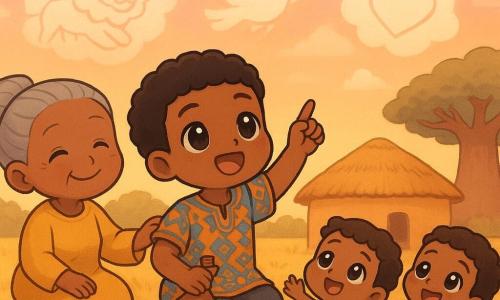
In a warm part of Africa, where the sun walked slowly like a golden drummer, there was a village with red earth and laughing children. Near the village, behind a low fence of woven branches, grew a medicinal herb garden. People said the garden could listen. Not with ears, no—plants do not have ears—but with leaves that fluttered like small green hands.
In that garden worked a woman named Faidah. Her name meant “useful,” and she wore it the way a tree wears its shade. Faidah was faithful—faithful to her neighbors, faithful to her promises, faithful even to tiny seeds that looked like crumbs.
Every morning she greeted the herbs as if they were old friends. “Good morning, Lemon Grass,” she would say. “Good morning, Bitter Leaf.” And the herbs answered in their own way, with scent and softness, with a rustle that sounded like a quiet yes.
One day, the elder who knew the stories came to the fence. His walking stick tapped the ground: tap-tap, tap-tap, like a patient bird.
“Faidah,” he said, “our village needs an anchor.”
An anchor? Faidah looked at the river far away, and then at her dry hands. She did not see any boats.
The elder smiled, as if he could read her thoughts like lines in the sand. “Not an anchor of iron,” he said. “An anchor of roots.”
He pointed to a bare patch beside the herb beds, where the soil lay open like a waiting bowl. “Plant a tree there. A tree that will live long and tell our children, ‘You belong here.'”
Faidah's heart beat a little faster. A tree was not a small thing. A tree was a promise that could not be folded and put in a pocket.
Still, she nodded. “I will plant it,” she said.
The elder's eyes shone. “Good. Courage is not a lion's roar only. Sometimes courage is a woman kneeling in the dirt, saying, ‘I begin.'”
And the garden, listening, listened even more.
Chapter 2: The Seed Like a Secret
Faidah began to search for the right seedling. In the market she saw many things: peppers bright as sparks, baskets woven tight as promises, and tiny fish shining like silver commas. But she did not see the tree she needed.
So she went to those who knew plants as well as they knew their own names. She visited Auntie Mosi, who made healing tea. She visited the beekeeper, whose hives hummed like a choir. She even asked the children, because children notice what grown-ups walk past.
“Have you seen a strong young tree?” she asked.
A boy grinned and said, “I saw a tree trying to dance in the wind!”
A girl giggled and replied, “I saw a seed that was so small, it could hide in a smile.”
Faidah laughed too, because laughter is a light load to carry.
At last she met an old traveler resting under a thorn tree. His clothes were dusty, and his eyes were kind. From his bag he took a little seedling wrapped in damp cloth.
“This is a baobab,” he said softly. “A tree that holds stories in its belly and water in its heart.”
Faidah touched the tiny leaves. They were delicate, yet they stood up straight, like they had good manners.
“Will it live in my garden?” she asked.
“If you give it patience,” the traveler said, “and if you give it courage. A young baobab is like a child. It needs someone to believe in it before it can believe in itself.”
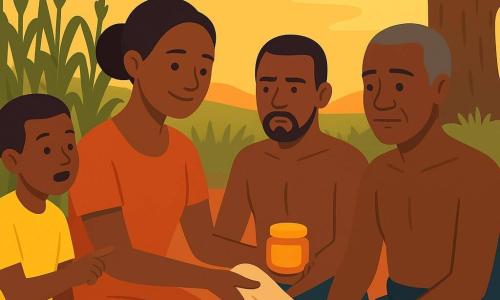
Faidah traded a bundle of dried mint and a gourd of honey for the seedling. She carried it home the way you carry a sleeping baby—carefully, slowly, with a steady breath.
That evening, clouds gathered like friendly elders around a fire. A few drops of rain fell, not a storm, just a gentle tapping—tap, tap, tap—like the sky saying, “Go on.”
Faidah stood beside the bare patch of soil. For a moment she felt the size of the task. What if she planted it wrong? What if goats nibbled it? What if the dry season came early?
Then she remembered the elder's words: not a lion's roar only. Sometimes courage is simply beginning.
She knelt. The soil was cool. She dug a hole and whispered, “Little tree, I am here. I will not forget you.”
The herb garden seemed to lean closer, as if to watch. The leaves of lemon grass shivered, and the bitter leaf nodded. Even the ants paused, as if they did not want to miss the moment.
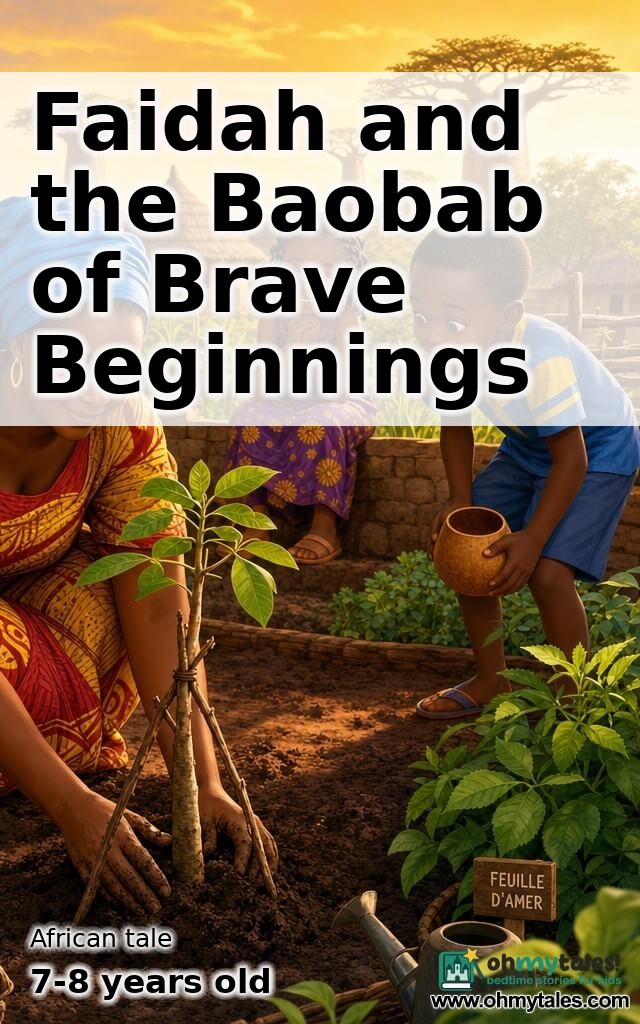
Faidah placed the baobab seedling into the earth. She tucked the soil around it, firm but gentle, like tucking in a blanket. She poured a cup of water and waited until the last drop disappeared.
“Grow,” she said, not loudly, but clearly. “Grow, and teach us to stay.”
Chapter 3: The Day the Wind Tested Her
In the days that followed, Faidah cared for the seedling as faithfully as she cared for the herbs. She watered it at sunrise, when the light was soft as porridge. She built a small fence around it with sticks and twine. She spread dry leaves as mulch, a brown hat to keep the soil from losing its coolness.
The children came to peek. They stood on tiptoe like curious birds.
“Is it big yet?” one asked.
“It is big in its dream,” Faidah replied, and they laughed.
Then, one afternoon, the wind arrived. Not the angry kind that throws things, but the stubborn kind that pushes and pushes like a goat trying to enter a closed door. It made the herb stems sway. It lifted dust into the air. It made Faidah's headscarf flap like a bright flag.
The little baobab bent. It bent low, almost kissing the ground.
Faidah's stomach tightened. She hurried to it, but she did not panic. Panic is like spilled water—you cannot pick it back up. She pressed her hand near the seedling's base and felt the soil. It was loosening.
“Ah,” she murmured, “so this is the test.”
She could have run for help. She could have cried out. But she remembered: courage is beginning, and courage is staying.
Faidah fetched three strong sticks and pushed them into the ground around the seedling. She tied them with twine, making a small triangle of support. She tightened the knots with calm fingers. She added more soil and pressed it down, firm as a promise.
The wind kept pushing. The seedling kept bending. But now it had friends—sticks like older brothers, twine like a gentle arm.
Faidah smiled into the wind. “You may practice your strength,” she said, “but so will we.”
Soon the wind got tired, as wind often does. It softened. It wandered away to bother another place. The herb garden sighed, and the leaves settled back into their ordinary songs.
The baobab still stood, a little crooked, but alive.
That evening, Auntie Mosi visited. She sniffed the air and nodded approvingly. “The garden smells proud,” she said.
Faidah wiped her hands. “It was only wind,” she answered.
Auntie Mosi chuckled. “Only wind? Wind is a teacher. Today it taught you that brave hearts can be quiet hearts.”
Faidah looked at the seedling and felt warmth rise in her chest. The baobab's tiny leaves seemed to shine, as if they had caught a bit of sunlight and decided not to give it back.
Chapter 4: The Basket of New News
Weeks passed, and the baobab grew. Not fast, not like a weed that races, but steadily, the way a drumbeat keeps time. Each new leaf was a small green sentence saying, “I am here.”
The herb garden thrived too. Lemon grass stood tall and sweet. Bitter leaf glowed dark and strong. People came for remedies and left with thanks.
One morning, the elder returned to the fence. His stick tapped: tap-tap, tap-tap. He looked at the young baobab and smiled so widely his cheeks nearly met his ears.
“You have planted more than a tree,” he told Faidah. “You have planted courage.”
Faidah bowed her head, a little shy. “I only did what needed doing.”
The elder lifted a woven basket from the ground. It was covered with a cloth patterned like ripples on water. “Then help me do another needed thing,” he said. “Carry this to the village square.”
Faidah took the basket. It was not heavy, but it felt important, like a drum before it is played. She walked through the paths of red earth, past huts and laughing goats. Children followed, whispering guesses.
At the square, people gathered. Faidah set the basket down and lifted the cloth.
Inside were “new news” for everyone: a small bundle of herbs for a new mother, a string of bright beads from a far cousin, a carved wooden spoon sent by an uncle who missed home, and letters marked with careful ink. There was also a tiny calabash of honey labeled for the school, and a folded cloth for the elder who had been sick.
The village murmured happily. News is food for the heart. Good news is a feast.
The elder spoke in his story-voice, the voice that walked like music. “Listen, listen,” he said. “A tree has been planted in the herb garden. Its roots are learning our names. Its shade will one day cool our heads. And because Faidah's hands were steady, our village remembers how to be steady too.”
Faidah felt her face grow warm, but she also felt tall inside, like the baobab reaching for tomorrow.
A child tugged her sleeve and asked, “Will the tree tell stories?”
Faidah smiled. “Yes,” she said softly. “It will tell the story of a seed that did not give up, and a woman who did not run away.”
The people shared the basket's gifts, and they shared laughter, and they shared plans. The sun leaned closer, pleased, like a grandfather enjoying a song.
And far beyond the square, in the listening herb garden, the little baobab stood with its leaves open. It drank the light. It held the wind's lesson. It waited for the years to come, ready to become an anchor of roots.
For in that village, everyone learned this simple thing: courage is not always loud. Sometimes it is faithful, patient, and planted—one brave day at a time.