The Morning Song
There was a village that hugged the river like a hand holding a drum. The houses leaned together, palms and clay, whispering to one another at sunrise. In that village lived a young woman named Amina, small as a new calabash but brave as a lion's whisper. Her hair braided like the river's twists, her feet used to the song of earth. Each morning she walked the path that smelled of dust and mango, carrying basket and salt and small things that needed mending.
Amina's roof had a tired patch, a strip where rain hummed when clouds passed. She listened to it like a wise elder listens to a story. “If we do not care for our roofs,” her grandmother had said like a drumbeat, “the sky will come down to borrow our warmth.” The words sat in Amina's heart like a seed waiting for rain. So she decided, quietly as a heron, that she would mend the roof before the rains grew loud.
The village nodded and hummed. The elders tapped their feet, the children chased each other in circles, and the goats chewed their thoughts. Amina gathered her reeds, her palm leaves, some clay for mending, and a bundle of songs. She set off toward the port of pirogues where the river kept secrets and fishermen kept stories.
The Port of Pirogues
The port lay like a necklace along the river's throat, beads of canoes and bright cloth. Pirogues leaned in colors—sun-yellow, onion-purple, blue like a kingfisher's wing. Men and women moved like a slow drumroll, voices weaving tales into the air. The water was a mirror that wanted to tell its own tale, and the boats answered with soft creaks.
At the port Amina met the old boatkeeper, Tano, whose beard knew the map of the moon. He laughed like rain in a calabash. “You carry songs in your basket,” he said. Amina smiled and hummed a tune taught by her grandmother — a tune that made the fish turn their bellies in the water and the children grin like bright moons.
The pirogues spoke in wooden sighs. One canoe, painted with a sun and a bird, offered her a plank. Another, with a carved fish, lent her a rope that smelled of salt and old stories. The people at the port remembered the old ways: you give a little, you take a little, and you keep the balance like the river keeps its banks. They tied the plank across two boats for her to rest and work. She sang, and the song braided the work with patience.
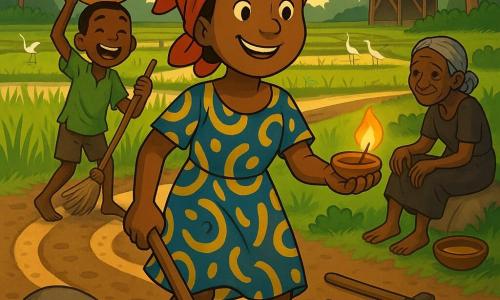
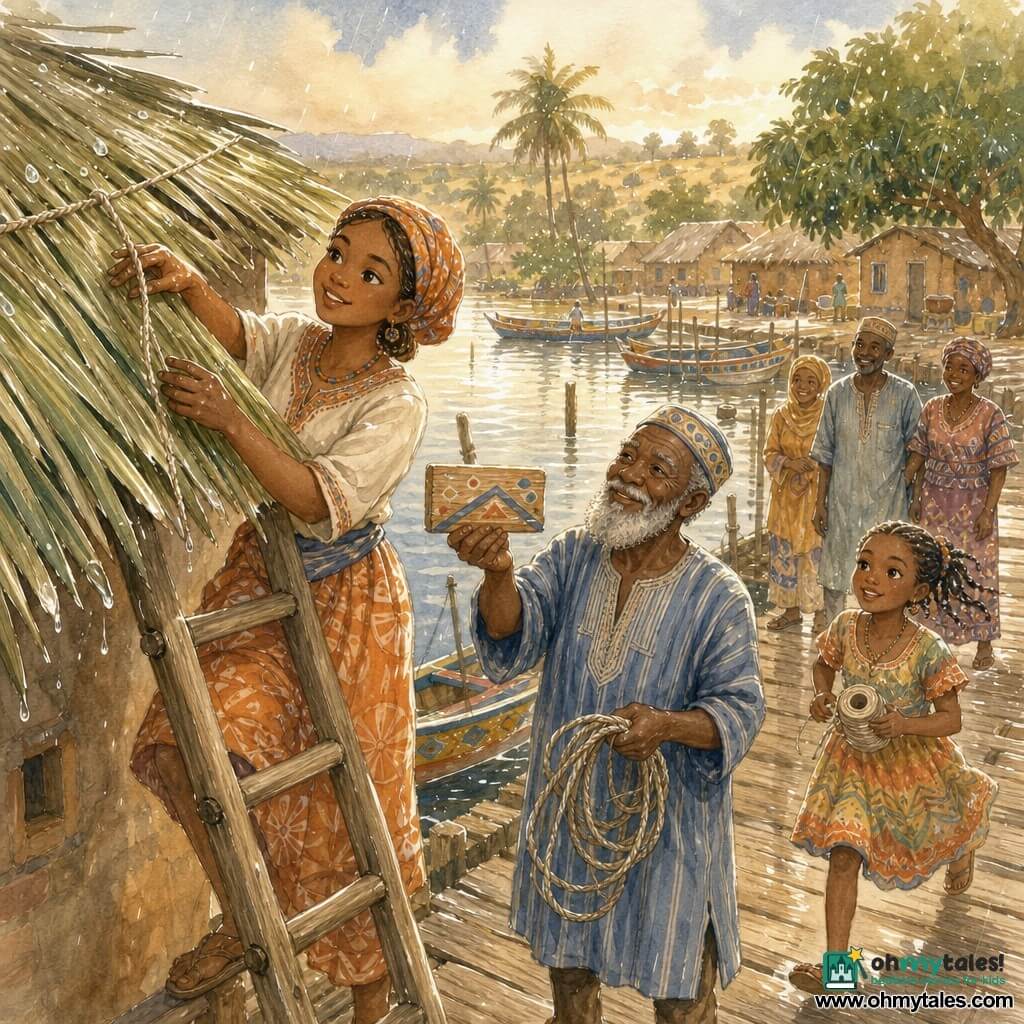
A girl at the port, small and curious, watched Amina and asked, “Will you fix your roof alone?” Amina knelt and touched the girl's hand. “Not alone,” she said softly, “with the river, the pirogues, and the songs of our mothers.” The girl clapped in delight and ran to fetch a coil of twine. From the port came laughter and the soft clinking of tools, like a chorus helping a single voice.
The Work of Hands and Stories
Amina climbed her ladder with palm-leaf bundles on her back, each leaf tied like a promise. The ladder creaked like a storybook opening. From above, the village laughed and watched—an audience of hummingbirds and grandmothers. She laid the palm leaves like scales on a fish, overlapping them so the rain would slide and not find a place to rest. Her hands moved steady as a drum, steady as a heartbeat.
When a stubborn piece would not fit, she remembered the stories of her people: how to bend without breaking, how to sing to the wood so it would soften. She sang low and clear, a rhythm that made the clay in her basket warm and pliant. “Ah, small roof,” she whispered, “we will be good together.” Her voice was a gentle wind that carried a little magic—nothing loud, only the kind that heals small things.
At noon the sun sat like a golden calabash on the edge of the sky. Children brought her mango slices that dripped sweet as promises. The goats looked up, chewing slow as if they were counting the rhythm of her work. An elder came with a pot of tea, the steam curling like a question mark. He offered advice, tapping the roof with a stick, and told a small tale of how once a roof had been mended with a mother's lullaby. Amina bowed her head, thankful for each hand and each tale. Every story was a stitch; every stitch was a story.
Mid-afternoon clouds gathered like wise witnesses. A few drops came, not angry but curious. The new palm leaves tasted them like a newborn tasting rain. The drops found no welcome in the patched roof; they slid away whispering, “We will visit another day.” The village clapped quietly. The port's pirogues sang their soft wooden song, pleased as old friends.
The Herd and the Evening Peace
When the work was done, Amina stood and looked at the roof she had woven. It looked like a turtle's shell, strong and old and patient. The sunlight laid a ribbon across it, and the village hummed itself to evening. She walked down to the port to give thanks, for no one mends alone; the world joins in, in small helpful hands and in songs.
The river took her thanks and carried them like soft leaves. At dusk the herd came down from the fields—cattle moving slow as poems, goats with bells that chimed like tiny moons. They came across the plain and gathered near the edge of the village, a calm tide of fur and horns. Amina watched them, and in their patient eyes she saw the old ways: respect for the land, for one another, for the songs that hold a people together.
The elder who had watched her climb now rested a hand on a pirogue. “You have honored the roof,” he said. Amina answered with a smile that was both shy and proud. “I only followed the path the elders spoke, the path that bends but does not break.”
That night the village slept under the fixed roof, warm as a story told at bedtime. The pirogues rocked gently like lullabies, and the river hummed to itself. The herd lay down close by, a sea of breathing peace. The bells gave one last soft chime, and the moon, round like a generous drum, watched over all.
Amina's work was small and bright, like a stitch in a great cloth. The roof would shelter more laughters and more songs. The village remembered how hands and stories and the river's generosity had joined. The tradition lived with each palm leaf and each shared song, carried on like grain in the hands of those who listen.
And so the night closed with a hush, a soft promise. The herd slept serene, close as a family of stories folded together, and the village dreamt of mornings where every roof is tended, every song remembered, and every hand ready to help.