Chapter 1: The Island That Taught Songs
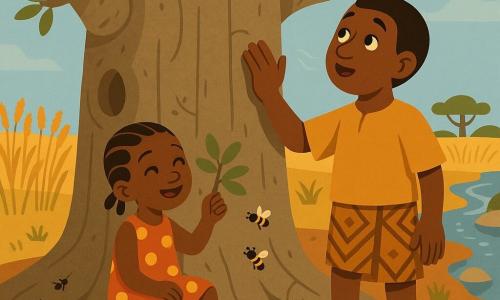
On an island in a wide African river, the morning light lay on the sand like warm cornmeal. The reeds whispered, the water clapped softly, and the mango trees held their leaves like green hands over the path.
Amina lived there, a grown woman with kind eyes and quick feet. Her laugh could hop like a little frog, and her thoughts could run like a gazelle. Too fast, sometimes.
“Amina,” the river seemed to say, “slow, slow.”
But Amina had a problem as bright as a red pepper: she did not like waiting. Not for cassava to cook, not for cloth to dry, not for the canoe to be tied. If waiting was a drum, she wanted to bang it once and be done.
That day she hurried along the sandy track to the village meeting place, carrying a basket of millet cakes on her head.
“Good morning, Auntie Amina!” called Kofi, a boy with dusty knees.
“Good morning! Move, move,” Amina said, smiling but stepping around him. “My feet are late.”
Kofi giggled. “Feet can't be late. They're attached!”
Amina laughed too, but her basket wobbled. A cake almost leaped out like a cheeky fish.
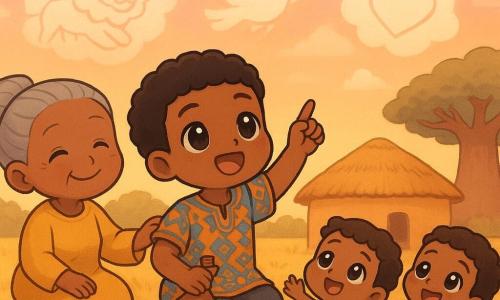
At the big baobab, Old Mama Sira sat on a low stool. She was a storyteller, a griot, with a voice like smooth river stones. Her walking stick leaned beside her, carved with little spirals.
“Amina,” Mama Sira said, “your eyes are racing again.”
Amina sighed. “Mama, I want to do things now. Waiting feels like sitting in a pot without a fire.”
Mama Sira tapped her stick. “Then the island will teach you. The river will teach you. Even the shadow will teach you. Will you listen?”
Amina nodded. She did not know how a shadow could be a teacher, but she was curious. Curiosity is a small bird; it pecks at the mind until you open the door.
Chapter 2: The Calabash of “Not Yet”
Mama Sira sent Amina to fetch water from the far side of the island, where the river hugged the rocks and the current sang louder.
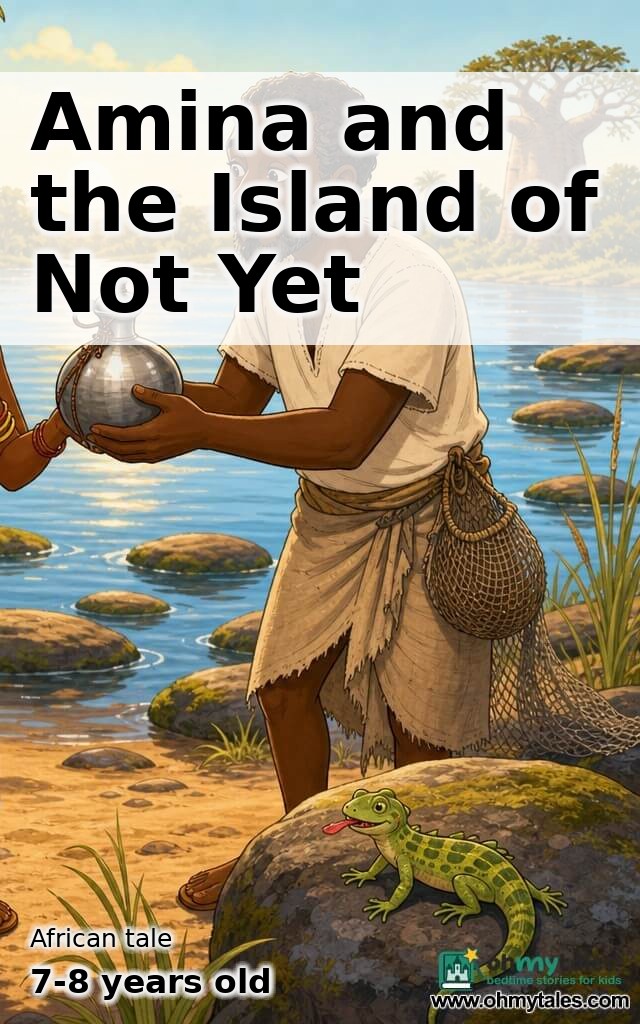
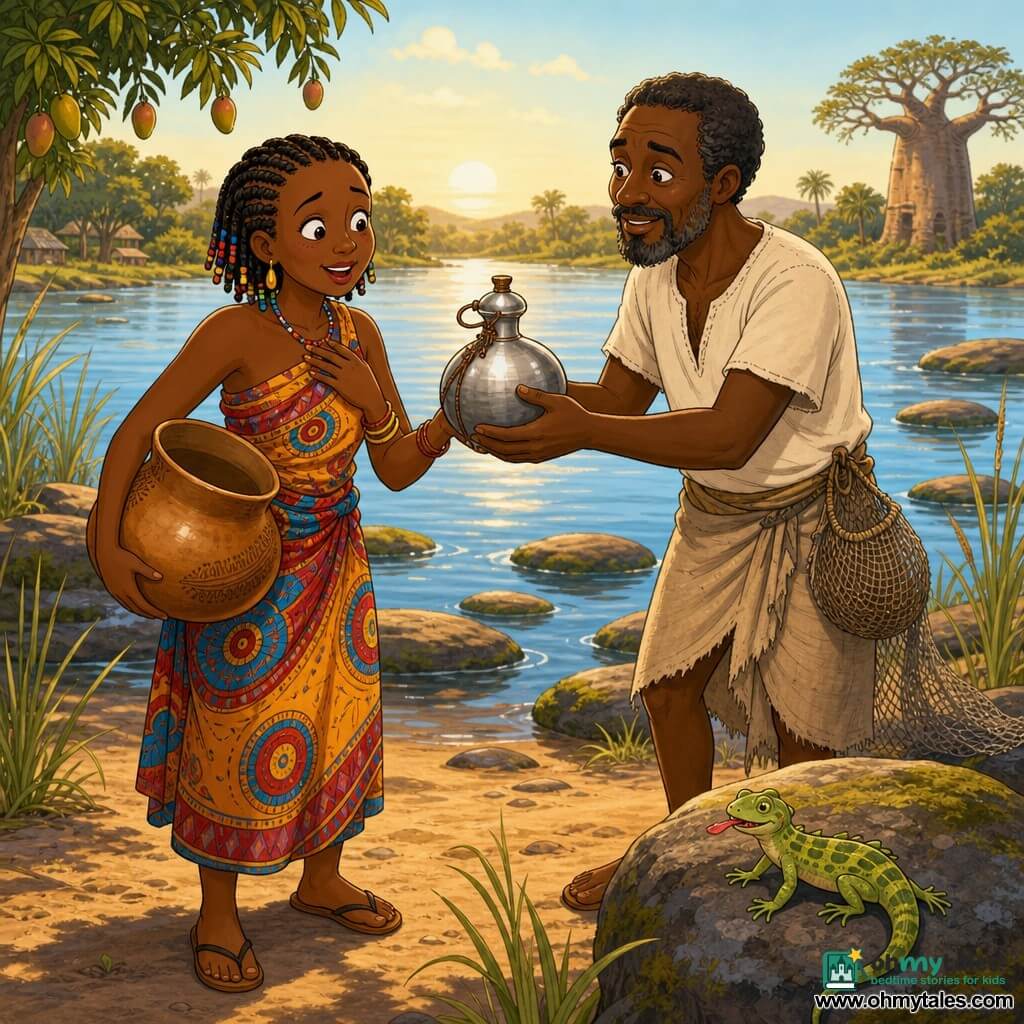
“Take this calabash,” Mama Sira said, handing her a shiny gourd. “But do not drink until you reach the singing rocks.”
Amina lifted it. It felt cool, promising, full.
“Why can't I sip now?” Amina asked.
Mama Sira's eyes twinkled. “Because ‘not yet' is a seed. If you plant it, it grows into wisdom.”
Amina walked, and the sun walked with her. The path curled between tall grasses. Birds stitched bright notes into the air. The calabash bumped against her hip and whispered, “Drink, drink.”
After a while her mouth became dry as a broom. She saw a small lizard sunning itself on a stone.
“Little lizard,” Amina said, “is it far?”
The lizard blinked slowly, as if time was honey. “Far is just far,” it seemed to say with its sleepy eyes. “Your hurry will not make it shorter.”
Amina snorted. “Easy for you. You don't carry water.”
She took one tiny sip. Just one. The river would not notice, she told herself.
But the sip became two. The water was sweet as fresh rain.
When she finally reached the singing rocks, she tipped the calabash to pour… and only a little trickle came out.
“Oh!” Amina groaned. “My calabash has become a gossip. It told my thirst all its secrets.”
At the rocks, a fisherman named Badu was mending his net. He looked up. “Amina, you are bringing water for Mama Sira?”
“Yes,” Amina admitted, “but I drank it. My mouth was yelling at me.”
Badu chuckled kindly. “My friend, a net is made one knot at a time. If I pull too fast, it tangles. If I pull steady, it holds fish.”
He handed her his water flask. “Drink now. Fill the calabash again. Take your time. The river is not going anywhere.”
Amina filled the gourd properly, and this time she walked back without sipping. She kept repeating, softly, like a drumbeat in her chest: “Not yet. Not yet. Not yet.”
When she returned, Mama Sira drank and nodded. “You carried water and you carried words. Which was heavier?”
Amina smiled sheepishly. “The words.”
Mama Sira laughed. “Good. Words can train the feet.”
Chapter 3: The Weaving of Waiting
The next lesson came in the weaving hut, where women worked with bright threads. The loom stood tall, like a wooden giraffe, its neck reaching up and up.
Amina had promised to help weave a cloth for the river festival. She wanted it finished before the afternoon.
“Quick, quick,” Amina said, grabbing a shuttle.
Nala the weaver raised an eyebrow. “Quick can be a thief. It steals straight lines and leaves crooked ones.”
Amina began to weave fast. The threads crossed like busy ants. For a moment the cloth looked fine. Then—snag! The yarn knotted into a stubborn lump.
Amina tugged. The knot tightened like a tiny fist.
“Oh no,” Amina whispered.
Nala put a gentle hand on her arm. “Listen, Amina. Cloth is like a story. If you rush the beginning, the middle falls over.”
Amina frowned. “But the festival—”
“The festival is patient,” Nala said. “It is coming like the moon. You cannot pull the moon with a rope.”
Together they loosened the knot. Nala showed her how to breathe, how to place each thread, how to count softly: “One, two… one, two…”
Amina tried again. Slower. The cloth began to grow smooth, a river of color: gold like sun, blue like deep water, green like new leaves.
As they worked, children passed by singing. Someone roasted plantains, and the smell floated in, warm and friendly.
Amina felt something new: a quiet inside her, like a small lake. Waiting was not an empty pot. Waiting could be a pot that gathers good smells.
When the cloth was done, Nala held it up. “See? Patience makes patterns.”
Amina touched the fabric. “It feels like a hug.”
Nala smiled. “That is because it was made with calm hands.”
Chapter 4: The Shadow on the Track
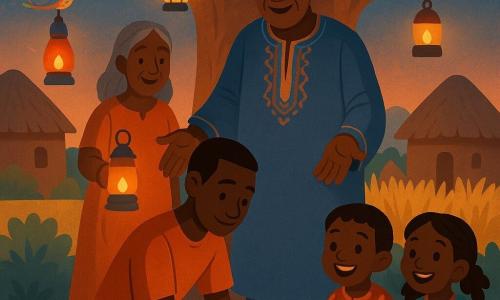
On festival day the island danced. Drums talked. Anklets chimed. The river wore sparkling light like jewelry.
Amina carried the woven cloth to the meeting place, and Mama Sira walked beside her.
“You have learned something,” Mama Sira said.
Amina nodded. “Waiting is not doing nothing. Waiting is doing the right thing, little by little.”
Mama Sira's stick tapped the ground. “Say it again, so your ears can keep it.”
Amina said it again. Then she added, “And when my mouth yells, I can answer, ‘Not yet.'”
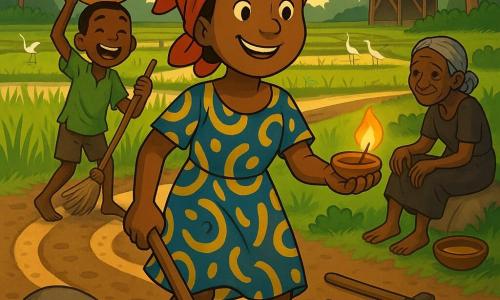
They reached the sandy track where the festival path began. Children ran ahead, but even their running felt playful, not pushy. Amina looked at the ground and saw her own shadow.
It stretched long and thin across the track, pointing forward like a quiet finger.
Amina paused. She did not rush. She watched the shadow lengthen as the sun leaned toward afternoon.
“What are you telling me?” Amina asked softly.
The shadow said nothing, but it showed her: time moves. It moves without being pushed. It moves like the river—steady, steady.
Mama Sira spoke in a gentle, singing voice. “A shadow grows when the sun travels. Your patience grows when you travel with time, not against it.”
Amina smiled, and her smile was slow and sure. She stepped onto the track, not racing, not dragging—just walking in rhythm.
Behind her, laughter rose like birds. Ahead of her, the long shadow lay on the path, calm as a promise.
And Amina, who once chased “now” like a runaway goat, walked with “not yet” as a friend—learning, day by day, to wait.