Chapter One: The Whispering Baobabs
Long ago, when the sun danced in golden circles and the nights sang with the voices of crickets, there lived a man named Mosi in a small village by the river. Mosi's heart was as wide as the open savannah, but sometimes, he acted before thinking, like a monkey leaping from one branch to another.
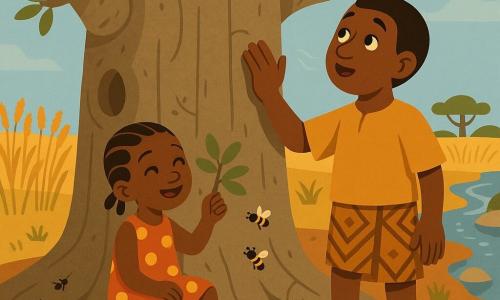
Mosi was known for his laughter that bubbled like a spring and his big hands that helped old and young. But he was also famous for his curiosity, which buzzed around him like a swarm of bees. And in that village, there stood two baobabs, tall and strong, their trunks twisted together like the arms of old friends. The villagers called them the Twin Baobabs and whispered that the winds told their secrets there.
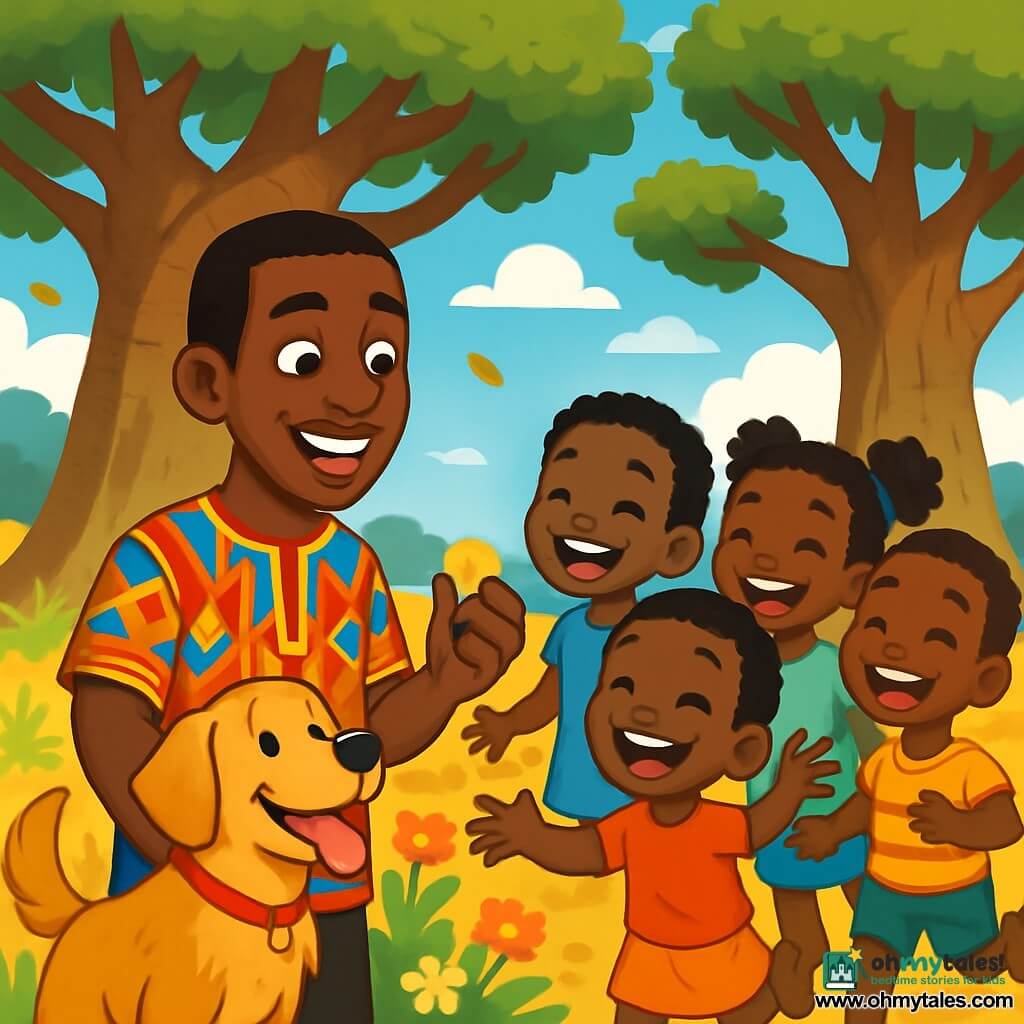
One bright morning, Mosi woke to the sound of the wind tapping on his window. It was not a gentle wind, but a playful one, swirling red dust and singing in a language only the wise could understand. Mosi stretched, yawned, and called to his dog, Bemba, whose fur was as golden as the sun on ripe millet.
“Come, Bemba!” Mosi said, his voice full of excitement. “Today, we will listen to the winds at the Twin Baobabs. Maybe they will share a secret with us.”
Bemba barked, wagging his tail like a drum, and together they set off. The journey was long, but the path was painted with wildflowers and butterflies, and the sun winked at them through the leaves.
As they walked, Mosi hummed a song, and Bemba trotted beside him, sniffing the air. The baobabs grew bigger and bigger until they reached the Twin Baobabs, their roots hugging the earth and their branches tickling the sky.
Mosi placed his ear against the rough bark. “What do you hear, Mosi?” asked Bemba, tilting his head.
“I hear the wind, Bemba,” Mosi whispered. “It says, ‘Listen, listen, listen well. The answer's hidden where the wise dwell.'”
Bemba wagged his tail, but his eyes were serious. “Let's not be too hasty, Mosi. Remember, not every secret is meant to be chased.”
But Mosi, like the river after a storm, could not be stopped.
Chapter Two: The Wise Man's Mistake
The sun climbed higher, painting the world in gold. Mosi and Bemba sat beneath the shade of the Twin Baobabs, their backs against the cool bark. The wind rustled the leaves, whispering secrets in a voice soft as cotton.
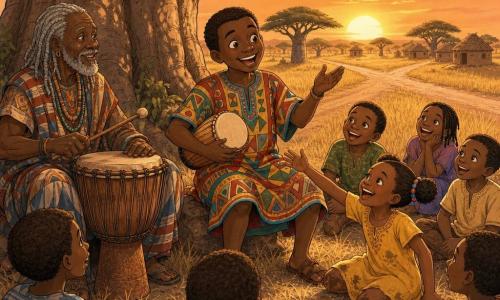
Suddenly, an old man appeared, his beard as white as the clouds and his eyes twinkling like stars. It was Baba Kato, the village sage, who always had a story in his pocket.
“Greetings, Mosi. Greetings, Bemba,” Baba Kato said, sitting down with a sigh. “What brings you to the Twin Baobabs?”
“We want to learn the language of the wind,” said Mosi, his eyes shining.
Baba Kato chuckled, his laughter rolling like thunder after rain. “Ah, the wind's language is tricky. Sometimes, it speaks in riddles. Sometimes, it speaks in silence.”
“Can you teach us?” Mosi asked.
Baba Kato nodded, then pulled from his bag a small drum. “The wind listens to those who listen to others. If you wish to understand, you must first give something of yourself.”
Mosi frowned. “What should I give?”
Baba Kato smiled, but his eyes were far away. “Share your millet, share your song, share your time. Only then will the wind trust you.”
Mosi scratched his head, puzzled. “But I don't have any millet with me.”
Baba Kato's eyes twinkled. “Then you must find a way to share. The wind will test you, and so will your friend Bemba.”
Bemba barked, wagging his tail. “I will watch over you, Mosi. Sometimes, you forget to listen.”
Mosi grinned. “I'll do better, Bemba. I promise.”
But as the day grew hotter, Mosi's stomach rumbled. He looked at Baba Kato, who was eating roasted maize, and his mouth watered. Without thinking, Mosi reached out and took a piece of maize without asking.
Baba Kato laughed. “Ah, Mosi! Quick as a squirrel, but slow to remember. To share, you must ask, and to ask, you must respect.”
Mosi blushed, feeling as small as an ant. “I'm sorry, Baba Kato. I was hungry and forgot my manners.”
Bemba licked Mosi's hand. “It's all right, Mosi. We all make mistakes.”
Baba Kato nodded. “Even the wise can make mistakes. Once, I mistook the sound of the wind for the cry of a bird and ended up chasing feathers all day!”
Mosi laughed, the weight in his heart lifting. “What did you learn, Baba Kato?”
“That sometimes, chasing the wrong thing teaches us the right lesson,” the old man replied, eyes sparkling.
Chapter Three: The Test of Generosity
As the afternoon shadows grew long, the wind wrapped around the Twin Baobabs like a soft blanket. Mosi and Bemba listened as Baba Kato told stories of the past, each tale a bead on the necklace of time.
Suddenly, a group of children ran up, their laughter bubbling like a stream. They were hungry and tired from playing in the fields.
Mosi remembered Baba Kato's words. He reached into his bag and found only a small square of millet bread his mother had given him. It was not much, but it was all he had.
Bemba looked at the bread, then at the children. “What will you do, Mosi?”
Mosi thought of eating the bread alone, but his heart pulled him in another direction. He broke the bread into small pieces and handed them to the children. Their eyes sparkled with joy, and their hands clapped in delight.
“Thank you, Mosi!” they cheered, their voices rising like birds at dawn.
Bemba wagged his tail. “You did well, Mosi. You shared what you had, even when it was little.”
Mosi smiled, feeling warm inside. “It felt good, Bemba. Like the sun after rain.”
Baba Kato nodded, his eyes proud. “The wind has seen your heart, Mosi. When you give, you don't lose. You grow.”
Just then, the wind whistled through the baobab branches, singing a new song. Mosi closed his eyes and listened. The words were clear as water:
“Generosity is the seed that grows into a mighty tree. What you give returns to you, many times over.”
Chapter Four: The Secret of the Winds
Night tiptoed softly across the sky, painting the world in blue and silver. The Twin Baobabs glowed in the moonlight, their shadows dancing on the ground.
Mosi, Bemba, and Baba Kato sat together, sharing stories and laughter. The wind, gentle now, circled them like a soft drumbeat.
“Baba Kato,” Mosi asked, “do you think the wind is happy with us tonight?”
The old man smiled, stroking his beard. “The wind is always watching, Mosi. It loves those who share, who listen, who care.”
Bemba barked softly. “And those who learn from their mistakes.”
Mosi nodded, feeling wiser than before. “I've learned that to listen to the wind, I must first listen to others. And to give, even when I have little, is to open my heart.”
Baba Kato's eyes twinkled. “You have learned well, Mosi. The world is a circle, and what you send out will return to you.”
As they spoke, a gentle breeze lifted the crumbs of millet bread from the ground, spinning them into the air. The wind carried the crumbs high into the baobab branches, where birds would find them at dawn.
Mosi laughed. “Look, Bemba! Even the birds will share in our meal.”
Bemba wagged his tail, eyes shining. “Sharing makes the world bigger, Mosi. And our hearts, too.”
Chapter Five: The Square of Millet
The next morning, the village awoke to the sound of singing. Mosi and Bemba returned from the Twin Baobabs, their steps light as feathers. The children greeted them with bright smiles, and even the elders nodded in approval.
Mosi's mother was waiting with a warm square of millet bread, fresh from the fire. She broke it into four pieces and handed one to Mosi, one to Bemba, one to Baba Kato, and one to a passing child.
“See,” she said, her eyes kind, “when we share, there is enough for everyone.”
Mosi took his piece and smiled at Bemba. “Today, we learned the language of the wind.”
Bemba barked. “And the language of the heart.”
Baba Kato joined them, his laughter ringing like bells. “The greatest wisdom is in giving. When you share, you become part of the song the wind sings through the baobab trees.”
And so, under the shade of the Twin Baobabs, the village shared their meal, their stories, and their laughter. The wind danced above them, carrying their happiness across the savannah, from one heart to another.
And Mosi knew, deep inside, that generosity was the seed from which all good things grow—a seed as small as a crumb of millet, yet strong enough to make the world bloom.