Chapter 1: The Terrace Above the River
The river looked calm from far away—just a silver ribbon sliding through green hills. Up close, it sounded like it was always in a hurry, hushing over stones and tugging at roots. Above it rose the river terrace: a long, flat shelf of earth and gravel, high enough to stay dry when the river raged.
Daniel Crowe stood at the edge of the terrace with a map in one hand and a pencil behind his ear. He wasn't the kind of explorer who ran into the wild yelling. He measured things first. He listened. He checked the wind. Then he stepped forward.
“Camp goes here,” he said, tapping a spot near a cluster of alder trees. “Sheltered, close to water, not too close to trouble.”
Mara, the team's geologist, squinted at the terrace wall where layers of sand and old pebbles showed like a cake sliced open. “That's a textbook terrace. It's been here for ages.”
“Long enough to hide something,” Daniel said, and his voice had that careful excitement he tried to keep under control.
Tariq, their logistics expert, hauled a crate off the pack raft and groaned dramatically. “If the terrace is hiding treasure, I hope it's the kind that walks itself into camp.”
Behind him, Lena, the youngest member of the team at sixteen, hopped down with a coil of rope. She had quick eyes and quicker questions. “Why are we so focused on the terrace again? Why not the caves near the cliff?”
Daniel unfolded the map on a flat stone and weighed the corners with smooth river rocks. “Because the old records mention a ‘high river shelf' where travelers left offerings before crossing. If people did that for centuries, things get buried. And buried things—” he glanced toward the terrace wall “—are sometimes protected by the earth itself.”
Mara brushed dirt from her hands. “Or trapped by it.”
Daniel nodded. “Exactly. Which is why we do this properly.”
He drew a simple sketch: a line for the terrace edge, circles for people, squares for packs. “Our goal today is not to be heroes,” he said. “It's to distribute the load so we can move safely. We go slower, we go farther.”
Tariq lifted an eyebrow. “So you're saying my heroic suffering is unnecessary?”
“Completely unnecessary,” Daniel said, and even his serious face softened.
They had six packs: two heavy, two medium, two small. Daniel knelt beside them and began shifting items like a chess player. He weighed the climbing gear against the food, the surveying kit against the medical bag.
“Lena, you take the rope and the lightweight tent. Mara, the sample bags and the field notebook. Tariq, you're strongest—” Daniel paused, just long enough for Tariq to look proud, “—so you get the cooking gear and half the water.”
Tariq's pride drooped. “Half the water is not a compliment.”
“It is if you drink it,” Mara said.
Daniel shouldered the heaviest pack himself. Not because he wanted to look brave, but because he knew his own pace, his own balance. A measured leader was still responsible for the hard parts.
As they climbed along the terrace, the ground changed under their boots. Gravel crunched, then softened into sandy soil. The air smelled of crushed leaves and sun-warmed stone. Dragonflies zipped over the river below like tiny helicopters with glass wings.
Daniel stopped beside a low mound near the terrace wall. It didn't look like much—just a hump in the earth, sprinkled with small stones. But the shape was too deliberate.
Mara crouched and touched the surface gently. “This was piled. A long time ago.”
Lena leaned closer. “Like a grave?”
“Possibly,” Daniel said. His voice grew quieter. “Or a marker.”
Tariq shifted his pack and frowned. “We are not digging up someone's great-great-great-grandparent, right?”
“We're not digging anything,” Daniel said firmly. “Not yet. And not without reason. Respect first.”
He took out small flags—bright orange—and placed them around the mound without touching it again. “We document. We observe. We don't disturb.”
Lena watched, thoughtful. “So exploring doesn't mean grabbing.”
“Exploring means learning,” Daniel said. “And learning means leaving a place alive enough for others to learn from too.”
They moved on as afternoon light slanted through the trees. The terrace stretched ahead like a hidden road above the rushing river, and Daniel felt the familiar pull of mystery—like a door you could almost see in the fog.
Then Tariq stopped so suddenly that everyone almost bumped into him.
“Uh,” he said. “Either this terrace is trying to swallow my boots, or there's a hole.”
Daniel stepped forward. In the sandy ground was a narrow depression, half covered by leaves. It sloped down, as if the earth had sagged.
Mara's eyes sharpened. “Sinkhole. Small, but fresh.”
Daniel's hand went up. “No one steps closer.”
Lena swallowed. “So the terrace isn't as solid as it looks.”
Daniel stared at the sagging ground, then at the terrace wall behind it. Old layers. Old water. Old secrets.
“Not solid,” he agreed. “But not unbeatable. We just have to be smarter than it is.”
Chapter 2: The Load and the Line
They backed away until the ground felt firm again. Daniel crouched and pressed his palm into the sand. It held. He pressed again. Still held. He moved sideways, testing, like someone trying to find the edge of a thin lake of ice.
Tariq watched, tense. “If you fall in, I'm writing ‘Daniel tested gravity' on your memorial plaque.”
Daniel didn't look up. “Make sure you spell my name right.”
Mara pulled out a small metal probe and pushed it into the ground near the depression. It slid in too easily, like stabbing a cake. She frowned. “There's a void underneath. Could be from old burrows. Could be from water cutting channels inside.”
Lena pointed at the terrace wall. “What if it's an entrance?”
Daniel's eyes narrowed, not with fear but with focus. “If it is, it's unstable. We don't go in. We don't even stand on it.”
He stood and took inventory in his head: ropes, stakes, a light shovel, measuring tape. Then he looked at his team—sweaty, alert, carrying their future meals on their backs.
“The goal doesn't change,” he said. “We distribute the load. We distribute the risk.”
Tariq rubbed his shoulder. “I'd like to distribute this pack to a donkey.”
Daniel unbuckled his own pack and set it down carefully on a flat rock. “We're shifting. Heavy items go in the center of the group, not on the edges. That way if someone slips, they're not pulled sideways. Lena, swap with me.”
Lena blinked. “Your pack is heavier.”
“Yes,” Daniel said, already handing her the lighter one. “I'm steadier on loose ground.”
Mara raised an eyebrow. “Measured, remember?”
Daniel gave her a quick, dry look. “Measured doesn't mean I can't lift things.”
They tightened straps and checked buckles. Daniel tied a rope around his waist and clipped it to the coil, then handed the other end to Tariq.
“You want me as your human anchor?” Tariq asked.
“Temporary,” Daniel said. “You're stable. If I step somewhere wrong, you pull me back. If you step somewhere wrong—”
Mara interrupted. “We pull you back and then laugh lovingly.”
Tariq sighed. “This team is a fountain of support.”
They advanced in a wide curve around the depression, staying closer to the trees where roots gripped the soil. Daniel moved first, planting each boot carefully, feeling for hollow spots. The rope stayed loose, but it was there—a promise.
The terrace quieted as they went. Even the river sounded farther away, like it was trying not to distract them.
When they reached solid ground beyond the sinkhole, Daniel raised a hand and the team stopped. He exhaled slowly.
“Good,” he said. “Now we mark the hazard.”
Lena pulled out the bright flags again. “Like the mound?”
“Like the mound,” Daniel said. He planted flags in a wide circle, then sketched the location in his notebook with a simple note: FRESH SUBSIDENCE—NO ENTRY.
Mara gazed at the depression. “If it is an entrance, it might lead somewhere important.”
“It might,” Daniel agreed. “But if we force it, we destroy what we're trying to understand. Some doors stay closed until you know how to open them without breaking the frame.”
Tariq looked at the terrace wall, where the layers seemed to lean like frozen waves. “So what's our next move, Captain Careful?”
Daniel folded the map again. “We reach the survey point. There's supposed to be an exposed section farther west. Natural erosion. No digging. We look for signs—carvings, stones out of place, anything that suggests human work.”
They walked on. The sun dipped lower, turning the river into a path of hammered copper. Birds called from the trees, sharp and bright.
After half an hour, the terrace narrowed and the wall rose higher. The ground underfoot became pebbly again, like the earth had remembered it was made from the river's leftovers.
Then Daniel saw it: a section where the terrace wall had collapsed, leaving a clean face of soil and gravel. And in that face, there was something that didn't belong.
A line of stones, set in a pattern—flat slabs stacked with purpose.
Lena whispered, “That's not natural.”
Mara stepped closer but kept a respectful distance. “It's a retaining wall. Or… a seal.”
Tariq lowered his pack with a thud. “Please tell me the ancient mystery comes with ancient instructions.”
Daniel's pulse thudded in his ears, but he kept his voice steady. “We observe first.”
He took out a tape measure and noted the height and width. Then he photographed the stone line, the surrounding soil, the layers above and below. He traced the outline in his notebook, careful as if the drawing itself mattered.
Lena stared at the stones. “So someone built this into the terrace.”
“Long ago,” Daniel said. “And if they sealed something, they probably wanted it to stay sealed.”
Mara's expression softened. “Sometimes people seal things to protect them. From floods. From thieves. From time.”
Daniel nodded. “Or to protect others from what's inside.”
Tariq made a sound halfway between a laugh and a gulp. “Comforting.”
Daniel crouched and examined the stones without touching. He noticed fine scratches—straight lines where rock had been worked, not cracked. A careful hand had been here. A careful mind.
He stood. “We don't open it today.”
Lena looked disappointed. “But—”
“But we can learn without breaking,” Daniel said. “We can find another way in. Or another way to understand. Tomorrow we survey the area around it and check for safer access points.”
The light was fading. They set camp back near the alder trees. As the fire crackled and the river whispered below, Daniel lay awake, staring at the dark shape of the terrace edge.
Mysteries weren't puzzles to rip apart. They were stories. And stories deserved patience.
Chapter 3: The Map That Wasn't on Paper
Morning arrived with cold mist crawling up from the river. It wrapped the terrace in a pale scarf, dampening sound. Even Tariq's complaints came out quieter.
Daniel gathered the team near the sealed stones after breakfast. “Today is a survey,” he said. “We spread out in pairs. We keep line of sight. We mark anything unusual. And we watch our footing.”
Lena practically bounced. “I'm with Mara?”
Mara nodded. “You're my assistant and my reminder not to lick rocks.”
“I only did that once,” Lena protested.
Tariq pointed at Daniel. “I want it noted that I offered to lick no rocks at all, ever.”
Daniel paired with Tariq, partly because Tariq was observant in a practical way—he noticed straps, scuffs, footprints. Useful things explorers sometimes missed when they stared at grand mysteries.
They moved along the terrace edge, scanning the ground for patterns: stones arranged too neatly, patches of soil that didn't match, plants growing in odd lines. The mist thinned, revealing sunlight like a spotlight moving across the scene.
Daniel stopped near a cluster of ferns. The ground dipped slightly, but not like the sinkhole. This dip felt older, settled.
He crouched. There, half hidden under leaves, was a stone with a smooth, worn surface. On it were faint grooves—curving lines that looked like waves.
Tariq leaned in. “Is that… art?”
“It's a marker,” Daniel murmured. He brushed away leaves with a twig, not his fingers. The grooves formed a simple image: a river bend, a triangle that could be a hill, and a short line that ended in a small circle.
Lena and Mara came running when Daniel called softly. Mara's eyes widened. “That's a map.”
Lena traced the air above it, careful not to touch. “River, hill, and… a dot.”
Daniel stared at the dot. “A location.”
Tariq crossed his arms. “So the terrace comes with directions after all.”
Mara squinted toward the real river. “If that bend is downstream, and that triangle is the hill with the split pine…”
Lena snapped her fingers. “The split pine is near the sinkhole!”
Daniel's stomach tightened. The sinkhole. The unstable ground. The place he had told everyone to avoid.
He forced himself to breathe. “We don't go onto the weak area,” he said. “But we can approach from the tree line again. Carefully. Roped.”
Tariq raised a hand. “And the load distribution plan?”
“Still,” Daniel said. “Even more.”
They returned to camp briefly to adjust. Daniel took extra rope and a small set of stakes. Mara packed the first-aid kit at the top of her bag. Tariq redistributed water so no one was overloaded. Lena carried only light gear—flags, notebook, and a compact flashlight.
“We move like a spiderweb,” Daniel said. “Connected. If one strand fails, the rest holds.”
At the sinkhole, the flagged circle looked more threatening in daylight. The ground inside had sagged further, leaves sliding toward the center as if pulled by an invisible hand.
Daniel anchored a rope around a sturdy alder. Tariq anchored the second rope around another tree, creating a safe line between them. Daniel clipped in.
Lena watched with wide eyes. “It's like a zip line, but… boring.”
“Boring is excellent,” Daniel said. “Boring means safe.”
He advanced along the tree-root edge, where the soil was firm. With the rope supporting him, he leaned forward to peer into the depression from a distance.
The hole wasn't deep enough to see a tunnel. But Daniel noticed something else: on the far side, where the earth had cracked, a slab of stone protruded—flat, worked, different from the natural gravel.
Mara whispered, “That's not just erosion.”
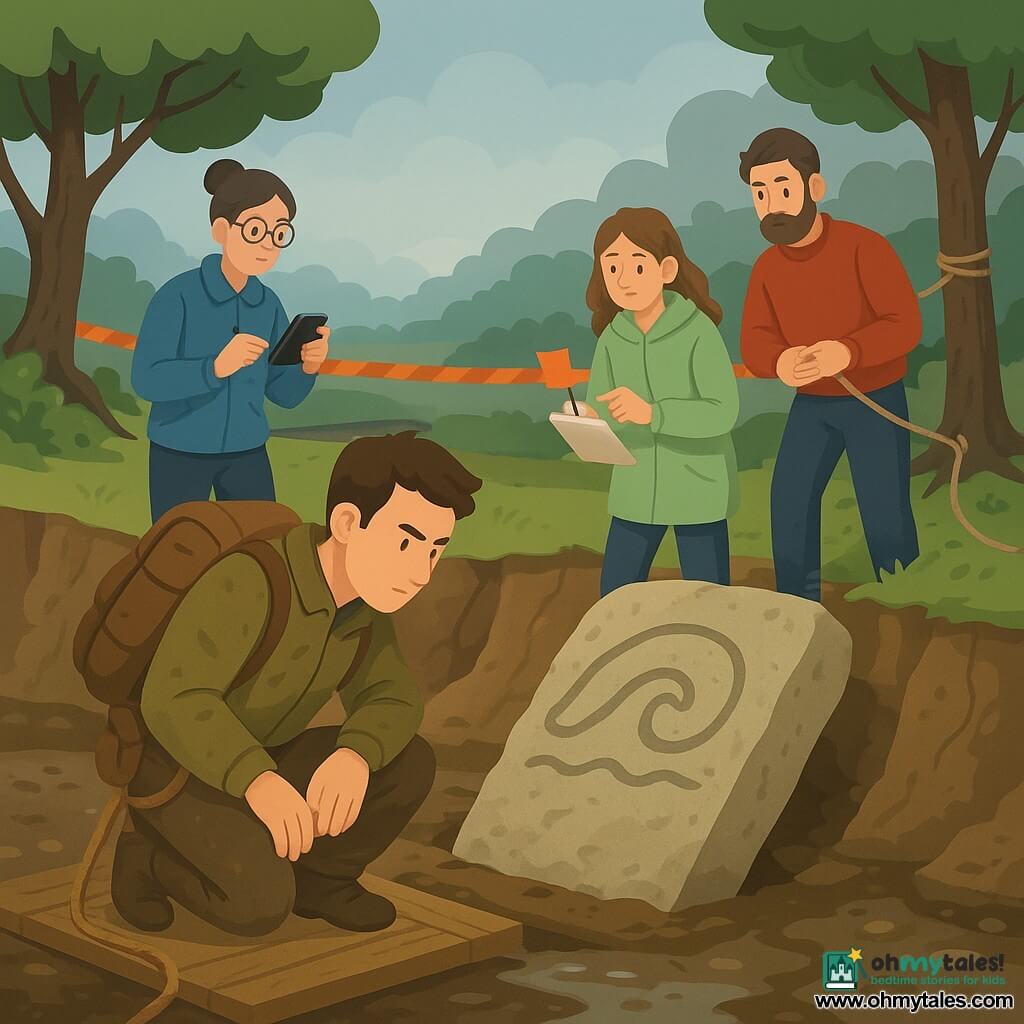
Daniel nodded. “A stone cap. Like a lid.”
Tariq swallowed. “So the sinkhole is opening… on top of something.”
Daniel's mind raced. Ancient people might have built a chamber into the terrace and covered it. Over centuries, water could have carved space around it. Now the terrace was giving up its secret on its own—dangerously.
He backed away to solid ground and unclipped. “We do not step into the flagged area,” he said. “But we can stabilize the edge.”
Mara frowned. “How?”
“Weight distribution,” Daniel said. “Not just for packs. For the land.”
He pointed to a safer zone where roots were thick. “We place planks and flat stones there, creating a temporary platform. It spreads our weight. No sudden pressure on one point.”
Tariq's eyes lit up. “So all those times you made me carry the planks—”
“Were moments of visionary leadership,” Daniel said.
They worked for an hour, sweating despite the cool air. They slid two lightweight boards from their gear and laid them across the firmest root network. They added flat stones on top to keep the boards from shifting. Daniel tested the platform with a careful step, then a second.
“Stable,” he said.
From the platform he could see the stone slab more clearly. Along its edge was a carved symbol: the same wave-line as on the map stone.
Lena's voice trembled with excitement. “It matches.”
Daniel felt awe rise like the river in spring. But he kept his hands still. “This is heritage,” he said quietly. “Whatever is under there, it survived because people respected it. We will too.”
Mara nodded. “We document. We inform the local heritage office. We protect the site.”
Tariq pointed toward the terrace wall where the sealed stones were. “So we have two sealed things: a wall and a lid.”
Daniel looked between them. “Two parts of one story,” he said. “And the terrace is trying to tell it before it collapses.”
A sudden crack snapped through the air, sharp as breaking ice.
Everyone froze.
A thin line split the sand near the flagged circle, widening by a finger's width.
Lena whispered, “Daniel…”
Daniel's heart pounded, but his voice stayed calm. “Back. Now. Slow.”
They retreated one step at a time, staying on the platform, then onto firm ground. The crack widened, then stopped, as if the earth had taken a breath and decided not to exhale.
Tariq let out a shaky laugh. “Boring. I would like more boring.”
Daniel stared at the fracture line. “We're out of time,” he said. “If the terrace collapses, it could destroy what's below. We need to secure the area and find a way to protect it without interfering.”
Lena clenched her fists. “How do you protect something you can't touch?”
Daniel looked at the river, relentless and patient. “With planning,” he said. “And courage that knows when to stop.”
Chapter 4: The Night of Rising Water
That afternoon, clouds rolled in like bruises spreading across the sky. The wind shifted, carrying the sharp smell of rain.
Mara checked her small weather device and frowned. “Storm coming. Big one.”
Tariq stared upward. “Of course. The terrace reveals ancient mysteries and the sky decides to add special effects.”
Daniel's mind went into problem-solving mode. A storm meant the river could rise. A rising river could undercut the terrace, triggering collapse—right where the sinkhole was opening.
“We secure camp higher,” Daniel said. “And we secure the sites.”
Lena looked toward the flags fluttering faintly. “We can't build a wall.”
“No,” Daniel agreed. “But we can reduce damage.”
They moved quickly. Daniel directed Tariq to relocate food and gear to a higher patch of ground away from the terrace edge. Mara and Lena gathered extra flags and reflective tape.
Daniel set stakes in a wide perimeter around the sinkhole and the sealed wall, connecting them with bright tape. It wouldn't stop the earth from falling, but it would stop a person from wandering into danger in the rain.
Then Daniel did something that made everyone pause: he took the time to place small signs—simple plastic cards with writing.
HAZARD—UNSTABLE GROUND
ARCHAEOLOGICAL SITE—DO NOT DISTURB
Lena watched. “Do you really think someone will come here tonight?”
“Maybe not,” Daniel said, hammering a stake firmly. “But respect isn't only for when people are watching. It's for always.”
The first raindrops struck like pebbles. Within minutes, the storm was a full drumbeat on leaves and tents. The river's voice grew louder, rougher, as if it were angry at being ignored.
Inside the main tent, the team sat close with headlamps glowing softly. Wind shoved at the fabric. Rain ran in streams down the sides.
Tariq tried to lighten the mood. “On the bright side, we won't need to carry water tomorrow.”
Mara snorted. “On the less bright side, we might need to carry the river.”
Daniel listened. The storm had a rhythm, but beneath it he heard something else: a low rumble, like distant thunder, except it didn't fade. It continued.
He unzipped the tent flap a few inches and peered out. The river below was no longer copper. It was a thick, dark ribbon, frothing at its edges. It had risen.
Daniel zipped the flap shut. “We need to check the terrace edge,” he said.
Lena's eyes widened. “In this?”
“Roped,” Daniel said. “Two people. Quick look. No hero stuff.”
Mara shook her head. “Too risky. The ground could be worse.”
Daniel weighed the options. If the terrace collapsed near the sinkhole, it could crush the stone lid, scatter the chamber, erase the story. But if he stepped wrong, he could become part of the disaster.
Measured. Not reckless. But not passive.
“I'll go with Tariq,” Daniel decided. “Mara stays with Lena. If we don't return in five minutes, you do not come after us. You call for us, and you stay put.”
Lena protested, voice cracking. “That's—”
“That's the rule,” Daniel said gently. “Resilience means making hard choices and keeping the team safe.”
Outside, the storm slapped them. Daniel clipped the rope around his waist; Tariq did the same. They moved along the safest route, staying near the trees. The terrace edge was a blur beyond the rain.
When they reached the flagged sinkhole perimeter, Daniel's headlamp beam cut through the darkness. The crack had widened. The flagged tape sagged where the ground had sunk.
Then, with a sound like a giant tearing cloth, the earth slid inward.
Daniel grabbed a tree trunk with one hand. Tariq planted his boots and held the rope tight. Sand and gravel poured down into the void, swallowing flags and leaves. For a moment the terrace seemed to shiver.
Daniel's light caught the stone lid as it tilted, half exposed, water rushing over it. The carved wave symbol gleamed wetly.
Tariq shouted over the storm, “Daniel! Back!”
Daniel forced himself to retreat. Every instinct screamed to do something—hold the earth, save the slab. But he knew he couldn't wrestle a terrace.
They backed away, rope taut between them. Another chunk fell, but this time it stopped short of the stone lid. The lid remained, wedged against firm earth like a stubborn tooth refusing to come loose.
Back in the tent, soaked and shivering, Daniel explained what happened. Mara's face was pale.
“It's getting worse,” she said.
Daniel nodded. “We have to act at first light. Not by digging. By protecting the area and reporting immediately. And we may need to retrieve documentation from the sealed wall before erosion damages it too.”
Lena hugged her knees. “What if the storm destroys everything before morning?”
Daniel looked at her steadily. “Then we'll have learned something important about time,” he said. “And we'll still have respected what we came to study. But I think…” He listened to the storm's roar, then the river's relentless rush. “I think the terrace is giving us a chance. A narrow one.”
Tariq managed a weak grin. “So, sunrise: we race the river, without racing.”
Daniel's mouth twitched. “Exactly.”
Chapter 5: The Chamber Under the Terrace
The storm weakened before dawn, fading into a steady drizzle. Mist rose from the river like steam from a giant kettle. The terrace smelled raw—wet soil, crushed grass, and the metallic tang of stone.
Daniel led the team to the sinkhole perimeter, moving slowly, eyes scanning for fresh cracks. The collapse had reshaped the ground: a jagged bowl where the earth had fallen away, exposing the stone lid almost completely.
Mara inhaled sharply. “It's open to the air now.”
“But not open to us,” Daniel said. He raised a hand when Lena stepped forward. “We stay on firm ground.”
Tariq pointed. “Look—there's a gap.”
He was right. Along one side of the lid, the earth had slid away, leaving a narrow opening into darkness beneath. Not big enough for a person to crawl through safely, but enough to see that there was space.
Lena whispered, “A chamber.”
Daniel's mind flashed with possibilities: offerings, tools, carvings, bones. History held in a pocket of earth. But the gap was unstable, and any attempt to reach in could collapse the lid or damage whatever lay inside.
Daniel swallowed and made himself speak with calm authority. “We do not enter. We do not reach in. We do not touch.”
Lena frowned, torn between curiosity and obedience. “Then what do we do?”
“We document,” Daniel said. “And we protect.”
Mara took photographs from multiple angles, including a scale marker Daniel placed on a stable rock nearby—not on the lid. Lena sketched the shape of the collapse, careful and detailed. Tariq measured the distance between safe points, muttering numbers under his breath.
Then Daniel turned toward the sealed stone line in the terrace wall. “Now we check the wall,” he said. “If the storm undercut it, we may lose it next.”
They reached the exposed wall section. Water had washed the soil clean, revealing more of the stacked slabs. And in the newly exposed area, there was something else: a narrow vertical groove, like a seam.
Mara's eyes lit up. “A doorway outline.”
Daniel leaned close, studying it without touching. The stones were fitted tight, but the seam suggested a removable slab. He felt the pull to pry, to push, to solve.
Instead, he backed up and looked around.
Old builders didn't design secrets for one person with a crowbar. They designed them with patterns, with clues, with respect for the place.
Daniel's gaze fell on the ground near the wall. A flat stone lay there, half-buried, washed clean by rain. On it was the wave symbol again—and a second symbol beside it: three short lines like reeds.
“The map stone,” Lena said, eyes wide. “The river and the reeds… that's here.”
Daniel nodded slowly. “This is a marker for the wall.”
Tariq looked from the seam to Daniel. “So the wall and the lid are connected.”
“Probably,” Daniel said. “One is the chamber. The other might be a record of what it is—without needing to open it.”
Mara crouched carefully, studying the marker stone's symbols. “Waves. Reeds. And this… a circle with a line through it.”
Lena tilted her head. “Like… ‘do not'?”
Daniel's chest tightened with a strange warmth. “Or ‘closed.'” He looked at the seam again. “A message: here is something, and it should remain protected.”
Tariq scratched his chin. “Ancient people invented ‘Keep Out' signs.”
“More like ‘Keep Safe,'” Mara corrected.
Daniel made his decision. “We leave the wall sealed,” he said. “We don't remove any stones. We record everything we can see, then we reinforce the area to prevent accidental damage.”
Lena's voice rose. “But what if the chamber collapses today? Don't we have to save what's inside?”
Daniel met her gaze. “Saving isn't always taking,” he said. “Sometimes saving is calling the right people, the people trained to stabilize and preserve without destroying. If we rush in, we might break what we came to honor.”
Mara nodded. “Heritage work is slow. That's part of the respect.”
Tariq sighed dramatically. “I knew I should have become an accountant. Their mysteries stay in folders.”
Daniel allowed himself a small smile. “And yet you're here.”
They spent the morning building a protective barrier at a distance: more tape lines, more signs, and a small drainage channel uphill to guide runoff away from the sinkhole bowl. Daniel insisted they move stones carefully from an area already disturbed by erosion, not from the chamber site.
“We don't steal from the past to fix the present,” he said when Lena reached for a tempting flat slab near the lid.
Lena withdrew her hand, cheeks flushing. “Right. Sorry.”
Daniel softened his voice. “Curiosity is good. Direction matters.”
By midday, the rain had stopped. The river still ran high, but it no longer sounded furious—just powerful.
Daniel sat on a dry rock, phone held up toward the sky, searching for signal. One bar flickered.
“Come on,” he muttered.
Tariq leaned over. “If you can call, tell them we found ancient ‘Do Not Touch' signs, and we are heroically obeying them.”
Daniel finally connected, speaking quickly but clearly to the regional heritage office, giving coordinates, describing the terrace collapse, the visible lid, the sealed wall, and the markers. He emphasized the risk: active erosion, unstable ground.
When he ended the call, he let out a breath he felt he'd been holding since the first crack.
“We did our part,” Mara said quietly.
Daniel looked back toward the sinkhole. The lid sat there, slick with mud, stubbornly intact. Beneath it, darkness held its secrets.
“Our part isn't over yet,” Daniel said. “We still have to get ourselves—and our notes—out safely.”
Chapter 6: The Crossing and the Keeper's Promise
Leaving sounded simple until Daniel studied the route back. The storm had changed the terrace. Two small slides had cut into the path they'd used on the first day, and one section near the alder trees had become a ribbon of slick clay.
Tariq stared at it as if it had insulted his family. “That's a leg-breaking invitation.”
Daniel nodded. “We reroute. And we redistribute again.”
They repacked for departure. Daniel made sure the documentation—Mara's photos backed up, Lena's sketches protected in waterproof sleeves, his notes sealed in a dry bag—was split between them. No single pack held everything.
“If someone drops a pack,” Daniel said, “we don't lose the whole story.”
Lena tightened her straps. “So the load distribution isn't just physical. It's information too.”
Daniel's eyes warmed. “Exactly.”
They moved in a tight formation along the tree line, avoiding the slick clay. Daniel placed himself where he could see everyone, matching his pace to the slowest step. He'd learned long ago that real leadership wasn't pulling ahead—it was keeping the group together.
At one tricky section, the ground sloped toward the river. Daniel stopped and tested it with his boot. It held, but the surface was slick.
Ropes came out again. Stakes went in. Tariq clipped in and muttered, “Measured explorers: making walking look like engineering.”
Mara answered, “Because it is engineering.”
Lena slipped once, a small skid that made her gasp, but the rope caught her and she steadied herself, face red with embarrassment.
Daniel's voice was calm. “Good catch. No shame in slipping. Shame is pretending the ground can't surprise you.”
Lena nodded, breathing hard. “Okay. Again. Slow.”
They crossed safely. The river roared below, but the team stayed on the terrace's safer spine until they reached the spot where the pack raft waited, tied to a tree like a patient animal.
As they loaded it, Lena looked back one last time toward the terrace. From here, the sinkhole and the sealed wall were hidden by trees, but Daniel could still feel their presence—like a book left open in a locked room.
Tariq caught his glance. “You look like you're leaving a friend behind.”
Daniel tightened a knot and checked it twice. “Not a friend,” he said. “A responsibility.”
Mara stepped beside him. “We did right by it.”
“We tried,” Daniel said.
They pushed off. The raft glided into the current. Water slapped the sides, cold and energetic. The hills drifted past, bright under a clearing sky.
Lena leaned forward, hair whipping in the breeze. “Do you think we'll ever know what's inside the chamber?”
Daniel watched the river's surface, the way it hid its depth with glittering light. “Maybe,” he said. “But the goal isn't to satisfy our curiosity at any cost. The goal is to protect the story so it can be read properly.”
Tariq pointed ahead. “And our goal right now is to not become part of the river's story.”
Daniel chuckled, then grew thoughtful. “Exploration isn't just about discovery,” he said over the rush of water. “It's about restraint. The courage to step forward, and the courage to step back.”
Mara nodded. “And resilience. Because the wild doesn't care about our schedules.”
They rode the current to a small settlement downstream where the heritage team could reach them more easily. By the time they arrived, Daniel's boots were soaked and his shoulders ached, but the dry bag with their notes was still sealed tight.
On the riverbank, Daniel looked upstream, toward the hidden terrace. He imagined the wave symbol carved by careful hands, the chamber waiting in the earth, and the river shaping the land as it always had.
He spoke quietly, not to his team but to the place itself. “We saw you,” he said. “We'll help keep you safe.”
Lena heard anyway. She smiled, small and serious. “Like a keeper.”
Daniel nodded once. “Like a keeper.”
And as they walked toward the road—packs lighter now, but meaning heavier—Daniel knew this was the kind of adventure that stayed with you. Not because you took something home, but because you left something behind intact, and carried the lesson forward.