The Watch That Wouldn't Move
Mara first noticed the watch the morning she chose to go underground. She had been cleaning the glass face with the corner of her scarf when she realized the hands—thin, delicate, stubborn—still pointed to twelve minutes after four. They always did. Her grandmother's watch had stopped on April 12, the day the River-Heart vanished from Arroyo Verde's council hall. What used to be a small village ritual—children washing the stone in spring water and elders reading ripples like weather—became a quiet grief. The fountain by the fig tree went dry. The old pipes creaked and “tasted” wrong. Without the stone, they said, the water forgot how to flow true.
Mara did not believe in stones that handed out miracles. She believed in limestone and aquifers and springs fed by the patient work of rain. Still, when the watch hands froze and never moved again, her doubt loosened. Maybe some things were true in more than one way.
She ran her fingers along the watch's warm brass edge. Her grandmother had traced maps with this watch on her wrist, and told stories about the Karst Belt caves as if they were sleeping creatures. “Caves listen,” she would say. “They will repeat what you say. Choose carefully.”
Mara chose a pack instead of a lecture hall. She studied maps, read the threads of rumors, and found the most persistent: a collector had rushed a bag of “ethnographic curiosities” through the sinkholes outside San Hueso. The bag was lighter when it came out. The River-Heart, carved smooth and round and moon-pale, could be sitting in a pocket of the earth at this very moment, waiting with the slow patience of stone.
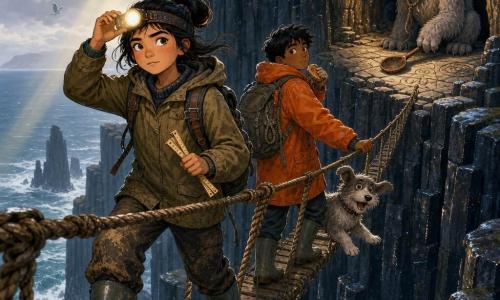
She bought a headlamp that didn't flicker, a coil of rope, a solid pair of boots, and lent out her most skeptical smile to anyone who asked if she was scared. At the supply post, Mara laid the last item on the counter out of habit. The man behind the counter whistled softly.
“Nice old watch,” he said. “Still ticking?”
“It stopped a long time ago,” Mara answered. “It's stubborn.”
“Where you headed with all that?” he nodded at the rope.
“To ask the caves a question.”
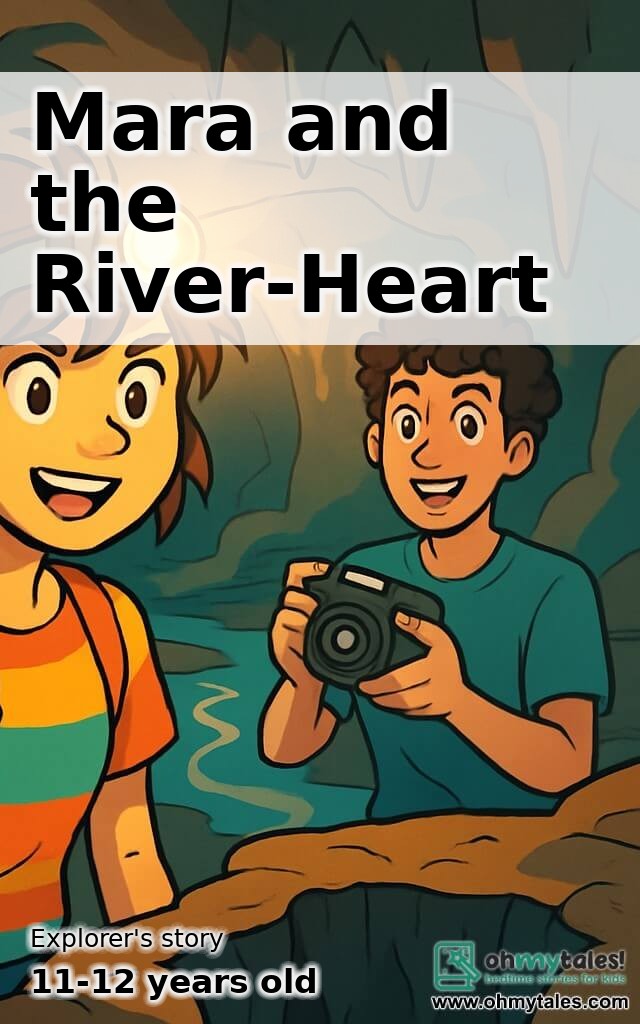
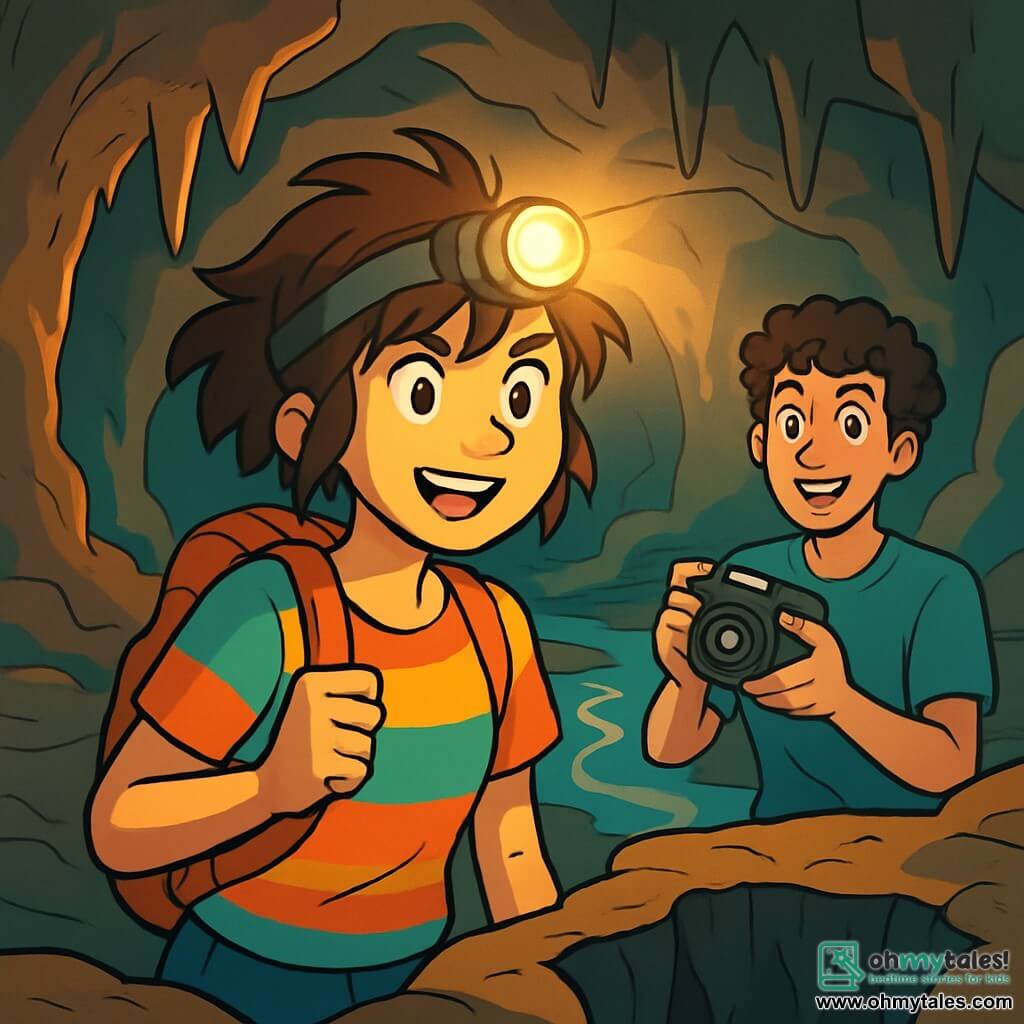
Someone laughed at the doorway, not in a mean way. A young man leaned in—light pack, wilder hair, a camera strapped across his chest as if it were another limb. His grin looked like he had just balanced on something narrow and enjoyed not falling.
“Did someone say caves?” he said. “I'm Kito. I'm looking for light where most people think there isn't any.”
Mara blinked at the camera. “Light underground is the first problem.”
“It's also the first photograph,” Kito replied, then, as if he'd practiced, added, “I heard about a sinkhole outside San Hueso. I can trade knots and tea for a place in the line.”
“I'm not leading a tour,” Mara said, but her voice softened. “I'm looking for something that belongs to my community.”
Kito's eyebrows lifted. “Then I suppose this isn't about getting likes.”
“It's about getting water,” she said.
Kito's smile thinned into something steadier. “Let me help. I can climb, and I know how not to blind a bat. Also, I've been told I can make people laugh in tight spaces.”
Mara considered the rope, the watch, the map in her head with its speculative dotted line down the throat of the earth. Her grandmother's voice was quiet in her memory. “Caves listen,” Mara murmured, and surprised herself.
Kito leaned closer. “Did you say something?”
“I talked to my grandmother,” she said. “She says we can take you if you listen back.”
Kito pressed a hand to his chest, in an exaggerated promise. “I'll listen so hard.”
Mara hid a smile. “Then we leave at dawn.”
Sinkholes and Singing Stone
The sinkhole yawned in the scrubland like a forgotten well. Vines hung down its sides in rope-thin threads. On the breeze came a cold breath, as if the earth were whispering secrets it preferred to keep. The morning was all color—sharp blue sky, green of mesquite leaves—and the hole was black. Kito lowered his camera and stared.
“This is… bigger than I imagined,” he said, keeping his voice small. “Like where dragons nap.”
“If there are dragons,” Mara replied, “they'll have to sign in.”
She checked the anchors, tied knots and then tied them again, even after Kito's deft hands had done the same. He watched with an approving nod, more interested than impatient. He hummed as he worked, something that almost matched the small drips they could already hear.
“First rule,” Mara said, fitting her harness. “We take nothing but notes. Leave nothing but footprints, and soft ones at that.”
“And photos,” Kito said. “Photos don't weigh much.”
“If they change what people do,” Mara said, “they weigh a lot.”
They descended. The light narrowed to a coin above them, bright and far. The air cooled and smelled of stone and old water. Their headlamps sheared off the darkness like careful knives. The walls showed bands of ancient seas, ripples frozen, the fossils of shells like thumbprints pressed by time. They paused in a chamber that echoed the click of Kito's camera like distant rain.
Kito lifted his voice to a whisper. “If I were a thief with a heavy pocket, where would I go?”
“Downhill until I found moving water,” Mara answered. “Water hides many sins.”
They followed a narrow ledge, their feet inching along a fault that had cracked open long before their great-grandparents were born. Twice, they stopped and listened: drips in the north, a slow draft in the west, a sound like a sigh from the east. Mara let the air ghosts write on her skin. They took the west.
After an hour, Mara touched the watch. The hands stared back: 4:12. The brass felt cool, then warmer, as if the stone had held someone's palm the moment before. She told herself it was the heat from her own wrist, but part of her did not argue very hard. On the floor, faint and promising, lay white chalk marks—arrows rubbed by the slide of a bag, a boot print that had once been heavy and now was just a shadow.
Kito crouched to photograph a tiny cave salamander gliding over a wet patch. He kept his distance. “Look at this little dragon,” he murmured. “He belongs here more than I ever will.”
“You and me both,” Mara said. “We're guests. And the host is old and careful.”
A few chambers later, they found the first wrong thing. A candy wrapper, soggy and splayed, stuck to a rock like a wet leaf.
Kito grimaced. “Who eats in a place like this and tosses trash?”
“People who forget they are guests,” Mara said, and tucked the wrapper into her pocket. “Not us.”
“What do we get if we're good guests?” Kito asked.
“Maybe directions,” Mara said, and touched the watch again.
Out of habit, Kito raised his camera. “Smile for the cave,” he joked, then lowered it quickly. “Just kidding. It's busy minding its own slow, important business.”
“It is,” Mara agreed. “And it's possible we'll need it to mind ours.”
Chalk Lines and Narrow Days
They moved through rooms of very old magic and very real physics. In one chamber, stalactites hung down like teeth, their tips so close to the stalagmites below it seemed the cave had tried to close a mouth and had forgotten how. They slid sideways through a squeeze so tight Mara's pack scraped a line across it like someone drawing a breath. Kito went first more than once, holding the rope steady like a promised hand for when she followed.
On the floor of a wider room they found a tripod leg, broken clean at one join. The metal had been there long enough to farm rust. Kito picked it up, turned it, and placed it carefully back where it was.
“Some photographer had a bad day,” he said softly.
“Maybe,” Mara said. “Or a day that got too fast.”
They sidled along the rim of an underground river, its water dark and quick, like the tail of a sleeping animal. Mara tested a rope across to a short wall where the flow thinned. She knotted a handline and went steady, stepping in rhythm with the pressure of the current and the tug of gravity. When Kito followed, he hummed that almost-song again, and the river's hum took it up and braided it into something older.
On the other side, chalk spoke again. This time, it was not a careless arrow; it was numbers. 4/12 was scrawled on a wall with three handprints below it, small and nervous. The chalk was dust by now. Only the shape remained.
Kito exhaled. “I don't believe in signs,” he whispered. “But I don't not believe either.”
“I believe in dates,” Mara said. “This is the day the watch quit.”
Kito looked at her wrist. “Is it doing anything… different?”
“Just reminding me that time doesn't always listen,” Mara said.
They sat for a few minutes on cool rocks and sipped water in the light of their headlamps. Kito wrung a little sweat from his hair and blinked through the salt.
“Why do they want your stone?” he asked. “To sell it, I get that. But why this one?”
“It's easy to pretend it's magic,” Mara said. “It glows faintly near clean water. But that's just gypsum dust tasting the air, or so my skeptical brain tells me. Still, my grandmother would say, it remembers us holding it every spring. It remembers our songs. Maybe it remembers the shape of our patience. Even if it's only stone, what it did made us care for our spring with care we wouldn't have used otherwise.”
Kito nodded slowly. “In my photos, if people see a beauty, sometimes they put their hands in their pockets instead of picking the flower. That's not exactly science, but it's cause and effect.”
Mara smiled. “Then this is about cause and effect on a very long scale.”
He leaned his head back against the rock. “What will you do if we don't find it?”
“We will,” she said, and surprised herself with the confidence. “If thieves left chalk, they were in a hurry. In a hurry, you drop weight. Heavy things.”
“Do you always guess right?” Kito asked.
“No,” Mara said. “But I practice guessing like it's a muscle.”
A while later, they entered a chamber that pounded with sound—water, magnified and folded. A fall crashed somewhere ahead, unseen but definite. They traced the noise and found a curtain of flow sliding down a rock face. The spray cooled their skin. In the edge of her vision, Mara saw a tiny gleam, like the pin-head light of a star between the threads of water.
Kito leaned forward. “Do you see that?” he murmured.
“Careful,” Mara warned. “The tool you want here is patience.”
He pressed his lips together. “I've been practicing.”
They did not touch the curtain. They skirted it instead, and found to the side a thin passage, like a breath taken through teeth. The chalk returned here and there, smeared and ghostly. The watch on Mara's wrist felt a touch warmer again. She kept breathing slow so her hands would not rush what was ahead.
When Breath Turns Heavy
The cough arrived like an uninvited thought—small, dismissible. Kito cleared his throat once, twice, and rubbed the edge of his throat with a knuckle, then smiled and shrugged at Mara as if to say, don't make a whole story out of this. She didn't, until the cough grew teeth.
By midday, he was pale beneath the cave dust and moving slower. He didn't complain, but he swayed once when he stood, steadying himself against the rock with fingers that had begun to shake.
Mara touched his forehead with the back of her hand. “You're heating up,” she said. “Sit.”
“It's a little chill in here,” Kito joked weakly. “I thought I'd make up for it.”
“Put the camera down,” Mara said, and gentled him into a squat on a flat bit of stone. “Drink.”
While he sipped, she wrapped a scarf around his mouth and nose, a simple filter against stirred-up dust. She did it for herself, too. They ate slow food—dried mango and nuts—while the cave dripped and the river whispered itself into the further dark. After, Mara mixed hydration salts into his water bottle. The salty lemon scent seemed too bright for this shadow place.
Kito's eyes flicked to hers. “We should turn back,” he said. “You can come again when I'm not trying to cough on stalactites.”
“We don't have endless tries,” Mara said softly. “A storm rolls over the plateau tomorrow. If it dumps water down here, our choices get smaller.”
“So we push on and I slow you down,” he said. “Math isn't my favorite subject.”
Mara looked at her watch. 4:12 looked back. She felt the cave's breath, the smell of wet limestone, the low groan of old stone adjusting itself under all the centuries of weight. She pictured the spring in Arroyo Verde, the children's bare feet on the tiles, the way an old man ran a finger along a crack in a pipe with love, and not complaint.
“Then we go slowly and we go smart,” she said. “If you get worse, we stop. If the cave warns us, we listen.”
He tipped two fingers to his forehead in a little salute. “You're the captain.”
“I'm the person who learned the hard way that plans should be drawn in pencil,” she replied.
They made camp on a dry island of stone where a trickle of clean water ran. Mara took the ceramic cup she always carried and filled it at the trickle. She poured a little onto a rock, old habit, not superstition—giving back what they took, in the smallest way. Kito watched without teasing.
“What's that for?” he asked quietly.
“Respect,” Mara said. “People forgot to show it and started losing things.”
He nodded. “I've been trying to take pictures that make respect the first word in someone's head.”
“Then don't die in a cave,” she said, and made him smile.
He slept fitfully, coughing now and then, while the cave kept its slow tempo. Mara lay awake, her body tired, her mind finishing its own walk. She thought of her grandmother holding this watch, clicking at it when it still worked, laughing when it didn't, and then looking at the sky and reading the hour by the angle of the sun. She thought of chalked numbers and handprints, of thieves in a hurry, of a bag growing lighter with panic and fear. She thought of how to move a sick friend through a narrow throat of stone without scraping the skin off his ribs.
In the night, the cave sounded different. A thick silence rose like fog, and then she heard it: the distant churn of water growing fuller. Rain had not begun on the surface yet, but somewhere, water had negotiated a new pathway. Caves were good at choosing new conversations.
She turned to Kito and touched his shoulder. He blinked, confused, then nodded when she explained. They moved their packs higher, secured everything, and sat with the knowledge like a third person. Time—the real kind—nudged them from the inside and the outside.
Kito's voice was rough when he spoke. “I didn't think the slowest place I'd ever been could hurry me.”
“It's honest in its own way,” Mara answered. “It gives warnings.”
“And chances,” Kito said, and coughed again, pressing the scarf tighter.
“We'll take the next one,” Mara said.
The Stone and the Flood
The chamber where they found it did not reveal itself with trumpets or golden light. It was small, almost shy, a sloping shelf of rock leading to a shallow bowl scratched by water's hand. Above, a thin shaft opened to the sky so slender that only a thread of daylight fell and slid across the bowl like a coin rolling. The air smelled fresh there, in a way that made Mara's ribs lift on their own.
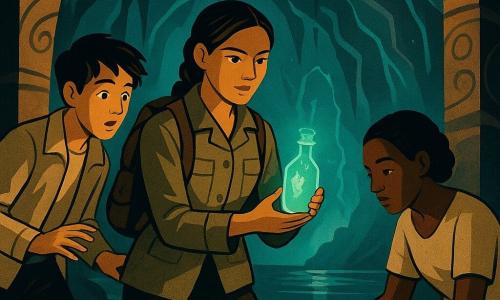
On the lip of the bowl sat something that did not belong to the cave and yet seemed to have learned its posture. It was round and pale and smooth with the softness of stone that had been held by a thousand careful hands. It was the size of an apple that had been fed moonlight.
Kito sucked in a breath. “Is that—?”
Mara swallowed, and the sound was loud in her own ears. “It is,” she said. “Or it learned how to pretend perfectly.”
The River-Heart did not glow like in stories because stories are impatient. But there was a glimmer at its edge where the thread of light stroked it. Mara reached out and then, stopping herself, looked at her watch. The brass face warmed against her skin. And then, in the dense, patient quiet, she heard it: a small tick, faint and almost embarrassed, as if the watch had been holding its breath for years and had finally decided to let it go, just once.
Kito's eyes went wide. “Did your grandmother just tell a joke I can't hear?”
“She's laughing at me,” Mara said, and the joy surprised her. “And the watch is making up its mind.”
She looked around the chamber. Foot scuffs on the slope, chalk on the wall—4/12 in a shaky hand—told the rest of the short story. The thieves had found the bowl, maybe climbed up to the skylight like the chimney of a house and looked out. Maybe one of them, sick with more than greed, had sat right there and wheezed, and the others had set the stone down while they tried to haul their friend up. The stone had not gone with them.
Kito nudged his scarf down and spoke in a rasp. “Take it home.”
Mara nodded. She pulled a cloth from her pack—a clean square of soft, woven cotton dyed with indigo, the kind her grandmother would have used for bread—and, with a carefulness that made her fingers ache, she wrapped the River-Heart. It had the weight of something that had listened. Not heavy. Not light. A listening weight.
The watch ticked again. Once, twice. Then, as if embarrassed to be caught, it stilled. The hands, stubborn and faithful, remained at 4:12. Mara tied the cloth around the stone and tucked it into the belly of her pack where it would not knock against any surface.
From a crack between rocks, a thin line of water began to thread and then to pour. The rain atop the world had kept its promise and had arrived a few hours early. The water gathered on the lip of the bowl, hesitated, and then spilled like a slow ribbon down the slope.
Kito set his jaw. “We have to find the higher route.”
“There's a branch that climbed a bit before here,” Mara said. “We'll backtrack. Slowly. Smartly.”
They moved. The water moved with them, adding its voice to their thoughts. Kito wavered once at a tight passage and Mara took his pack. He protested and she gave him a look that made him close his mouth and save his breath. He smiled at that, or tried to. He used his camera strap to brace himself around a corner slick with mist, and when he slipped, he caught himself with a laugh that was half cough.
“This is not the most flattering angle of me,” he muttered.
“It's the most honest,” Mara said, and grinned back despite the dark and the rush. “You can post it to your memory.”
They came to the underground river again, louder and pushier than before. The handline they had knotted earlier quivered slightly. Mara watched the flow, read it like a page, and timed their steps. She went first, choosing places where the current offered less argument. Kito followed, the cough pulling at his ribs. At one point he slumped against the swallowing dark and closed his eyes.
Mara placed a hand between his shoulder blades. “Count to ten,” she said. “For each number, imagine a photograph you haven't yet taken.”
He began to count, softly, and the words steadied his breath. He spoke them like small pictures: “One, the salamander, two, your grandma's watch, three, the thread of light like a coin…” By ten, he was moving again, eyes open and focused and very aware of where his feet went.
They wound around a chamber that rang like a bell with the new water. On a ledge, half hidden by broken stone, lay a small leather bag. Mara glanced inside: a waterlogged notebook, a packet of coins, and a business card for a gallery in the city with a name they both recognized and disliked. She took the notebook carefully. The pages clung with stubbornness to each other, but a word or two peeked: “drop,” “ill,” “4/12,” and once, “sorry.”
Kito looked away. “Everyone thinks they're the hero of their story,” he said, his voice low. “Sometimes that story eats other stories for breakfast.”
“I can't hate someone I don't know,” Mara said. “But I can choose not to be them.”
The water rose slowly. They rose faster. The cave narrowed, then widened, then offered a climb that was not too hard and not too easy, and then, like turning a page that had been stuck to the one before, the space changed.
Light You Can Carry
Dawn met them with a quiet that felt like a blessing. They emerged into a bowl of scrub and boulders, the grey sky washing the world in soft, patient color. The rain above had been quick, not cruel. The air smelled of creosote and wet dust and the sharp metal of lightning that had already ended.
Kito sank to a rock and exhaled, a sound that belonged to the sky. He pulled his scarf down and grinned in a way that tugged the fever lines but didn't seem to mind. Mara sat beside him and held the pack as if it were made of eggs.
He touched the side of it gently. “You carrying a moon in there?”
“Just a memory that remembers us,” Mara replied.
They walked slow the rest of the day, stopping often. Mara made a little wind-catcher out of her scarf for Kito, so the breeze would cool him while he rested. She listened to his cough for roughness and counted breaths when he slept. At a creek that flowed clear over stones the size of fists, she did what her grandmother would have done. She unwrapped the River-Heart and let it sit in the water for a few minutes, just enough to kiss the current. It seemed to glow a little. Maybe it was only the way water makes everything look more like itself.
Kito took a photo with care, his hands steady, his face thoughtful. “I won't share this unless you say,” he said. “Some things aren't for everyone.”
“Some things are like seeds,” Mara said. “They need the right soil.”
They reached Arroyo Verde in the afternoon, legs rubbery, hearts ready. The village, white-walled and sun-warmed, felt like a stone that had been worn by friendly hands. People came out: old friends, curious children, a dog that wove figure-eights around Mara's legs as if to knit her back into the ground. Mara took the River-Heart out in its cloth and held it so people could see without touching. The murmur that grew was soft and full.
An elder stepped forward, a woman with hair the color of first snow and a smile like a bridge. She put her hands on Mara's shoulders and leaned forward to look into her face. “You are your grandmother's granddaughter,” she said.
“Only the parts I worked on,” Mara replied.
They carried the River-Heart to the fountain by the fig tree. The old pipes groaned a little, like bones waking up. Someone began to sing one of the songs, not loud, not for show, but because her mouth knew it. They placed the stone in its cradle, at the lip where the water first rose. The fountain burbled once, twice, and then water, clear as thought, flowed into the basin and over the tiles. Later, Mara would test it, learn the science and the story both, and write both down with equal respect. Now, she let joy be the fact in front of her.
Kito leaned on the wall and watched with his camera hanging quiet. He coughed, softer now, and smiled at the children's feet splashing small, careful splashes.
“You did it,” he said.
“We did it,” Mara answered. “And also the cave, and the rain, and the very old time that made the passage under the world.”
Kito nodded. “I have to go,” he said after a while, almost reluctantly. “There's a clinic in San Hueso. And after, a mangrove farther south that needs a witness. They're cutting it down one small, boring piece at a time.”
“Boring is dangerous,” Mara said. “It makes people not look.”
“I want to make looking the first thing,” he said. “If I do it right, maybe the mangrove gets to keep breathing for kids who haven't been born yet.”
Mara reached into her pocket and took out the watch. It lay in her palm like a small sun that had already set. The hands were where they had always been, stubborn and true to that one story. She closed her fingers and then opened them again.
“Take this,” she said. “Not to own. To carry for a while.”
Kito's eyes widened. “I can't take your grandmother's—”
“It belongs to time as much as to me,” Mara said. “It reminds you that not everything moves when you tell it to. Take care of it, and bring it back if you pass this way again.”
He cupped it like a sparrow. “I'll listen to it,” he said.
“And to caves, and to mangroves,” she said. “To old women and children and salamanders. And also to your own cough.”
He laughed, then winced, then laughed again. He lifted the camera, took one last picture—not of the stone, not of the fountain, but of Mara's face with the water behind it and her eyes reflecting a little white spark of the sky. He lowered the camera and stepped forward, awkward suddenly.
“I'm terrible at goodbyes,” he said.
“Me too,” she said, and then hugged him quick and firm. “Thank you for climbing into a hole in the ground to bring a stone home.”
He nodded, throat working. “Thank you for letting me be useful.”
As he turned to go, the dog followed, hopeful, then returned to circle Mara's legs. The children's voices rose and fell. The elder hummed a line from an old song. Mara sat by the fountain and watched the way water made everyone's hands look beautiful.
When the sun leaned west, she took a broom and swept the tiles, because joy made her want to tidy. She picked a piece of trash out of the fig tree's roots and thought about the caves—their old bones and new water, their patience and their warnings. She thought about the River-Heart doing its quiet job, a job that made people pay attention, a job that asked nothing in return except for hands that would carry it carefully and minds that would remember what it taught.
She thought about responsibility like it was a kind of friendship you built with places, not things you did because you had to. It was the only kind worth keeping; it kept you back.
Mara lifted her face to the wind that came up the canyon and smiled. She would write down the maps as she remembered them, and the smell of wet rock, and the way the watch had ticked in a secret. She would go back to the caves, but not to take or to prove anything. She would go to listen.
And when another child asked her someday if stones could bring rain, she would say, yes, in a way, the same way pictures can save a mangrove and a broom can clean a fountain and a careful rope can turn into safety. It's not magic. It's paying attention, together. It's choosing to return what belongs to everyone.
At the clinic in San Hueso, Kito would hold a watch that wasn't moving and smile at the nurse when she asked why he kept checking it. He would tell her it helped with patience. Then he would go, carrying his camera and a story, to stand among mangrove roots and show people the light where most didn't think there was any.
And the caves would go on being themselves—slow, quiet, immense, repeating what they were told. If you listened, they said: Take only what you're ready to care for. Leave places better than you found them. Time will do its work. So will you.