Chapter 1: The Map That Wasn't on Any Map
The sea looked harmless from far away—just a wide, glittering sheet under the late-afternoon sun. Up close, it sounded like a thousand secret conversations: shush, hiss, thump, pause. Waves pressed their palms against the rocks and pulled back again, as if they were trying to open a locked door.
Noah Hayes stood at the edge of the headland and let the wind tug at his hair. He didn't lean too far. He never did, not because he was afraid, but because he was careful. Calm didn't mean careless.
Behind him, his team struggled up the last stretch of cliff path. Boots scraped. Straps creaked. Someone's metal water bottle clinked like a bell.
“You'd think the university could fund a chairlift,” grumbled Tessa, who had a talent for complaining in a way that made you laugh instead of feel annoyed.
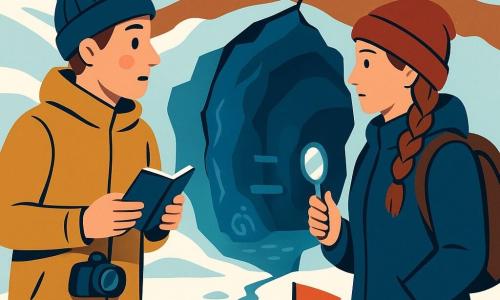
Dr. Laleh Rahimi arrived next, breathing steadily, her notebook already open. “The older charts mention a ‘cleft in the basalt' somewhere along this coast,” she said, as if she'd been reading the wind. “A hidden cove. It's been missing from modern maps for at least a century.”
Milo, the youngest after Noah, dropped his pack with a thud and stared at the ocean. “Missing? Like… stolen?”
“Eroded,” Laleh corrected, smiling. “Or forgotten. Places don't vanish. People just stop looking.”
Noah touched the folded map in his pocket, feeling the crisp edge of the old paper. It had arrived in a plain envelope with no return address, just a single sentence written in neat, black ink:
Name the route so it can be found again.
He didn't tell the others about the envelope yet. Not because he didn't trust them, but because the message felt like a responsibility handed to him alone. He was the one who kept the team steady. The one who could turn panic into a plan.
He pointed down the cliff line. “There. That darker strip. The rock's cracked wider than the rest.”
Tessa squinted. “Looks like a shadow.”
“It's too straight for a shadow,” Noah said. “That's a seam.”
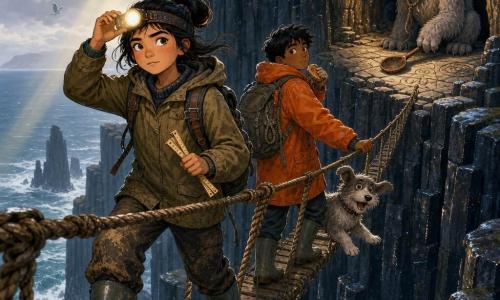
They followed him along a narrow shelf where sea spray made the stones slick as soap. Noah went first, testing each step with his boot, shifting his weight like a careful chess move. The air smelled of salt and crushed seaweed, sharp enough to wake you up from the inside.
The seam in the rock became a passage—tight, jagged, and dim. The sound of the ocean changed. It no longer roared. It muttered, muffled by stone.
Milo shivered. “Feels like we're sneaking into the world's basement.”
Tessa bumped his shoulder. “If we find old bikes and dusty ghosts, I'm leaving.”
Noah listened to the stone. He listened to the wind. He listened to the people behind him, too—the rhythm of their breathing, the scrape of their boots. He didn't rush. Hidden places punished rushing.
The passage bent sharply, then opened.
A cove unfurled below them like a secret kept for a long time. The water was a deep green, calmer than the sea outside, as if the rocks were arms protecting it. The sand wasn't yellow but pale gray, sprinkled with black pebbles that gleamed like wet ink. On the far side, half covered by vines and salt-stained bushes, stood an arch of stone carved with patterns.
Not random patterns. Marks. Symbols.
Laleh's eyes widened. “That—Noah, that could be pre-colonial coastal script. Or something older.”
Tessa stared at the arch and then at the cliff walls. “So… nobody's been here?”
Noah's calm held, but his heart ran faster. He tasted iron in the air, as if storms had once clawed through here and left their teeth behind.
“We have,” he said quietly. “So now it's our job to make sure it isn't lost again.”
He pulled the envelope from his pocket and showed them the sentence inside.
Milo read it aloud. “Name the route so it can be found again.”
Laleh nodded slowly. “That's not just exploration. That's stewardship.”
Tessa lifted an eyebrow. “Stew-what?”
“Taking care,” Noah said. He looked at the cove like it was a sleeping creature. “We'll map it carefully. We'll name the path properly, and we won't leave it messier than we found it.”
Milo grinned. “So… we're basically naming a secret doorway.”
Noah's mouth twitched—almost a smile. “Exactly. And first, we figure out where it leads.”
Chapter 2: Names That Stick Like Sea Salt
They climbed down using a rope anchored to a sturdy rock. Noah checked the knot twice, then once more, because the ocean didn't care about confidence. It cared about physics.
When his boots hit the gray sand, it felt packed and cool. The air inside the cove was different—less windy, more damp, carrying the earthy scent of vines and the faint sweetness of flowering shrubs.
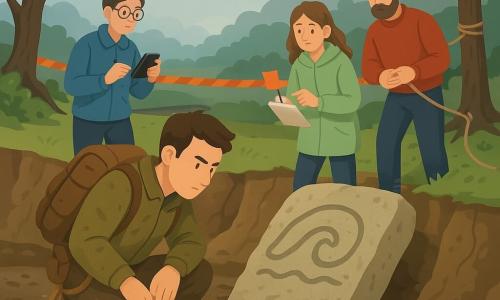
Laleh crouched beside the stone arch. She traced the carved symbols without pressing too hard, as if touching them might wake them. “These lines… they're intentional. A message.”
Milo whispered, “Maybe it says, ‘Keep out.'”
Tessa pointed at the sand. “Or maybe it says, ‘Please remove shoes, no snacks, ancient floor.'”
Noah set his pack down and unrolled a blank waterproof chart on a flat rock. He pulled out a compass, a small measuring tape, and a pencil tied with string so the wind couldn't steal it.
“Our mission isn't only to find what's here,” he said. “It's to make a route that someone else can follow safely. So we name things clearly. Names are like handholds.”
Milo blinked. “Handholds?”
“On a cliff,” Noah explained. “If you can't see the top, you still climb by what you can grip. A good name is a grip. It tells you what something is and how to approach it.”
Tessa plopped onto a stone and began tugging seaweed off her boot. “Okay, Captain Calm. What do we call the creepy hallway we came through?”
Noah thought of the tight passage and the way the sound of the sea had turned into a whisper. “The Whisper Cleft.”
Milo nodded, impressed. “That's actually cool.”
“And the shelf path above?” Laleh asked.
Noah pictured the narrow ledge and the slick salt shine. “Saltglass Ledge.”
Tessa made a face. “Sounds like a fancy restaurant.”
“It's descriptive,” Noah said, and then he added, “and slightly dramatic. We can compromise if you want.”
“Nope,” Milo said quickly. “Saltglass Ledge stays.”
They marked the names on the chart. Noah measured distances, noting angles from the headland. Laleh sketched the arch and the symbols. Tessa, who claimed she hated “boring map stuff,” turned out to be excellent at spotting landmarks: a distinct split boulder shaped like a shark fin, a cluster of tide pools that reflected the sky like tiny mirrors, a crooked tree that leaned over the sand like it was trying to eavesdrop.
Milo wandered to the tide pools. “Noah! There are starfish down here. And… something shiny.”
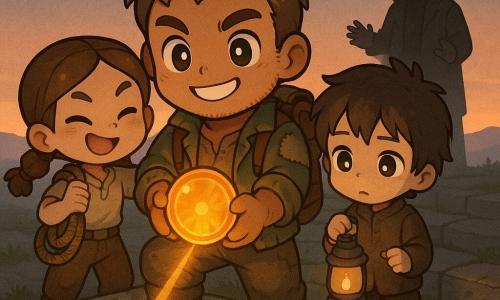
Noah walked over, careful not to crush the limpets clinging to the rocks. In the shallow water, between ribbons of kelp, lay a thin metal disk half buried in sand. Noah lifted it gently. It was corroded, but an etched spiral was still visible.
Laleh's voice tightened with excitement. “That isn't modern. It could be an old marker.”
“A pirate coin?” Milo asked, eyes bright.
Tessa snorted. “Sure, and the pirates politely labeled their treasure in neat handwriting.”
Noah turned the disk in his fingers. On one side, the spiral. On the other, faint lines that looked like a simplified map—three curves, a dot, and a sharp angle.
“A route,” Noah murmured. “This might be a guide.”
He held it up to the stone arch, comparing the spiral to the carved patterns. The shapes weren't identical, but they felt related—like two versions of the same story.
Laleh leaned closer. “If this disk is a marker, there may be others. A trail of clues.”
“A scavenger hunt designed by… ancient people?” Milo said, almost reverently.
Noah wasn't sure if the thought was comforting or unsettling. The cove felt quiet, but it didn't feel empty.
He stood and looked past the arch. The vines hid a narrow opening, dark as a mouth.
“We log everything,” Noah said. “We keep our names clear. And we go one step at a time.”
Tessa hefted her pack. “One step at a time is my favorite speed.”
Milo slipped the metal disk into a padded pouch. “What do we call the arch?”
Noah studied the carved stone, the way it framed the darkness beyond. “The Tidemark Gate,” he said. “It's the entrance… and the warning.”
Laleh wrote it down, her pen scratching like a tiny insect. “Then we pass through the Tidemark Gate,” she said, “and see what has been waiting.”
Noah took a slow breath and nodded. “Stay close. Watch your footing. And if you feel scared, say it. Courage isn't silence. Courage is choosing the next step anyway.”
They stepped under the arch, and the air changed again—cooler, older, as if it had been stored in stone jars for hundreds of years.
Chapter 3: The Cave That Listened
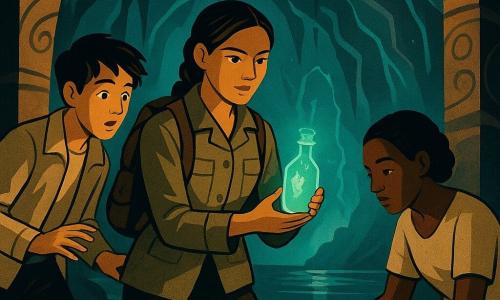
Inside, the light dropped quickly. The opening was narrow, forcing them to walk single file. Their headlamps clicked on, beams sliding over wet rock that glistened like the backs of black whales.
The cave smelled of damp mineral and something faintly smoky, like a campfire that had burned out long ago. Water dripped in a patient rhythm: plink… plink… plink.
Milo whispered, “This place is definitely listening.”
Tessa whispered back, “Then tell it to listen to my knees, because they're complaining.”
Noah went first, lamp low, scanning the ground. The cave floor wasn't flat. It rose and dipped, scattered with stones that could twist an ankle if you weren't paying attention. Every few meters, he paused and looked back, making sure the others were steady.
Laleh's voice was hushed but firm. “Do you hear that?”
Noah stopped. At first he heard only dripping water and their own breathing. Then—faint, like a faraway drum—a deep, slow thud.
Thud… pause… thud…
“It's the tide,” Noah said. “Waves pushing air through a chamber.”
Tessa's laugh was small and sharp. “Great. The cave has lungs.”
They reached a wider space where the ceiling arched high above, vanishing into darkness. Their headlamps caught something on the wall: more carvings. Not just lines this time, but shapes—boats, fish, and a long winding path with marks along it.
Laleh stepped closer, excitement overriding caution. Noah gently caught her elbow. “Careful. The ground here looks softer.”
She nodded, grateful rather than annoyed. “Thank you. You're right.”
The carvings showed a route, and beside the route were symbols—some like the spiral on the metal disk, others like triangles and half-moons.
Milo held up the disk. “It matches! Look—spiral here, spiral there.”
Noah traced the carved route in the air without touching. The path seemed to lead from the cove into the cave, then deeper, then up, ending at a symbol shaped like an eye.
“An exit?” Tessa guessed.
“Or a lookout,” Noah said. “We should name this chamber for the map.”
Milo tilted his head. “The Map Room?”
Tessa made a face. “Too normal. This place deserves something cooler.”
Noah listened to the slow breathing of the tide. “The Listening Hall,” he decided.
Laleh wrote it down. “Listening Hall.”
They moved on. The passage narrowed again, forcing them to duck. The rock brushed Noah's shoulder like a cold hand. He kept his breathing even. Panic stole air; calm saved it.
Then the ground changed.
The solid stone became a slope of loose pebbles. Noah tested it with his boot. Pebbles slid, whispering downhill.
“Everyone stop,” he said, voice low and steady.
Tessa froze mid-step. “Uh. Is this the part where we dramatically fall into a bottomless pit?”
“No,” Noah said. “But it could be a rockslide. Step back slowly. One at a time.”
Milo's eyes were wide in the headlamp light. “I didn't even do anything.”
“No one did,” Noah said. “The cave is just… delicate.”
Noah crouched and scanned for a safer route. On the left, a strip of firmer rock hugged the wall, like a narrow sidewalk. He tapped it with his trekking pole. Solid.
“Follow me,” he said. “Left side. Put your feet where I put mine.”
He moved carefully, weight low, hands ready. The pebbles shifted under the center of the slope, but the firm strip held. One by one, the others copied him. Tessa's usual jokes were gone; she concentrated fiercely, lips pressed tight.
Halfway across, Milo's boot slipped. Pebbles scattered with a hiss. His arms windmilled.
Noah lunged, catching Milo's strap and hauling him toward the wall. The movement sent a small wave of stones sliding down, but it stopped before it became dangerous.
Milo's breath came fast. “I'm sorry. I'm sorry.”
“No,” Noah said, gripping Milo's shoulder until he felt the shaking ease. “You reacted. You didn't freeze. That's good.”
Tessa exhaled. “Okay, Captain Calm, remind me to never make fun of your ‘one step at a time' thing again.”
“Noted,” Noah said, and the corner of his mouth lifted.
They reached the far end of the slope. Noah marked it on the chart with a bold line and a name.
“Call it Pebble Slide,” Milo offered, voice still shaky.
Noah nodded. “Pebble Slide. Clear and honest.”
Laleh shone her light ahead. The passage rose sharply now, twisting upward. The air was cooler. The tide's breathing faded.
Somewhere above them, a draft carried the scent of open air and wet leaves.
Noah looked at his team. “We're close to something,” he said. “Remember: we don't just find it. We understand it, respect it, and make it safe for others.”
Tessa muttered, “And hopefully it doesn't eat us.”
The cave didn't answer. But it seemed to listen as they climbed.
Chapter 4: The Riddle of the Stone Eye
The upward passage ended at a stone door.
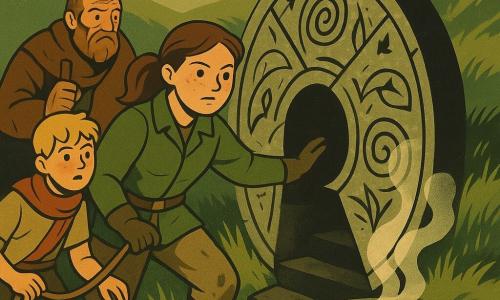
Not a door with hinges or handles—just a slab fitted into the rock face, carved so precisely it looked grown there rather than built. In its center was the eye symbol Noah had seen on the wall map. The “pupil” was a small hollow, round and shallow.
Milo leaned in. “That's… definitely a door.”
Tessa pointed at the hollow. “And that's definitely where you put the magic eyeball to open it.”
Laleh ignored them, scanning the carvings around the edge. “These markings are worn. People touched them often. That means the door was used.”
Noah's headlamp beam slid over the stone. The air here was still, as if the passage behind them was holding its breath.
He pulled the metal disk from Milo's pouch, careful with the fragile corrosion. “The pupil looks about the right size.”
Milo swallowed. “So we just… stick it in?”
Noah didn't answer right away. He studied the ground. Fine dust lay in the grooves near the base of the door. No footprints, but subtle scratches suggested something had slid across the stone in the past.
A trap? Maybe not spikes and swinging axes like in movies, but older dangers were often simpler: collapsing stones, wrong turns, sudden drops.
“No rushing,” Noah said. He checked the ceiling and walls for cracks. He looked for holes where darts might shoot—then felt slightly silly, but not silly enough to ignore the possibility. He tested the air with his hand for drafts. Nothing obvious.
Laleh pointed to a set of symbols near the door. “These are like instructions. See—this sequence repeats: spiral, wave, spiral, mountain.”
Tessa squinted. “Spiral-wave-spiral-mountain. That's… poetic?”
Noah held the disk up again. One side had the spiral. The other had the route-like lines: three curves, a dot, a sharp angle. Curves could mean waves. The sharp angle could mean a mountain ridge.
“So it's not just ‘insert disk,'” Noah said. “It's ‘turn it' in a specific order.”
Milo perked up, fear turning into focus. “Like a combination lock.”
Noah nodded. “Exactly.”
He fitted the disk into the hollow. It slid in with a gritty scrape and sat flush. He tried turning it gently clockwise. It moved a little, then stopped with a soft click.
From somewhere inside the stone, a faint vibration answered, like a distant string plucked.
Tessa whispered, “Nope. I don't like that sound.”
Noah kept his voice level. “It's just a mechanism.”
He rotated the disk back to its starting point and tried a different direction. Click. Another vibration.
Laleh watched the carvings. “The sequence might mean: spiral—wave—spiral—mountain. Maybe we turn to the spiral mark, then to a wave mark, then spiral again, then mountain.”
Noah scanned the rim of the pupil hollow. Four tiny notches were carved at equal distances. One notch had a spiral etched beside it. Another had a wave line. Another had a second spiral. The last had a sharp peak.
Milo exhaled in relief. “Oh! It's literally labeled.”
Tessa frowned. “Ancient people had better user interfaces than my phone.”
Noah smiled briefly. Then he turned serious again. “We follow the sequence. Slowly.”
He aligned the disk with the first spiral notch. Click.
Then to the wave notch. Click.
Back to the second spiral. Click.
Finally to the mountain. Click.
For a heartbeat, nothing happened. Noah's pulse ticked in his throat.
Then the stone door shuddered. Dust trembled down like gray snow. With a deep, reluctant groan, the slab slid sideways into the wall.
Cold air rushed out from the opening beyond, smelling of damp soil and something sweet—ferns, maybe, or moss warmed by sunlight.
Milo let out a laugh that sounded like it had been trapped in his chest for hours. “We did it!”
Tessa peeked through the gap. “Okay, that is officially awesome.”
Beyond the door was a tunnel lined with smoother stone, and at the end of it, a faint circle of daylight.
Noah removed the disk and tucked it safely away. “We name this door,” he said.
Laleh didn't even hesitate. “Stone Eye Door.”
Tessa nodded. “Accurate. Slightly creepy. Perfect.”
They stepped through, and the tunnel's walls felt warmer than the cave behind, as if they had passed from the ocean's memory into the land's.
Noah's map grew heavier with ink: Whisper Cleft, Saltglass Ledge, Tidemark Gate, Listening Hall, Pebble Slide, Stone Eye Door.
Each name was a promise.
They walked toward the daylight, and Noah felt a quiet certainty. Whatever waited ahead, they would meet it with clear eyes and steady steps.
Chapter 5: The Garden Above the Sea
The tunnel opened into a hidden valley.
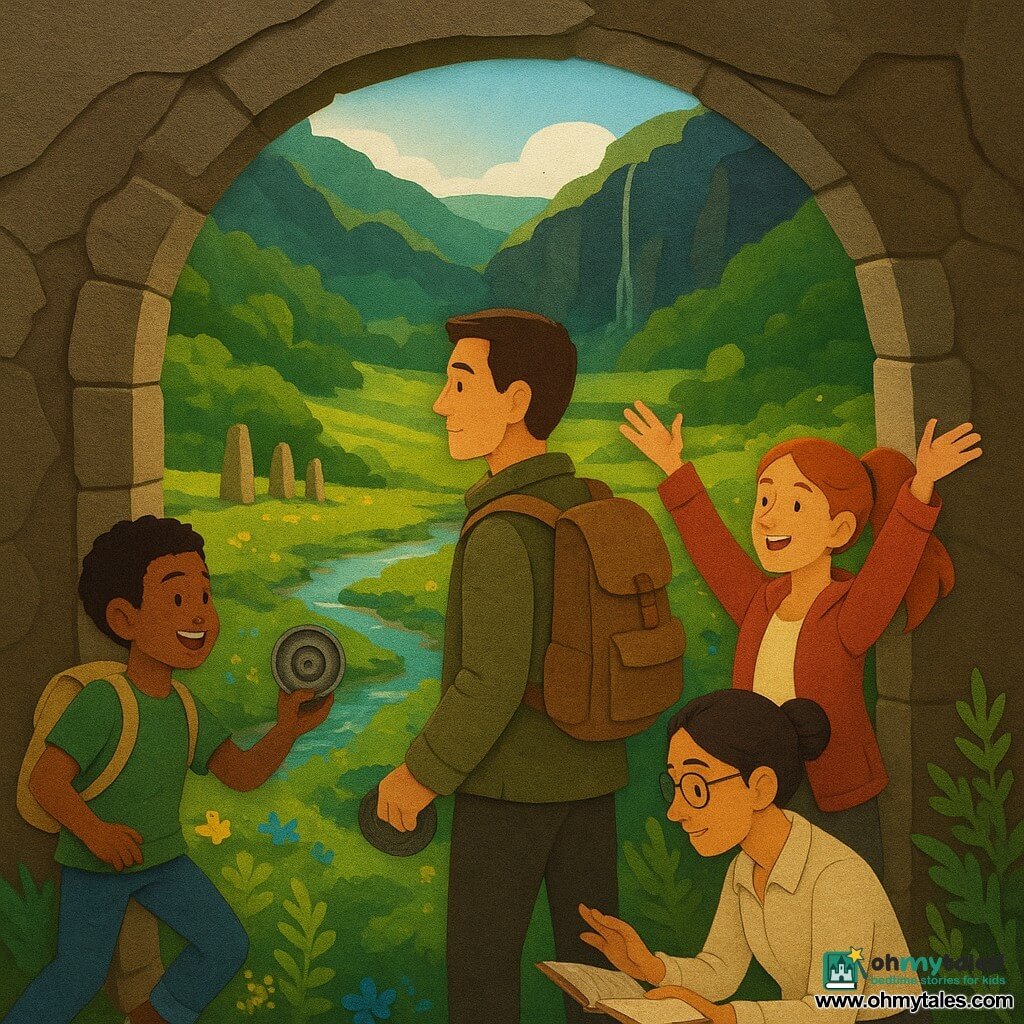
Noah stepped out first, blinking in the sudden brightness. Sunlight spilled over green slopes and scattered stones. Ferns grew in thick curls, and wildflowers dotted the grass like bits of paint—blue, yellow, white. A thin stream ran down the center, singing over rocks.
The most surprising part was the silence. Not empty silence, but sheltered silence. The roar of the ocean was gone, replaced by birdcalls and the soft rush of leaves.
Milo turned in a slow circle. “We just walked through a cave and came out in… a secret garden.”
Tessa spread her arms wide. “I claim it. This is my backyard now.”
Laleh looked up at the valley walls. “These cliffs would hide this place completely from the outside. A natural fortress.”
Noah took out the chart and began sketching the valley's outline, using the compass to note direction. He found a flat rock and set his pencil down carefully, anchoring the paper with stones.
“We need a name,” Milo said.
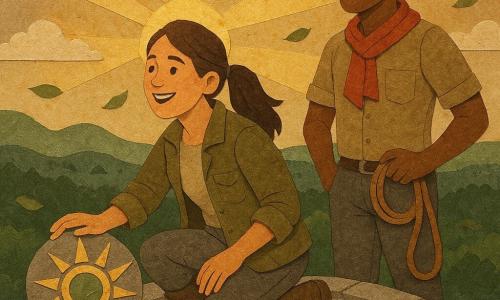
Noah watched the stream sparkle. He watched the way the valley cradled sunlight like it was holding a fragile treasure. “Sunhold Valley,” he said.
Tessa nodded. “Nice. Sounds like a place you'd find on a fantasy map.”
Laleh crouched near the stream. “Look at this.” She pointed to stones along the water's edge, arranged in a line that looked too neat to be random.
Noah approached. The stones formed a path—stepping stones leading upstream. On each stone, a faint spiral was carved.
Milo's eyebrows shot up. “More spirals. So this is definitely on purpose.”
Noah followed the stepping stones with his eyes. They led toward a cluster of tall rocks at the far end of the valley. From here, the rocks looked like broken teeth, dark against the bright grass.
Tessa groaned playfully. “Of course it leads to something pointy and dramatic.”
They crossed the stream using the stones, testing each one. The carvings were worn smooth underfoot, like thousands of steps had polished them.
Halfway across, Noah noticed the stream's surface twitch. Not from wind—there was hardly any—but from something moving underneath. A pale shadow slipped through the water and vanished beneath a rock.
Milo leaned over. “Fish?”
Noah grabbed the back of Milo's jacket gently and pulled him away from the edge. “Maybe. Or eels. Either way, don't put your hands in.”
Tessa grinned. “Captain Calm strikes again.”
They reached the far bank and climbed a small rise. The “broken teeth” rocks were actually a circle of standing stones, some leaning, some straight, all mottled with lichen. In the middle was a low mound covered in grass. A single stone slab lay flat on top, carved with the same coastal script.
Laleh's breath caught. “A marker. A meeting place. Or a memorial.”
Milo whispered, “What if it's… a tomb?”
Tessa's voice softened. “If it is, we don't mess with it.”
Noah felt a flash of pride. Tessa joked a lot, but she wasn't careless. Wisdom could wear a loud jacket.
He walked the circle slowly, counting stones. Twelve. He noted the arrangement on the chart.
“Name it,” Laleh said quietly. “For the map.”
Noah studied the standing stones and the way the sunlight slipped between them, making bright bars on the grass like a cage made of light.
“The Sunring,” he said.
They stood in silence for a moment, listening to birds and the stream. The place felt old, but not cold. It felt like someone had built it with patience and purpose.
Then Milo broke the quiet with a squeak. “Uh… Noah?”
Noah turned. Milo was pointing at the valley entrance—the tunnel mouth they had come from.
Water trickled from it now. More than trickled. A thin sheet poured down the stone like a curtain.
Tessa's eyes widened. “Was that there before?”
Noah's calm sharpened into focus. He ran to the tunnel entrance and shone his headlamp inside. The floor inside was wet, and the water level was rising, creeping forward with quiet determination.
“The tide,” Laleh said, voice tense. “The cave system must connect back to the sea. It's flooding.”
Milo's face went pale. “But our way out—”
“Not that way,” Noah said, firm. “We find another route. This valley must have an exit, or it wouldn't have been used.”
Tessa swallowed. “So the cave is closing behind us.”
Noah looked at the standing stones and the mound. An old place like this wouldn't trap its visitors. It would guide them—if they could read it.
He forced his thoughts to slow down, like lowering a glass into water so it wouldn't crack.
“Look for a path,” he said. “Something intentional. Not just any slope. Something marked.”
They split up but stayed within shouting distance. Noah scanned the valley walls. Ferns clung to cracks, and the cliffs were steep. But near the far right side, he spotted a line of pale stones set into the grass—almost hidden, like a whisper written on the ground.
“Here!” he called.
The stones formed a trail that climbed toward a narrow notch in the cliff. Above the notch, a single standing stone leaned outward like a finger pointing the way.
Milo ran up, then stopped, panting. “So… the valley has a back door.”
Noah nodded. “And we name it, so nobody has to guess during a flood.”
Tessa looked back at the tunnel, where water now spilled like a small waterfall. “Please name it quickly.”
Noah studied the notch and the pointing stone. “Pointer Pass,” he said.
Laleh wrote it down, her handwriting tight. “Pointer Pass. Exit route from Sunhold Valley.”
They climbed, legs burning, breaths quick. Noah kept pace steady, checking on everyone, reminding them to drink. Resilience wasn't just bravery. It was managing your energy when fear tried to steal it.
Behind them, the valley stayed bright and peaceful, as if it didn't care about tides or time. Ahead, the pass narrowed, and the wind returned—fresh and salty, like the world outside calling them back.
Chapter 6: The Route That Keeps Its Promise
Pointer Pass opened onto a ridge above the coast, higher than where they had started. The ocean spread out below, silver and restless. From here, the hidden cove was invisible—tucked behind rock like a secret tucked behind teeth.
Milo dropped onto the grass, laughing and half-crying at the same time. “We made it!”
Tessa lay beside him, staring at the sky. “I would like to officially apologize to my legs.”
Laleh sat carefully and pressed her palm to the ground, as if thanking it. “That exit… it was designed. This wasn't random.”
Noah stood for a moment, letting the wind cool the sweat on his face. His chest still felt tight, but his mind was clear. They had navigated an unknown place without breaking it, without panicking, and without leaving anyone behind.
He opened the chart one last time and reviewed the names and notes. The route wasn't just lines; it was a story someone could follow. A safe passage through mystery.
He looked at his team. “Before we head back, we finalize the itinerary.”
Tessa sat up. “You mean your sacred naming duty.”
“Our shared duty,” Noah corrected gently.
Laleh nodded. “The names need to be practical. No inside jokes that only we understand.”
Tessa clutched her chest dramatically. “So I can't name the pebble slope ‘Leg Betrayal Hill'?”
“No,” Noah said, and then, because humor mattered too, he added, “but I respect the accuracy.”
Milo grinned. “Can we at least add it in parentheses?”
Laleh's smile warmed. “Absolutely not.”
Noah drew a clean final line: from the headland approach to Saltglass Ledge, through Whisper Cleft into the hidden cove, past the Tidemark Gate into the Listening Hall, across Pebble Slide to the Stone Eye Door, into Sunhold Valley, and out through Pointer Pass to the ridge.
He wrote a short safety note beside each: slick rock, narrow passage, loose pebbles, tide risk, steady climb. No drama. Just truth.
When he finished, he folded the chart carefully, as if it were fragile not from paper but from meaning.
Milo watched him. “Do you think whoever sent that envelope… will be happy?”
Noah thought of the old carvings and the stepping stones worn smooth. He imagined people long ago guiding each other through the cove, not to hide treasures, but to protect a place and the knowledge of it.
“I think they wanted the route to survive,” Noah said. “Not the secret.”
Tessa raised an eyebrow. “Deep.”
Noah shrugged. “Wisdom is usually simple. Protect what matters. Share what helps. Don't pretend you're the first person to ever stand somewhere.”
Laleh looked out at the sea. “We'll submit the map to the coastal heritage council,” she said. “With restrictions, of course. This place deserves respect, not crowds.”
Milo sat up straighter. “So we're not turning it into a tourist spot with snack stands.”
Tessa sighed dramatically. “There goes my dream of selling ‘Tidemark Gate' keychains.”
Noah laughed softly—brief, real. Then he took the old envelope from his pocket. On its back, he wrote with his pencil:
Route named. Kept safe. Found again.
He tucked it into his pack, not as proof, but as a reminder.
They began the walk back along the ridge, the wind at their backs. Below them, waves continued their endless work on the rocks—patient, strong, and unbothered by human plans.
Noah glanced once more toward where the hidden cove must be, concealed and calm.
He didn't feel like he had conquered anything. He felt like he had listened, learned, and left a clear trail for those who would come after—people who would need courage, intelligence, and resilience, just like they had.
And maybe, if they were wise, they would add their own careful notes, and keep the promise going.