Chapter 1: The Map That Didn't Like Being Folded
Elias Crowe was polite in the way a fox is polite: he held doors, said “please,” and never stole anything without permission. Which meant he didn't steal at all—unless you counted borrowing a biscuit from the camp tin when no one was looking.
He stood inside a canvas tent that snapped in the wind like a sail. Outside, the Arctic plain spread out in white and blue, and the air smelled sharp, like clean metal. A small stove hissed. A kettle trembled.
On the table lay the reason Elias had traveled so far north: a thin, creased journal belonging to Armand Lavigne, a famous traveler who had vanished for months years ago and returned with stories no one could quite prove. Lavigne had claimed he'd found a “singing hill of ice” and marked an itinerary across the tundra with careful sketches.
Elias's mission was simple and not simple at all: confirm the route. If Lavigne had really passed through this region, there would be traces—old cairns, carved marks, maybe even a shelter. The northern heritage office had asked Elias to document everything respectfully, not to “collect souvenirs like a greedy magpie,” as the letter put it.
Elias tapped the journal. “All right, Armand,” he murmured. “Let's see if you were exaggerating or just dramatic.”
A voice from the tent flap said, “You talk to books now?”
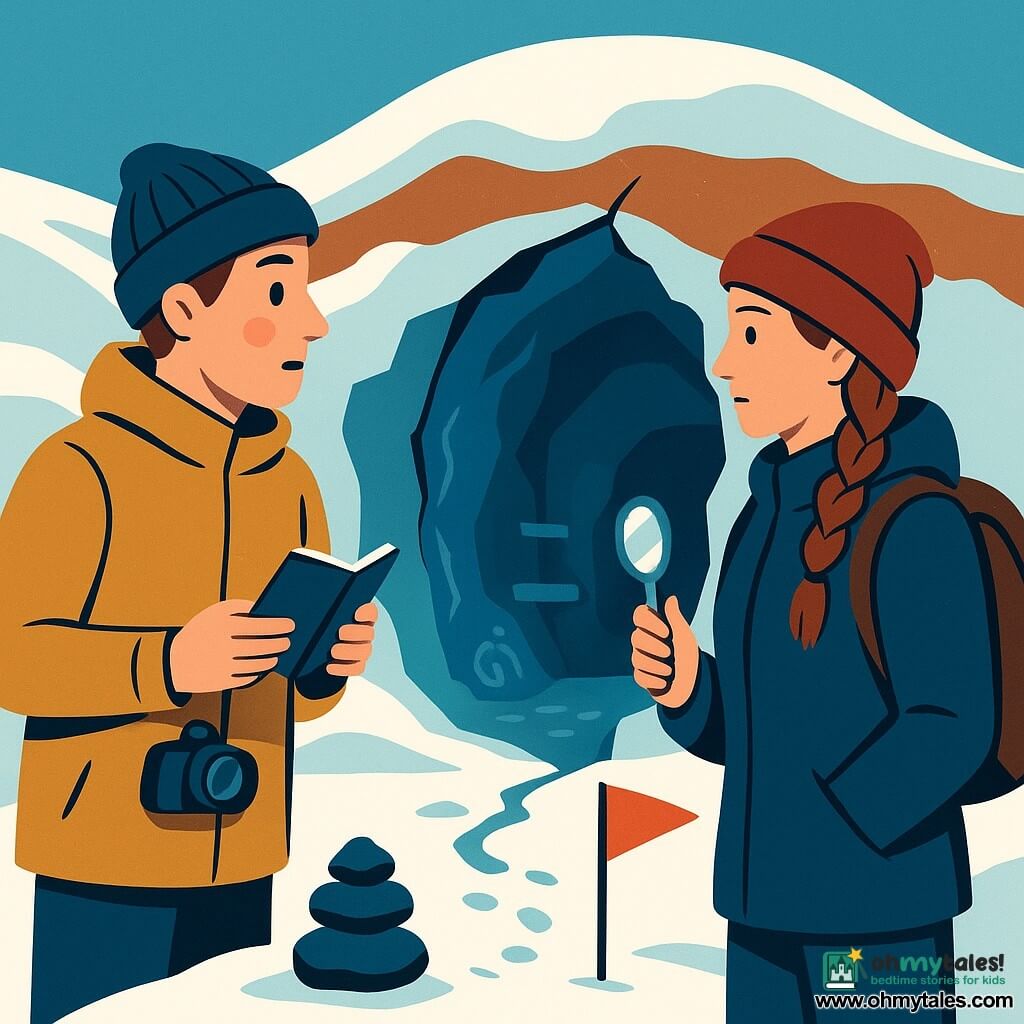
Elias turned. Mina, the local guide, ducked in with a gust of cold air and a grin. Her cheeks were red from the wind, and her braid was crusted with tiny beads of ice.
“Only the famous ones,” Elias said. “It keeps them humble.”
Mina set down a bundle of flags and a coil of rope. “The weather window is decent. Not kind—just decent.”
“Decent is excellent up here.”
She leaned over the map Elias had unrolled. “This is the route Lavigne drew?”
Elias nodded. “He claimed he crossed the river bend, then aimed for a pingo he called the ‘Ice Drum.' He wrote that it ‘guarded the old path like a watchful whale.'”
Mina's eyes flicked to the journal's sketch: a smooth, round hill rising from flat land. “Pingo,” she said softly. “We have them. Rare, but real. Ice trapped under earth, pushing up like it wants to breathe.”
Elias's fingers traced Lavigne's penciled line. “He also wrote something about a stone marker at the pingo's base.”
Mina straightened. “If there's a marker, we respect it. We photograph, measure, write down, and leave it. No chipping off pieces, no pocket treasures.”
Elias lifted both hands. “My pockets are empty and my manners are full.”
Mina snorted. “Your manners are like that kettle. Always about to whistle.”
Elias tucked the journal into a waterproof pouch. “Then let's go find your watchful whale.”
They stepped out into the light. The sky was pale, stretched thin like paper. Wind combed the snow into long ripples. Their sled waited—two runners, a load of gear, and enough snacks to make a bear consider negotiation instead of theft.
Elias pulled his hood up. The cold kissed any skin it could find. Somewhere out there, an ancient hill of ice and soil waited, holding secrets older than either of them.
And Elias, mischief and all, felt his heart thump with the joy of a mystery that might actually be true.
Chapter 2: White Silence, Loud Decisions
By midday, the world had narrowed to three things: the crunch of snow under boots, the steady pull of the sled, and the wind's constant opinion about everything.
Mina walked ahead, reading the land like it was a story written in drifts and shadows. Elias followed, checking the compass, then Lavigne's map, then the sky—like one of those people who checks the fridge three times expecting new food to appear.
“Do you think Lavigne made it up?” Elias called.
Mina didn't turn. “He might have. People like stories. But the land doesn't care about stories. The land only cares about truth.”
Elias liked that, even if it made him feel as small as a pebble.
They reached the river bend Lavigne had drawn. It wasn't a river now, more like a frozen ribbon. The ice was cloudy, with trapped bubbles like tiny, stunned fish.
Mina crouched and tested the surface with her pole. Tap. Tap. A deeper thud. She nodded. “We cross here. Spread your weight. Don't jump around like an excited seal.”
“I've never been compared to a seal in my life,” Elias said, then stepped onto the ice as carefully as if it were made of thin glass.
Halfway across, the wind fell quiet. The silence felt heavy, like someone had put a blanket over the world. Elias's ears rang.
Mina paused, head tilted. “Hear that?”
Elias listened. At first, nothing. Then—faintly—something like a low hum. Not quite a sound, not quite a vibration. It made his teeth feel strange.
“The ice?” Elias whispered.
Mina's gaze sharpened. “Pressure. Changing temperature. Sometimes it sings.”
Elias thought of Lavigne's “singing hill.” The journal suddenly felt less like a brag and more like a warning.
They hurried off the river and onto firmer snow. A line of darker shapes rose ahead: scattered boulders, black against white.
Mina stopped. “These aren't random.”
Elias approached. The rocks formed a crooked line, like teeth. One boulder had a small pile of stones at its base—a cairn, old and half-swallowed by snow.
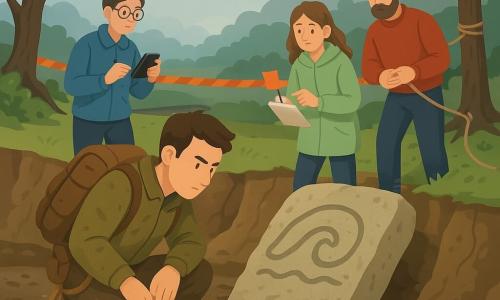
He knelt, brushing gently with a gloved hand. Under the frost, a flat stone showed marks: shallow carvings, worn smooth in places.
Mina's voice went careful. “Don't touch too much. Oils from your gloves, even through fabric… better to keep it minimal.”
Elias pulled out his notebook and camera. “Right. Document, don't disturb.”
He photographed the carvings from different angles, then sketched them. The shapes looked like a simple map: a curve like the river bend, a dot, and a spiral.
“A spiral,” Elias murmured. “Like a coiled shell.”
Mina studied it. “Or like wind. Or like a hill.”
Elias lifted the journal and compared Lavigne's notes. Lavigne had mentioned “a spiral sign at the teeth of stone.”
“So he was here,” Elias said, excitement flashing through his cold bones. “This is proof.”
Mina nodded once. “Proof, yes. But also responsibility. This marker isn't ours. It belongs to the people and the land.”
Elias's grin softened. “We're guests.”
“Exactly.”
As they moved on, clouds rolled in like slow gray smoke. The wind returned, sharper than before, and it carried tiny pellets of ice that stung Elias's cheeks.
Mina pointed. “See that swell on the horizon?”
Elias squinted. There, barely visible through the blowing snow, was a rounded rise. Too smooth to be a normal hill.
His stomach flipped. “The pingo?”
Mina's eyes narrowed. “Looks like it. And the weather is changing its mind.”
The sky dimmed, as if the world had inhaled. Elias tightened his grip on the sled rope.
Adventure, he thought, was mostly decisions made with numb fingers.
Chapter 3: The Ice Drum
They reached the pingo as the storm arrived in earnest. Up close, it was enormous—an oval mound of earth and ice, rising from the flat tundra like a sleeping giant's back. Snow clung to its sides in streaks. The wind slid around it, whining as if annoyed by the obstacle.
Elias stared. “It really does look like a whale.”
Mina walked a slow circle at its base, eyes scanning. “Pingos can crack. The core is ice. If it warms, pressure changes. We stay alert.”
Elias pulled out Lavigne's journal. The famous traveler's sketch matched the shape almost perfectly, even the way a darker band cut across the lower slope.
“He wrote there was a marker near the southern side,” Elias said, then glanced at Mina. “We look, we document, we leave it.”
Mina's mouth twitched. “You're learning.”
They rounded the pingo, leaning into the wind. On the sheltered side, the air calmed enough for Elias to hear his own breathing again. The snow here was less scoured, and the ground showed patches of frozen soil.
Then Mina stopped so fast Elias nearly walked into her.
Half-buried in snow was a slab of stone, tilted like a crooked tooth. Beside it, a circle of smaller rocks formed a neat ring.
Elias's voice dropped. “This is… intentional.”
Mina nodded. “Very.”
Elias knelt at a respectful distance and zoomed in with his camera. The slab had carvings, deeper than the ones at the cairn. A spiral again, but this time it wrapped around a line that looked like a path.
He opened Lavigne's journal and found the matching page. Lavigne had written:
“By the Ice Drum, I found the Old Sign. It points not only to a place, but to a promise: tread lightly, take only what you can carry in memory.”
Elias exhaled. “For once, he's not dramatic. That's… actually beautiful.”
Mina crouched too, careful not to step inside the stone ring. “This could be a boundary marker. Or a reminder. Either way, it's part of heritage. People long ago put their time into this. We don't mess with it.”
Elias snapped more photos and wrote down the location, the direction it faced, the measurements he could estimate without touching. He felt oddly proud, like he was doing the right kind of exploring—the kind that didn't leave scars.
A gust slammed into the pingo, and something answered from inside: a deep, hollow boom.
Elias froze. “Did the hill just—”
Boom. A lower note, like a drum struck underwater.
Mina's eyes widened. “Pressure cracks. The pingo is shifting.”
Elias swallowed. The sound wasn't just loud—it was alive, vibrating through the soles of his boots.
They stepped back, watching the slope. Fine snow trickled down like sand. A thin line appeared near the darker band, a crack opening like a mouth.
Mina grabbed Elias's sleeve. “We move. Now. No hero poses.”
Elias tried to joke, but his voice came out tight. “I was about to pose heroically, too.”
They hauled the sled away from the base, aiming for a shallow dip in the land where they could set camp out of the wind. Behind them, the pingo boomed again, and the crack widened enough to show a glimpse of bluish ice beneath the soil.
Elias's mind raced. If the pingo collapsed, it could swallow the marker—or expose something hidden.
A part of him, the mischievous part, wanted to run back and peek.
Mina must have read his face. “Curiosity is good,” she said, “but you don't feed it with your life.”
Elias nodded, jaw clenched. “Camp first. Then we think.”
They pitched the tent quickly, hands clumsy with cold. Snow rattled against the fabric. Inside, the stove warmed the air to something almost friendly.
Elias stared at the journal by lantern light. Lavigne's next line was smudged, but he could make out a few words:
“…beneath the drum… a hollow… not to be entered…”
Elias looked up at Mina. “He found something inside the pingo.”
Mina's gaze held steady, serious as stone. “Then we decide carefully what ‘confirming the itinerary' means. Some places are meant to be seen from the outside.”
Outside, the Ice Drum rumbled, as if it was listening.
Chapter 4: A Door Made of Frozen Earth
The storm eased overnight, leaving the world scrubbed clean and painfully bright. The pingo stood against the sky, quiet now, as if it had never made a sound.
Elias and Mina approached again, slower than before. Their footprints from yesterday were half-filled with drifted snow.
The crack on the pingo's side was still there. In daylight, it looked like a dark seam, ragged at the edges. A small slump of soil had slid away, exposing ice that shone blue-green, like a trapped piece of summer lake.
Mina stopped at a safe distance. “We don't climb. We don't poke. We observe.”
Elias lifted his camera. “Agreed.”
But as he zoomed in, he noticed something that didn't fit: the crack wasn't random. It curved, then straightened, like it had followed a line. Near the bottom, the exposed ice formed an edge—too sharp, too flat.
“It looks like… a corner,” Elias said.
Mina's eyebrows rose. “Natural ice can break clean.”
“Yes,” Elias said, “but can it break clean in a rectangle?”
They moved sideways until the light hit the opening just right. Shadows inside suggested a hollow space. Not a cave made by melting water—more like a chamber.
Elias's heart hammered. “Lavigne's ‘hollow.'”
Mina's voice hardened. “And he wrote ‘not to be entered.'”
Elias nodded quickly. “We won't. But we can document the entrance from outside. If it's man-made—or used by people—it matters.”
Mina hesitated, then pulled a small mirror from her kit. “We can reflect light inside without stepping closer.”
They inched forward, careful about cracks in the ground. Mina angled the mirror, catching sunlight and bouncing it into the opening.
For a moment, the inside glowed.
Elias sucked in a breath.
In the chamber were stone shapes—stacked, deliberate, like low shelves. And on one wall, faint but visible, were markings: a spiral and a line, just like the stone slab outside.
Not a treasure room. Not a secret lair. Something older and quieter.
Mina lowered the mirror. Her voice was almost a whisper. “This could be a storage place. Or a shelter. Or a ceremonial space. We don't know.”
Elias's mind buzzed with questions. “Should we report it? Of course. But… what if people come and ruin it?”
Mina's gaze was sharp. “That's why reports go to the right people. Heritage protection, local elders, scientists who work with communities. Not to random thrill-seekers.”
Elias nodded, relieved. “Right. No posting, no bragging.”
“Exactly. And we take notes that help protect it—location, photos—without making it easy for the wrong crowd.”
Elias scribbled quickly, hands shaking a little, not from cold but from the feeling of standing near something that had survived centuries of wind and silence.
A sudden crack sounded underfoot—small, but clear.
Mina's head snapped down. A thin fissure had appeared in the frozen soil near Elias's boot, like a hairline in glass.
“Back,” she said, calm but urgent. “Slowly.”
Elias stepped away, but the ground gave a soft, unsettling shift. The pingo didn't boom this time; it sighed, a low groan.
Mina grabbed his pack strap and guided him backward. “Don't run. Running makes you fall.”
Elias forced himself to move steadily, even though every part of him wanted to sprint like a cartoon character.
They reached safer ground, and the pingo settled again, quiet.
Elias let out a breath he hadn't realized he was holding. “So,” he said weakly, “no entering hollow ice chambers. Got it.”
Mina allowed a thin smile. “You're brave, Elias, but bravery isn't doing the most dangerous thing. It's choosing not to, even when you want to.”
Elias glanced at Lavigne's journal. The famous traveler's reputation suddenly seemed less like wild storytelling and more like hard-earned caution.
“Okay,” Elias said. “We've confirmed the marker, the pingo, and the hollow. Now we confirm the rest of his route—without getting eaten by the earth.”
Mina pointed toward the far side of the pingo. “Lavigne's map shows he headed east, to a ridge of black rock. If he left another sign, it will be there.”
Elias tightened his gloves. “Then let's follow his footsteps. Politely.”
Mina snorted. “Politely and alive.”
They walked on, leaving the Ice Drum behind, its secret chamber still hidden under frozen earth—kept safe by distance, respect, and a decision that felt like courage.
Chapter 5: The Ridge of Black Teeth
The ridge rose from the snow like the spine of a dragon—jagged black rocks, sharp angles, and shadows that looked too deep. The wind funneled through the gaps, making a moaning whistle.
Elias tried to sound cheerful. “Charming place. Very welcoming.”
Mina tugged her hood tighter. “Rocks don't welcome. They endure.”
They climbed carefully, using hands and knees at times. The stones were cold enough to sting through gloves. In the hollows, snow had packed into hard slabs.
At the top, the view stretched forever: white plains, the faint line of the frozen river, and far away, the round hump of the pingo like a sleeping animal.
Elias took out Lavigne's journal. “He wrote about ‘black teeth that bite the wind.' This must be it.”
Mina scanned the ridge. “Look for a cairn. Travelers stack stones to guide those who come after—if they know how and why to do it.”
Elias followed her gaze and spotted a small pile near a sheltered nook. It was partly collapsed, as if someone—or something—had bumped it.
He approached and crouched. “We should rebuild it.”
Mina shook her head. “Not yet. First we check if it's meant to be that way. Sometimes broken markers are warnings.”
Elias blinked. “A warning?”
Mina pointed to the ground. A narrow crack ran along the rock, hidden under a dusting of snow. Beyond it, the stone dropped into a steep chute.
Elias's stomach lurched. “So the cairn was telling people—don't step here.”
Mina nodded. “Or it used to. Now it's damaged, and the warning is weaker.”
Elias swallowed. “We should mark it again.”
Mina took a bright flag from her pack. “Temporary marker, yes. And we document the original cairn's state. Repairing heritage markers isn't always simple. You need the right people to decide.”
Elias helped place the flag at a safe distance from the crack, where it wouldn't disturb the cairn. Then he photographed everything: the broken pile, the crack, the surrounding rocks.
As he worked, he noticed something wedged between two stones near the cairn: a strip of leather, stiff with age, with a metal button dulled by time.
His hand hovered, then stopped. “Mina. There's… something.”
Mina crouched beside him. “Don't pull it out.”
Elias nodded, heart racing. “Could it be Lavigne's?”
Mina's eyes narrowed. “Or someone older. Either way, it's an artifact. We don't remove it.”
Elias angled his camera and zoomed in. The button had a mark: a small compass rose.
Lavigne's journal, flipping under Elias's gloved fingers, showed a drawing of his coat—fastened with compass-rose buttons.
Elias's voice came out amazed. “He was here. Right here.”
Mina's expression softened a little. “And he lost a piece of himself on the route.”
Elias looked at the leather strip again. It felt strange, seeing proof that a famous traveler had been cold and tired enough to snag his coat and tear it. History suddenly had sharp edges.
A gust slammed into them, and Elias wobbled. Mina grabbed his elbow.
“Careful,” she said. “This ridge wants to throw you off.”
Elias steadied himself. “Rude ridge.”
Mina's eyes flicked to the sky. “Weather's shifting again. We go down before the wind gets worse.”
As they descended, Elias glanced back at the cairn and the leather strip hidden in stone.
He didn't feel disappointed that he couldn't take it. He felt… trusted. Like the land had allowed him to see, as long as he promised not to grab.
At the base of the ridge, Mina checked the map. “Lavigne's last note says he turned toward the coast after this. If his itinerary is true, he should have reached an old shoreline camp.”
Elias adjusted his pack. “Then we finish the route.”
Mina gave him a look. “And we finish it the right way.”
Elias grinned. “Polite fox, remember?”
Mina shook her head, but she was smiling too.
Chapter 6: The Camp That Time Tried to Hide
The land sloped gently toward the coast. The air changed—saltier, wetter, even through the cold. The wind carried a distant roar, not of waves exactly, but of ice shifting against ice.
They found the camp near a line of low dunes dusted with snow. At first, Elias saw nothing but lumps and shadows. Then the shapes sharpened: old tent rings made of stones, half-buried wood, and a fire pit filled with frozen ash.
Elias's voice went quiet. “People lived here.”
Mina nodded. “Seasonal camp, maybe. Hunters, travelers. This is not just ‘old stuff.' It's someone's story.”
Elias knelt near a tent ring, careful not to step inside it. The stones were arranged with purpose, a circle against the endless wind. He imagined hands placing them, laughing, arguing, eating, sleeping.
He took photos, then wrote notes: size, layout, condition. He made sure to capture the way the camp fit into the landscape, sheltered behind dunes.
Mina walked to the fire pit and crouched. “See this?”
Elias joined her. In the ash were tiny fragments—bone chips, charred wood, maybe bits of shell.
Mina's face was serious. “We don't touch. Even stepping too close can crush things. We keep distance.”
Elias backed up a little. “It feels wrong to be here.”
Mina looked at him. “It would feel wrong if you were careless. Respect can make a place safer.”
Elias swallowed. “Lavigne wrote he camped ‘where old circles guard the warmth of vanished fires.' This must be it.”
He flipped to the last pages of the journal. There was a sketch of the dunes and the tent rings. Next to it, a final note:
“I followed the signs not to claim them, but to be guided. The route is not mine. It is borrowed from the land and from those who walked before.”
Elias read it twice. The words landed heavier than the wind.
Mina exhaled slowly. “He understood something important.”
Elias nodded. “So our mission is done.”
“Almost,” Mina said, and pointed to a rock at the edge of the camp.
On its flat face was a carved spiral—fainter than the others, but unmistakable. Below it, a line pointed back inland, toward the pingo.
Elias stared. “It connects everything. The teeth of stone, the Ice Drum, the ridge, this camp… It's one route.”
Mina's eyes were bright. “And it's a route with meaning, not just directions.”
Elias lifted his camera, then paused. “Should we even photograph the spiral? What if it leads people here?”
Mina considered. “We document it for protection, but we're careful with what we share publicly. Some knowledge is for guardians, not crowds.”
Elias took a close photo, then a wider one that showed the rock in context, not like a treasure clue.
As they prepared to leave, the wind dropped again, and the world grew still. For a moment, Elias could hear a soft crackle from the sea ice, like distant applause.
He looked back at the camp. “Thank you,” he said, not loudly, but sincerely, as if the stones could hear.
Mina glanced at him. “Talking to places now?”
Elias shrugged. “Only the important ones.”
They trekked back toward their starting point over the next day, following the confirmed line. The journey felt different now—less like chasing a legend and more like carrying something fragile: knowledge.
When they finally reached the main camp, Elias's fingers were sore, his cheeks windburned, and his notebook was thick with notes.
The heritage officer's radio crackled. “Status?”
Elias pressed the button. “Route confirmed,” he said. “And we found markers and a coastal camp site. No disturbances. Full documentation.”
Mina watched him, approving.
Elias added, “Also… Lavigne was right about the Ice Drum.”
A pause. “Meaning?”
Elias looked out at the distant horizon, where the pingo sat like a quiet heartbeat under the sky. “Meaning it's real,” he said. “And it deserves respect.”
He clicked the radio off and turned to Mina. “So. Biscuit?”
Mina's grin returned. “Polite fox. You can have two. You earned it.”
Elias laughed, the sound bright in the cold air, and felt something warm inside that wasn't just the stove: the steady pride of exploring bravely, thinking carefully, and leaving the past exactly where it belonged—alive in the land, not trapped in his pocket.