Chapter 1: The Map That Wouldn't Sit Still
The jungle breathed like a huge animal—slow, warm, and damp. Every leaf seemed to sweat. Dr. Mira Kellan wiped her forehead with the back of her glove and adjusted the straps of her pack.
“Okay,” she said, mostly to herself, “we walk, we listen, we don't do anything heroic and stupid.”
A bright-green parrot clicked its beak from somewhere above, as if it had opinions about that.
Mira was an explorer, but not the movie kind who jumped over pits without thinking. She studied old journals the way other people studied sports scores. She measured twice. She wrote everything down. If she took a risk, it was because she'd checked the odds and packed a backup plan.
And still—today felt different.
In her hand, a thin sheet of oilskin held an old map copied from a crumbling notebook. The ink lines were faded, but the drawing showed a mountain shaped like a shark tooth. A dotted trail climbed from the jungle into clouds, ending at a tiny symbol of a sun.
Below the sun was a single word in careful, slanted handwriting: REACH.
Mira's guide, a lean man named Tavo, stopped beside a strangler fig that wrapped a dead tree like a fist. “The ruins are ahead,” he said. “After that, the ridge. You still want the summit?”
Mira looked up. The canopy hid the sky, but she could feel the mountain's pull, like a quiet dare. “Yes,” she said. “But we go smart. Slow and steady.”
Tavo grinned. “Smart is good. The jungle likes to punish proud people.”
A dragonfly skimmed past, its wings flashing like tiny pieces of glass. Mira watched it and thought of the map again. It didn't truly move, of course, but sometimes the lines seemed to tilt in her mind. As if the mountain didn't want to be found easily.
She tapped her notebook with a pencil. “We find the ruins, we find the path. Then we climb.”
Tavo nodded. “And we watch for the green stones.”
“Green stones?” Mira asked.
“The old ones used them,” Tavo said. “Like eyes.”
Mira felt a thrill crawl up her spine—part worry, part wonder. “Eyes,” she repeated, tasting the word like it might be a clue.
They pushed forward. The ground changed underfoot from soft leaf litter to harder earth. Vines hung like ropes. Once, a monkey threw a seed pod that hit Mira's shoulder with a soft thump, as if the jungle itself was testing her patience.
“Nice shot,” she muttered, and the monkey chattered as if proud.
When the first carved stone appeared under a carpet of moss, Mira stopped so suddenly Tavo nearly bumped into her.
Half-buried in roots, the stone had a spiral pattern and a line of symbols she recognized from the old notebook. Her heart sped up.
“We're close,” she said, voice low.
The jungle seemed to lean in and listen.
Chapter 2: The Door Under the Vines
The ruins were not a single building but a broken chain of them, scattered like giant teeth across a clearing. Nature had been working hard for centuries—roots knotted through cracks, ferns grew out of windows, and a tree had claimed the center of what might once have been a courtyard.
Mira's boots sank slightly into wet earth as she stepped forward. The air smelled of crushed leaves and stone that had been sleeping too long.
Tavo raised a hand. “Careful. The ground lies.”
Mira took a stick from her pack and tested the soil before each step. Twice, the stick slid into soft spots that would have swallowed an ankle. “You weren't kidding,” she said.
“I never kid about holes,” Tavo replied solemnly. Then his mouth twitched. “Other things, yes.”
Mira laughed, quick and quiet. It made the clearing feel less heavy.
They moved between leaning walls covered in vines. Mira's fingers brushed carvings—geometric patterns, animals with too many eyes, and, over and over, the same sharp mountain symbol.
She pulled out her notebook and drew. “This is a landmark system,” she said. “Like a trail sign.”
Tavo crouched near a slab of stone. “This one has the green stones.”
Mira knelt beside him. Set into the slab were small, polished disks of green mineral, cloudy like bottle glass. They caught the weak sunlight and held it.
“Like eyes,” Mira whispered.
Tavo touched one gently, then pulled his hand back. “Cold.”
Mira leaned closer. Around the stones, shallow grooves formed a pattern—circles inside triangles, triangles inside circles. Her mind slid into problem-solving mode. Not fear, not excitement. Focus.
“This is a door,” she said.
Tavo glanced at the wall beside the slab. It looked solid—just stone and vines.
“Not a door you can push,” Mira continued. “A door you have to ask.”
She brushed vines aside and found a narrow seam. The wall had been fitted so carefully that time and plants were the only things holding it shut.
Mira looked at the grooves and stones. “We need to align something,” she said. “These green disks might rotate.”
Tavo tilted his head. “And if we get it wrong?”
Mira smiled without humor. “Then something unpleasant happens. That's usually how ancient builders discourage visitors.”
Tavo stood. “We could leave it.”
Mira's eyes flicked toward the mountain beyond the trees—barely visible, a darker shape rising behind the jungle. The map's sun symbol burned in her thoughts.
“We will not rush,” she said. “We will not guess. We will test.”
She took out a small brush and carefully cleaned the grooves. Beneath the dirt, faint marks appeared: tiny scratches, like tally lines.
“Instructions,” Mira murmured. “Or a warning.”
She counted the scratches near each green disk—one had three, one had five, one had eight. She remembered a pattern from the notebook: the old culture used numbers in spirals, not straight lines.
“Three-five-eight,” she said. “A sequence.”
Tavo crossed his arms. “What does it mean?”
Mira felt the familiar satisfaction of a puzzle that wanted solving. “It means the builders expected someone patient enough to notice.”
She placed her hands on the disks and tried to turn the one marked three. It moved with a gritty resistance, then clicked.
Nothing exploded. No darts shot from the wall. Mira exhaled slowly.
“One,” she said.
Tavo raised his eyebrows. “You look disappointed there were no darts.”
“Give it time,” Mira replied.
She turned the disk again—click. Again—click. After the third click, the stone under her palm warmed slightly, as if waking up.
Mira paused. “Okay. That's three.”
She moved to the five-marked disk and repeated the careful turns, counting out loud. “One… two… three… four… five.”
The air shifted. Not wind—more like a pressure change, the way your ears feel before a storm.
Tavo took a step back. “Mira?”
“I know,” she said, though her stomach tightened. “Last one.”
The eight-marked disk felt heavier. She turned it once. Twice. Her hands were slick with sweat. On the seventh click, she stopped.
“Why did you stop?” Tavo asked, voice tense.
“Because,” Mira said quietly, “this is where brave and stupid start looking the same.”
She listened. The jungle's noises continued—birds, insects, distant dripping. No sudden silence. No angry hiss of trapped mechanisms.
She turned it the eighth time.
Deep inside the stone, something sighed. The seam in the wall brightened with a thin line of green light, as if the eyes had opened.
Then the wall shifted, sliding inward with a smoothness that felt impossible for something so old. Vines snapped and fell like cut ropes.
A dark passage waited behind it, smelling of cold stone and rain.
Tavo stared. “You asked politely,” he said.
Mira clicked on her headlamp. “And we're going to say thank you by not dying in there.”
Chapter 3: The Hall of Listening Stones
The passage swallowed their footsteps. Outside, the jungle had been loud and alive. Inside, every sound felt like it belonged to someone else.
Mira angled her lamp downward. The floor was made of flat stones fitted together, some cracked by roots that had tried and failed to break in.
On the walls, carvings spiraled—mountains, suns, and people climbing in long lines. Their faces were simple, but their posture told a story: heads lifted, arms reaching, legs braced against steep rock.
“This place honors climbing,” Mira said.
Tavo's voice echoed softly. “Or warns against it.”
Mira took out a small piece of chalk and made a mark on the wall near the entrance. “So we can find our way back.”
Tavo gave her an approving nod. “Smart.”
They walked deeper. The air cooled, and Mira could feel tiny beads of moisture settling on her skin. The passage widened into a chamber with a ceiling so high her lamp beam couldn't find the top.
In the center stood a ring of stone pillars. Each pillar held a green disk—larger than the ones outside—set at eye level. They faced inward, like a circle of watchers.
“The green stones,” Tavo whispered. “Eyes.”
Mira's mouth went dry. She forced herself to breathe evenly. “They might be decorative,” she said, though she didn't believe it.
On the floor between the pillars lay a mosaic of black and white stones forming a path. The path zigzagged from the chamber entrance to an archway on the opposite side.
Mira crouched at the edge. The first tile was white. The second was black. The third was white.
It looked like a game board.
Tavo pointed to the archway. “That goes toward the ridge,” he said. “Smell the air. Less damp.”
Mira nodded. “But the path is… weird.”
She tested a tile with her stick. Solid. She stepped on the first white tile.
Nothing happened.
Tavo stepped on the stone behind her, not on the mosaic. A sharp clicking sound snapped through the chamber.
Mira froze. “Don't move,” she hissed.
Tavo lifted his foot slowly. The clicking stopped.
He swallowed. “So… the floor listens.”
Mira's thoughts raced. The tiles, the pillars, the eyes. An alarm system. Not meant to kill, perhaps, but to prevent careless wandering.
“This is a listening floor,” she said. “Pressure triggers something. The mosaic path might be the safe route.”
Tavo looked at the pillars. “And if we step wrong?”
Mira tilted her head, listening. There was a faint trickle somewhere, and beneath it, a low hum—almost like the stone itself vibrated.
“Let's not find out,” she said.
She stepped to the next tile—black—careful, centered. Still nothing. She moved again: white. Then black.
Her lamp beam slid across the pillars. The green disks reflected light, but she also saw tiny holes around their edges.
Tavo saw her staring. “Darts?”
“Maybe,” Mira said. “Or… sound.”
Tavo blinked. “Sound?”
Mira remembered the tally scratches outside, the way the wall had sighed open. “These builders liked patterns. Maybe it's musical. Pressure on the wrong stones could trigger something that collapses parts of the ceiling… or calls animals… or—”
“Or wakes up ghosts,” Tavo offered.
Mira gave him a sideways look. “Ghosts would be simpler. At least you can talk to them.”
She continued along the zigzag. Halfway through, her boot slipped slightly on a damp tile and landed with a soft tap on the stone beside the path.
The chamber responded immediately.
A deep note rolled through the pillars, like a drum struck far away. The green disks glowed brighter.
Mira's heart slammed. She jerked her foot back onto the mosaic path.
The note faded, and the glow dimmed.
Tavo's eyes were wide. “That was one mistake,” he said.
Mira swallowed. “And we've learned the warning is real. Good. That means it also has limits.”
“Limits?” Tavo asked.
“Yes,” Mira said, voice steadier than she felt. “If one mistake killed you, no one would get through, not even the builders. This is a lesson, not a trapdoor.”
She took the next step, slower, using the stick to check for slick patches. Her muscles ached from tension, but she kept moving.
At the final tile, a white one near the archway, Mira paused and looked back at the ring of pillars. In the dim light, it truly did feel like being watched by a circle of ancient eyes.
“Permission granted,” she murmured, then stepped off the mosaic and through the archway.
Beyond it, a narrow corridor climbed upward. Cool air brushed Mira's face, carrying a scent like wet granite.
Tavo let out a long breath. “I prefer jungles,” he said. “At least vines don't judge you.”
Mira's laugh came out shaky. “Give them time.”
Chapter 4: Rope Bridges and Thin Choices
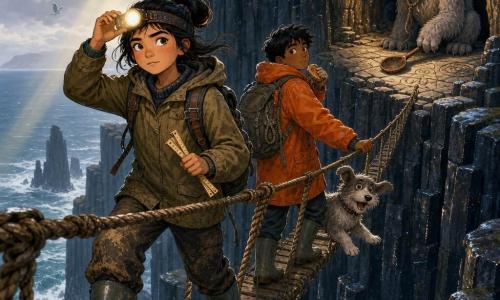
The corridor ended at a stone opening, and suddenly the world dropped away.
Mira stepped into daylight and found herself on a ledge. The jungle sprawled below like a green ocean, and beyond it the mountain rose—steep, gray, and sharp against a bruised-blue sky. Wind hit her face with surprising force, drying sweat into salt.
Between their ledge and the next outcropping stretched a rope bridge.
It was old, woven from thick vines and wooden slats dark with age. Moss clung to the ropes in places. Far beneath, mist drifted up from a ravine, hiding the bottom.
Tavo stared at it. “That,” he said, “is a terrible idea.”
Mira's stomach agreed.
She took a knee and examined the bridge's anchor points. The ropes were looped around stone posts carved with the same mountain symbol. The knots were complex—more than decoration. The builders knew ropes.
Mira tugged gently. The rope held, creaking like a tired door.
“It's not fresh,” she said. “But it might be stronger than it looks.”
Tavo crossed his arms. “Might. That word is dangerous.”
Mira nodded. “Which is why we don't sprint across while yelling victory speeches.”
She opened her pack and pulled out a coil of modern climbing rope and two carabiners. Tavo's eyes widened.
“You brought that through the jungle?” he asked.
“I bring it everywhere,” Mira said. “Some people carry lucky charms. I carry safety.”
She anchored the rope around a stone post on their side and threaded it through a carabiner on her harness. Then she clipped a second carabiner to the bridge's main rope, creating a simple backup: if a slat broke or her foot slipped, she'd still be connected.
Tavo watched, impressed despite himself. “Studious explorer,” he said. “Not just brave.”
“Brave is easy,” Mira replied. “Careful is hard.”
She stepped onto the first slat. It dipped, then steadied. The bridge swayed with the wind, a slow side-to-side motion that made the ravine seem to tilt.
Mira kept her eyes on the far side, not the mist below. She moved one slat at a time, testing with her foot before shifting her weight.
Halfway across, a gust shoved the bridge. The ropes snapped tight, and the slats rattled under her boots.
Mira's breath caught.
“Lean into it!” Tavo called from behind. “Like a sailor!”
Mira did, bending her knees and lowering her center of gravity. The swaying eased, turning from panic into rhythm. She took another step. Then another.
A slat near the end cracked with a sharp sound.
Mira froze, muscles screaming to run, but she didn't. Running was how you fell.
She looked down. The slat was split, but the ropes on either side still held. Carefully, she shifted her weight back and stepped over the broken piece, landing on the next slat with a controlled breath.
When her boots hit solid rock on the far side, relief flooded her so fast she almost laughed.
She secured the rope to a post on this side and called, “Your turn! Clip in.”
Tavo approached the bridge like it had personally insulted him. He clipped into the safety line, muttering, “If I survive, I'm telling everyone I did it without looking scared.”
“You can tell them whatever you want,” Mira said. “Just don't tell the bridge. It'll get confident.”
Tavo snorted, then stepped out. He moved steadily, pausing when the bridge swayed. Twice, Mira saw his jaw tighten, but he kept going.
On the cracked slat, he hesitated.
“Step over,” Mira instructed. “Slow.”
Tavo did, and a moment later he was beside her, breathing hard.
“I did not enjoy that,” he announced.
Mira patted the stone post. “Neither did I. Which means we're still thinking.”
They followed the ledge path upward. The stone underfoot changed from jungle-wet to dry and gritty. The air thinned, and the sounds of insects faded, replaced by wind and the occasional call of a distant hawk.
After an hour, they reached another ruin—smaller, perched like a watchtower on a shoulder of the mountain. Part of its roof had collapsed, and inside, the floor was littered with broken pottery and pale bones of small animals.
Mira's lamp beam caught a carved panel on the wall. It showed the same zigzag path as the mosaic floor, but now it climbed a mountain. At the top was the sun symbol again.
And under it, carved deeply:
REACH, BUT DO NOT RUSH.
Mira traced the letters with her fingertip. The stone was cold, but the message felt warm in her mind, like advice from someone who understood.
Tavo peered over her shoulder. “Even the mountain agrees with you,” he said.
Mira smiled. “Good. I'd rather not argue with a mountain.”
Chapter 5: The Storm That Tried to Teach Them
The trail narrowed into a ridge. On one side, the slope fell away into cloud. On the other, jagged rock rose like broken teeth. The path was barely a path—more a series of natural steps and ledges.
Mira checked her compass and compared it to the map. The summit was closer now, a gray point above them, sometimes hidden by drifting mist.
Then the wind changed.
It came colder, sharper, carrying the metallic smell of rain. Clouds thickened, sliding over the ridge like a slow tide.
Tavo squinted. “Storm,” he said. “Fast one.”
Mira's mind clicked into planning mode. “We need shelter,” she said. “Not the ruin. Lightning likes ruins.”
Tavo pointed ahead. “There—overhang.”
They hurried—not running, but moving with purpose. Mira's boots scraped rock, and her pack tugged at her shoulders. The first drops hit, fat and heavy, making dark spots on the stone.
They reached a shallow cave-like overhang just as the sky cracked open.
Rain hammered the ridge. Wind shoved it sideways, so it felt like being sprayed with icy needles. Thunder boomed, close enough to vibrate in Mira's ribs.
They crouched under the overhang, pressed against the back wall. Water streamed down the rock face like curtains.
Tavo shouted over the storm, “Still want the summit?”
Mira laughed, because the alternative was to panic. “Ask me again when I can feel my ears!”
A lightning flash turned the world white for an instant. Mira blinked, then noticed something in the rock beside her—carvings, worn and shallow, hidden until the water made them shine.
She leaned closer. The carving showed a line of figures on a ridge, facing a storm. Some turned back. Others crouched low and waited. One figure—small but centered—pointed toward a sheltered notch.
Mira's breath fogged in the cold air. “This is part of the route,” she said.
Tavo frowned. “In a storm?”
“Not in the storm,” Mira corrected. “For the storm. They expected it.”
Thunder rolled again, less violent now, moving away. The rain stayed heavy, but the lightning became less frequent.
Mira pulled out her notebook and sketched the carving quickly, hands stiff with cold. “The ridge is teaching us,” she said. “Wait when it's dangerous. Move when it's smart.”
Tavo's lips quirked. “So the mountain is a teacher.”
“An unforgiving one,” Mira said, rubbing her arms. “But fair.”
They waited. Minutes stretched. Mira used the time to check their gear: rope dry enough, headlamp working, water bottle sealed, energy bars not turned into sad mush.
Finally, the rain eased into a steady drizzle. The wind softened.
Tavo leaned out and looked. “Lightning's gone,” he said. “But the rocks will be slick.”
Mira nodded. “Then we climb like we're carrying eggs.”
Tavo blinked. “Eggs?”
“Very expensive eggs,” Mira said. “The kind you can't replace.”
They stepped back onto the ridge. The world smelled newly washed—sharp stone, clean rain, and the faint green scent of wet moss. Mist curled around them, turning the path into a tunnel of gray.
Mira moved carefully, using her hands as much as her feet. She found holds in cracks, tested each one before trusting it. Twice, she slipped a little, but her grip held.
Resilience wasn't about never slipping, she reminded herself. It was about recovering without losing your head.
Ahead, the ridge rose into a steep section with a narrow notch—just like the carving.
Mira's pulse quickened. “We're on the right way,” she said.
Tavo grinned, rain dripping off his nose. “The mountain approves.”
Mira snorted. “The mountain doesn't approve. It just hasn't thrown us off yet.”
Chapter 6: The Summit and the Sun Mark
The last climb was the hardest. The ridge turned into a scramble over sharp rock. The air was thinner now, and each breath felt smaller, like it had to squeeze into Mira's lungs.
They reached a flat shelf just below the top. Wind rushed over it, cold enough to sting. Beyond, the summit rose in one final slope, not tall but steep, like the mountain was saving its stubbornness for the end.
Mira tightened her harness. “Rope up,” she said.
Tavo frowned. “It's not that high.”
Mira met his eyes. “It's high enough to regret. We're tired. The rock is wet. This is where ‘almost there' tricks people.”
Tavo exhaled, then nodded. “Measured audacity,” he said, as if trying the words on.
Mira smiled. “Exactly.”
They clipped in. Mira led, placing her feet carefully, her fingers searching for edges. She moved in short bursts, resting when her arms trembled. The rope between them was both a tool and a promise: we don't leave each other to luck.
Near the top, Mira spotted something strange—a line of green disks embedded in the rock, leading upward like stepping-stones for the eyes.
“Look,” she called.
Tavo craned his neck. “The green stones again.”
Mira followed them, not stepping on them, just using them as markers. The disks were set in a spiral pattern that tightened as it neared the summit. The builders had turned the climb into a story you could read with your feet.
Finally, Mira's hand closed over the edge of the summit rock. She pulled herself up and stood.
The world opened.
Clouds drifted below like slow rivers. The jungle was far away now, a soft green blanket. The wind was fierce, but the sun had broken through, pouring gold over the peaks around them.
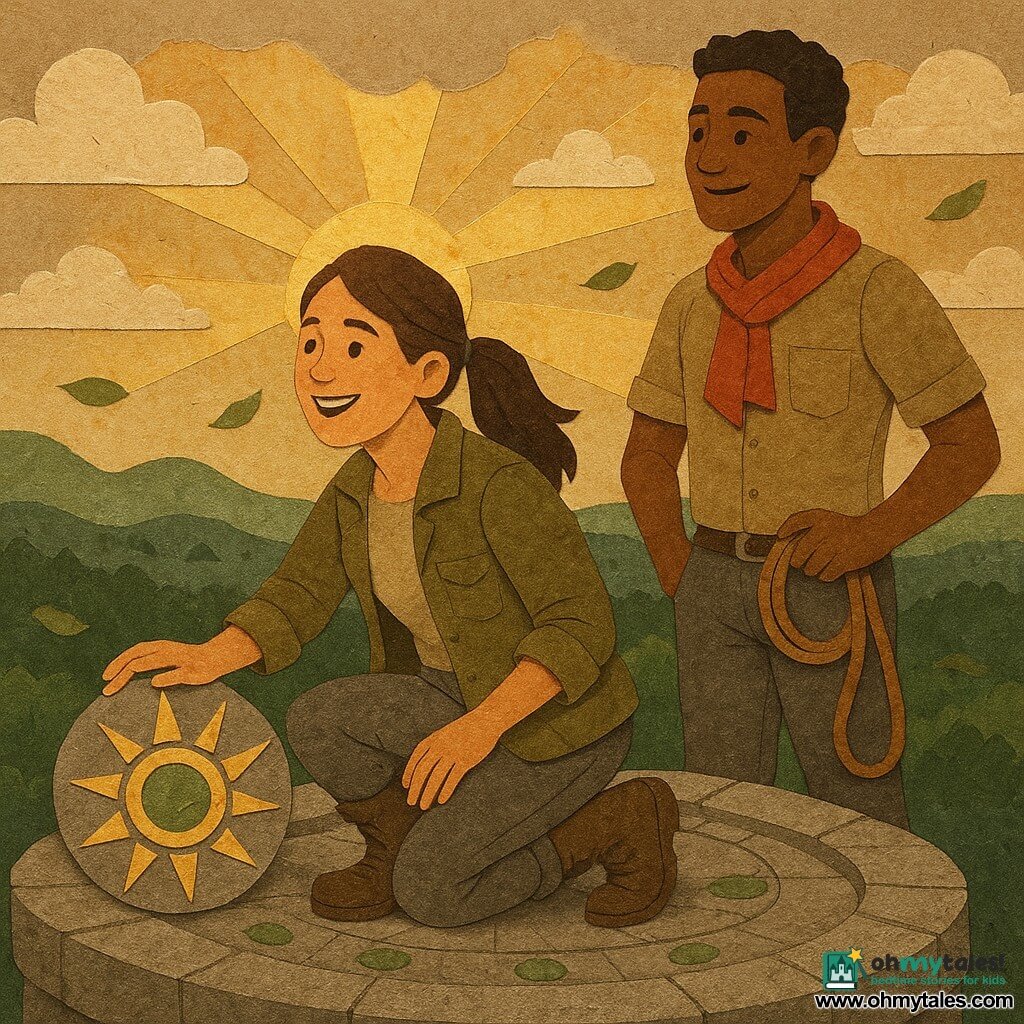
At the center of the summit sat a low stone platform. On it was the sun symbol—carved deep and filled with the same green mineral, glowing softly in the sunlight.
Mira approached with reverence she didn't try to hide. She knelt and brushed away a thin layer of grit. Around the sun symbol were more carved words in the same careful script:
REACH.
LOOK.
RETURN WISE.
Tavo climbed up beside her, breathing hard. He read the words and let out a slow whistle. “That's… actually good advice.”
Mira's eyes stung, and she wasn't sure if it was wind or emotion. She took out her notebook and wrote the message down exactly.
She sat on the rock and let herself simply be there for a moment—boots on ancient stone, face in cold sun, heart thudding with the wild joy of making it.
Tavo sat beside her. “So what's the treasure?” he asked, voice teasing.
Mira looked out at the endless distance. “This,” she said. “And the path. And the fact that we did it without turning into a sad news story.”
Tavo laughed. “A very scholarly treasure.”
Mira reached into her pack and pulled out two crushed energy bars. She handed him one. “Feast.”
He unwrapped it and took a bite. “Tastes like sweetened cardboard.”
“Victory-flavored cardboard,” Mira corrected.
They stayed only a short time. The wind was cold, and clouds were already gathering again in the distance.
On the way down, Mira paused beside the sun platform and touched the carved edge lightly.
“Thank you,” she whispered, feeling slightly silly and not caring.
Tavo raised an eyebrow. “Talking to rocks again?”
“Talking to history,” Mira said. “It's polite.”
They descended slowly, following the spiral of green stones back down. Mira's legs shook with fatigue, but her mind felt clear. She knew she'd return to her research with new notes, new sketches, and a new respect for the builders who had created a mountain that didn't just challenge the body—it trained the judgment.
When the jungle canopy swallowed the mountain behind them again, Mira glanced back once.
She couldn't see the summit anymore, but she could feel it in her chest like a steady flame.
Measured audacity, she thought. Reach—but do not rush.
And she walked on, already wondering what other quiet messages the world had carved into stone, waiting for someone patient enough to notice.